
NEW DELHI —India’s AI “Building” Takes Shape: In a landmark interview with ANI on the sidelines of the India AI Impact Summit 2026, Prime Minister Narendra Modi articulated a vision that is as much about national pride as it is about economic necessity. “My vision is that India should be among the top three AI superpowers globally,” the Prime Minister declared, signaling that the nation is no longer content being a mere back-office for Western tech.
As Day 2 of the summit concluded at a packed Bharat Mandapam, the numbers backing this ambition came into sharp focus: a staggering $200 billion in expected investments over the next two years.
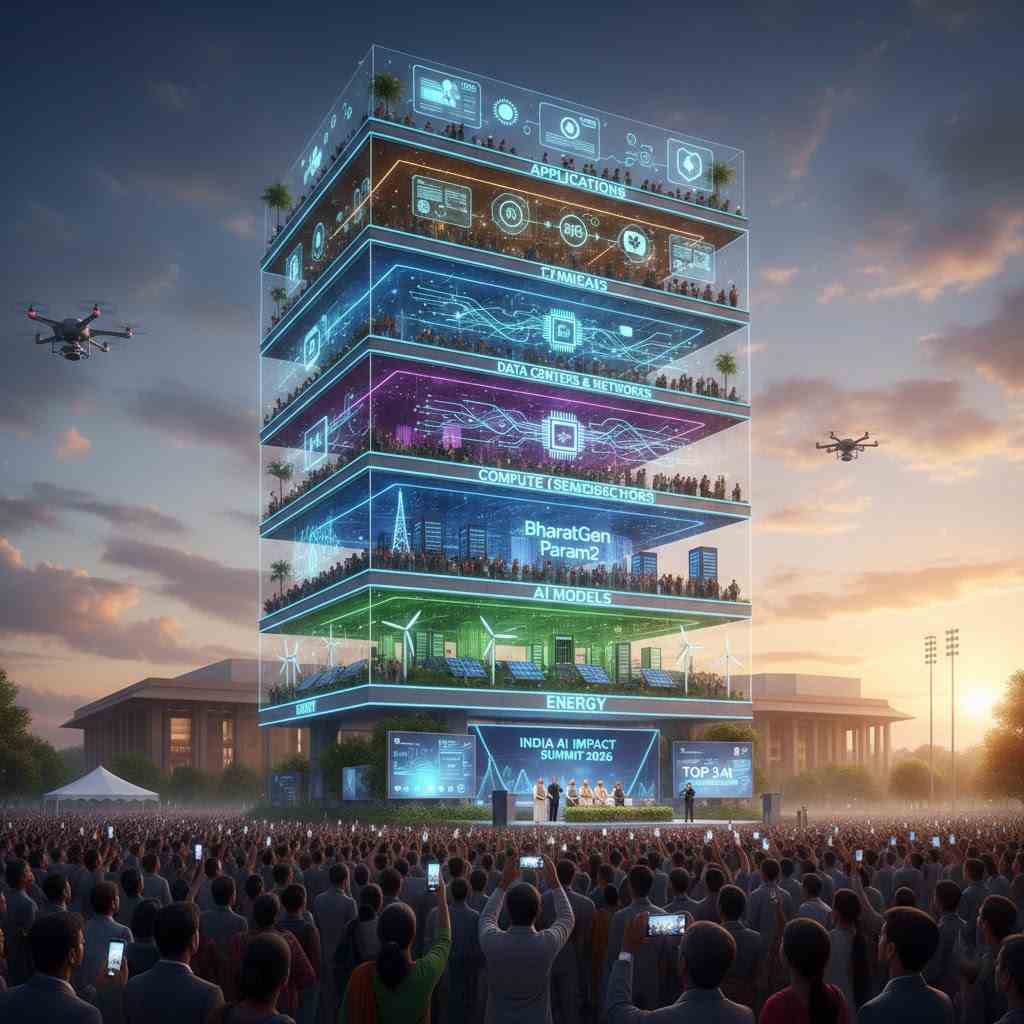
India’s AI “Building” Takes Shape: The “Five-Floor” AI Architecture
Union IT Minister Ashwini Vaishnav broke down this massive $200 billion figure by using a simple but effective analogy: a five-story building. To build a “comprehensive AI ecosystem,” India is focusing on five distinct layers of the AI stack.
1. The Ground Floor: Energy
Without power, AI is just a collection of dormant circuits. Massive AI models require vast amounts of electricity. India is prioritizing affordable, reliable, and clean energy to ensure the sustainability of its data centers.
2. The Second Floor: Data Centers & Networks
Think of this as the “highways” of AI. This layer involves the literal homes for servers and the fiber-optic arteries (including widespread 5G) that move information across the subcontinent.
3. The Third Floor: Compute (Semiconductors)
The “muscle” of the system. India is aggressively courting semiconductor giants to ensure that the chips doing the heavy lifting—training and running models—are available locally. The government has already operationalized a shared facility with over 38,000 GPUs to lower the barrier for startups.
4. The Fourth Floor: AI Models
The “brain” of the operation. This is where India’s sovereign AI projects, like BharatGen, come into play, training systems on native data rather than relying solely on Western-centric datasets.
5. The Fifth Floor: Applications
The “roof” that the public actually sees. From health diagnostics to agricultural platforms, this is where the technology touches the lives of 1.4 billion people.
Global Giants vs. Sovereign Strength
While the $200 billion will largely flow from the private sector into infrastructure, an additional $17 billion is being carved out specifically for deep-tech and applications.
The summit revealed a significant shift in how the world views India. Global players are no longer just selling products here; they are building with India.
- Anthropic: The AI major officially opened its Bengaluru office this week. It has already embedded its “Claude” platform into the operations of Air India to ship custom software faster and is working with Cognizant to modernize legacy systems for 350,000 employees.
- OpenAI & Google: Both are expanding their domestic presence, with Google recently announcing a $15 billion plan to establish its first dedicated AI hub in the country.
However, the Prime Minister emphasized that India cannot rely solely on foreign models. Western AI often lacks the nuance required for India’s 22 official languages and hundreds of dialects.
The Rise of “Bharat” AI
Addressing this linguistic gap, two major domestic offerings were unveiled during the summit:
- BharatGen’s Param2: A government-backed, 17-billion-parameter model designed to support all 22 official Indian languages natively.
- Sarvam AI: Backed by Lightspeed and Khosla Ventures, Sarvam is launching models that prioritize voice over text—a crucial feature for a population where oral communication often bypasses literacy barriers.
Chaos and Crowds: A Test of Scale
The sheer scale of India’s interest in AI was evident in the logistics. Over 300,000 people registered for the event, far exceeding the capacity of the Bharat Mandapam venue. The resulting congestion led to an official apology from Minister Vaishnav, who assured that a “war room” had been set up to manage the crowds for the final two days.
As French President Emmanuel Macron prepares to deliver the keynote address on the summit’s final day, the message from New Delhi is clear: India is building a “self-reliant yet globally integrated” AI future.