
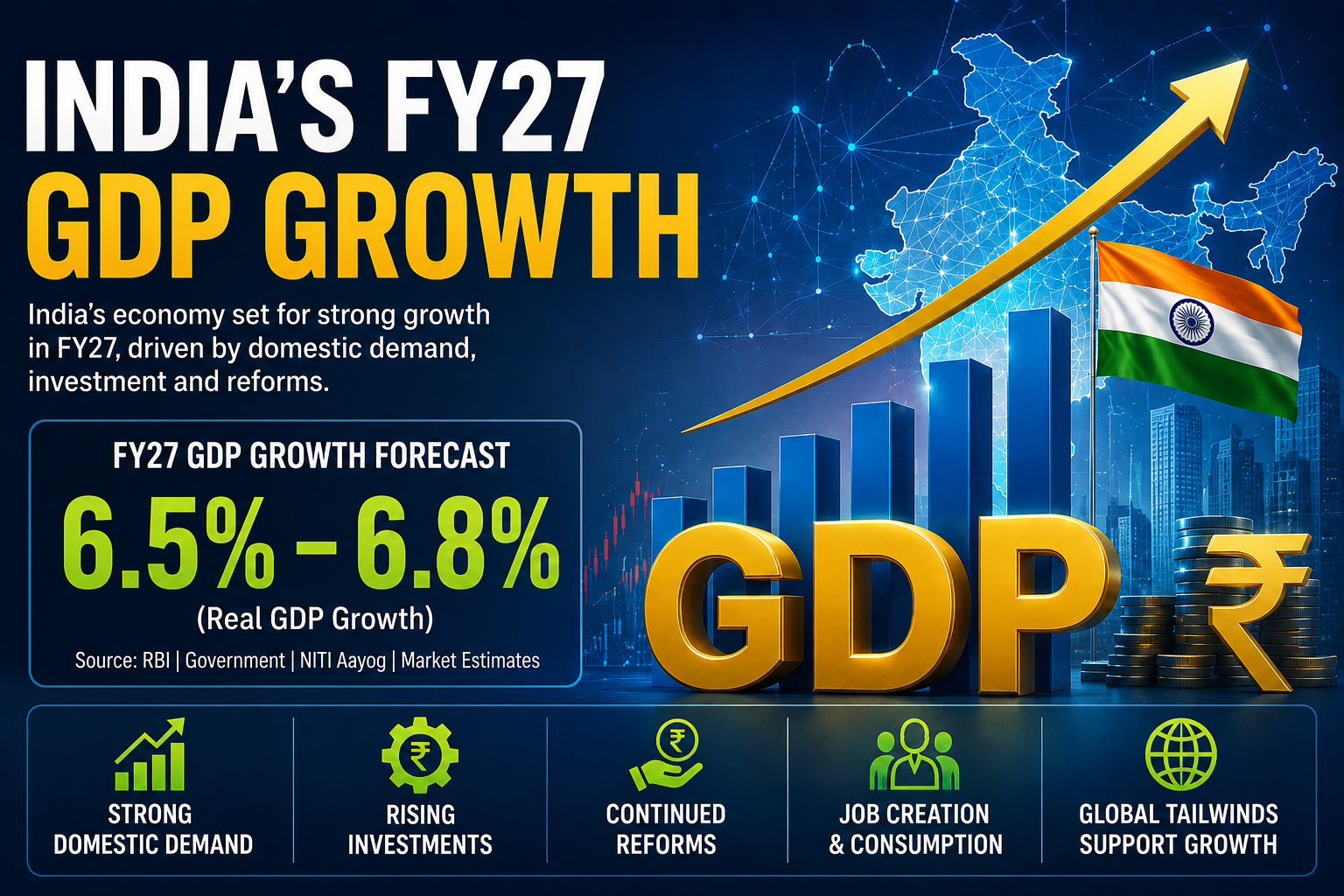
India’s FY27 GDP Growth and the economy is in a strange spot right now. Look at one set of charts, and it feels like the momentum is fading. Switch to another data set, and the market looks rock solid.
It all comes down to a big clash happening in the current financial year (FY27): Real GDP vs Nominal GDP.
While the actual volume of economic growth (Real GDP) is cooling down from its recent peaks, the raw market value (Nominal GDP) is jumping up. If you want to know what is actually happening to your money and the Indian market this year, you have to look at the friction between these two numbers.
India’s FY27 GDP Growth : Key Highlights
The Macro Paradox: India’s economy is witnessing a strange split. While inflation is artificially driving up Nominal GDP numbers, the actual ground production (Real GDP) is visibly cooling down.
Real GDP Growth Forecast: After maintaining a solid 7%+ streak for three consecutive years, India’s actual economic growth is projected to moderate down to between 6.5% and 6.8% for FY27.
The RBI’s Revision: Acknowledging heavy global headwinds, the Reserve Bank of India (RBI) officially trimmed its economic growth projection for the fiscal year from 6.9% to 6.6%.
The Rupee’s Slide: Driven by continuous capital flight and a soaring import bill, the Indian Rupee is facing massive pressure, with analysts warning it could edge closer to the 100-per-dollar threshold this year.
Geopolitical Collateral: The US-Israel-Iran conflict has severely disrupted critical Middle Eastern shipping lanes. Since India imports over 80% of its crude oil, this regional instability acts as a direct tax on local businesses.
Food Inflation Fuse: Retail inflation spiked to an 18-month high of 4.38%. Because food items command a massive 46% weight in India’s consumer inflation basket, any potential monsoon failure poses a severe risk to household budgets.
A Tale of Two Halves: FY27 is expected to be a split story. The First Half will remain sluggish and cautious as industries absorb high raw material costs, while the Second Half is poised for a strong rebound fueled by festive demand and expected RBI rate cuts.
The Big Split: Production vs Price Tags
Let’s skip the textbook definitions and look at the real-world difference:
Real GDP is about actual stuff. It tracks the physical volume of goods and services produced. It deletes the fake boost caused by inflation.
Nominal GDP is just about the current price tag. If prices go up, nominal GDP expands automatically—even if factories are producing the exact same amount of goods.
For three years straight, India managed to keep its real growth above the 7% mark. That is the magic number India needs to hit consistently to become a developed nation by 2047.
But for FY27, real GDP growth is slowing down to somewhere between 6.5% and 6.8%. On the other hand, nominal GDP is going to look highly inflated.
The catch? Corporate revenue and government tax collections will look great on paper because things are expensive (nominal growth). But the actual, physical volume of business happening on the ground (real growth) is taking a hit.
Global Drama and the Trade Deficit
This slowdown isn’t completely homegrown. India entered 2026 on a strong footing, but massive global shocks changed the game overnight.
The military escalation in the Middle East involving the US, Israel, and Iran has sent shockwaves through Asia. Since that region controls massive shipping routes and oil corridors, global trade took an immediate hit.
For India, this is bad news. We import over 80% of our crude oil. When shipping gets delayed and oil prices go wild, it acts like a direct penalty tax on Indian businesses.
Because buying essential global goods has become expensive, India’s trade deficit is widening. Seeing this geopolitical mess, foreign investors are pulling their money out of emerging markets like India and moving it into safer bets like US Treasuries.
The Rupee’s Run Toward 100
All this capital flight and high import bills have severely bruised the local currency. The Indian Rupee is sliding fast against the US Dollar, and many market experts are openly warning that the rupee could hit the psychological 100-per-dollar mark during this fiscal cycle.
A tanking rupee triggers a painful chain reaction:
Imported Inflation: Everything we buy from abroad—crude oil, machinery, electronics, minerals—gets instantly more expensive because we are paying with a weaker currency.
No Export Advantage: Usually, a weak rupee helps exporters. But right now, global demand is low and shipping costs are crazy high, so our exporters can’t even exploit the advantage.
Squeezed Margins: Indian factories that rely on imported parts are seeing their raw material costs skyrocket. They either lose profits or pass the bills down to you.
The Food Inflation and Monsoon Gamble
Domestic shoppers are already feeling the pinch. Driven by sudden spikes in food and fuel, retail inflation hit an 18-month high of 4.38% recently.
A sub-5% inflation number sounds okay on a government report, but the real issue is what is driving it. Food items make up a massive 46% of India’s Consumer Price Index (CPI) basket.
Because food completely dominates the inflation scale, any bad news on the farms instantly triggers panic. This is where weather risks come in. Erratic monsoons and El Niño patterns are hanging over the economy like a dark cloud. If the rain fails or hits unevenly, crop yields drop, food prices shoot up, and the daily cost of living explodes for the common man.
Growth Forecasts: A Game of Two Halves
Because of these heavy external headwinds, major financial institutions have downsized their expectations for India.
The Reserve Bank of India (RBI) cut its FY27 growth forecast down to 6.6% from its earlier 6.9% estimate. Independent global firms like Deloitte are predicting a similar 6.5% to 6.8% range.
But if you look closely, FY27 is going to be a story of two completely different halves:
The Tough First Half: Growth will stay slow, flat, and highly cautious. Businesses will spend the first six months just trying to survive high raw material costs and broken shipping routes.
The Recovery Second Half: Things are expected to pick up speed later in the year. A massive wave of festive season demand, potential interest rate cuts by the RBI, and stabilized global trade lines should bring the momentum back.
The Balancing Act and Long-Term Fixes
The government and the RBI are trapped in a tough policy dilemma. How do you stop inflation without killing economic growth?
If the government gives massive subsidies to keep fuel and fertilizer cheap for the public, it will miss its fiscal deficit targets and scare away foreign investors. But if the RBI fights inflation too aggressively by raising interest rates, it will make loans expensive, freeze private investments, and crush real GDP growth even further.
The Long View: Despite this messy year, India’s core structural engine is still intact. The country is aggressively pushing through massive Free Trade Agreements (FTAs) with major global powers to get Indian factories inside global supply chains.
But signing trade deals won’t fix everything. To make sure India’s growth creates actual wealth moving forward, the country needs to move fast on core domestic fixes:
Building better highways, railways, and ports to cut internal transport costs.
Fixing local supply chains so a crisis in the Middle East doesn’t shock Indian markets.
Cutting down red tape and complex compliance rules for businesses.
Investing heavily in skill development so the workforce can handle modern manufacturing.
The massive gap between real and nominal GDP isn’t a sign of an internal economic collapse. It’s just an economy wrestling hard with global chaos. The ultimate test for India this year is how well it protects its currency, its factories, and its everyday consumers from an incredibly unstable world.