
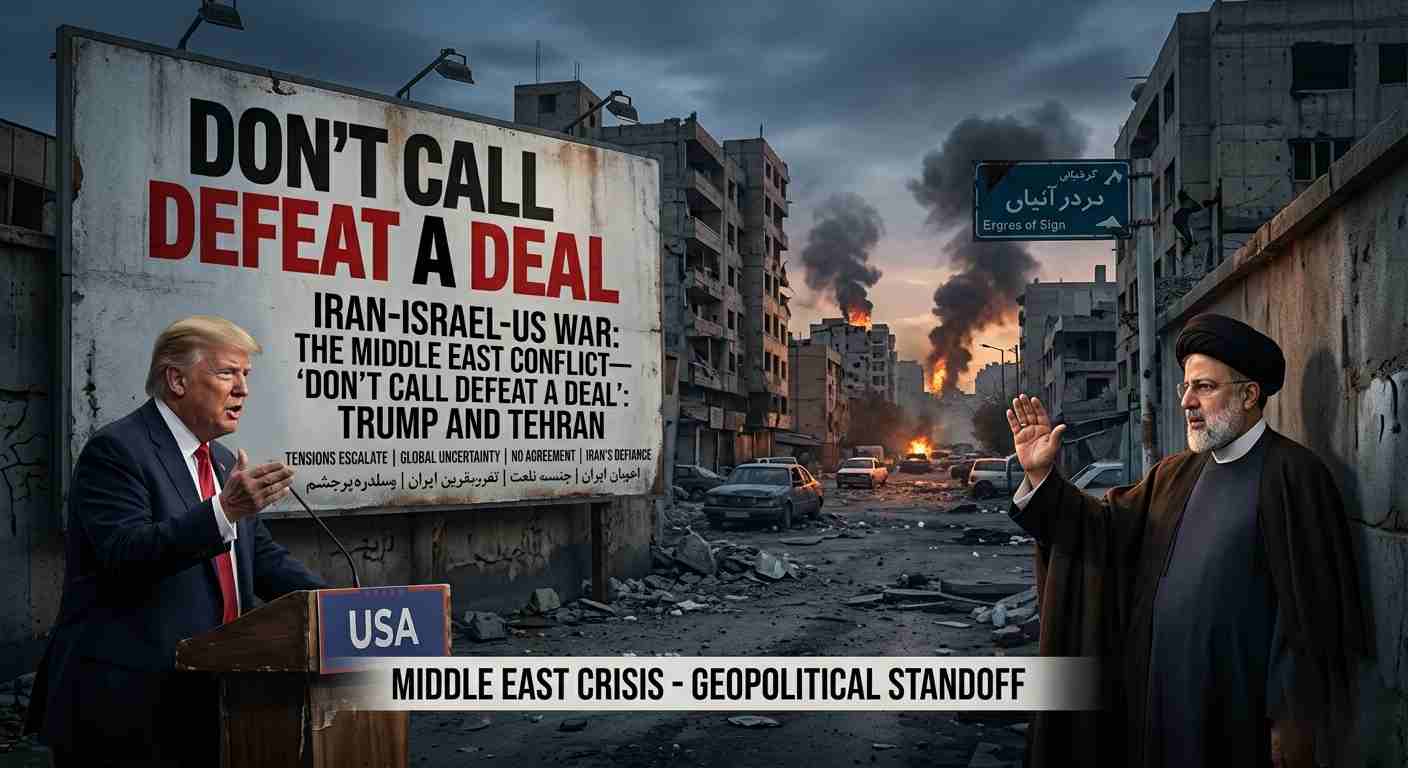
Iran-Israel-US War: The drums of war in the Middle East have been beating with a relentless, deafening rhythm for four weeks now—a conflict that has already defied the gravity of early predictions and the promise of a “swift conclusion.” US President Donald Trump, a man who built his political brand on “America First” isolationism and the art of the deal, finds himself ensnared in a geopolitical spiderweb more complex than any real estate acquisition in Manhattan.
As the conflict hits the one-month mark, a stark, dangerous disconnect has emerged between the rhetoric coming out of the Oval Office and the defiance echoing from the bunkers of Tehran. While Trump projects the image of a peacemaker on the verge of a historic breakthrough, Iran’s military command has issued a chilling rebuttal: “Do not call your defeat an agreement.”
Trump’s Gamble: The “Bluster-and-Build-Up” Strategy
Iran-Israel-US War: The Middle East Conflict—”Don’t Call Defeat a Deal”: A High-Stakes Poker Game Between Trump and Tehran

Less than 24 hours ago, the atmosphere in Washington seemed strangely optimistic. President Trump, in his characteristic bold style, claimed that the US and Iran had engaged in two days of “very good and productive conversations.” He took to Truth Social to announce a unilateral “olive branch”: instructing the Department of War to postpone all military strikes against Iranian power plants and energy infrastructure for five days.
To the casual observer, this looked like the beginning of the end of the war. Trump even named his “A-Team” of negotiators, including Vice President JD Vance and Secretary of State Marco Rubio. However, the President’s “good cop” routine was immediately tempered by his “bad cop” commentary.
“I can tell you they’d like to make a deal, and who wouldn’t? If you were there, look, their navy’s gone, their air force is gone, their communications are done—that’s the biggest problem,” Trump told reporters at the Oval Office.
This is a classic Trump maneuver: project total dominance to force a concession. By claiming the enemy is already defeated, he seeks to lower their bargaining price. But this “peace through strength” philosophy is being met with a simultaneous military surge. Reports indicate the administration is deploying 3,000 soldiers from the elite 82nd Airborne Division to the region.
This creates a central conundrum: Is Trump truly seeking a diplomatic exit, or is the “five-day pause” merely a tactical reset before a larger escalation? The deployment suggests that the White House is using the threat of a ground invasion as a “pressure tactic” to drag a battered Iran to the table.
Tehran’s Resilient Defiance: “Stability Through Force”
If Trump expected a grateful response to his five-day pause, he was sorely mistaken. The Iranian military spokesperson, representing the joint command, dismissed the American narrative as “fake news” and “self-entanglement.”
The Iranian response was not just a rejection of talks; it was a philosophical counter-attack. “Stability in the region is guaranteed by the powerful hand of our armed forces. Stability comes through force,” the spokesperson declared. The message was clear: Iran does not view itself as a defeated nation begging for terms. Instead, they characterized the US overtures as a mask for American failure.
Perhaps most damaging to Trump’s narrative was the spokesperson’s mockery: “Have your self-entanglements reached the stage where you’re negotiating with yourselves?”
This rhetoric serves a dual purpose. Internationally, it signals to allies and adversaries that the Iranian regime remains intact despite the loss of its Supreme Leader. Domestically, it aims to project an image of unshakeable resolve to a population currently living under a total information blackout.
The Intelligence Gap: Underestimating the IRGC
Four weeks into the conflict, it is becoming increasingly apparent that the US and Israel may have operating under flawed intelligence or outdated assumptions.
The initial strategy appeared to be “decapitation.” The belief was that neutralizing Ayatollah Ali Khamenei would shatter the Iranian establishment, trigger a popular uprising, and lead to an immediate change in guard.
That did not happen.
Instead, the Islamic Revolutionary Guard Corps (IRGC) took the reins with brutal efficiency. Rather than collapsing, they pivoted to a strategy that “shocked” the White House: targeting US allies among the Arab neighbors in the Gulf.
In a rare admission of being caught off guard, Trump remarked, “They weren’t supposed to go after all these other countries… We were shocked.” By striking at the energy infrastructure of the Gulf states, Iran turned the conflict from a bilateral war into a global economic crisis.
Pressure Mounts on the White House
Trump is now fighting a war on three fronts: the military front in Iran, the diplomatic front with disgruntled allies, and the political front at home.
The Ally Crisis: Arab nations, who have spent decades building “booming economies,” are now seeing their progress threatened by Iranian reprisals. They are moving from quiet support of the US to active pressure for a ceasefire.
The Domestic Slump: A recent Reuters/Ipsos poll shows Trump’s approval rating has hit its lowest point since his return to the White House. The American public, weary of “endless wars,” is growing restless. Trump’s base supported him on the promise of bringing troops home, not sending the 82nd Airborne into a Middle Eastern quagmire.
The Israeli Factor: While Trump is desperate for a “win” to flaunt before the next election cycle, Israel remains hesitant to accept a ceasefire before Iran’s nuclear and proxy capabilities are totally dismantled.
Why Iran May Fight On: The Logic of the Cornered
Why would a country with a “gone” navy and “done” communications refuse a peace deal? For the Iranian leadership, the answer is survival and deterrence.
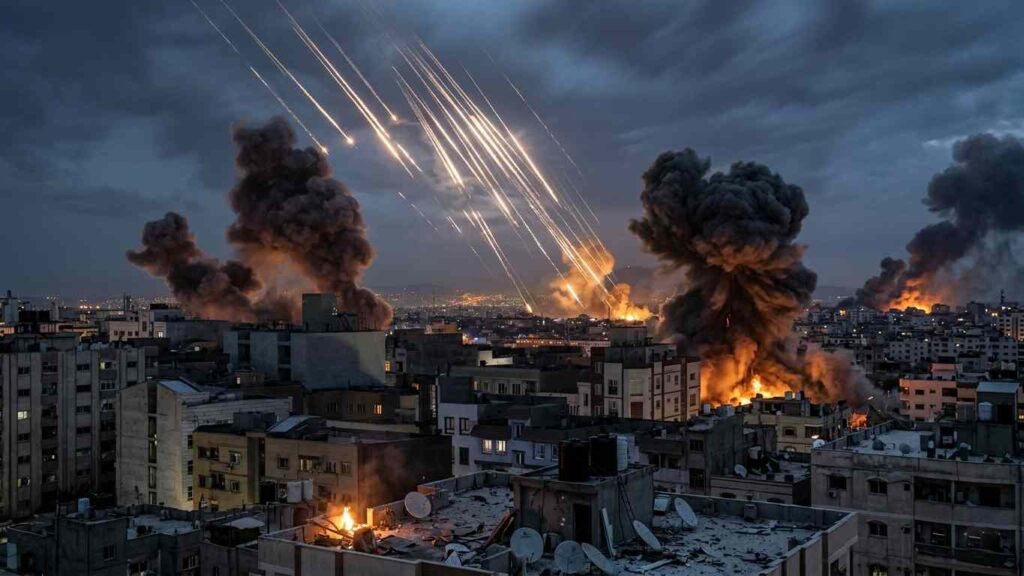
The Deterrence Gap: Tehran has been attacked twice in a single year. From their perspective, agreeing to a “rehashed” 15-point list of demands—the same one they rejected a year ago—would be strategic suicide. They need a deal that guarantees they won’t be attacked again in six months.
The Hormuz Lever: Iran still holds the “nuclear option” of global trade: the Strait of Hormuz. By choking this waterway, they can keep oil prices high enough to cause political pain in Washington. For Tehran, dragging out the conflict is a way to gain leverage for a “sustainable” proposal rather than a “capitulation” agreement.
The Martyrdom Narrative: Following the assassination of the Supreme Leader, the IRGC cannot be seen as “giving in” to Trump. To do so would invite internal rebellion from hardliners who view the conflict in religious and existential terms.
The Human Cost: A Nation in the Dark
While the generals and presidents play their high-stakes poker game, the Iranian people are paying the ultimate price.
1,500 Dead: The death toll is rising, and urban infrastructure is crumbling.
The Digital Iron Curtain: For 25 days, the state has blocked 90 million people from the global internet. This isn’t just about stopping protests; it’s an economic death sentence for thousands of small businesses.
Internal Purges: Reports from Al Jazeera suggest the regime is executing citizens on “national security” charges to preempt a January-style uprising.
A young jewelry business owner in Tehran summed up the despair: “This time, there is not even a word about when the internet might get reconnected. It is not only humiliating, but it is also forcing businesses to close down.”
Conclusion: Who Will Blink First?
The Middle East is currently caught in a “Don’t Call it a Defeat” paradox. Donald Trump needs a victory to save his domestic standing and fulfill his image as the “Master Negotiator.” Iran needs a victory to justify the enormous cost of its resistance and the blood of its leaders.
As the five-day strike pause ticks away, the world watches with bated breath. Will the 3,000 soldiers of the 82nd Airborne be the final push that forces a deal, or the spark that ignites a regional conflagration that no one—not even Trump—can control?
In this game of geopolitical chicken, the only certainty is that the “previous prices of energy and oil,” as the Iranian spokesperson warned, are a thing of the past. The “powerful hand” of force is currently steering the ship, and diplomacy is struggling to find its voice in the dark.