
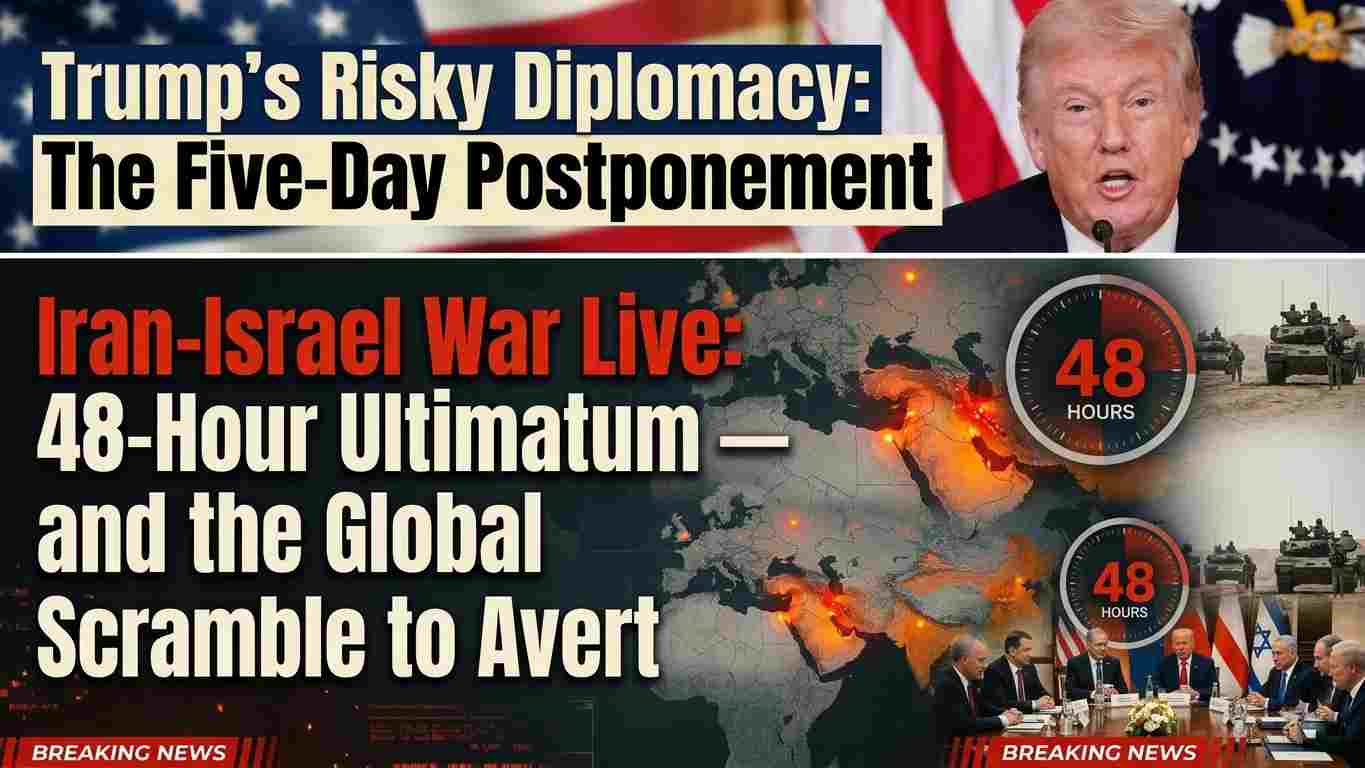
Iran-Israel War : The month-long conflict in West Asia, which began on February 28, 2026, reached a fever pitch this weekend as U.S. President Donald Trump issued a chilling ultimatum to Tehran: reopen the Strait of Hormuz within 48 hours or face the “obliteration” of Iran’s entire power grid.
However, in a whirlwind 24 hours of “whiplash diplomacy,” the President has since announced a five-day postponement of these strikes, citing “productive conversations,” even as Iranian officials dismiss the claims of talks as “fake news” designed to manipulate a volatile oil market.
Iran-Israel War : The Ultimatum that Shook the Markets
On Saturday, the geopolitical landscape shifted from a conventional regional war to the brink of a global economic collapse. President Trump, citing the continued blockade of the Strait of Hormuz—which carries 20% of the world’s oil and liquefied natural gas (LNG)—warned that the U.S. military was prepared to target Iranian energy and fuel facilities.
“If the Strait is not fully reopened, we will obliterate their power plants. We are not playing games,” Trump stated, marking a sharp departure from his Friday comments where he suggested the war was “winding down.”
Market analysts immediately sounded the alarm. Tony Sycamore, an analyst at IG, warned that the 48-hour window created a “ticking time bomb.” Experts predicted a “Black Monday” scenario for global stock exchanges, fearing that a strike on power infrastructure would lead to a total Iranian retaliation against Gulf energy hubs in Saudi Arabia, the UAE, and Qatar.
Tehran’s Defiance: “Fake News” and Missile Reach
As the U.S. moved heavy landing craft and Marines toward the Persian Gulf, Tehran responded with a display of long-range force. For the first time since the conflict began, Iran fired ballistic missiles targeting the US-British base at Diego Garcia in the Indian Ocean and a strike near Israel’s Dimona nuclear reactor.
Mohammad Bagher Ghalibaf, Iran’s Parliament Speaker, took to X (formerly Twitter) to vehemently deny that any negotiations with Washington were taking place.
Market Manipulation: Ghalibaf accused the Trump administration of spreading “fake news” to stabilize oil prices and escape a military “quagmire.”
Infrastructure Threats: Iran warned that if its power plants are touched, it will target all U.S. energy, IT, and water desalination facilities across the Middle East.
European Coverage: Israeli intelligence reports suggest Iranian missile ranges now cover European capitals, including Berlin, Paris, and Rome, raising the stakes for NATO allies.
A Fragile Pause: The Five-Day Postponement
In a sudden reversal on Sunday morning, President Trump announced he would delay the strikes for five days. He claimed that Washington and Tehran are discussing a 15-point deal to end the war. According to the President:
Nuclear Disarmament: Points 1, 2, and 3 of the deal involve Iran permanently giving up its nuclear ambitions.
Economic Relief: Trump suggested that if a deal is reached, oil prices—currently at four-year highs—would “drop like a rock.”
Regime Change: Despite talking about a deal, Trump added a layer of complexity by stating he still desires a “very serious form of regime change” in Tehran.
Tehran’s response to the postponement was cynical. Officials suggested the delay was merely a tactic to “buy time” for U.S. military logistics and to prevent a total collapse of the global equities market before the Monday opening bell.
The Human and Economic Toll
The conflict, now entering its fourth week, has become the deadliest and most economically disruptive event of the decade.
| Category | Impact Data (Approx.) |
| Total Deaths | Over 2,000 (1,200+ in Iran, 1,000+ in Lebanon, 15 in Israel) |
| U.S. Casualties | 13 Service Members killed in action |
| Global Oil Prices | Near 4-year highs; Brent Crude volatility remains extreme |
| Energy Crisis | IEA warns crisis is “worse than the 1970s oil shocks” |
In Iran’s Lorestan province alone, 157 deaths have been reported. Meanwhile, Israel saw over 180 injuries following two massive Iranian missile strikes over the weekend, testing the limits of its Iron Dome and Arrow defense systems.
The Islamabad Connection: Backchannel Diplomacy?
Despite the public denials from Tehran, reports have surfaced suggesting a high-level meeting may be convened in Islamabad, Pakistan, later this week. Sources indicate that key figures, including U.S. envoy Steve Witkoff, Jared Kushner, and JD Vance, may meet with Iranian representatives to find a diplomatic exit ramp.
The role of regional players remains critical. While Japan considers minesweeping operations to reopen the Strait, most NATO allies remain hesitant to join a war they feel was launched without sufficient consultation.
The “All Options” Doctrine
Treasury Secretary Scott Bessent echoed the administration’s hardline stance, stating that “all options are on the table,” including sending U.S. ground troops to secure Kharg Island, Iran’s critical oil export hub. Iran has countered this by threatening to “mine the entire Persian Gulf” if a single foreign soldier steps onto its soil.
As the world watches the countdown to the new five-day deadline, the global economy hangs in a delicate balance. Whether the “15-point deal” is a reality or a diplomatic smokescreen remains to be seen.
Disclaimer: This information is based on various inputs from news agency.