
West Bengal Voter List Update: The democratic fabric of West Bengal is currently undergoing a stress test unlike any seen in recent electoral history. As the state gears up for its high-stakes 294-member assembly elections scheduled for late April, the spotlight has shifted from the campaign trail to the digital databases of the Election Commission of India (ECI).
On Monday night, at the stroke of 11:45 PM, the Chief Electoral Officer (CEO) of West Bengal, Manoj Kumar Agarwal, released the first Supplementary Voters’ List. This release marks a pivotal moment in the Special Intensive Revision (SIR) process—a massive judicial and administrative undertaking to verify the credentials of nearly 60 lakh voters whose status was marked as “under adjudication.”
West Bengal Voter List Update:The Genesis of the ‘Under Adjudication’ Crisis
The controversy began on February 28, when the final voters’ list was initially published. To the shock of many, approximately 60 lakh names—a staggering number for any single state—were flagged. These individuals were placed in a legal limbo, neither fully removed nor fully confirmed, pending a deep dive into their documentation.
To address this, an unprecedented judicial machinery was triggered. Following directives from the Supreme Court, 705 judicial officers were drafted to scrutinize the documents of these individuals. Their task: to determine, with surgical precision, who belongs on the roll and who must be deleted.
Breaking Down the Numbers: The First Supplementary List
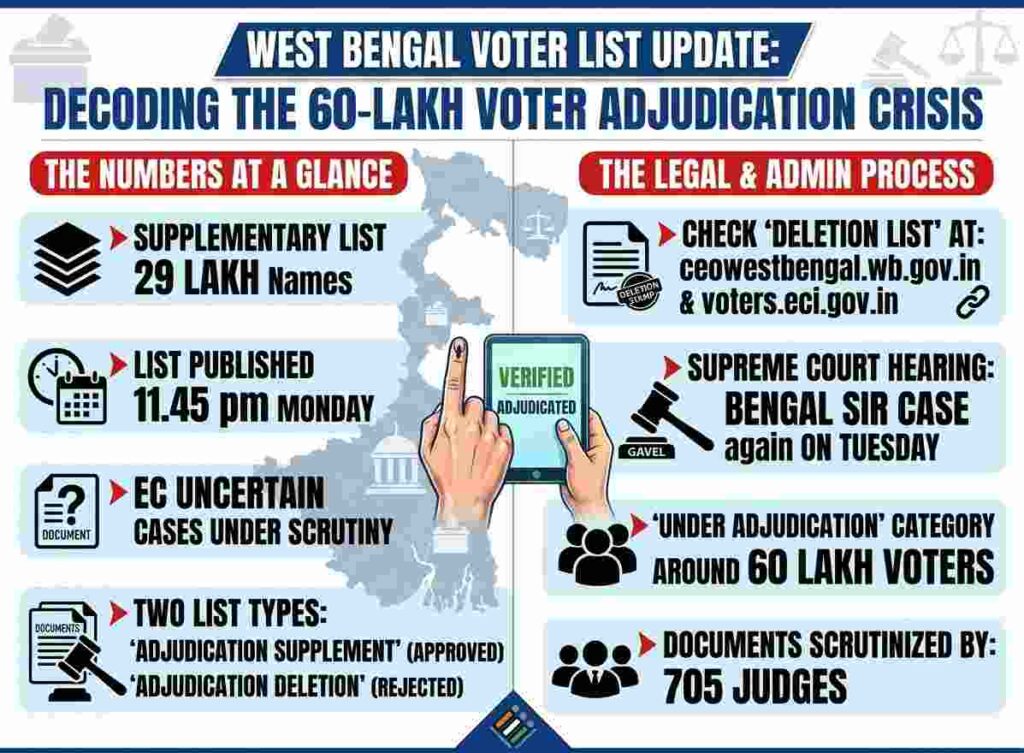
According to CEO Manoj Kumar Agarwal, the first supplementary list released contains the results for 29 lakh names that have been successfully adjudicated so far.
| Category | Statistics |
| Total Under Adjudication | 60 Lakh |
| Processed in First Phase | 29 Lakh |
| Daily Processing Rate | ~2 Lakh names |
| Judicial Personnel Involved | 705 Judges |
| Tribunals Established | 19 Appeal Tribunals across 23 districts |
While 29 lakh names have been processed, the exact ratio of “Adjudication Supplement List” (approved) vs. “Adjudication Deletion List” (rejected) remains a point of intense scrutiny. Early reports suggest that while the list is technically available on the CEO West Bengal website (ceowestbengal.wb.gov.in) and the ECI portal, high traffic and technical hurdles have made downloading the data difficult for the common citizen.
The SIR Process: A Judicial Shield or an Administrative Hurdle?
The SIR (Special Intensive Revision) is intended to be a cleanup act—a way to ensure that “ghost voters” or those with insufficient documentation do not influence the upcoming polls. However, the scale of the operation has invited both praise for its rigor and criticism for its timing.
1. The Role of the Judiciary
Unlike standard revisions, which are often handled by booth-level officers (BLOs), this process is being overseen by judicial officers. The inclusion of former High Court judges in the 19 newly formed appeal tribunals adds a layer of legal gravitas to the proceedings. This is a clear signal from the Supreme Court that the right to vote is a fundamental pillar that cannot be stripped away without due process.
2. How to Check Your Name
You can check if your name is on the list in three ways:
Online: Visit the website
ceowestbengal.wb.gov.in.ECI Website: Go to
voters.eci.gov.in.Mobile App: Use the ECI Net app on your phone.
Political Turbulence and Allegations
In a state as politically charged as West Bengal, a voter list revision of this magnitude is never just about data—it’s about power.
Congress leader Adhir Ranjan Chowdhury has been vocal in his criticism, accusing Chief Minister Mamata Banerjee of “politicizing” the issue. The opposition alleges that the complications in the SIR process are being leveraged to influence the electorate, while the ruling party maintains that they are merely following ECI and Supreme Court mandates. The friction between the state government and the central poll body continues to be a defining theme of this election cycle.
Security Measures and Social Order
The publication of such a list is a sensitive event. Fearing “untoward incidents” or public unrest from those who might find themselves disenfranchised, the state government has gone into overdrive.
Directives have been issued to District Magistrates (DMs) to implement strict crowd-control measures. Furthermore, the state police chief and the Kolkata Police Commissioner have been put on high alert. The goal is to ensure that the administrative process of updating the rolls does not spill over into street-level instability.
Looking Ahead: The Countdown to April 23
With the first supplementary list out, the clock is ticking. The ECI has indicated that more lists will be published as the remaining 31 lakh names are adjudicated.
The timeline is tight. With polling scheduled for April 23 and 29, and the counting set for May 4, the Election Commission must balance speed with accuracy. Any error in the “Adjudication Deletion List” could lead to widespread disenfranchisement, while any laxity could compromise the integrity of the vote.
What Voters Should Do Now
If you are a voter in West Bengal, the next 48 hours are crucial:
Check Your Status: Visit the CEO West Bengal website or use the ECI Net app immediately.
Verify the List Type: Identify if your name is in the Supplement List or the Deletion List.
Act Fast: If your name is missing or deleted erroneously, gather your documents and approach the district sub-divisional office or use the online appeal portal without delay.
Conclusion: A Test of Democracy
The “Bengal SIR case” is more than just a logistical exercise; it is a testament to the complexity of maintaining a clean electoral roll in a country of 1.4 billion people. As 705 judges continue to pore over records at a rate of 2 lakh names a day, the eyes of the nation remain on West Bengal.
The integrity of the April elections depends entirely on the transparency of this adjudication. Whether this process strengthens the democracy or creates a new layer of controversy will be determined in the days to come.
Disclaimer: This information is based on various inputs from news agency.