

The Jio LEO satellite network Mukesh Ambani’s Reliance Jio has cleared its first major government roadblock to launch India’s own low-Earth orbit (LEO) satellite internet. India’s space regulator, IN-SPACe, officially gave a “technically sound” nod to Jio’s satellite fleet proposal.
ISRO and the Department of Telecommunications (DoT) jointly reviewed and backed this evaluation.
This clearance shifts the dynamic for the entire Indian telecom market. Jio now has the initial green light to build a massive network of nearly 1,600 LEO satellites. The company aims to use this space network to bridge data gaps in rural areas, support mobile network backhaul, and reinforce strategic military communication lines.
The Scale of Jio’s 1,600-Satellite Ambition
Building a comprehensive space-based communication network requires massive capital, precise engineering, and strong regulatory backing. Reliance Jio’s proposal addresses all three pillars by laying out a blueprint for a high-throughput non-geostationary satellite orbit (NGSO) constellation.
Unmatched Data Capacity
The standout feature of Jio’s proposal is its sheer volume of data delivery. The network aims to offer a total capacity ranging between 4.5 to 5 terabits per second (Tbps) across India. This massive bandwidth can comfortably support millions of simultaneous users, high-density enterprise operations, and critical government infrastructure without the high latency issues common to traditional geostationary satellites.
Ground Infrastructure and Operations
A satellite constellation depends heavily on the ground infrastructure supporting it. To ensure seamless connectivity and minimal signal degradation, Jio plans to establish 20 to 22 gateway ground stations strategically distributed across the Indian subcontinent. These ground stations will serve as the primary link between the space fleet and India’s terrestrial fiber networks, ensuring smooth data routing and service reliability.
How Jio Compares to Global Titans Like Starlink and Amazon
The satellite internet market in India is rapidly becoming a battleground for global tech giants. However, Jio’s newly cleared technical proposal positions it aggressively ahead of its international competitors in terms of allocated and planned capacity for the Indian market.
Satellite Fleet and Capacity Comparison
| Feature / Metric | Reliance Jio | Elon Musk’s Starlink | Amazon’s Project Kuiper |
| Proposed Fleet Size | ~1,600 LEO Satellites | 10,000+ globally | Planned Global Fleet |
| Target Indian Capacity | 4.5 to 5 Tbps | 600 Gbps (Approved) | 3 Tbps (Proposed) |
| IN-SPACe Status | Technically Approved | Active/Approved | Pending Authorisation |
| Primary Target Services | Broadband, Backhaul, Direct-to-Device | Consumer Broadband | Enterprise & Consumer Broadband |
While Elon Musk’s Starlink commands the largest operational fleet globally, its approved capacity for the Indian airspace remains capped at 600 gigabits per second (Gbps). Meanwhile, Amazon’s Project Kuiper has proposed a 3 Tbps capacity for the region but still lacks the crucial IN-SPACe technical authorization. By securing a technical nod for up to 5 Tbps, Jio has positioned itself to offer a significantly wider pipe for data, allowing it to serve a larger market share simultaneously.
Strategic Significance: Geopolitics and National Defense
Beyond the commercial benefits of providing high-speed internet to the remotest corners of India, the project holds immense geopolitical and strategic weight. Shifting global alliances demonstrate that relying on foreign-owned satellite constellations for critical communication introduces severe vulnerabilities during geopolitical crises.
Key Strategic Dimensions:
Hosting Defense Payloads: Senior government levels have already initiated preliminary discussions regarding the integration of defense-related payloads onto a segment of Jio’s LEO constellation. If these discussions solidify, the network will double as a vital asset for national security, providing secure, encrypted, and resilient communication channels for the Indian Armed Forces and border surveillance.
Reducing Foreign Dependence: By establishing a fully indigenous LEO fleet, India effectively insulates its digital infrastructure from external political pressures. IN-SPACe specifically highlighted this strategic value to the central government, recommending strong policy and regulatory support to help the country establish its first domestic non-geostationary satellite orbit network. Furthermore, Jio’s orbital parameters allow it to seamlessly coexist with any future domestic satellite constellations India might choose to launch later.
Diversified Services: From Rural Broadband to Direct-to-Device
Jio does not view this satellite fleet merely as a backup system for areas without fiber optic cables. Instead, the company plans a multi-tiered service rollout to disrupt several market segments at once:
Fixed Satellite Services (FSS): Delivering high-speed enterprise broadband to remote industrial sites, maritime operations, and aviation sectors.
Cellular Backhaul: Empowering telecom operators to extend their 4G and 5G mobile network coverage into deep rural pockets without the exorbitant cost of laying physical cables through difficult terrain.
Mobile Satellite Services (MSS): Introducing direct-to-device connectivity. This technology enables everyday smartphones to connect directly to satellites in emergency scenarios where traditional cell towers face damage or do not exist.
The Road Ahead: Navigating International Regulators
While passing the IN-SPACe and ISRO technical evaluation marks a massive victory for Reliance Jio, the constellation will not launch overnight. The company must now navigate a multi-step international and domestic regulatory pipeline before the first rocket leaves the launchpad.

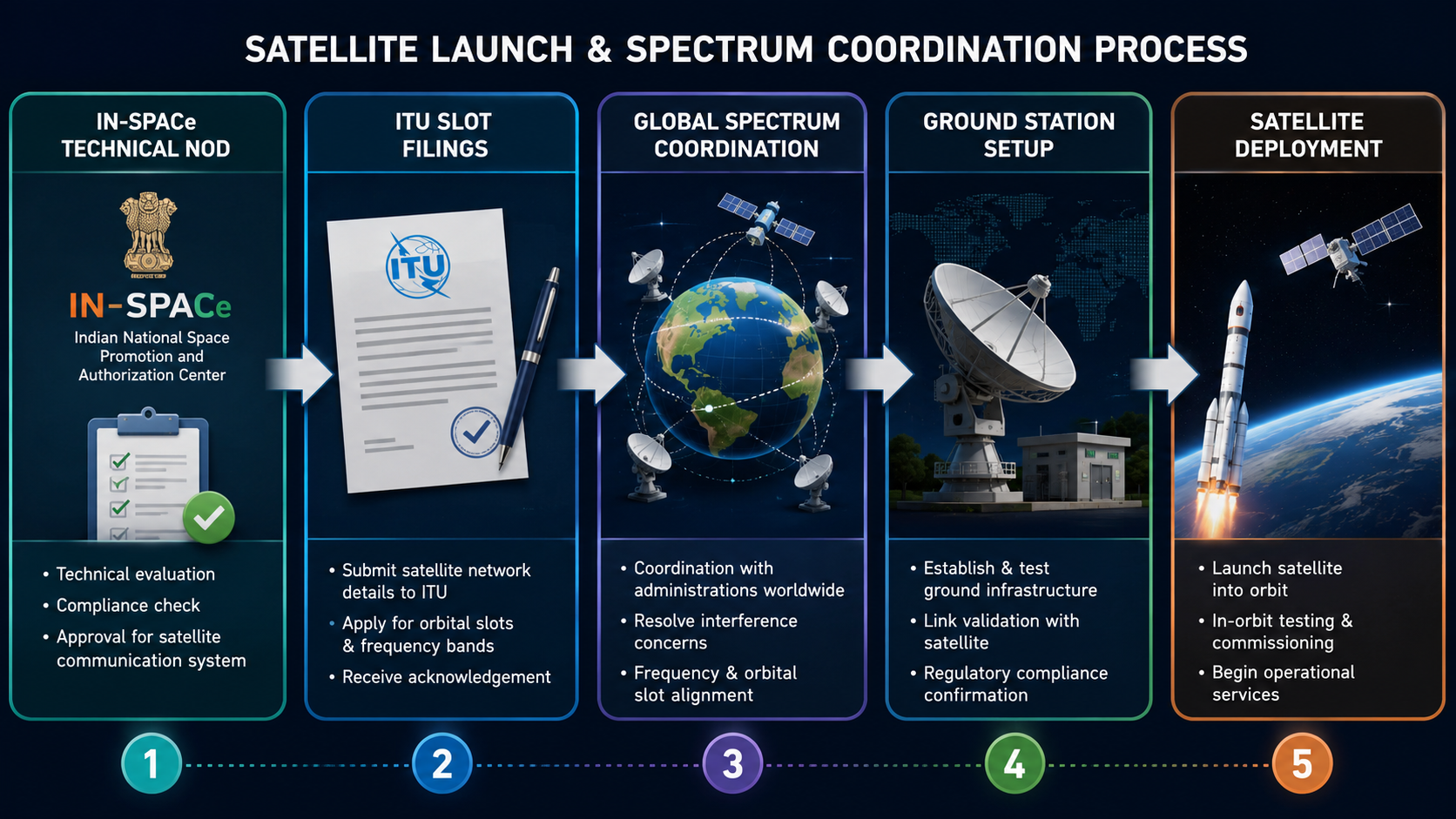
With the technical clearance secured, the Government of India can now officially extend its diplomatic and regulatory backing to Reliance Jio at the international level. The next critical phase involves filing for specific orbital slots with the International Telecommunication Union (ITU).
Following the ITU filings, Jio will engage in extensive coordination meetings with other global satellite operators. This step is mandatory to ensure that Jio’s 1,600 satellites do not cause any frequency or signal interference with existing fleets orbiting the Earth. Once Jio locks in these international rights and finishes constructing its domestic ground stations, the company will finally have the green light to deploy its satellites and reshape India’s digital future from the