
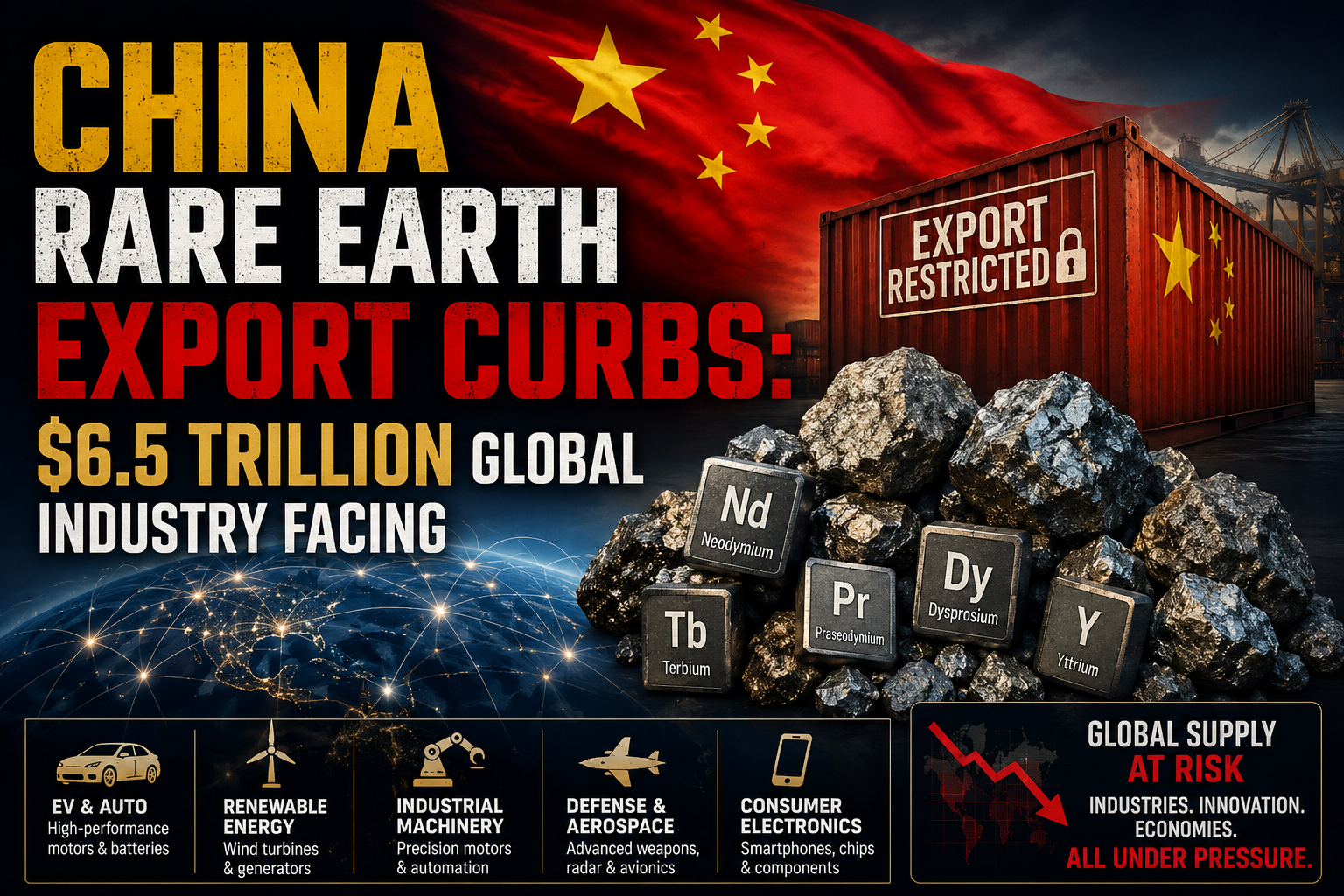
China Rare Earth Export Curbs on rare earth exports now pose a direct, structural threat to Western industrial stability. In its latest assessment, the International Energy Agency (IEA) highlighted the extreme reliance of global markets on Chinese critical minerals, warning of significant downstream disruptions.
According to the IEA’s landmark Global Critical Minerals Outlook, the full implementation of Beijing’s export controls places $6.5 trillion of downstream economic production outside of China at immediate risk.
These 17 critical metals are absolutely non-negotiable for high-tech manufacturing. As geopolitical tensions escalate, these supply chains have become a primary strategic battleground. A prolonged choking of these lines will severely impact everyday consumer electronics, global defense networks, and the transition to clean energy.
The Core Threat: Why Refined Rare Earths Matter
Rare earths are not inherently rare in the earth’s crust. However, extracting them in high concentrations—and chemically refining them without severe environmental damage—remains incredibly difficult.
[Mined Raw Ore] ➔ [Cracking & Acid Leaching] ➔ [Solvent Extraction] ➔ [High-Purity Oxides] ➔ [Metals & Magnets]
                                                                                         │
                                                            ★ China Controls 85-90% of This Refined Loop ★
Elements like neodymium, dysprosium, and praseodymium drive the most advanced industries in the world:
Neodymium Magnets: These permanent magnets power electric vehicle (EV) drivetrains and large wind turbine generators.
Defense Systems: Military contractors use these metals for precision missile guidance, radar arrays, sonar systems, and stealth coatings for fighter jets like the F-35.
Consumer Technology: These elements run smartphone vibration motors, high-end optical lenses, hard drives, and fiber-optic networks.
Because China spent the last four decades building a massive, vertically integrated monopoly on extraction and chemical processing, Western manufacturing heavily relies on this single-source pipeline.
Mapping the $6.5 Trillion Downstream Fallout
While the raw market value of rare earths accounts for billions of dollars annually, their leverage over massive downstream industries is immense. A few grams of refined dysprosium can halt the production of a $60,000 electric vehicle or a multi-million-dollar defense asset.
The IEA warns that the United States and Europe will bear nearly half of the total economic impact from a sustained supply cutoff.
Sector Exposure Breakdown
| Industry Sector | Critical Material Dependency | Primary Vulnerability | Potential Global Impact |
| Automotive & EVs | Neodymium, Dysprosium, Graphite | Permanent magnet motors, battery anodes | Severe production halts, skyrocketing EV battery prices |
| Defense & Aerospace | Samarium, Neodymium, Yttrium | Precision guidance, radar systems, jet engines | Delayed military procurement, defense supply bottlenecks |
| Clean Energy | Neodymium, Terbium | Wind turbine generators, utility-scale grid storage | Drastic slowdown in global decarbonization targets |
| High-Tech & Electronics | Lanthanum, Cerium, Gadolinium | Microchips, advanced glass polishing, sensor systems | Widespread electronics shortages, surging consumer tech costs |
The EV and Battery Bottleneck: Enter Graphite
While rare earths capture major headlines, China’s export controls on graphite present an equally dangerous bottleneck for the global lithium-ion battery supply chain.
China currently controls over 90% of the world’s processed graphite output, which forms the anode (negative electrode) of almost every EV battery on the market.
Global Processed Graphite Market Share
China: 90%
Rest of the World: 10%
The IEA projects that a full enforcement of graphite export curbs puts an additional $300 billion of downstream battery production at risk. Unlike rare earths, where alternative mining projects are slowly starting up, finding immediate substitutes for battery-grade purified graphite remains exceptionally difficult.
The “Mineral Security Premium” as Economic Insurance
Commenting on the crisis, IEA Executive Director Fatih Birol stated that vast amounts of economic value now depend on highly concentrated, vulnerable critical mineral supply chains. He noted that while diversifying these sources raises procurement costs, companies must view this extra cost as a mineral security premium—a necessary economic insurance policy against geopolitical shocks.
For decades, Western purchasing managers prioritized the lowest possible market cost, buying almost exclusively from cheap, subsidized Chinese refiners. Today, a security-first approach is actively replacing that strategy.
Building a chemical processing plant in Texas or Western Australia costs significantly more than operating in Inner Mongolia due to stricter environmental mandates, higher labor costs, and a lack of legacy infrastructure. However, Western firms increasingly view this premium as a mandatory investment to prevent total factory shutdowns.
The IEA’s $9.2 Billion Emergency Stockpile Framework
To mitigate these systemic supply vulnerabilities, the IEA advocates for a coordinated, multilateral approach to mineral security. The agency urges democratic nations to collaborate on building collective strategic reserves of 11 high-risk materials.
Initial Purchase Cost: $9.2 Billion
Net Annual Maintenance: $900 Million
Target Materials: 11 High-Risk Critical Minerals (including magnet rare earths and battery metals)
While a $9.2 billion upfront cost and nearly a billion dollars in annual upkeep require significant capital, these numbers are tiny compared to a multi-trillion-dollar supply cutoff. A robust strategic buffer gives Western manufacturers several months to reconfigure supply chains or locate alternative raw components during an active embargo.
Can the West Successfully Decouple?
Western economies face a race against time to build alternative supply chains. The IEA report notes that governments are responding to the danger, with public financing commitments for new critical mineral projects quadrupling to $65 billion.
These investments are beginning to show early results:
Refining Diversification: New processing capacity coming online in the United States (via MP Materials) and expansion projects in Malaysia (operated by Lynas) helped reduce China’s share of the global rare earth refining market from 90% down to 85%.
The 2035 Outlook: If planned processing pipelines across Australia, North America, and Southeast Asia stay on schedule, the IEA projects China’s market share could drop to 70% by 2035.
The Processing Bottleneck Remains Persistent
Despite this progress, true decoupling remains incredibly slow. Even under ideal conditions, China will maintain a commanding supermajority of the refined market for the next decade.
While Western countries are successfully mining raw ore, they lag severely in the complex chemical processing stage. Mining is only half the battle; without local chemical separation plants to produce pure rare earth oxides, raw ore mined in California or Australia must still ship to China for final processing.
A similar concentration issue impacts other key energy transition metals. Indonesia has rapidly consolidated its position as the dominant hub for nickel refining, while China remains the primary center for processing lithium, cobalt, and manganese. These two countries accounted for over three-quarters of the recent growth in refined mineral supply, meaning that geographical concentration is actually increasing in key battery sectors.
A New Era of Resource Nationalism
The geopolitical friction over rare earth export curbs reflects a permanent structural shift in global trade. The era of frictionless, hyper-globalized supply chains is rapidly ending, giving way to an era of resource nationalism and protective trade barriers.
Export curbs by major resource holders—such as China, the Democratic Republic of Congo (cobalt), and Zimbabwe (which banned raw lithium exports)—have turned theoretical supply chain risks into immediate business hazards. For Western industries, the message from the IEA is definitive: the days of cheap, unregulated access to critical minerals are over. Survival in this new landscape requires heavy public capital, international cooperation, and a clear willingness to absorb the mineral security premium.