
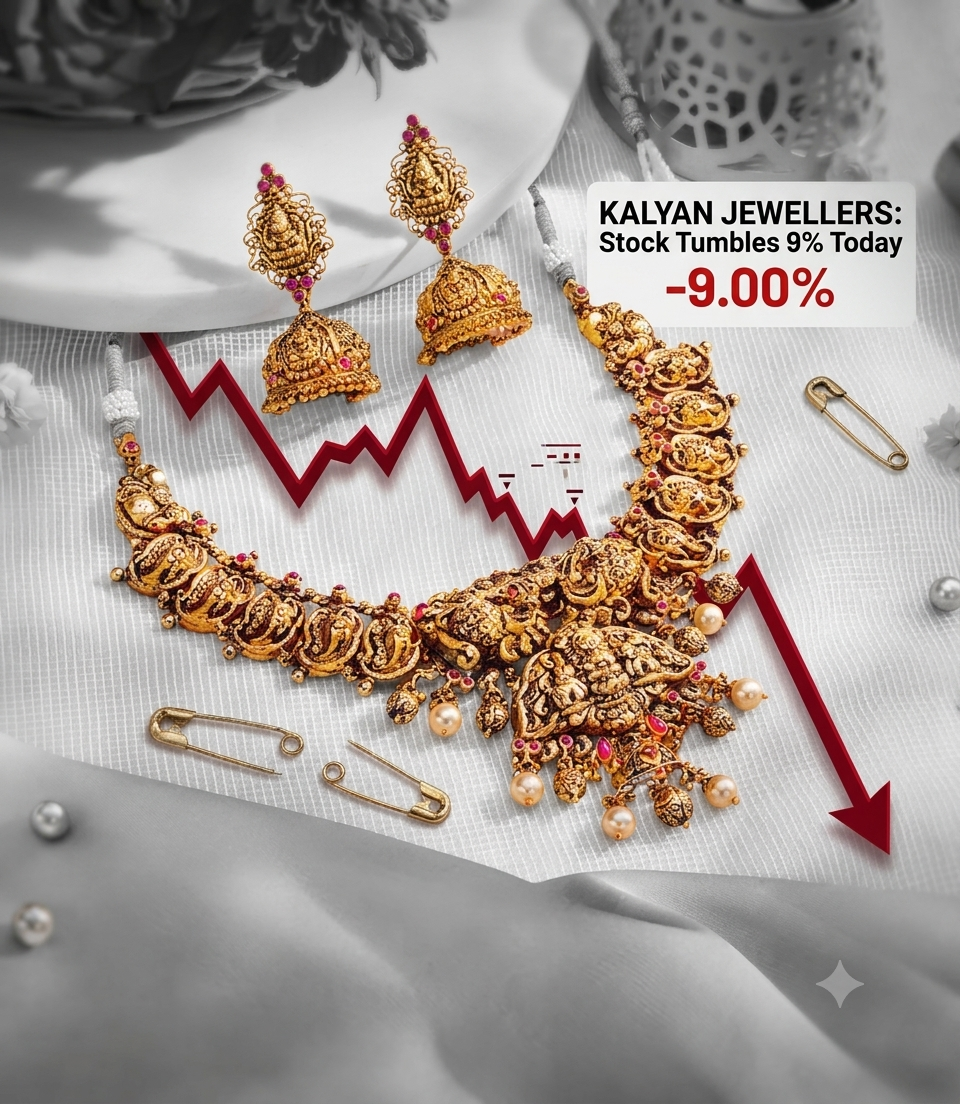
The Kalyan Jewellers share price became the center of dramatic market action on Tuesday. The company’s stock experienced a sharp, unexpected plunge of nearly 9% during early morning trade. For retail investors and market observers looking purely at the headline operational numbers, this steep decline was a bewildering turn of events. Just hours prior, the Thrissur-headquartered jewelry major had released an incredibly strong business update for the first quarter of the fiscal year 2027 (Q1 FY2027), boasting a spectacular 38% year-on-year consolidated revenue expansion.
In typical financial markets, a near-40% top-line growth rate is cause for celebration and immediate bullish momentum. Yet, the reality on the trading floor of the National Stock Exchange (NSE) and Bombay Stock Exchange (BSE) told a completely different story. The stock slipped all the way down to an intra-day low of ₹348.35 from its previous close of ₹381.25. This sudden correction wiped out a substantial portion of recent investor gains and stretched the company’s year-to-date losses for 2026 to over 27%.
To fully make sense of why a structurally sound, fast-growing company suffered such harsh treatment from institutional and retail investors alike, we have to look past the surface-level metrics. The answer lies in a complex mix of elevated market expectations, a fierce multi-front war with industry titan Titan Company, localized operational disruptions, and classic profit-booking after a multi-year secular bull run.
The Kalyan Jewellers share price Q1 FY2027 Operational Data Blueprint
When analyzing the operational machinery of Kalyan Jewellers during the April–June quarter, it becomes clear that the business itself is firing on almost all cylinders. The macro-narrative of consumer behavior moving away from unorganized, neighborhood goldsmiths toward trusted, organized corporate retail brands remains completely intact.
Domestic Performance: Navigating the ‘Adhik Maas’ Hurdle
The company’s primary engine, its domestic India operations, recorded a revenue jump exceeding 38% year-on-year. This growth wasn’t just a byproduct of aggressive new store additions; it was driven by organic consumer demand. The same-store-sales-growth (SSSG)—a vital health metric for retail operations tracking revenue generated by outlets open for at least a year—registered a healthy 28% increase.
What makes this domestic performance particularly impressive is that it was achieved in the face of a significant cultural and calendar structural headwind: the Adhik Maas period. Occurring once every three years, this extra month in the traditional lunar calendar is widely regarded across many regions of India as an inauspicious time to purchase gold, hold weddings, or start new ventures. Because wedding-related purchases form the bedrock of high-ticket Indian jewelry retail, a full 28 days of Adhik Maas falling entirely within the June quarter usually acts as a severe drag on sales velocity. Kalyan managed to power right through this historical lull, highlighting robust underlying consumer momentum on the ground.
International Footprint: Weathering Geopolitical Storms
On the international front, led heavily by the expatriate-rich markets of West Asia (the Middle East), Kalyan reported a consolidated revenue growth of roughly 35% year-on-year. Looking purely at the Middle East territory, revenue grew by 30%.
This segment had to overcome its own distinct set of challenges. In April, the region suffered severe geopolitical instability that caused localized supply line anxieties and a direct impact on retail footfalls. Furthermore, unseasonal weather disruptions and catastrophic flooding in major shopping hubs like Dubai temporarily halted regional commerce. Despite these external anomalies, a late-quarter recovery in consumer traffic ensured that the international business maintained its status as a core stabilizer, contributing roughly 14% to Kalyan’s total top-line consolidated revenue.
Candere: The E-Commerce Rocket Evolving into Omnichannel
Perhaps the most explosive growth node within the entire Kalyan portfolio belongs to its digital-first subsidiary, Candere. Long seen as a niche online play targeted at younger, millennial, and Gen-Z consumers buying lightweight, everyday jewelry, Candere saw its revenue surge by a jaw-dropping 112% year-on-year during Q1 FY2027.
This triple-digit hyper-growth indicates that Candere has reached an inflection point. The management’s strategy to pivot Candere from an online-only e-commerce outlet into a true omnichannel player is paying rich dividends. By opening 5 physical Candere boutique showrooms during the quarter, the company successfully bridged the trust gap, allowing digital shoppers to experience physical touchpoints, which dramatically increased conversion rates and average ticket sizes.
Why Strong Numbers Met a Weak Market Response
With domestic revenue up 38%, international revenue up 35%, and digital revenue up 112%, a 9% crash in the stock price seems entirely counterintuitive. However, stock markets do not value companies in a vacuum; they value them based on relative performance against peers and the absolute weight of market expectations.
1. The Shadow of Titan’s Explosive Outperformance
The most immediate catalyst for the drop in Kalyan’s stock price was the competitive benchmarking set by its largest corporate rival, Titan Company Limited (the operators of the Tanishq brand). Just days prior to Kalyan’s disclosure, Titan dropped its own Q1 business update, revealing that its core consumer business revenue grew by 41% year-on-year, driven by an exceptional 39% surge within its domestic jewelry division. Crucially, Titan’s international operations went viral, recording an astronomical 128% year-on-year explosion.
When institutional funds and asset managers looked at the two updates side by side, a clear dynamic emerged. While Kalyan’s performance was objectively stellar, it technically lagged behind Titan’s growth pace in key high-margin segments. In the hyper-competitive luxury retail landscape, even a minor variance in growth trajectories can cause massive capital reallocation. Following the announcements, investors shifted capital out of Kalyan and into Titan, driving Titan shares up by over 3.5% while hammering Kalyan down.
2. High Margin Anxiety and the Revenue Mix
A persistent concern lurking beneath Kalyan’s impressive top-line growth is the near-term trajectory of its operating margins. Sophisticated market participants are heavily focused on product mix. In jewelry retail, margins are driven by three components: diamond and studded jewelry sales, making charges, and the utilization of recycled gold versus freshly imported bullion.
Kalyan has been aggressively pushing its “Shine with India” gold recirculation campaign. On the sustainability front, it is a masterclass: recycled gold accounted for more than 46% of total revenue for the entire quarter, with the month of June seeing the share of recycled gold jump to an unprecedented 55%. While using recycled gold reduces reliance on expensive imports and helps manage macro working capital, the rapid adjustments in sourcing can create short-term volatility in hedging strategies and gross margin calculations. The market appears to be taking a conservative, “wait-and-see” approach, choosing to see the full audited profitability figures in the upcoming quarterly earnings release before bidding the stock higher.
3. Exhaustion from a Secular Bull Run
It is also essential to acknowledge the mechanics of market cycles. Kalyan Jewellers had been an absolute multi-bagger darling of the Indian stock market over the preceding 24 months. When a stock undergoes massive price appreciation based on future growth expectations, the eventual realization of those strong numbers frequently triggers a “sell the news” phenomenon. Institutional investors who sat on massive paper profits used the highly liquid, high-volume trading window of the Q1 update to cash in and book profits, creating immediate downward pressure on the day’s order book.
Technical Analysis: Key Support and Resistance Zones
From a technical chart perspective, the day’s sharp sell-off has fundamentally altered the short-term market structure for the counter, pushing the stock below several critical exponential moving averages (EMAs).
Market technicians note that the ₹381–₹400 range has now solidified into a heavy overhead resistance zone. Any future bullish recovery will require significant trading volume to break back above this ceiling. On the downside, the key psychological and historical level of ₹350 was breached during the morning panic, though the stock saw minor buying interest around the ₹348 mark.
According to prominent market analysts, the crucial structural support zone to watch now sits between ₹340 and ₹330. If the stock fails to hold above ₹330 on a daily closing basis, it could accelerate a deeper technical correction toward the ₹310 level, as stop-losses on long positions get triggered. Traders are widely advising against opening aggressive, fresh long positions until the stock shows clear signs of base-building and price stabilization.
Detailed Stock Specification Toolbar
To give a comprehensive, scannable overview of where the equity stands following this turbulent trading session, the key data points have been compiled below:
| Stock Metric / Parameter | Value / Data Specification | Context & Implications |
| Current Market Price (NSE Low) | ₹348.35 | Represents an intraday drop of ~8.62%. |
| Previous Closing Price | ₹381.25 | The benchmark price before the Q1 announcement shock. |
| Year-to-Date (YTD) Return (2026) | -27.4% | Reflects broader sector corrections and cooling valuations. |
| Consolidated Q1 Revenue Growth | +38% YoY | Driven heavily by domestic network expansion. |
| India Same-Store-Sales-Growth | ~28% | Demonstrates robust organic growth despite Adhik Maas. |
| Candere Digital Platform Growth | +112% YoY | Proves the scalability of the omnichannel retail shift. |
| Recycled Gold Sourcing (June) | >55% of Revenue | Drastic increase from the “Shine with India” campaign. |
| Total Global Showroom Network | 524 Outlets | Includes 12 new Kalyan & 5 new Candere stores this quarter. |
| Primary Immediate Support Zone | ₹330 – ₹340 | Critical floor; a breach could intensify selling pressure. |
| Primary Immediate Resistance Zone | ₹381 – ₹400 | Major technical hurdle for any near-term recovery. |
Looking Forward: Golden Opportunities or Continued Pressure?
Even though the stock market reacted badly, Kalyan Jewellers’ actual business looks solid for the long run. Management is highly optimistic about the next quarter. Customer traffic has already recovered heading into July, and the company is preparing fresh collections, new marketing campaigns, and more store launches.
The second half of the year is always the most profitable time for Indian jewelry brands. Major festivals like Dhanteras and Diwali, combined with the busy winter wedding season, always create a massive boom in gold sales. Plus, with the unlucky Adhik Maas month out of the way, the upcoming quarters won’t face any artificial sales drops.
Furthermore, Indian consumers are rapidly shifting away from small, unorganized local goldsmiths toward trusted national brands like Kalyan and Titan. This formalization of the economy gives big retailers a permanent runway to grow.
For long-term investors, this sudden drop in the Kalyan Jewellers share price doesn’t mean the company is failing. Instead, the market is simply cooling down after the stock flew too high, too fast. While short-term traders should be careful due to the current downward momentum, the company’s rapid expansion—adding 17 new showrooms in just three months—shows its growth story is far from over. The main thing to watch now is whether management can turn this massive 38% revenue growth into solid, long-term net profits.
Disclaimer: The information provided above is for educational purposes only. We strongly advise investors to consult with SEBI-certified financial experts before making any investment decisions.