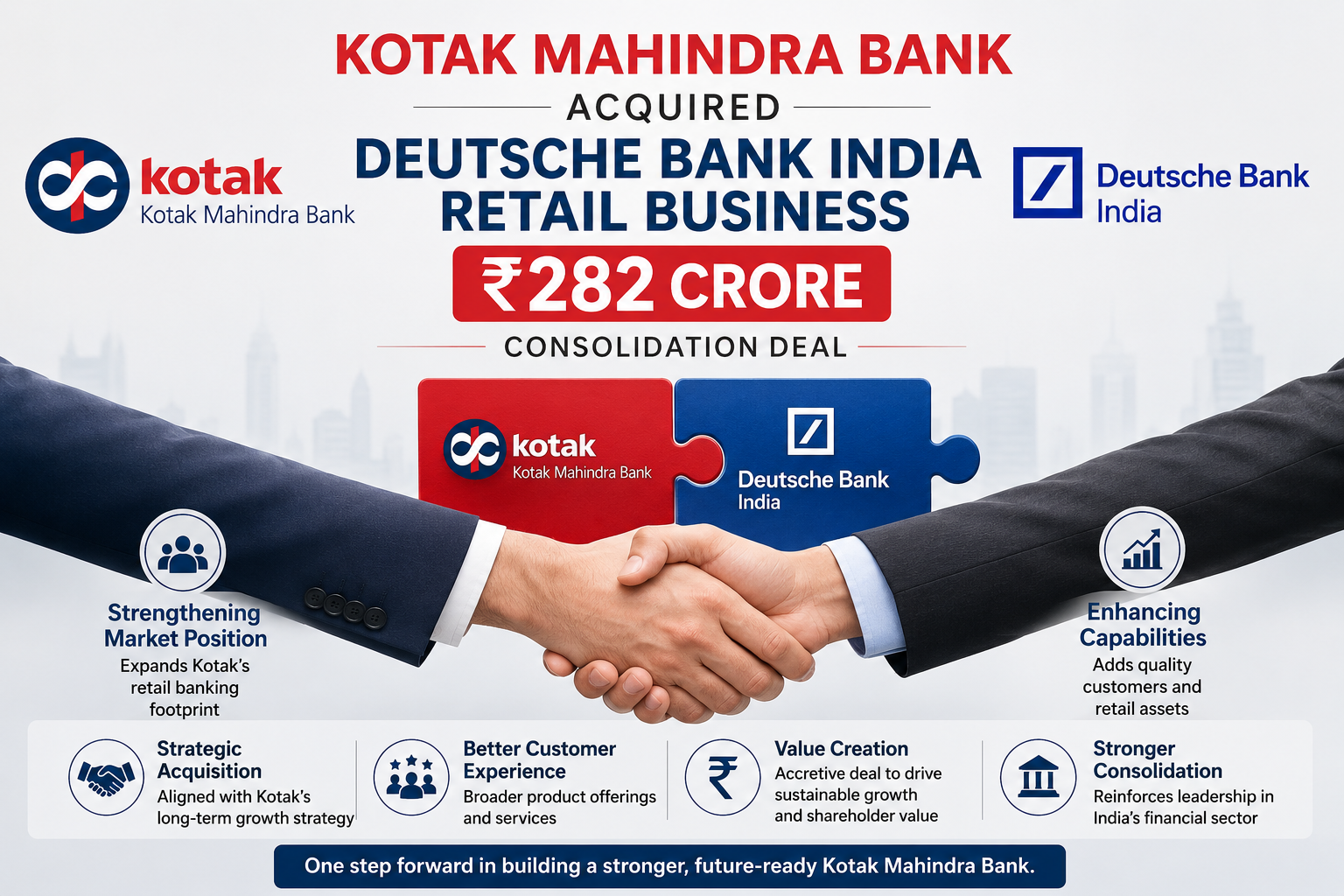
On Tuesday, June 30, 2026, Kotak Mahindra Bank acquired Deutsche Bank India retail business for ₹282 crore in cash.
This is a major deal in Indian banking that helps Kotak grow quickly while allowing Deutsche Bank to focus on its corporate global operations.
Key Details of the Deal:
What Kotak gets: ₹29,000 crore in loans, ₹16,000 crore in deposits, and ₹10,500 crore in investment assets (AUM).
The Customers: Kotak gains 1.5 lakh (150,000) premium, wealthy customers.
The Staff: About 1,000 experienced Deutsche Bank employees will join Kotak.
Timeline: The entire transfer is expected to be finished by September 2027.
In short, Kotak is expanding aggressively to serve wealthy clients in India, while Deutsche Bank is stepping back from everyday personal banking to focus on big businesses.
Breakdown of the ₹282 Crore Acquisition Deal
The transaction structured between Kotak Mahindra Bank and Deutsche Bank AG (DBAG) operates via its Indian branch network. The definitive corporate filing shows a clean break transaction rather than a joint venture or structural partnership.
Financial Considerations and Valuation Adjustments
The base cash consideration for the business undertaking stands at ₹281.7 crore. However, corporate finance experts highlight that the final consideration at the time of closing (expected by late 2027) will be subject to adjustments. These adjustments will depend on the exact movement of deposit balances, loan quality metrics, and final AUM value retention during the transitional phase.
Because it is an all-cash deal, Kotak Mahindra Bank will fund the purchase out of its internal cash reserves without creating any fresh equity dilution. This keeps existing shareholder value intact while adding a substantial revenue-generating engine.
Non-Binding Referral Agreements
Alongside the core banking business transfer, Kotak’s wholly-owned subsidiaries—Kotak Mahindra Asset Management Company Limited (Kotak AMC) and Kotak Alternate Asset Managers Limited (KAAML)—have entered into non-binding term sheets with Deutsche Investments India Private Limited (DIIPL). This peripheral arrangement establishes a systematic client referral pipeline. Under this roadmap, wealth management and advisory clients managed under the outgoing Deutsche Bank structure will be seamlessly guided toward Kotak’s domestic portfolio management services (PMS) and specialized investment advisory structures.
THE KOTAK-DEUTSCHE BANK INDIA DEA:

Transaction Value:  ₹281.7 Crore (All-Cash Deal)
Expected Closing:   September 2027
Regulatory Nods:    CCI, RBI, NSDL, CDSL
Core Portfolio:     Retail Banking, Wealth Management & Private Banking
Portfolio Size: Assets, Loans, and Customers
The financial impact of the transaction becomes evident when looking at the portfolio metrics transferred from the German lender to Kotak’s domestic platform. As of the financial books closed on March 31, 2026, the retail, private banking, and wealth division of Deutsche Bank India holds premium credit and liability positions:
Total Loan Book (Advances): Estimated at approximately ₹29,000 crore. This includes premium retail loans, mortgages, and credit facilities extended to high-income individuals and small-to-medium enterprises (SMEs).
Total Customer Deposits: Standing at roughly ₹16,000 crore. Given Deutsche Bank’s typical high-income demographic, these deposits represent low-cost, stable CASA (Current Account Savings Account) and premium fixed term-deposits.
Assets Under Management (AUM): Valued at ₹10,500 crore within the wealth management and private banking silos.
Customer Base Consolidation: Kotak absorbs a highly sticky tier of 1.5 lakh affluent customers.
Human Capital Transition: Around 1,000 corporate employees specializing in premium retail and wealth advisory services will move directly into Kotak’s operational payroll.
Strategic Intent Behind the Consolidation
This acquisition represents a deliberate, calculated move by both corporate entities, aligning perfectly with their long-term growth and structural blueprints.
          KOTAK MAHINDRA BANK                          DEUTSCHE BANK
   =================================         =================================
   • Scale up affluent urban banking         • Execute Global "Hausbank" strategy
   • Gain ₹29,000 Cr premium loans           • Simplify operational footprint
   • Absorb 1,500 cr elite wealth AUM        • Maintain corporate & investment arm
   • Capitalize on return-on-equity          • Transition global NRI wealth offshore
Why Kotak is Expanding Its Affluent Footprint
For Kotak Mahindra Bank, led by Managing Director and CEO Ashok Vaswani, organic growth in the highly competitive premium banking space is both costly and time-consuming. By acquiring this readymade portfolio, Kotak skips several steps in building brand loyalty among India’s elite retail customers.
The deal directly serves Kotak’s core strategy: building a scaled, customer-centric affluent and SME banking franchise. Adding an established, high-yield loan book of ₹29,000 crore boosts its asset portfolio, while the influx of elite clients offers high cross-selling potential for insurance, mutual funds, brokerage accounts, and specialized credit cards. At closing, the transaction is projected to be Return-on-Equity (RoE) accretive for Kotak, meaning it will immediately enhance profitability per share.
Deutsche Bank’s Global Hausbank Strategy
Conversely, for Deutsche Bank, selling off its Indian retail arm is a key step in its global transformation. Under the corporate Global Hausbank strategy, the Frankfurt-headquartered institution is systematically simplifying its international footprint. The goal is to exit resource-intensive retail markets where it lacks massive scale, freeing up capital to focus on core corporate banking, investment banking, and institutional asset management through DWS.
Kaushik Shaparia, CEO of Deutsche Bank Group India and Emerging Asia, emphasized that India remains an essential growth market. However, the bank will now focus its energy on large corporate clients, multi-nationals, trade finance, and institutional investment systems. Its onshore wealth clients gain a stable domestic home with Kotak, while Deutsche Bank’s private bank pivots to serving global ultra-high-net-worth clients and Non-Resident Indians (NRIs) from international hubs outside India.
Regulatory Clearances and Transition Timeline
A transaction of this scale requires navigating several strict compliance and institutional checkpoints. Because Kotak Mahindra Bank and Deutsche Bank are both scheduled commercial lenders under the Reserve Bank of India (RBI), the entire transition is set up on a multi-month runway, targeted for full completion by September 2027.
Required Approvals
Before the assets can be formally transferred under the Business Transfer Agreement, the banks must secure nods from several regulatory bodies:
Competition Commission of India (CCI): To ensure the acquisition doesn’t create an anti-competitive monopoly in the domestic wealth and retail banking spaces.
Reserve Bank of India (RBI): To review asset classifications, transfer modalities, and capital adequacy requirements.
NSDL and CDSL: The National Securities Depository Limited and Central Depository Services (India) Limited must sign off on transferring the demat and depository accounts of Deutsche Bank’s premium wealth clients to Kotak’s platforms.
Client and Employee Continuity Plans
Both financial institutions have assured stakeholders that day-to-day operations will face zero disruptions during this transition phase. The 1.5 lakh customers will continue to access their existing accounts, debit cards, investment platforms, and wealth managers without immediate changes.
The transfer of the 1,000-member workforce is a deliberate move to ensure operational continuity. By retaining the same relationship managers and wealth experts, Kotak aims to prevent customer churn and ensure a smooth migration process.
Financial Benchmarks and Market Impact
To understand the scale of this acquisition, it helps to look at where Kotak Mahindra Bank stands in the Indian financial sector as of mid-2026.
Kotak Mahindra Bank Overall Balance Sheet Context
As of March 31, 2026, the Kotak Mahindra Group maintained an extensive domestic physical footprint with 5,581 operational branches across India. The group’s total asset base stood at a massive ₹10,03,353 crore.
While a ₹29,000 crore loan acquisition represents a modest percentage of Kotak’s overall balance sheet, it delivers a massive concentration of high-margin, affluent urban assets. This allows Kotak to deploy capital efficiently without incurring the heavy infrastructure costs of building new premium branches from scratch.
Deutsche Bank’s Institutional Footprint in India
Despite exiting the domestic retail banking business, Deutsche Bank retains a deep institutional anchor in India after more than 45 years of continuous operations. Notably, more than a quarter of its entire global workforce remains stationed within Indian back-offices, GCCs (Global Capability Centers), and technology development hubs, including its specialized facilities in GIFT City, Gujarat. Even after transferring its retail branches, Deutsche Bank will remain the single largest European banking entity operating within India, maintaining corporate banking hubs that connect Indian businesses to its global network covering 48 countries.
Stock Market Reaction: Kotak Mahindra Bank Share Price Analysis
With the official acquisition announcement landing after the closing bell on Tuesday, June 30, 2026, market analysts expect Kotak Mahindra Bank’s stock to see high trading volumes on Wednesday, July 1.
Recent Technical Performance on the NSE
On Tuesday, June 30, Kotak Mahindra Bank’s shares settled slightly lower, down 0.82% to close at ₹392.25 per unit on the National Stock Exchange (NSE). The stock has seen mixed performance recently, dropping a little over 1% over the past week, but bouncing back with a 3% gain over the course of the month.
On a broader Year-to-Date (YTD) basis, the stock has faced some structural headwinds, down roughly 11% since the start of 2026. Looking at its 52-week range, Kotak climbed to a high of ₹453.20 on October 20, 2025, before hitting a support low of ₹345.50 on April 2, 2026.
KOTAK MAHINDRA BANK LTD (NSE: KOTAKBANK) STOCK SNAPSHOT :
Current Price: ₹392.25 (down 0.82% on June 30).
Total Market Capitalization: ₹3.94 Lakh Crore
Recent Trends: The stock is up 3% this month, but down about 11% since the start of 2026.
52-Week Range: Highest at ₹453.20; lowest at ₹345.50.
Market Analyst Outlook
Most institutional analysts view this asset purchase as a clear long-term positive for Kotak’s stock valuation. At a market capitalization of ₹3.94 lakh crore, the lender is well-capitalized to absorb this book smoothly.
While the cash outflow of ₹281.7 crore is relatively small, adding ₹29,000 crore in high-quality advances and an elite depositor base should help expand net interest margins (NIMs) over time. Dalal Street will likely track how well Kotak retains these high-yield wealth clients through the transition, as well as the pace of final regulatory clearances over the coming quarters.
Industry Implications: The Changing Face of Indian Banking
This transaction highlights a broader trend across the Indian financial sector: foreign banking conglomerates trimming their retail operations to hand them over to aggressive, well-capitalized domestic private banks. This pattern mirrors previous major consolidations, such as Axis Bank’s high-profile acquisition of Citibank’s India consumer business.
Why Foreign Retail Banks are Pivoting
Running a retail banking network in India demands continuous capital investment in physical branches, localized digital apps, and extensive regulatory reporting. For foreign institutions like Deutsche Bank, competing for mass retail market share against deep-pocketed domestic giants is a tough climb.
By shifting focus to corporate lending, investment underwriting, and cross-border trade finance, foreign banks can generate higher returns on equity while leaving consumer operations to domestic players.
The Rise of Domestic Premium Consolidators
Meanwhile, large Indian private banks are eager to buy up these high-end foreign portfolios. The affluent urban consumer segment is one of the most profitable areas in Indian banking today, driven by rising disposable incomes and a growing demand for sophisticated wealth management.
By acquiring these pre-vetted customer portfolios, domestic private banks can instantly scale up their premium divisions. This strategy allows them to capture greater market share and boost long-term fee income with minimal operational friction.
Conclusion: What Lies Ahead for Stakeholders?
The news that Kotak Mahindra Bank acquired Deutsche Bank India retail business marks a true win-win deal for both financial institutions, though its full success will depend on smooth execution between now and September 2027.
For Kotak Mahindra Bank: The focus shifts to securing swift clearances from the CCI and RBI, while kicking off its integration strategy to ensure the 1.5 lakh incoming affluent clients feel right at home.
For Deutsche Bank Group: This exit allows leadership to streamline its Indian corporate footprint, optimizing resources to back institutional clients while routing international NRI wealth through its offshore hubs.
For Retail and Wealth Clients: Your accounts, funds, and relationship management remain steady for now. The primary transition involves your underlying accounts moving to a larger domestic network with over 5,500 branches, bringing a wider range of localized digital products and domestic investment options.
As the financial markets open on July 1, all eyes will be on Kotak Mahindra Bank’s stock performance. This deal sets a clear benchmark for corporate consolidation, highlighting how India’s private banking giants are ready to drive the next wave of financial growth.
Disclaimer: For educational purposes only. The investment insights and market views shared above belong solely to the respective analysts or broking companies. This is not financial advice. Please do your own research and consult a certified professional before investing your money.