
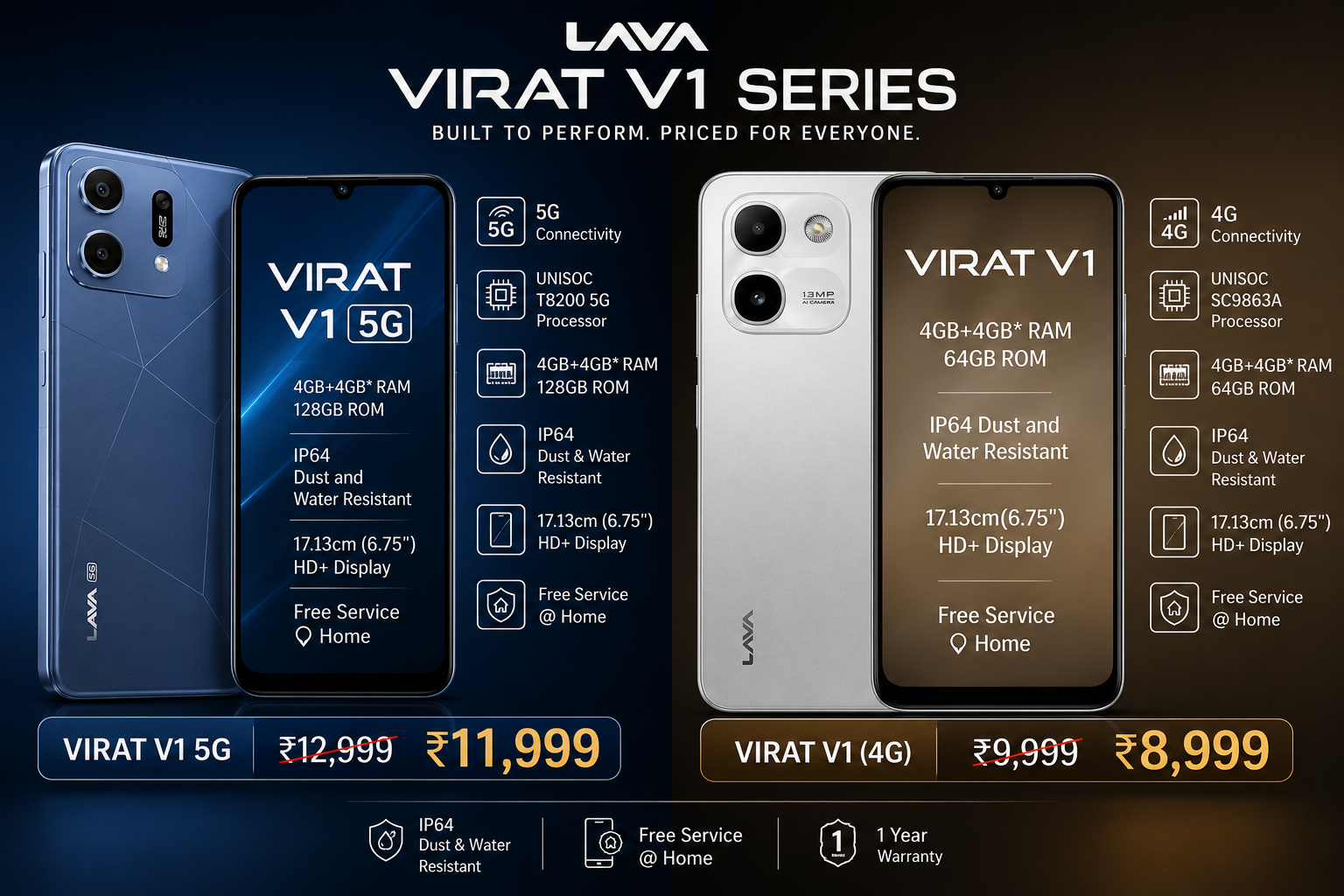
Lava Virat V1 5G and its 4G sibling, the Lava Virat V1, have officially hit the Indian market, shaking up the sub-₹13,000 smartphone space. Domestic smartphone maker Lava has partnered with Flipkart to introduce this youth-focused lineup, aiming to offer solid hardware, completely clean software, and peace-of-mind after-sales service.

If you are tired of budget smartphones cluttered with unwanted pre-installed apps and annoying push notifications, Lava’s newest duo wants to change the narrative.
1. Price, Day-One Offers, and Availability
Lava has strategically targeted two distinct budget tiers with this series. The standard 4G Lava Virat V1 sits firmly in the sub-₹10,000 category, while the Lava Virat V1 5G targets the sub-₹13,000 segment.
Both devices come in a unified single-memory variant featuring 4GB of physical RAM and 64GB of onboard storage. The smartphones will be available exclusively online via Flipkart and Lava’s official web store starting July 31st at 12:00 PM (Noon).
Pricing and Color Options Breakdown
| Model Name | Standard Retail Price | Introductory Day-1 Offer Price | Color Variants |
| Lava Virat V1 (4G) | ₹9,999 | ₹8,999 | Nilgiri Blue, Himalayan Silver |
| Lava Virat V1 5G | ₹12,999 | ₹11,999 | Arya Blue, Sonar Gold |
The ₹1,000 launch discount on day one brings the entry barrier for a 5G phone down to ₹11,999, positioning the device directly against entry-level 5G competition from brands like Moto, Poco, and Realme.
2. Complete Technical Specifications Toolbar
Below is a detailed specification matrix comparing every hardware and software component between the two models in the Virat series.
| Hardware / Software Feature | Lava Virat V1 (4G Variant) | Lava Virat V1 5G Variant |
| Display Size & Type | 6.75-inch HD+ LCD, Waterdrop Notch | 6.75-inch HD+ LCD, Waterdrop Notch |
| Refresh Rate | 90Hz | 120Hz |
| Processor (SoC) | UNISOC SC9863A (28nm, Octa-Core) | UNISOC T8200 5G (Octa-Core) |
| RAM Configuration | 4GB LPDDR4X (+ Virtual RAM Expansion) | 4GB LPDDR4X (+ Virtual RAM Expansion) |
| Internal Storage | 64GB | 64GB |
| Expandable Storage | Dedicated Slot (Up to 256GB via microSD) | Dedicated Slot (Up to 1TB via microSD) |
| Rear Camera Setup | 13MP AI Primary Camera + Secondary Lens | 13MP AI Primary Camera + Secondary Lens |
| Front Camera | 5MP Selfie Camera | 5MP Selfie Camera |
| Battery Capacity | 5,000 mAh | 6,000 mAh |
| Charging Power | 10W Standard Charging (USB Type-C) | 10W Standard Charging (USB Type-C) |
| Operating System | Android 15 Go Edition (Pure Stock) | Android 16 (Pure Stock) |
| Bloatware Status | Zero Bloatware / Zero System Ads | Zero Bloatware / Zero System Ads |
| Durability Rating | IP64 Dust & Water Resistance | IP64 Dust & Water Resistance |
| Biometric Security | Side-Mounted Fingerprint Scanner, Face Unlock | Side-Mounted Fingerprint Scanner, Face Unlock |
| Audio Hardware | 3.5mm Headphone Jack, Bottom Loudspeaker | 3.5mm Headphone Jack, Bottom Loudspeaker |
| Wireless Connectivity | Dual 4G VoLTE, Wi-Fi 802.11 b/g/n, Bluetooth 4.2 | Sub-6GHz 5G, Wi-Fi 802.11 a/b/g/n/ac, Bluetooth 5.0 |
| Service Warranty | Free Home Service Warranty Included | Free Home Service Warranty Included |
3. Deep Dive into the Lava Virat V1 5G
Performance Engine and Benchmarks
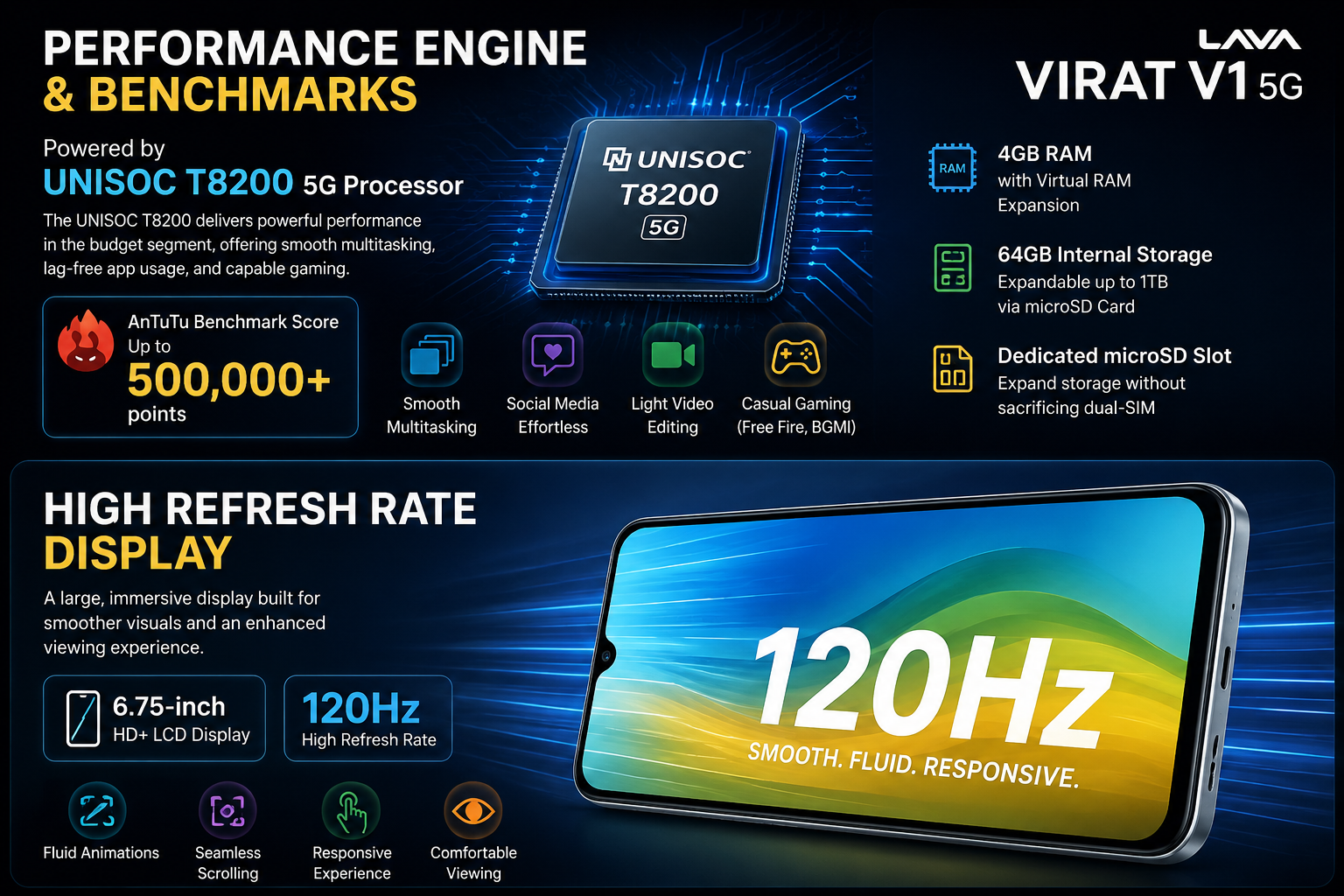
The Lava Virat V1 5G is driven by the UNISOC T8200 5G processor. While UNISOC was historically known primarily for low-cost 2G and 4G feature chips, their newer T-series processors offer competitive performance in budget tiers.
The UNISOC T8200 achieves synthetic AnTuTu benchmark scores approaching 500,000 points. This gives it enough headroom to manage multitasking, social media apps, light video editing, and casual gaming sessions on titles such as Free Fire or BGMI at low-to-medium graphics settings.
Complementing the SoC is 4GB of physical RAM, supported by software-based virtual memory expansion. While 64GB of internal storage might feel modest for power users, Lava includes a dedicated microSD card slot that supports memory expansion up to 1TB without sacrificing dual-SIM functionality.
High Refresh Rate Display
Up front, the device features a large 6.75-inch HD+ LCD panel. While an FHD+ panel would provide sharper text, the HD+ resolution helps reduce processing load and conserves battery life.
To offset the lower resolution, Lava integrated a 120Hz high refresh rate. This ensures fluid animations, seamless page scrolling, and a responsive feel while navigating the user interface or browsing online feeds.
Large 6,000mAh Battery Pack
Battery endurance is a core highlight of the Virat V1 5G. It houses a huge 6,000mAh battery. Combined with the power-efficient HD+ display, the device can comfortably last two full days of moderate usage on a single charge.
The main drawback here is the 10W charging speed. Replenishing a 6,000mAh cell through a 10W USB Type-C charger will take over three hours from near empty, meaning users will likely prefer overnight charging.
4. Deep Dive into the Lava Virat V1 (4G Variant)

Processing Power and Everyday Performance
For users who do not require 5G connectivity or want to keep their spending strictly under ₹10,000, the base Lava Virat V1 offers an entry-level alternative.
It relies on the UNISOC SC9863A chipset. Built on a legacy 28nm manufacturing process, this octacore processor handles core utility functions—such as WhatsApp messaging, YouTube video playback, web browsing, and voice calls. However, it is not designed for heavy mobile gaming or resource-heavy applications.
Display and Daily Usability
The display size remains identical to its 5G counterpart at 6.75 inches with an HD+ resolution. However, the refresh rate is tuned down to 90Hz. While lower than the 120Hz rate on the 5G version, 90Hz still offers a noticeably smoother experience than standard 60Hz panels found on many ultra-budget phones.
Battery and Efficiency Balance
The 4G Lava Virat V1 incorporates a 5,000mAh battery. Thanks to the lower power demand of the 90Hz refresh rate and basic display resolution, users can expect roughly 1.5 days of active runtime. Like the 5G variant, charging is handled via a 10W USB-C port.
5. Cameras, Build Quality, and Doorstep Service
Camera Capabilities
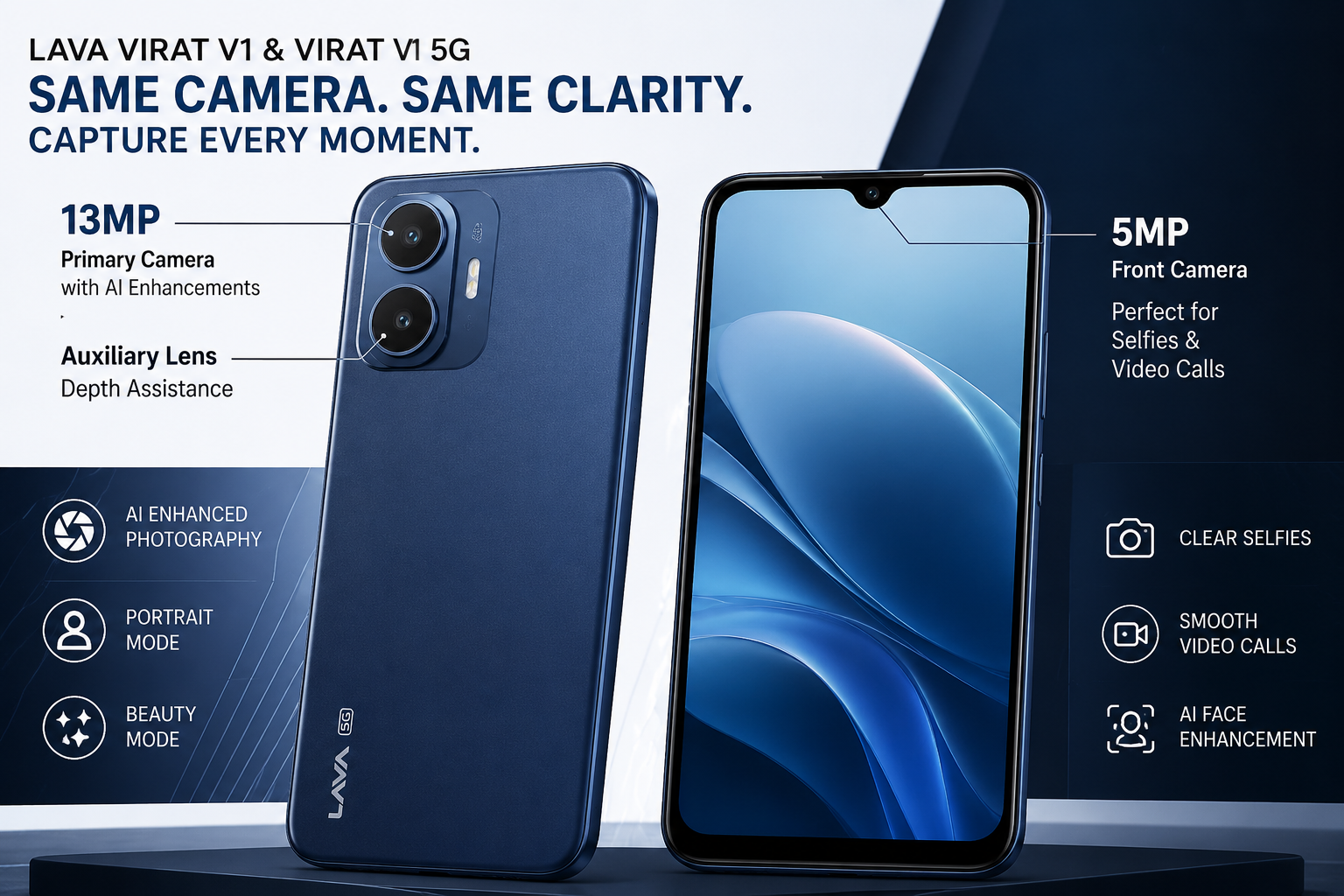
Both the Lava Virat V1 and Virat V1 5G share identical camera specifications:
Primary Rear Camera: 13MP sensor with AI enhancements and a secondary auxiliary lens for depth assistance.
Front Camera: 5MP sensor housed inside a traditional waterdrop-style notch.
These camera setups are tailored for basic daily photography—capturing documents, casual outdoor photos, and handling video calls. Given the entry-level sensor hardware, photographic quality will be best in well-lit conditions, while low-light shots will show standard noise and reduced detail.
IP64 Build Quality and Durability
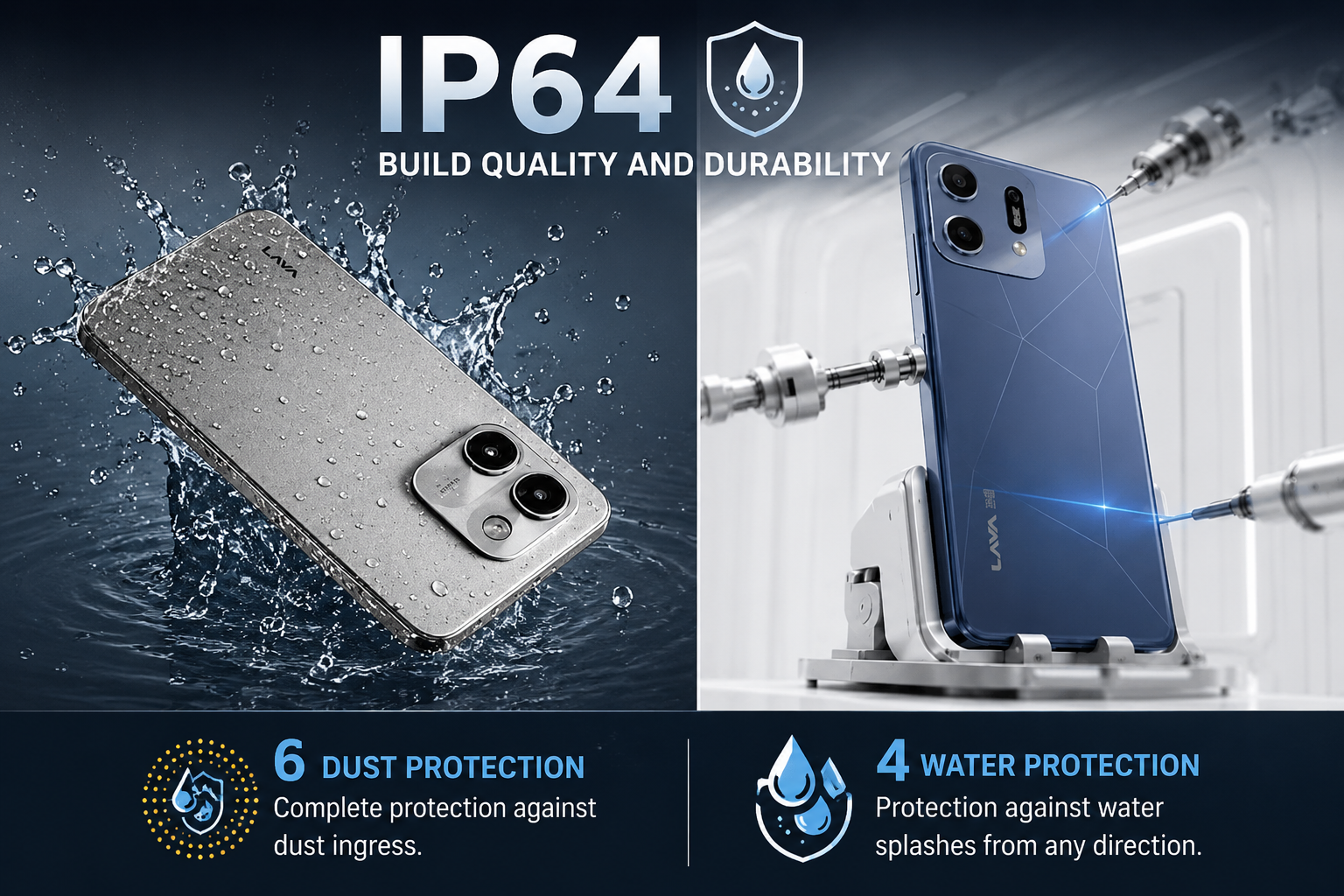
Budget devices rarely carry formal Ingress Protection (IP) ratings. However, Lava has certified both the Virat V1 and Virat V1 5G with an IP64 rating.
6 (Dust Protection): Complete protection against dust ingress.
4 (Water Protection): Protection against water splashes from any direction.
While the phones cannot be fully submerged under water, an IP64 rating offers peace of mind against rain splashes, accidental spills, and dusty environments.
6. Comparative Market Analysis
To understand where the Lava Virat series fits in the current market, it helps to look at how it compares with other options in similar price brackets.
Lava Virat V1 (4G) vs. Entry-Level Competitors
At its day-one offer price of ₹8,999, the Lava Virat V1 competes against phones like the Infinix Smart 20 series or basic Redmi A-series models.
While competing options might occasionally offer slightly faster charging speeds, Lava balances this with its clean Android 15 Go software, IP64 rating, 90Hz screen, and home repair service, making it a strong contender for buyers who prefer a clean, straightforward software experience.
Lava Virat V1 5G vs. Sub-₹13,000 5G Competitors
At ₹11,999 (Launch Price), the Lava Virat V1 5G enters an active market alongside devices like the Poco M-series, Moto G-series, and Samsung M-series budget models.
The device’s main strengths are its clean Android 16 interface, large 6,000mAh battery, and 120Hz display. The main trade-off remains its 10W charging speed, which is slower than some competing models offering 18W or 33W charging.
7. Summary of Key Pros and Cons
Pros
Clean Software Experience: Pure stock Android (Android 16 on 5G / Android 15 Go on 4G) without bloatware or ads.
Generous Display Specs: Smooth 120Hz refresh rate on the 5G model and 90Hz on the 4G model.
Long Battery Life: Massive 6,000mAh battery capacity on the Virat V1 5G.
Solid Durability: Certified IP64 rating for dust and splash resistance.
Convenient After-Sales Support: Free doorstep repair service included.
Expandable Memory: Dedicated microSD slot (up to 1TB expansion on the 5G model).
Cons
Slow Charging: 10W charging speed takes a long time to fill large 5,000mAh / 6,000mAh batteries.
Basic Camera Setup: 13MP primary and 5MP front cameras are limited to basic, everyday shots.
Entry-Level Processing on 4G Model: The UNISOC SC9863A SoC on the base V1 is suited primarily for lightweight daily tasks.
Final Thoughts
The launch of the Lava Virat V1 and Lava Virat V1 5G brings a clear focus back to software usability in the budget market. By removing third-party bloatware and intrusive advertisements, Lava offers a clean, reliable user experience that stands out in the sub-₹13,000 category.
For buyers seeking an affordable 5G device with a clean Android interface, a smooth 120Hz display, multi-day battery endurance, and convenient doorstep service, the Lava Virat V1 5G presents a compelling package—especially at its launch offer price of ₹11,999.
Related Comparisons & Reviews
If you are exploring other options in this price range, you might also be interested in these detailed specs and breakdowns: