
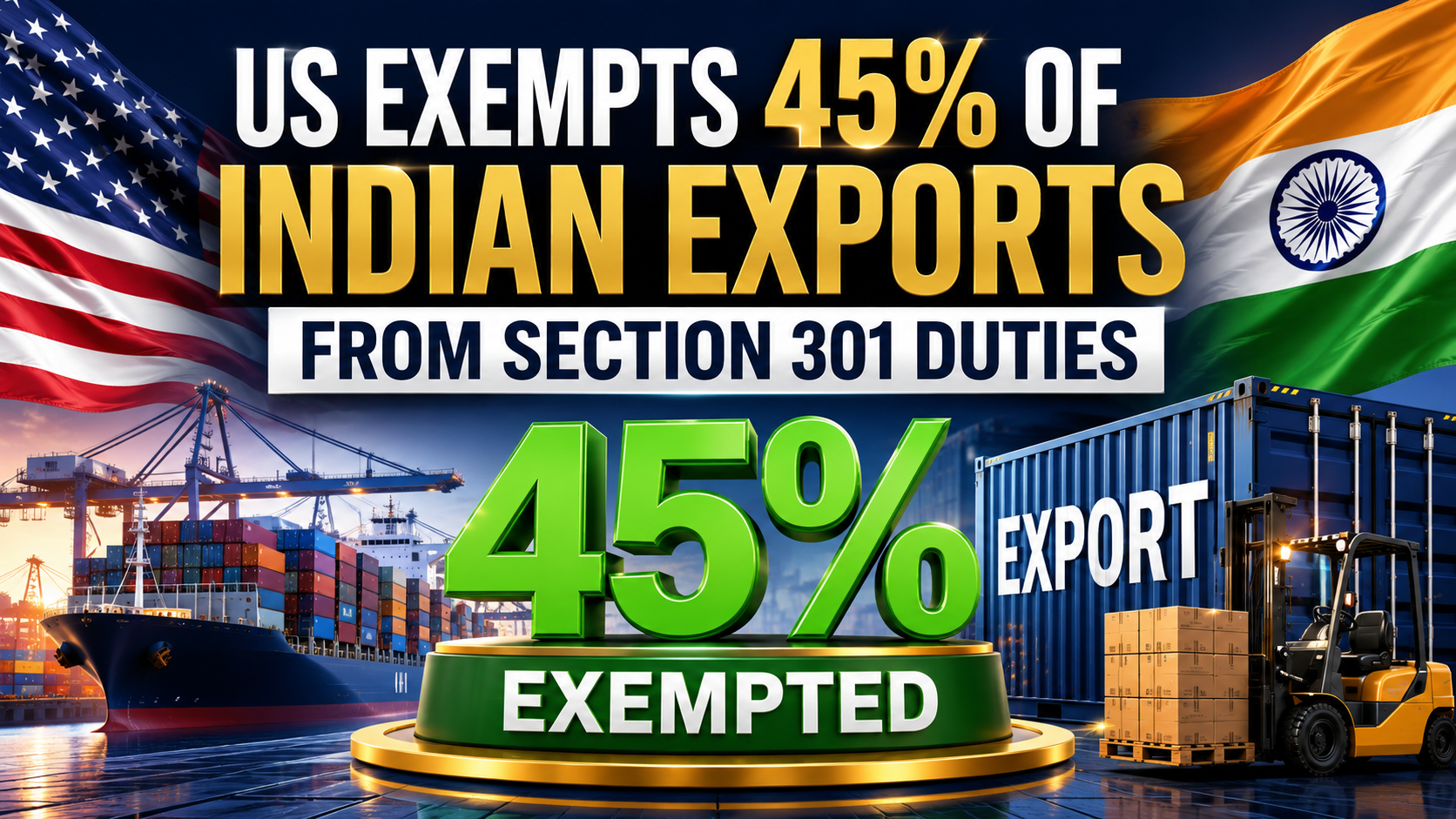
The global trade arena just witnessed a major regulatory shift, but Indian exporters have managed to secure crucial breathing room. The United States Trade Representative (USTR) officially finalized its Section 301 investigation regarding global forced labor import controls across 60 economies. While Washington implemented fresh additional trade duties, the Ministry of Commerce and Industry confirmed that approximately 45 percent of Indian exports to the US will remain completely exempt from the new 10% additional tariff.
This development provides relative stability to key industrial segments while shifting the remaining 55 percent of Indian goods into a lower, competitive duty tier compared to other major manufacturing rivals like China. Here is an in-depth breakdown of what this decision means, how targeted exemptions work, where the textile mechanism stands, and how trade associations are reacting.
Breakdown of the New US Duty Structure
The Office of the United States Trade Representative concluded its comprehensive probe under Section 301 of the Trade Act of 1974. Initially, US authorities proposed a 12.5% ad valorem tax on Indian goods. However, following intense diplomatic consultations, formal written responses, and active participation in public hearings by the Indian government, Washington moved India into its lower tariff bracket.
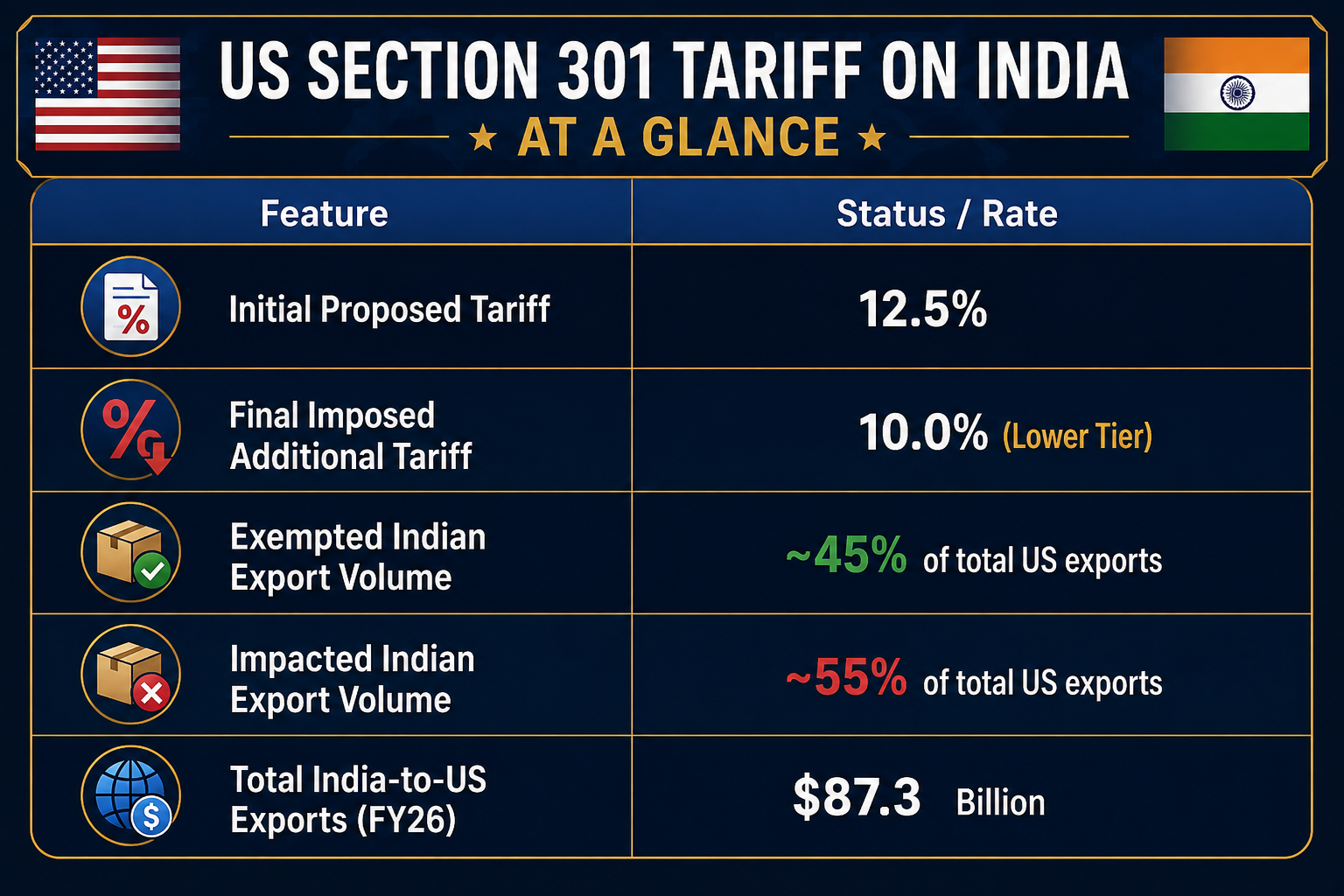
The revised 10% rate replaces the temporary global Section 122 duties and positions Indian exporters at a 2.5 percentage-point relative advantage over competing trade hubs that face the higher 12.5% blanket tax rate.
What Products Escape the 10% Tariff Shield?
Nearly half of India’s export catalog to the United States avoids the extra cost burdens entirely. The Commerce Ministry outlined two main product categories driving these exemptions:
Excluded High-Value Essentials: Critical shipments such as generic pharmaceutical formulations, mobile smartphones, and specifically named industrial inputs are not subject to the new 10% duty.
Pre-existing Section 232 Frameworks: Products already regulated under broad US national security trade provisions—such as steel, aluminum items, and automotive components—remain outside the scope of Section 301 forced-labor levies.
Because these core categories form a massive bulk of India’s annual $87.3 billion export trade with America, the fiscal shield cushions Indian manufacturing supply chains against severe price shocks.
Status of the Pending Textile-Specific Trade Mechanism
While many sectors celebrated the relief, apparel and garment manufacturers are watching upcoming bilateral discussions closely. The USTR’s final report made reference to potential textile-specific trade rules or tariff-rate quota adjustments.
Ministry Statement: “A textile-specific mechanism mentioned in the final US measures has not yet been established. India is continuing discussions with the US on the matter as part of the ongoing negotiations for a proposed bilateral trade agreement.”
Until both nations finalize this framework, Indian textile shipments entering American ports will attract the general 10% additional rate, subject to future adjustments once quota frameworks are officially ironed out.
Gems and Jewelry Industry: Relief Mixed with Operational Hurdles
Responding to the USTR announcement, the Gem and Jewellery Export Promotion Council (GJEPC) firmly dismissed any allegations linking India’s gem sector to forced labor practices.
While acknowledging that a 10% duty offers a competitive edge over regional neighbors like China and Hong Kong (facing 12.5% rates), the GJEPC highlighted ongoing international market pressures:
The Competitive Edge: India holds a 2.5% duty cushion compared to several East Asian manufacturing centers.
The Disadvantage: Natural diamond processing hubs in Europe and parts of Africa continue to enjoy zero-duty entry for natural diamonds under separate bilateral treaties.
Exporters in Surat and Mumbai will need to optimize operational costs to offset this tariff differential against duty-free European supply lines.
Strategic Takeaway for Indian Trade Strategy
India’s active diplomatic engagement prevented a worst-case trade scenario. By adopting clearer import regulations and maintaining open channels with Washington, New Delhi secured a lower tariff tier that protects nearly half of its US-bound cargo. As negotiations proceed on the broader bilateral trade agreement, all eyes now turn to how quickly the two countries can establish a structured framework for the textile and apparel sector.