
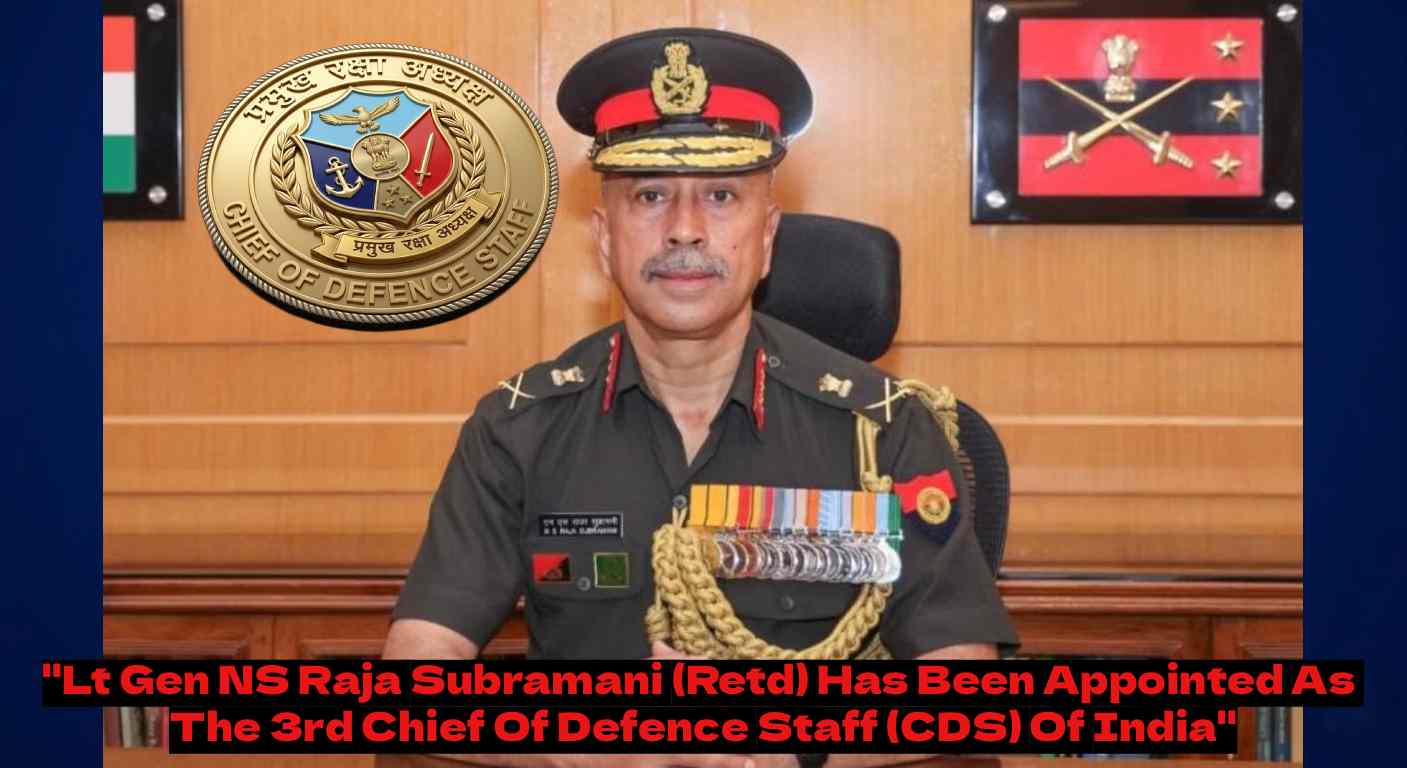
The Indian government has officially signaled a significant transition in its top military leadership. Lt Gen NS Raja Subramani (Retd) has been appointed as the 3rd Chief of Defence Staff (CDS) of India. He is set to succeed General Anil Chauhan, whose distinguished tenure concludes on May 30, 2026.
This appointment comes at a pivotal time when India is navigating complex geopolitical shifts, particularly along the Line of Actual Control (LAC) with China and the volatile Line of Control (LoC) with Pakistan. Often referred to by peers as a “quiet professional” with a sharp intellectual edge, Lt Gen Subramani’s elevation is being viewed as a strategic move to accelerate the theaterization of India’s armed forces.
The Profile of a Strategic Visionary
Born on July 21, 1968, in the bustling city of Mumbai, the journey of Lt Gen NS Raja Subramani from a young cadet to the highest-ranking military officer in the country is a masterclass in dedication and tactical brilliance. Commissioned into the 8th Battalion of the Garhwal Rifles in December 1985, his career has spanned over four decades, touching every critical aspect of India’s national security architecture.
What sets the General apart is not just his operational experience, but his academic depth. An alumnus of the National Defence Academy (NDA) and the Indian Military Academy (IMA), he sought a global perspective on warfare. He earned a Master’s degree from the prestigious King’s College London and an M.Phil in Defence Studies from Madras University. This blend of “boots-on-the-ground” experience and “ivory tower” strategic thinking makes him a rare breed of military leader.
1. Expert of the ‘Two-Front’ Challenge: Pakistan and China
One of the primary reasons for his selection is his reputation as a Pakistan and China expert. In an era where “collusive threats” from these two neighbors are no longer a theoretical scenario but a lived reality, having a CDS who understands the nuances of both borders is indispensable.
Northern and Eastern Frontiers: Having served as the Colonel General Staff (Operations) at the Eastern Command and the Chief of Staff at the Northern Command, he has a granular understanding of the Himalayan terrain and the PLA’s (People’s Liberation Army) tactics.
The Western Front: His command of the II Corps (Kharga Corps)—one of the premier strike formations of the Indian Army—gave him deep insights into offensive capabilities against Pakistan.
2. A Veteran of High-Stakes Operations
Throughout his 40-year career, Lt Gen NS Raja Subramani has been where the action is. His leadership during Operation Rhino in Assam, where he commanded the 16th Battalion of the Garhwal Rifles in a counter-insurgency role, proved his ability to handle internal security with precision.
Furthermore, his stint as the Deputy Commander of a Rashtriya Rifles sector in Jammu and Kashmir provided him with firsthand experience in the complexities of asymmetric warfare and proxy-war dynamics.
3. Bridging the Gap: Diplomatic and Intelligence Experience
A modern CDS must be part soldier, part diplomat. Lt Gen NS Raja Subramani fits this mold perfectly.
Diplomatic Stint: He served as the Defence Attaché at the Indian Embassy in Astana, Kazakhstan. This experience in Central Asia—a region of immense strategic interest to India—honed his skills in military diplomacy.
Intelligence Prowess: Serving as the Deputy Director General of Military Intelligence at the Integrated Headquarters of the Ministry of Defence, he was at the heart of the information flow that drives national policy.
4. The Road to the Top: From Vice Chief to CDS
The path to the CDS office was paved by his recent high-profile roles. On July 1, 2024, he assumed the role of the 47th Vice Chief of the Army Staff (VCOAS). In this capacity, he worked closely with General Upendra Dwivedi to modernize the force under the “Atmanirbhar Bharat” (Self-Reliant India) initiative.
After retiring in July 2025, he wasn’t away from the action for long. His appointment as a Military Adviser to the National Security Council Secretariat (NSCS) in September 2025 kept him involved in the highest levels of policy-making, ensuring a seamless transition into the role of CDS.
5. Focus on Theaterization and Integration
The biggest challenge facing Lt Gen NS Raja Subramani will be the creation of Integrated Theatre Commands. Unlike his predecessors, he inherits a framework that is already in motion. His task will be to iron out the inter-service differences between the Army, Navy, and Air Force to create a unified fighting force.
His experience as the Chief Instructor (Army) at the Defence Services Staff College (DSSC), Wellington, will be crucial here. Having taught the next generation of officers about jointmanship, he is well-placed to lead the cultural shift required for theaterization.
6. Decorated for Excellence
Military honors are a reflection of a soldier’s contribution to the nation. The General is one of India’s most decorated officers, holding the following prestigious awards:
Param Vishisht Seva Medal (PVSM): For distinguished service of the most exceptional order.
Ati Vishisht Seva Medal (AVSM): For distinguished service of a high order.
Sena Medal (SM): For individual acts of exceptional devotion to duty.
Vishisht Seva Medal (VSM): For distinguished service.
7. A Vision for 2026 and Beyond
As he takes charge on June 1, Lt Gen NS Raja Subramani will also function as the Secretary to the Government of India, Department of Military Affairs (DMA). His primary focus is expected to be:
Modernization: Fast-tracking the induction of indigenous drones, AI, and cyber-warfare capabilities.
Logistics: Streamlining the supply chains across the three services.
Human Resources: Managing the Agnipath scheme and ensuring the morale of the rank and file remains high.
Conclusion: The Man for the Moment
The appointment of Lt Gen NS Raja Subramani is a testament to the government’s preference for continuity, intellectual depth, and operational grit. As India faces a volatile global order, the 3rd Chief of Defence Staff will need to utilize every bit of his 40-year experience to ensure that the Indian Armed Forces remain a formidable, integrated, and future-ready force.
His journey from a young officer in the Garhwal Rifles to the pinnacle of India’s military hierarchy is not just a personal achievement but a promising sign for the nation’s security.