
The Meta Layoffs landscape of the global technology sector is undergoing a massive, permanent realignment, and Facebook’s parent company is currently at the epicenter of this seismic shift. In a move that highlights the industry’s aggressive pivot toward automation, Meta has initiated a fresh round of layoffs targeting approximately 8,000 employees globally. Workers in Singapore—one of the company’s primary engineering and operational hubs in Asia—were among the very first to receive termination notices early Wednesday morning.
This sweeping workforce reduction is not merely a traditional cost-cutting exercise; rather, it represents a fundamental, structural pivot orchestrated by Chief Executive Officer Mark Zuckerberg. As the company aggressively reallocates billions of dollars into artificial intelligence (AI) infrastructure, traditional corporate roles are being systematically downsized to fund the next frontier of digital computing.
The Immediate Impact: Singapore Hit First as Notifications Roll Out
For hundreds of employees at Meta’s sprawling Asia-Pacific headquarters in Singapore, the reality of the corporate restructuring hit with sudden and jarring precision.
Midnight Notifications
Reports from Bloomberg and The Business Times indicate that affected staff members in Singapore began receiving automated layoff notifications as early as 4:00 AM local time on Wednesday. The pre-dawn timing left many workers locked out of internal systems, communication channels, and corporate databases before they had even logged on for their regular shifts.
A Global Rolling Phenomenon
While Singapore bore the initial brunt of the announcement due to timezone alignment, the retrenchment exercise is structured as a rolling global event. Employees across the United States, Europe, and other international jurisdictions are slated to receive their respective notices throughout the week as local business hours commence.
Affected Departments
Unlike previous rounds of layoffs that primarily targeted non-technical staff, recruitment, and human resources, this restructuring cuts deep into core operational teams. The affected divisions include:
Core Engineering: Engineering teams managing legacy features, regional localization, and traditional non-AI software architecture.
Product Development: Product managers and designers attached to consumer applications that fall outside the immediate scope of generative AI.
Operations & Support: Global operations, customer success, and localized business support functions that are increasingly targeted for automated workflows.
Decoding Mark Zuckerberg’s AI Restructuring Strategy
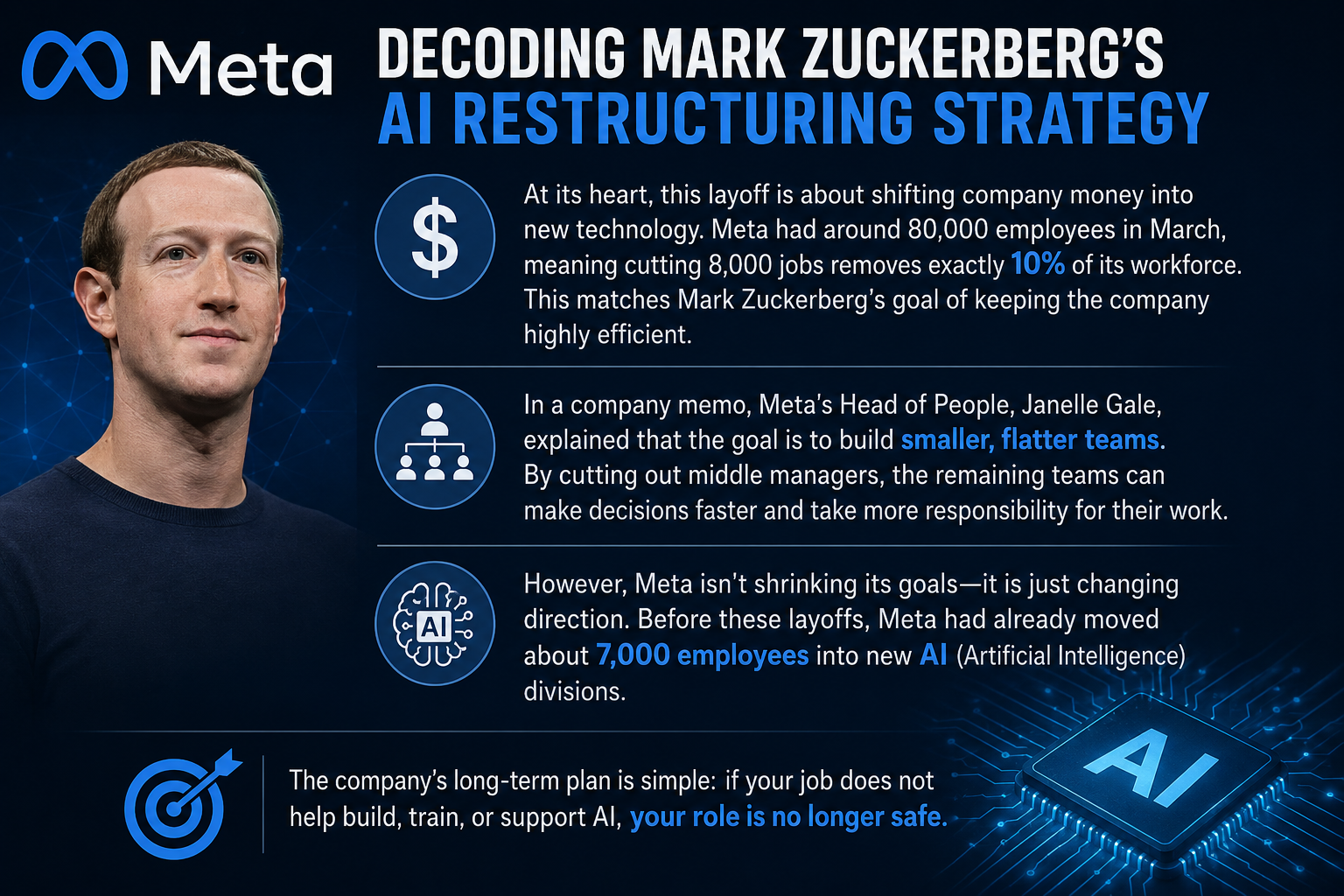
At its heart, this layoff is about shifting company money into new technology. Meta had around 80,000 employees in March, meaning cutting 8,000 jobs removes exactly 10% of its workforce. This matches Mark Zuckerberg’s goal of keeping the company highly efficient.
In a company memo, Meta’s Head of People, Janelle Gale, explained that the goal is to build smaller, flatter teams. By cutting out middle managers, the remaining teams can make decisions faster and take more responsibility for their work.
However, Meta isn’t shrinking its goals—it is just changing direction. Before these layoffs, Meta had already moved about 7,000 employees into new AI (Artificial Intelligence) divisions. The company’s long-term plan is simple: if your job does not help build, train, or support AI, your role is no longer safe.
| Metric | Details of the Restructuring |
| Global Workforce Impact | Approximately 8,000 employees (10% of total staff) |
| Primary Hubs Affected First | Singapore (APAC Headquarters), followed by US and Europe |
| Financial Savings Target | Estimated $3 Billion annually in structural operating costs |
| Projected AI Infrastructure Spending | Up to $145 Billion in capital expenditure for data centers and chips |
| Internal Reallocations | 7,000 workers moved to AI divisions prior to layoffs |
The Financial Paradox: Cutting Personnel to Fund ChipsThe financial dynamics driving Meta’s corporate decisions reveal a fascinating paradox within the modern tech economy. On one hand, Wall Street analysts estimate that eliminating 8,000 full-time positions will save the company approximately $3 billion annually in operational overhead, salary packages, and office space expenses.
On the other hand, Meta’s capital expenditure is projected to skyrocket to unprecedented heights. Industry forecasts suggest that Meta’s aggregate investments in AI infrastructure—specifically advanced Nvidia graphics processing units (GPUs), custom silicon chip design, massive hyper-scale data centers, and the immense electricity grids required to power them—could surge to as much as $145 billion over the coming cycles.
This massive capital migration demonstrates that the financial premium in Silicon Valley has fundamentally shifted. Capital that was once allocated to maintaining large, highly compensated human engineering teams is now being redirected toward acquiring computational power. For tech conglomerates, the path to long-term profitability is no longer viewed through the lens of expanding human capital, but rather through the lens of maximizing algorithmic throughput and large language model (LLM) dominance.
The Controversial Leaked Audio: Are Workers Training Their Replacements?
As if the reality of the layoffs were not disruptive enough for tech workers, a controversial, unverified audio recording purports to feature Mark Zuckerberg discussing the granular mechanics of Meta’s AI development. The viral clip has circulated widely across social media and digital tech forums, igniting an intense, polarized debate surrounding workplace surveillance, employee consent, and the ethics of corporate machine learning.
"We're in a phase where basically the AI models learn from watching really smart people do things."
— Purported excerpt of Mark Zuckerberg from a leaked internal Meta meeting.
The voice in the recording expands on this concept, suggesting that Meta’s internal elite software engineers and data scientists provide an infinitely higher quality of training data for advanced AI models than outsourced third-party data-labeling contractors.
The Surveillance Apparatus
According to corresponding internal leaks and reports regarding Meta’s internal IT infrastructure, the company utilizes highly sophisticated employee-monitoring and productivity-tracking software. This enterprise-grade software quietly captures a continuous stream of workplace activity, including microscopic inputs such as precise keystrokes, application switching, mouse clicks, and cursor movements across employee systems.
The Core Controversy
While background tracking software has existed for decades in the financial and corporate sectors for security compliance and intellectual property protection, its application in the AI era takes on a far more complex dimension. Critics, labor advocates, and tech ethicists argue that if an enterprise tracking system harvests an engineer’s creative problem-solving steps to train an LLM, the boundary between measuring productivity and extracting intellectual labor becomes entirely erased.
The immediate, visceral fear rippling through Meta’s remaining engineering teams is that employees are unknowingly, systematically documenting the exact methodologies required to automate their own positions out of existence. Human expertise, once viewed as the primary value driver of a technology company, is effectively being treated as raw digital material, processed to refine algorithmic systems that operate at a fraction of the long-term cost.
Ethical Implications and the Historical Precedents of Tech Surveillance
Meta’s silence about the leaked audio has only made people talk more. This situation highlights a major shift in how companies value and manage professional office work.
Dr. Srinivas Padmanabhuni, an AI expert and CTO of the tech firm AiEnsured, explained that this is part of an ongoing trend in Big Tech. For over ten years, Silicon Valley companies have gathered user data and digital activity without paying people for it.
Moving from collecting customer data to collecting employee data is the next step for these companies. Dr. Padmanabhuni compared this to older data privacy scandals, like Cambridge Analytica, which focused on tracking user behavior for ads.
Today, data ethics have moved directly into the workplace. If a company can claim user data to train AI, it can easily claim an employee’s daily work code, messages, and problem-solving habits as its own property. Because laws in places like the US still allow companies to monitor employees heavily, workers have very little power to stop it.
Looking Ahead: The Permanent Shift to an AI-Centric Tech Economy
The ongoing developments at Meta are part of a broader, macroeconomic trend sweeping across the global technology ecosystem. Major tech enterprises are systematically shedding headcount in traditional business units—such as legacy ad-tech, localized product support, and regional marketing—while simultaneously engaging in competitive, highly aggressive hiring sprees for specialized AI talent.
The AI Hiring Boom
Even as Meta cuts 8,000 workers, the company’s talent acquisition portals remain open for engineers specializing in:
Autonomous AI agents capable of executing complex workflows.
Hyper-personalized algorithmic recommendation systems for digital media.
Next-generation large language model infrastructure and multimodal systems.
This creates a highly fragmented job market within the tech sector. Generalist software engineers, front-end developers, and middle-tier product managers face an increasingly competitive, contracting job market. Meanwhile, specialized machine learning researchers and infrastructure engineers command historic premiums in compensation and corporate influence.
The Long-Term Outlook
For the broader workforce, the events unfolding at Meta serve as a powerful case study for the future of work in the age of generative automation. The corporate playbook for the modern tech era has been clearly drafted: streamline legacy systems, minimize the long-term liabilities associated with large human workforces, compress organizational hierarchies, and channel the resulting capital savings directly into computational power.
As Meta’s global rolling layoffs continue to filter through offices in the United States and Europe, the tech community is left to grapple with an uncomfortable reality. The software applications running quietly in the background of corporate systems may no longer simply be monitoring daily productivity to ensure accountability—they may well be actively learning the precise methodologies required to replace the humans operating them.