
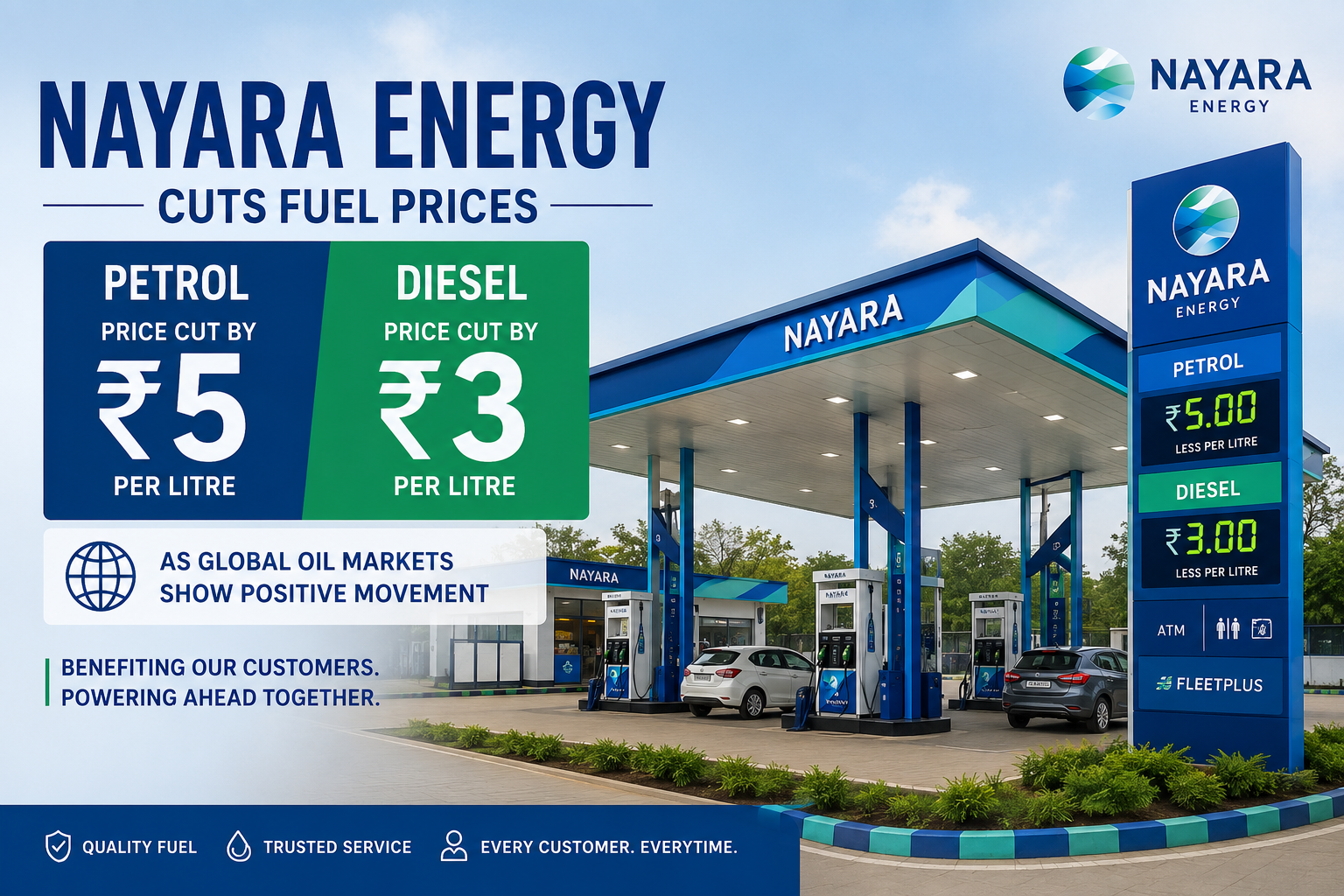
In a massive relief for Indian motorists navigating high fuel costs, major relief has finally arrived at the fuel pumps, albeit from an unexpected quarter. Nayara Energy cuts petrol price by ₹5 per litre and diesel by ₹3 per litre across its entire retail network in India. This surprising development marks the very first reduction in retail automobile fuel prices by any oil marketing company in more than two years, signaling a potential shift in the domestic energy market after months of intense geopolitical volatility.
The strategic price revision went into effect on Wednesday, July 1, 2026, across the private retailer’s expansive network of more than 7,000 fuel stations nationwide. The decision follows a noticeable retreat in international crude oil benchmarks, offering immediate relief to everyday commuters and transport operators who have been grappling with record-high operational expenses.
Why Nayara Energy Cut Fuel Prices: The Global Context
The primary catalyst behind this sudden price drop is the stabilizing situation in West Asia. Over the last several months, energy markets worldwide remained on absolute tenterhooks due to escalating hostilities. This geopolitical friction previously culminated in severe energy supply disruptions, driving international crude prices to dangerous highs.
The Role of Maritime Routes and Easing Tensions
A major factor in cooling down global oil rates has been the reopening of a key maritime route that had previously faced blockades and security threats. The restoration of normal traffic through this crucial channel has effectively revived the smooth flow of both crude oil and liquefied natural gas (LNG) shipments bound for Asian and European markets.
With immediate supply disruption anxieties dissipating, international oil traders have adjusted their risk premiums downward. As global crude rates cooled down over the past couple of weeks, Nayara Energy moved swiftly to pass the financial benefits of lower procurement costs directly down to Indian consumers.
A Contrast to Previous Hikes
Interestingly, this proactive stance is highly characteristic of Nayara Energy’s dynamic pricing model. Back in March 2026, when the intense conflict between Iran and the United States was at its absolute peak, Nayara Energy—which is majority-owned by Russia’s energy giant Rosneft—became the first fuel retailer in India to aggressively hike prices. At that time, they raised petrol by ₹5.30 per litre and diesel by ₹3 per litre due to supply shocks caused by the maritime blockage in the strategic Strait of Hormuz, a critical waterway responsible for carrying nearly one-fifth of the entire global oil supply. Just as they were the first to raise tariffs during a global crunch, they have now become the first to initiate a roll-back as market dynamics stabilize.
State-Owned Fuel Retailers Maintain Status Quo
While customers visiting Nayara outlets can immediately cash in on these savings, the situation remains vastly different across the rest of the country’s fuel infrastructure. Public sector undertakings (PSUs) have chosen to adopt a much more cautious, wait-and-watch approach.
No Revisions from the Big Three: State-owned oil marketing giants, including Indian Oil Corporation (IOC), Bharat Petroleum Corporation Ltd (BPCL), and Hindustan Petroleum Corporation Ltd (HPCL), have kept their retail prices completely unchanged.
Market Monopolization: Together, these three public sector giants control well over 90% of India’s operational fuel retail stations.
The Consumer Impact: Because the state-run firms have refused to match Nayara’s price cut, the vast majority of Indian motorists will still have to pay older, higher rates unless they actively seek out a branded Nayara Energy pump station in their respective localities.
Industry analysts suggest that public sector retailers might be holding back to recoup the massive under-recoveries they faced during the peak periods of the international oil spike earlier this year.
Massive Relief After a Brutal Summer Price Surge
This pricing relief comes right after an incredibly punishing summer season for Indian vehicle owners. The domestic fuel market witnessed a series of compounding price hikes throughout May 2026.
Specifically, on May 25, 2026, domestic petrol and diesel rates shot up by more than ₹2.50 per litre in a single day. When looking at the cumulative revisions spanning from mid-May onwards, retail fuel prices had jumped by nearly ₹7.50 per litre. This extreme rally pushed retail fuel prices to their highest recorded levels in over two years, fanning the flames of retail inflation and driving up the everyday cost of living.
Fortunately, Nayara’s price cut operates in tandem with another major economic relief measure. The commercial sector recently received a massive boost after oil marketing firms officially announced a significant ₹183.50 reduction in the price of 19-kg commercial LPG cylinders. Combined, these twin reductions provide a much-needed breathing room for local businesses, manufacturing logistics, and commercial transport fleets.
Government Rolls Back Auto Fuel Restrictions
In another highly positive development for the country’s broader logistics ecosystem, the Central Government has officially rolled back strict auto fuel curbs starting July 1, 2026.
Timeline of India's Auto Fuel Regulatory Changes (2026)
│
├── June 12: Emergency restrictions implemented due to Strait of Hormuz blockade.
│   └── 200-litre daily diesel limit enforced per vehicle for bulk buyers.
│
└── July 1: Centre completely lifts bulk sales bans and vehicle rationing.
    └── Fuel supply normalized across all private and public retail networks.
The original temporary emergency restrictions were implemented back on June 12, 2026. This was a direct policy response to the severe disruptions in global energy supply caused by military standoffs and subsequent blockades in the Strait of Hormuz. To prevent panic buying and domestic hoarding, the government had implemented a strict 200-litre daily limit per vehicle for diesel purchases, alongside heavy regulatory curbs on state-run oil companies selling auto fuels to large bulk consumers.
According to officials, these temporary measures successfully ensured that sufficient quantities of petrol and diesel remained physically available at retail pumps nationwide, successfully safeguarding civilian consumers from unexpected dry-outs. With supply chains fully restored and Nayara fully prepared after a scheduled refinery turnaround at its massive 20 million-tonne per year oil refinery in Vadinar, Gujarat, the network is running at maximum capacity to satisfy domestic consumption.
Why Local Pump Prices Will Vary Across Indian States
Even though Nayara Energy has mandated a uniform base cut across its corporate network, the final price printed on your fuel bill will inevitably vary depending on where you reside. This regional price disparity boils down to the unique tax structures implemented by different regional administrations.
India’s retail fuel pricing is heavily influenced by localized financial dynamics:
Value-Added Tax (VAT): Every state government levies its own independent VAT or sales tax percentage on petroleum products.
Local Tariffs & Freight Charges: The geographic distance between a city and the nearest oil refinery or supply depot dictates the transportation cost, which is ultimately factored into the final pump price.
Because petroleum products currently sit outside the national Goods and Services Tax (GST) framework, individual state governments retain full autonomy to set local tax percentages, ensuring that fuel remains notably cheaper in certain regions compared to others.
City-Wise Fuel Price Breakdown: July 1, 2026
To give you a clearer perspective on how much fuel costs differ across major urban centers, here is the official breakdown of city-wise prices recorded on Wednesday.
Petrol Prices Across Major Cities
As of July 1, 2026, Hyderabad holds the unfortunate title of being the most expensive metropolitan area to buy fuel in the country.
| Major Indian City | Retail Petrol Price (Rs per Litre) |
| Delhi | ₹102.12 |
| Hyderabad | ₹115.69 |
| Kolkata | ₹113.51 |
| Mumbai | ₹111.21 |
| Chennai | ₹107.76 |
| Bengaluru | ₹111.68 |
| Bhubaneswar | ₹108.97 |
| Gurugram | ₹102.97 |
| Chandigarh | ₹101.54 |
Diesel Prices Across Major Cities
Similarly, commercial transport operators in Hyderabad face the steepest overheads, while commuters in Chandigarh enjoy some of the lowest tariff rates in Northern India.
| Major Indian City | Retail Diesel Price (Rs per Litre) |
| Delhi | ₹95.20 |
| Hyderabad | ₹103.82 |
| Kolkata | ₹99.82 |
| Mumbai | ₹97.83 |
| Chennai | ₹99.55 |
| Bengaluru | ₹99.56 |
| Bhubaneswar | ₹100.68 |
| Gurugram | ₹95.64 |
| Chandigarh | ₹89.47 |
How Consumers Can Maximize Fuel Savings
Since public sector companies (IOC, BPCL, HPCL) haven’t changed their prices, you will need to plan your fuel stops carefully to take advantage of these new lower rates.
Consumer Advisory Note:
Before pulling up to a regular pump station, look closely at the corporate branding. To pocket the direct savings of ₹5 on petrol and ₹3 on diesel, you must specifically locate one of the 7,000+ Nayara Energy outlets distributed across the country.
Because Nayara’s retail footprint is smaller than the government-owned network, these exact savings might not be available in every single tier-3 city or remote rural pocket. However, for motorists living in urban hubs or commuting regularly along major national highways, mapping out a nearby Nayara station could lead to substantial cost reductions over a full monthly fuel budget.
Moving forward, all eyes remain firmly fixed on the public sector fuel marketing boards. Industry experts are waiting to see whether competitive market pressure from private players like Nayara Energy will eventually force the state-run giants to follow suit and drop their retail rates in the coming days.