
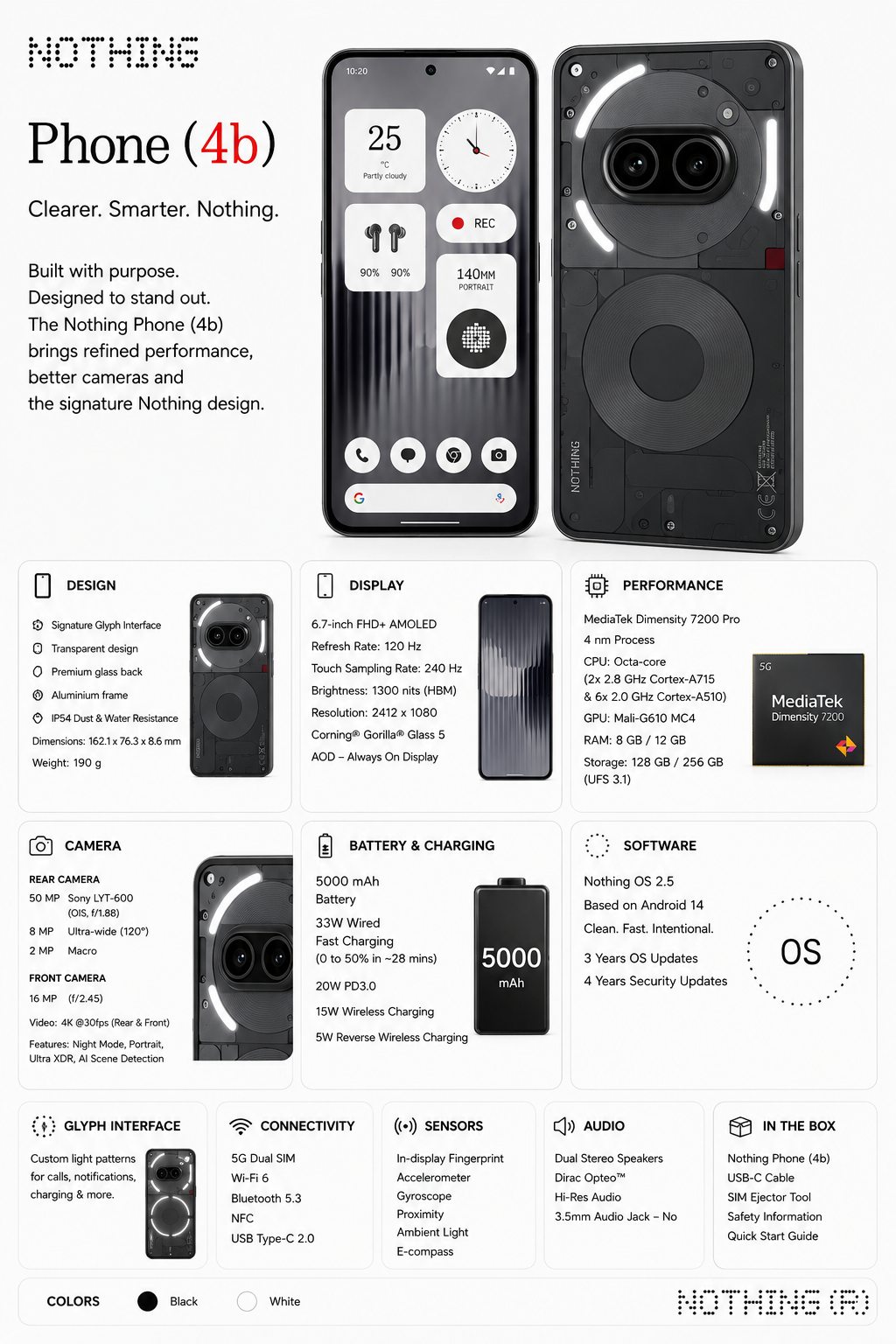
The Nothing Phone (4b) specification details are officially out, sending shockwaves through the mid-range smartphone market. After weeks of subtle hints, technical sketches, and playful teasers, the London-based tech disruptor Nothing has finally pulled back the curtain on its newest creation. This device marks the birth of an entirely new “b” series, tailored specifically to offer a highly premium aesthetic at a significantly lower entry price point.
However, the official announcement comes with a massive twist that has left North American tech enthusiasts thoroughly disappointed. Carl Pei’s venture has explicitly confirmed that this breathtaking piece of hardware will not be launching in the United States or Canada in any capacity. For users across Europe, India, and other global regions, though, the July 7 launch event is shaping up to be one of the most exciting mobile releases of the year.
Let’s dive into a comprehensive, human-centric breakdown of the design choices, internal hardware leaks, global availability, and what makes this phone a fascinating step forward for the brand.
The Design Philosophy: When the 4a Series Meets Minimalist Synergy
Nothing has built its entire brand identity around the art of transparency, and the Phone (4b) doubles down on this ethos with a brilliant hybrid design language. According to the engineering team, the Phone (4b) blends the highly praised unibody construction and crystal-clear camera bump of the premium Phone (4a) Pro with the beloved, simplified Glyph Bar from the standard Phone (4a).
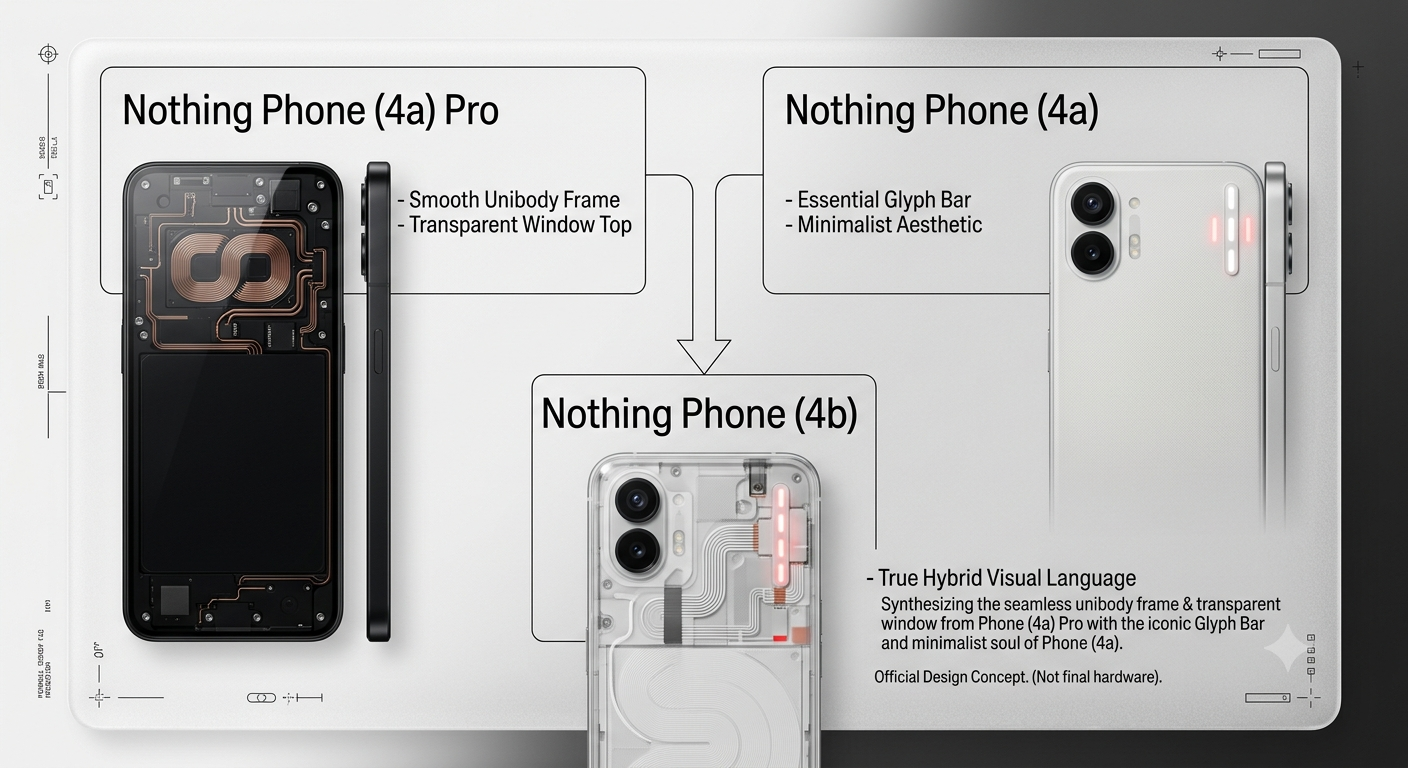
The result is a visually striking, beautifully minimalist rear panel that feels completely smooth and unified in your hand. Unlike older generations that relied on a separate mid-frame and glass sandwich approach, the Phone (4b) features a fluid, seamless transition from the back panel directly into the outer edges.
While Nothing has remained tight-lipped regarding the exact materials used for this unibody frame, reputable industry insiders suggest that it utilizes a highly durable, structurally reinforced polycarbonate finish instead of raw aluminum. This subtle material shift ensures excellent structural integrity and a warm, soft-touch feeling during everyday use while keeping manufacturing costs remarkably low.
Unpacking the Glyph Bar vs. Glyph Matrix
One of the most defining characteristic shifts on the back of the Phone (4b) is the implementation of the classic Glyph Bar over the more expensive Glyph Matrix displays seen on their flagship tier.
Instead of an intricate grid of hundreds of individual, micro-controlled LEDs that can track timers or volume bars progressively, the Phone (4b) utilizes targeted, solid LED light strips. This design choice strips away unnecessary complexity while preserving the core functionality that users love:
Visual Ringtone Sync: The lighting patterns blink in perfect harmony with Nothing’s custom, localized 8-bit ringtones.
Essential Notifications: A dedicated strip can remain lit up silently to let you know when a high-priority contact or application has sent a notification.
Flip to Glyph: Placing the phone face down on a desk automatically silences the ringtone, switching the device to an elegant, non-intrusive light-only notification mode.
The layout itself features a distinct, horizontal camera plateau near the top of the device. On the left side of this plateau sits a vertically aligned dual-camera housing, while the functional Glyph Bar is placed vertically on the right side, creating a beautifully balanced, geometric ecosystem.
Nothing Phone (4b) Specification Details: The Leaked Internal Hardware
While the company’s official teasers focused heavily on aesthetics, a series of massive benchmark listings and supply chain leaks via trusted tipster Yogesh Brar have given us an incredibly clear picture of the silicon driving this smartphone.
Hardware Component | Expected Technical Specifications |
Processor | Qualcomm Snapdragon 6 Gen 4 (4nm Architecture) |
Graphics Processing Unit | Adreno 810 |
Display Panel | 6.7-inch Flexible AMOLED, 120Hz Refresh Rate |
Screen Resolution | 1.5K Crisp Pixel Density |
Primary Rear Camera | 50 Megapixel Sony LYT-710 with Optical Image Stabilization (OIS) |
Secondary Rear Camera | Ultra-Wide Angle Sensor |
Front Selfie Camera | 32 Megapixel Center Punch-Hole |
Battery Capacity | 5,400 mAh High-Density Lithium-Polymer |
Wired Charging Speed | 50W Fast Charging Support |
RAM Configurations | 8GB LPDDR5X |
Storage Configurations | 128GB / 256GB UFS 3.1 |
Operating System | Nothing OS based on Android |
The Powerhouse Core: Snapdragon 6 Gen 4
At the center of the Nothing Phone (4b) sits Qualcomm’s highly efficient Snapdragon 6 Gen 4 processor. Built on an advanced 4-nanometer node process, this platform strikes a magnificent balance between casual gaming performance and hyper-optimized power saving. Paired with 8GB of fast LPDDR5X RAM, multitasking through social apps, heavy web browsing, and multi-layered productivity tasks will feel incredibly snappy.
A Cinematic 120Hz AMOLED Screen
Up front, the Phone (4b) refuses to compromise. It boasts a stunning 6.7-inch AMOLED display capable of pushing a smooth 120Hz refresh rate. Thanks to the underlying AMOLED technology, users can look forward to infinitely deep black levels, vibrant color accuracy, and excellent sunlight legibility. The transition to a sharp 1.5K resolution ensures that text, mobile videos, and interface elements appear perfectly crisp without draining the battery like a traditional 4K display.
Camera Capabilities: High Megapixels Meet Smart Processing
Nothing has simplified the rear camera module to focus entirely on quality over quantity. Rather than padding out the spec sheet with useless 2MP macro or depth lenses, the Phone (4b) utilizes a clean, effective dual-camera configuration.
The main star of the show is a 50 Megapixel primary camera sensor, heavily tipped to be the Sony LYT-710. This sensor comes equipped with physical Optical Image Stabilization (OIS), a feature that is frequently omitted in budget-conscious devices. OIS mechanically counteracts the natural shaking of your hands, allowing the shutter to remain open longer in low-light environments without introducing blurry motion artifacts.
The primary sensor is accompanied by an ultra-wide secondary camera, allowing you to capture sweeping landscape photography or cramped group shots without having to awkwardly step backward. On the front, a 32 Megapixel selfie camera is neatly integrated into a centered punch-hole cutout, handling high-definition video calls and social media content creation effortlessly.
Monstrous Endurance: The 5,400mAh Battery
If there is one specific area where the Nothing Phone (4b) completely eclipses its more expensive siblings, it is absolute longevity. The engineering blueprints reveal that Nothing has managed to pack a massive 5,400mAh battery into the chassis.
When you combine a massive physical battery cell with the hyper-efficient, 4nm architecture of the Snapdragon 6 Gen 4 chipset, the real-world battery performance is bound to be legendary. Casual users can easily look forward to a comfortable two days of usage on a single charge.
When you do finally run out of juice, the device supports 50W wired fast charging, allowing you to top up the massive cell from zero to roughly 60% in just over half an hour. To cut down costs and keep the price aggressive, wireless charging has been omitted from this specific model.
The Big Letdown: Why is the Nothing Phone (4b) Skipping the US?
For North American fans of transparent tech, the reality is bittersweet. Nothing has officially confirmed that the Phone (4b) will not launch in North America, completely removing the United States and Canada from its retail distribution map.
This decision boils down to the incredibly complex, expensive, and restrictive nature of the US carrier market. In North America, the vast majority of consumers purchase their smartphones directly through network operators like T-Mobile, Verizon, and AT&T via monthly installment plans. For an independent brand to list a device on these carrier shelves, it must undergo millions of dollars worth of custom lab testing, regulatory certifications, and specific band optimization.
Because the “b” series is designed to operate on razor-thin profit margins as an affordable ecosystem entry point, absorbing those massive US carrier certification fees simply didn’t make financial sense for Nothing. The company is strategically focusing its resources on markets like India, Europe, and parts of Asia, where unlocked, carrier-free smartphone sales are the absolute norm.
Software Longevity: Nothing OS Meets Android
Software has always been a monumental strong suit for Nothing, and the Phone (4b) continues that legacy out of the box. The device runs the latest iteration of Nothing OS, built on top of a clean, bloatware-free Android framework.
The custom skin strips away the annoying duplicate apps and aggressive background tracking found on rival budget interfaces, replacing them with a gorgeous, stylized aesthetic featuring dot-matrix fonts, custom interactive widgets, and highly cohesive monochrome icon packs.
Furthermore, Nothing is promising an incredibly robust support timeline for a budget device: 3 years of major Android operating system updates alongside 5 years of consistent security patches. This level of long-term commitment ensures that your smartphone remains fully secure and packed with modern software features for half a decade.
Launch Timeline, Color Variations, and Pricing Expectations
The official global launch event is locked in for July 7 at 4:00 PM IST (11:00 AM BST). Nothing will be hosting a comprehensive YouTube livestream to showcase the final software features and retail packages.
       [ GLOBAL LAUNCH TIMELINE - JULY 7 ]
  -----------------------------------------------
   11:00 AM BST              | London Time
   04:00 PM IST              | Indian Standard Time
  -----------------------------------------------
In terms of aesthetics, Nothing is straying slightly from its rigid black-and-white color palette. The Phone (4b) will officially launch in three distinct color variants:
Classic Dark Black: For those who prefer a stealthy, mechanical look.
Minimalist Clean White: The quintessential, bright Nothing look.
Light Blue Finish: A stunning, vibrant pastel blue that beautifully showcases the internal geometric shielding and components under the clear unibody shell.
The phone will be sold globally in two distinct memory and storage tiers:
8GB RAM + 128GB Internal Storage
8GB RAM + 256GB Internal Storage
While final retail numbers will be revealed on stage, early industry indicators point to an incredibly aggressive pricing structure. The device is expected to launch underneath the pricing umbrella of the current Nothing Phone (4a), with a projected price tag hovering around ₹29,999 in India (approximately £285 / €335). This places it squarely in competition with mid-range giants from Poco, Redmi, and Samsung, giving budget buyers a drastically more stylish option.
Final Thoughts: A Generational Shift for Tech Enthusiasts
The Nothing Phone (4b) represents a crucial pivot point for the tech brand. By abandoning plans for sub-brand iterations like a new CMF phone, Carl Pei’s team is consolidating their focus back onto the core Nothing ecosystem. They are proving that a budget-conscious smartphone doesn’t have to look generic, feel cheap, or ship with compromised software longevity.
While the lack of a North American release is a tough pill to swallow for western fans, the sheer value packed into the Nothing Phone (4b) specification details makes it an absolute triumph for the global mid-range landscape. If you live in an eligible region and are looking to upgrade your mobile setup this July without breaking the bank, this gorgeous piece of hardware deserves a spot at the absolute top of your shopping list.