
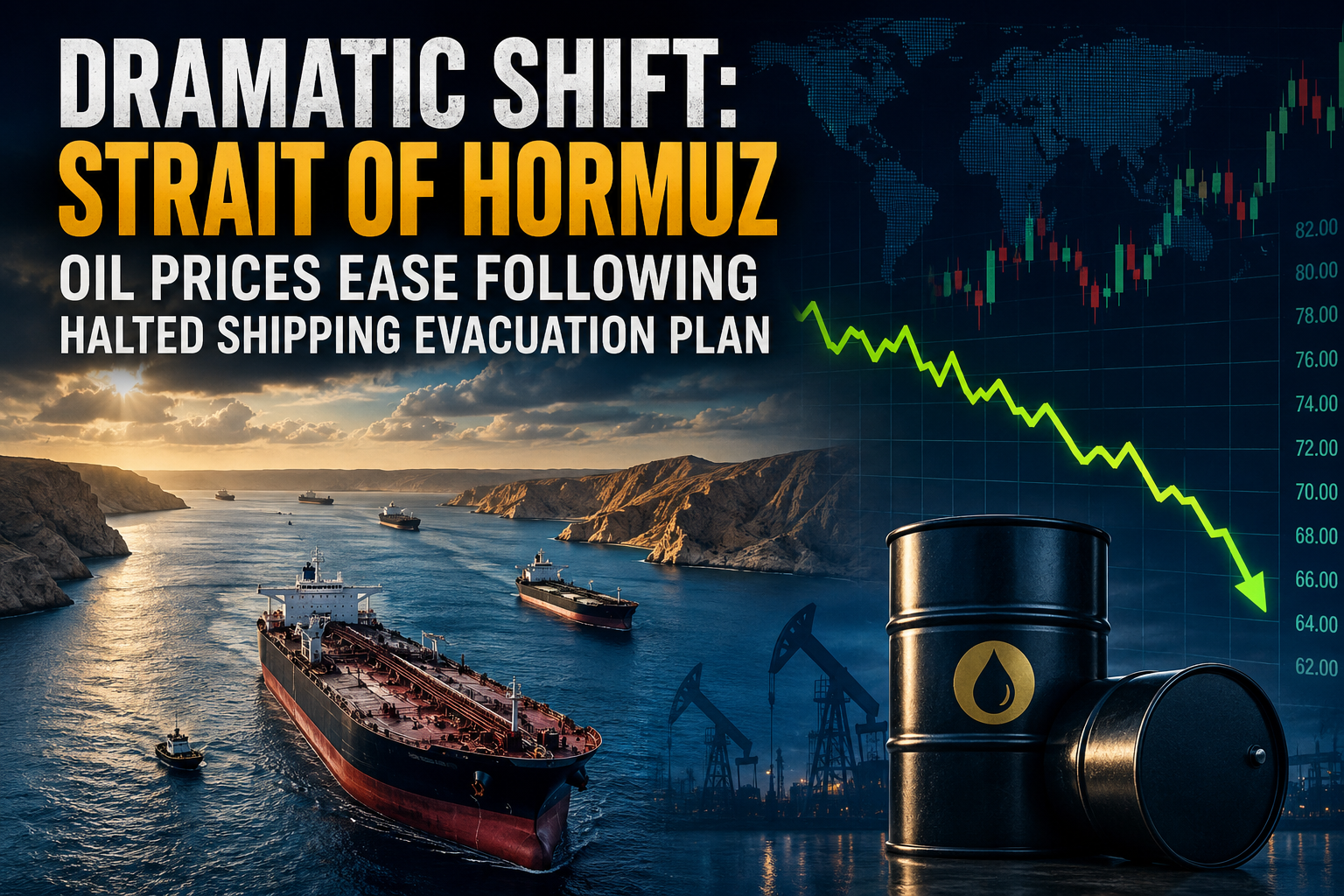
The global energy market faced another tumultuous day as Strait of Hormuz oil prices experienced wild fluctuations following an abrupt pause in an international shipping evacuation plan. Investors and energy analysts worldwide watched in real-time as a sudden surge in crude prices gave way to a modest retreat on Friday. The market’s volatility underscores the ongoing fragility of the West Asia peace process, even as major world powers attempt to stabilize one of the planet’s most critical maritime choke points.
Early trading sessions saw international benchmark Brent crude jump by as much as 4 percent. This sudden spike was triggered directly by the International Maritime Organization’s (IMO) decision to immediately halt its coordinated effort to safely evacuate stranded cargo ships from the strategic waterway. However, as the initial shock subsided, those gains eroded. By mid-day, Brent futures for August delivery settled down 1.80 percent at $74.11 per barrel, pulling back from an intraday high that had breached the $76 mark just a day prior.
The Catalyst Behind the Sudden Maritime Shockwave
The sudden reversal in market sentiment traces its roots directly to a fresh security incident within the critical shipping lane. The IMO made its high-stakes decision to suspend the evacuation initiative after a commercial cargo vessel reported being struck by an “unknown projectile.” According to maritime reports, the attack took place near the Omani coast as the ship attempted to traverse the narrow passage.
This sudden outbreak of violence sent shockwaves through regional tracking networks. Just days prior, optimism had been growing regarding a return to normal commercial operations. On Wednesday, shipping tracking platforms MarineTraffic and Kpler documented that 70 vessels successfully transited the waterway. This marked a more than twofold increase from the previous day and represented the highest concentrated daily traffic volume recorded since March 1. The projectile strike effectively shattered those brief hopes of immediate normalization, reminding traders that the threat of disruption remains incredibly high.
Asian Markets Bleed Amid Geopolitical Anxiety
The ripple effects of the maritime incident immediately registered across major global financial hubs, with Asian equity markets bearing the brunt of the initial panic. Investors reacted to the risk of a renewed energy crunch by liquidating positions in highly sensitive tech and manufacturing indices.
Seoul’s Kospi: As the best-performing major index globally this year, the South Korean benchmark suffered a staggering 8 percent drop by 05:00 GMT.
Tokyo’s Nikkei 225: Japan’s primary index plummeted by approximately 4.6 percent as energy security concerns gripped the import-dependent nation.
Taipei’s Taiex: Taiwan’s flagship index shed more than 3 percent during a volatile trading session.
Hong Kong’s Hang Seng: The index slid 1.9 percent into the red, reflecting widespread regional caution.
Financial analysts noted that the sharp sell-offs were reflective of a broader fear: that any prolonged closure or security degradation in the strait could trigger an inflationary spiral across Asian supply chains.
Rhetoric Escalates as US and Iran Trade Blame
Behind the physical volatility in the shipping lanes lies a highly complex diplomatic standoff. United States intelligence and defense officials moved quickly to attribute the cargo ship attack to Iranian forces, a claim that has been widely circulated by major international news outlets including The New York Times, CBS News, and Reuters.
Concurrently, Iran’s Persian Gulf Strait Authority issued a stern public warning via the social media platform X. The regional authority asserted its absolute right to regulate shipping within the corridor, explicitly stating that any maritime vessel attempting to use shipping routes outside of its officially designated “framework” would no longer be guaranteed safe passage.
“The consequences arising from passage through unauthorized routes shall be the responsibility of the owner, operator, and vessel commander,” the Iranian authority warned.
Further complicating matters, Iran’s Revolutionary Guards reinforced this stance on Thursday, June 25, 2026. They cautioned against any unsanctioned crossings of the waterway, promising that non-compliant vessels “will be dealt with.” The military branch additionally denounced an alternative route through the strait that had been publicized by unnamed “certain authorities.”
Diplomatic Maneuvers: Marco Rubio Warns of ‘Total Chaos’
As the maritime situation deteriorated, diplomatic efforts intensified across the Gulf region. U.S. Secretary of State Marco Rubio traveled to Bahrain to attend an emergency meeting with the Gulf Cooperation Council (GCC). Addressing the media from the summit, Rubio delivered a stark warning regarding Iran’s attempt to impose unilateral oversight and financial tolls on commercial shipping.
According to Rubio, allowing Iran to enforce arbitrary tolls within the Strait of Hormuz would establish a dangerous global precedent. He warned that such practices would inevitably spread to other vital international waterways, risking “total chaos” for global commerce. Despite the harsh rhetoric, the Secretary of State emphasized that the United States remains firmly open to achieving a “real, enduring” peace in the region. However, he clarified that any potential agreement must not undermine the long-term security and economic prosperity of the United States and its regional allies.
This diplomatic friction comes on the heels of a highly controversial memorandum of understanding signed between Washington and Tehran just last week. While that initial agreement was designed to bring a formal end to nearly four months of intense warfare—causing Brent crude prices to drop sharply at the time—the latest incident proves that the path to absolute peace is filled with obstacles. Currently, Brent crude is hovering roughly 2 percent above its pre-conflict baseline.
Fragile Ceasefires Under Strain Across the Region
The volatility surrounding the shipping lanes cannot be viewed in isolation; it is deeply intertwined with broader regional conflicts that continue to test signed ceasefires. Beyond the immediate waters of the Gulf, friction between Israeli forces and Hezbollah in Lebanon is further complicating the geopolitical landscape.
On Thursday, June 25, 2026, senior Israeli and Lebanese officials publicly denied reports that an Israeli military withdrawal from occupied southern Lebanon had occurred. The denials followed statements from an anonymous U.S. official who had suggested that Israel pulled back a portion of its troops as a good-faith gesture toward the Lebanese government.
Almost simultaneously, the Iran-backed political and military group Hezbollah accused Israel of executing a “flagrant” violation of their current ceasefire agreement. Hezbollah spokespersons alleged that an Israeli drone strike in southern Lebanon targeted and killed three civilians. While Hezbollah classified the event as a direct, unprovoked attack on non-combatants, the Israeli military countered by stating that the strike successfully targeted and neutralized active Hezbollah combatants. This exchange marks what Hezbollah claims is the third major structural breach of the ceasefire by Israel since its implementation.
Analytical Outlook: What Lies Ahead for Global Crude Supply?
Market experts believe that the current stabilization of crude prices is temporary, masking a deep underlying anxiety among major energy buyers. The Strait of Hormuz is widely regarded as the single most critical maritime artery for the global energy industry. In peacetime, roughly one-fifth of the world’s total supply of petroleum and liquefied natural gas (LNG) transits through this narrow body of water.
June Goh, a senior oil market analyst at Sparta in Singapore, provided insight into how trading desks are interpreting these rapid-fire developments. Goh emphasized that the projectile attack serves as an abrupt reality check for energy markets, reminding participants of just how fragile the current U.S.-Iran ceasefire truly is.
According to Goh, the physical logistics of oil production are reaching a critical bottleneck. There is an urgent, pressing need for large commercial tankers to safely enter the region and offload the immense crude stocks currently sitting in onshore storage tanks. Until these high stockpiles are drawn down and transported to global markets, normal upstream oil production cannot safely or efficiently resume in West Asia.
Moving forward, the direction of global oil benchmarks will likely depend on whether the IMO feels secure enough to resume its shipping evacuation plan, and whether the U.S.-Iran memorandum of understanding can withstand these localized acts of aggression. For now, energy markets remain on a knife-edge, balanced precariously between diplomatic hope and tactical reality.