
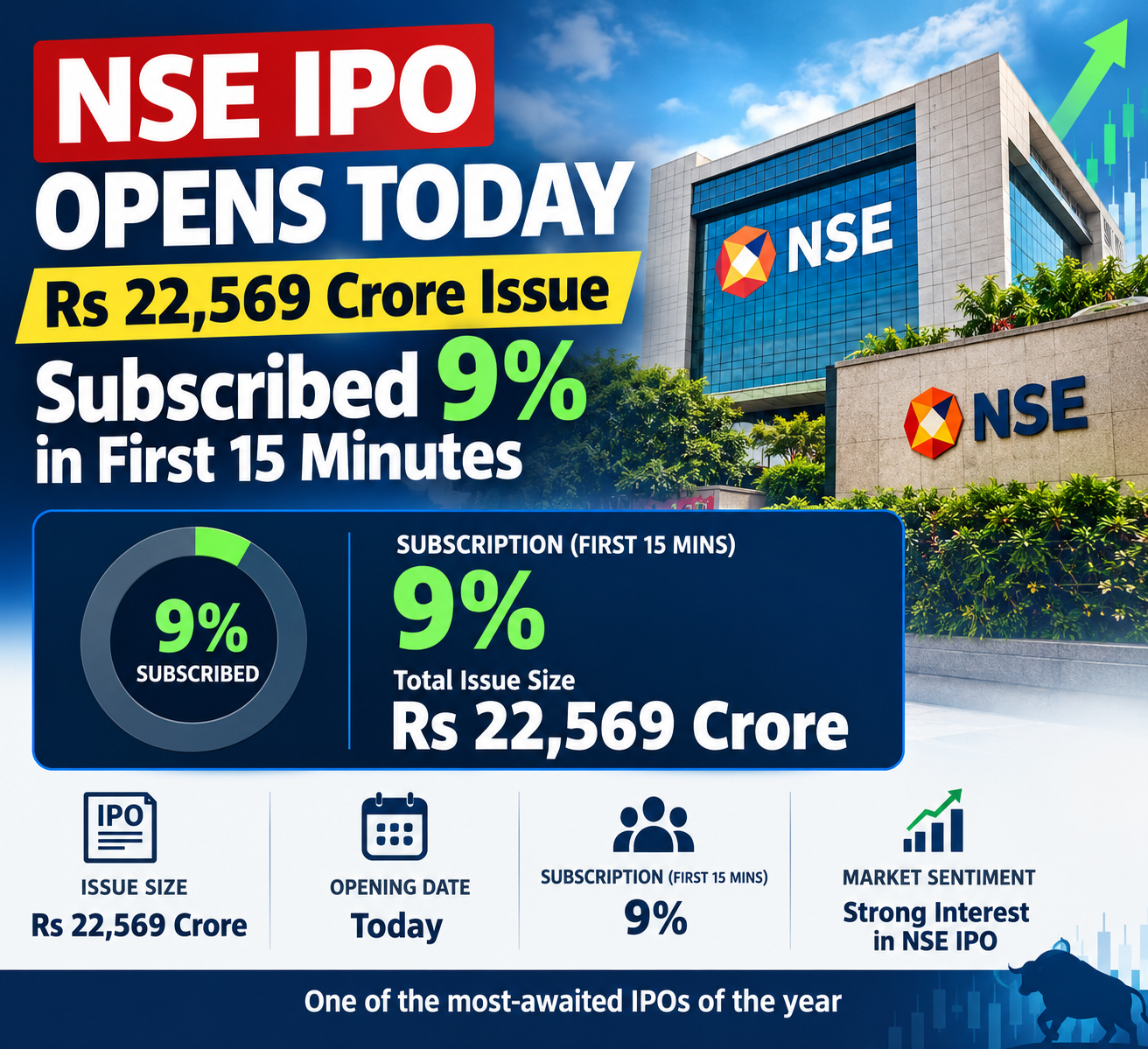
NSE IPO opens for subscription today as India’s premier stock exchange launches its historic Rs 22,569 crore initial public offering. Bidding for the public issue began at 10:00 AM on Thursday, September 17, 2026, and saw rapid investor interest, getting 9% subscribed within the first 15 minutes of trading. This flagship public issue stands as the country’s third-largest IPO to date, positioning the National Stock Exchange among the top ten largest listed exchanges globally by valuation.
Before the public opening, the exchange raised Rs 6,746.2 crore from leading institutional investors through its anchor book placement. Flagship domestic institutions like the Life Insurance Corporation of India (LIC) joined international funds including Abu Dhabi Investment Authority (ADIA), Fidelity, Monetary Authority of Singapore, and Government Pension Fund Global to secure stakes.
Key Overview of the NSE IPO
| Parameter | Details |
| Issue Window | September 17, 2026 – September 21, 2026 |
| Price Band | Rs 1,700 to Rs 1,785 per equity share |
| Issue Size | Rs 22,569 crore (100% Offer for Sale) |
| Valuation at Upper Cap | ~Rs 4.42 lakh crore |
| Tentative Allotment Date | Tuesday, September 22, 2026 |
| Tentative Listing Date | Thursday, September 24, 2026 |
| Implied P/E Ratio | ~42.9x (FY26 earnings) |
10 Core Highlights Every Investor Must Track
1. Subscription Timeline
The three-day subscription window remains open from September 17 through September 21. Bidding closes at 5:00 PM on the final day for retail and institutional applicants.
2. Official Price Band
The company set its price band at Rs 1,700 to Rs 1,785 per share. Retail applicants can bid in defined lot sizes corresponding to the upper band.
3. Share Allotment Schedule
Basis of allotment finalisation is scheduled for Tuesday, September 22. Unsuccessful bidders will see refund initiations on the following working day.
4. Scheduled Listing Date
The shares will debut on the primary market on Thursday, September 24, making it one of the most anticipated listings of the year.
5. Latest Grey Market Premium (GMP) Trend
Unofficial market trackers report grey market premiums ranging between 8.96% and 9.08%. Investorgain reported a premium of Rs 162 per share, signaling potential listing gains around Rs 1,947 per share.
6. Strong Anchor Book Backing
Marquee global and domestic investors participated heavily in the anchor placement. Primary backers include LIC, HDFC Life, Nippon Life, Fidelity, ADIA, and the Monetary Authority of Singapore.
7. Massive Enterprise Valuation
At the upper price band threshold of Rs 1,785, the exchange commands a total market capitalization of roughly Rs 4.42 lakh crore.
8. Pure Offer for Sale Structure
The entire Rs 22,569 crore offering consists of an Offer for Sale (OFS) by 23 existing equity holders, meaning zero capital raised will flow into the exchange’s balance sheet.
9. Steady Growth Metrics
NSE continues to expand its market footprint across core operations:
Listed Entities: Expanded to 3,005 in Q1 FY27, up from 2,978 in FY26 and 2,719 in FY25.
Market Capitalisation: Total value of listed companies reached Rs 474 lakh crore in Q1 FY27.
Passive Investments: Assets under management for Nifty-indexed passive funds rose to Rs 9 lakh crore.
10. Brokerage Ratings and Advice
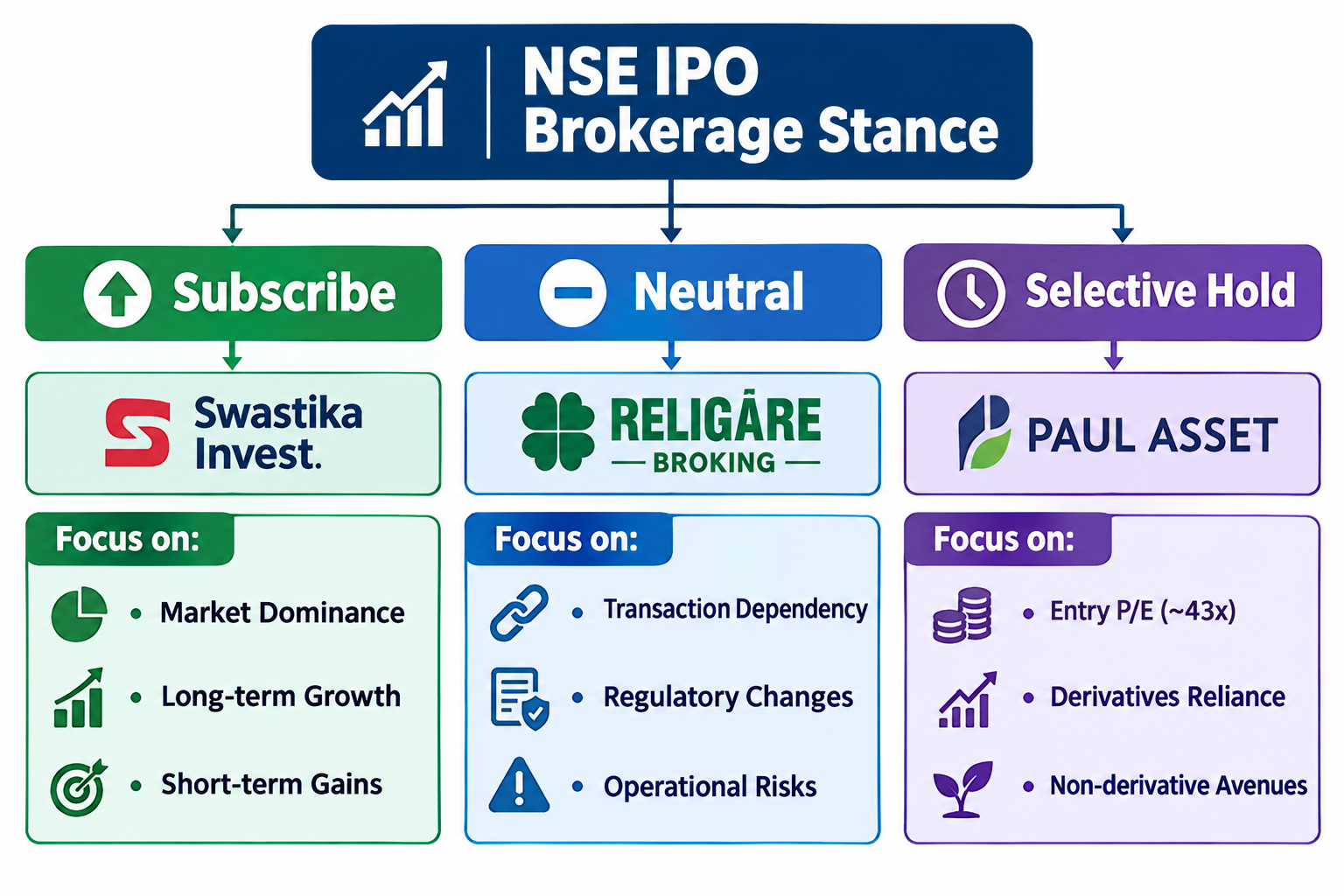
Swastika Investment: Recommends a ‘Subscribe’ rating, citing dominant market presence— holding nearly 93% share in cash markets and 99.8% in equity futures.
Religare Broking: Maintains a ‘Neutral’ stance, highlighting reliance on options transaction fees, regulatory exposure, and technology outage risks.
Paul Asset Management: Points out that at 42.9x FY26 earnings, valuation is reasonable compared to BSE’s 53x, but notes that future returns depend on diversifying away from pure options income into areas like GIFT City and data index solutions.
Pros vs. Cons Summary
Strengths:
High entry barriers and deep network effects in clearing and settlement.
Strong operating cash flow generation with high profit margins.
Attractive relative valuation compared to listed peers.
Risks:
Heavy earnings sensitivity to options volume and retail turnover.
Vulnerability to shifting regulatory policies on leverage and derivatives.
Single-point operational risk tied to core matching-engine infrastructure.
Disclaimer: Stock market investments and IPO subscriptions carry inherent risk. Financial details presented here are for informational purposes only. Consult a registered financial adviser before making investment decisions.