
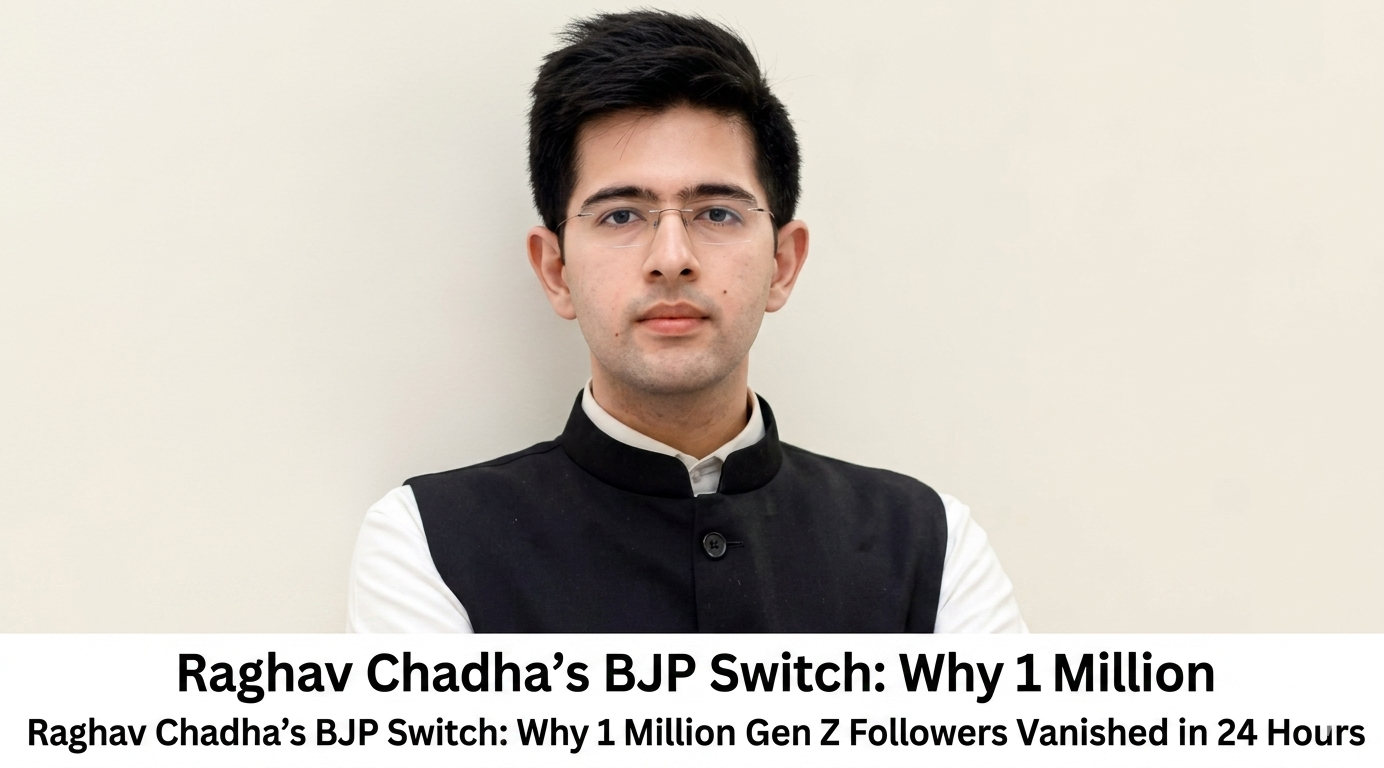
Raghav Chadha’s BJP Switch : The Indian political landscape witnessed a seismic shift this week, but the real explosion didn’t happen in the corridors of Parliament—it happened on Instagram. In a move that has left political pundits and digital strategists reeling, Raghav Chadha, the poster boy for “new-age politics,” officially jumped ship from the Aam Aadmi Party (AAP) to the Bharatiya Janata Party (BJP).
While floor-crossing is an old game in Indian democracy, the reaction from the youth has been unprecedented. Within 24 hours of his announcement, Chadha’s follower count plummeted by a staggering 1 million. This isn’t just a digital glitch; it is the “Gen Z Effect” in full force, proving that for the younger generation, political loyalty is built on brand authenticity, and perceived “betrayal” carries a heavy price.
Raghav Chadha’s BJP Switch The Shocking Exodus: By the Numbers
Data is the ultimate truth-teller in the digital age. On Friday, Raghav Chadha sat comfortably with 14.6 million followers. By Saturday afternoon, that number had crashed to 13.5 million.
A loss of 10 lakh followers in a single day is nearly unheard of for an Indian politician. To put this into perspective, most politicians spend years and crores of rupees in digital marketing to gain that kind of reach. This mass “unfollow” campaign, trending under the hashtag #UnfollowRaghavChadha, signals a deep disconnect between Chadha’s strategic move and the expectations of his core audience.
Why Gen Z Feels Betrayed
Raghav Chadha wasn’t just another MP; he was a vibe. At 37, suave, articulate, and married to Bollywood star Parineeti Chopra, he bridged the gap between serious policy-making and pop culture.
Unlike veteran leaders who stick to grand ideological speeches, Chadha built his brand on relatability. He tackled issues that actually bothered young Indians:
Gig Economy Advocacy: He famously worked as a Blinkit delivery partner for a day to highlight the plight of delivery agents.
The “Samosa” Politics: He spoke about the exorbitant prices of snacks at airports.
Digital Rights: He campaigned for daily data limit transparency.
Paternity Leave: He pushed for modern family values in a traditionally patriarchal political setup.
By moving to the BJP—a party he spent years vocally criticizing—Chadha has, in the eyes of his followers, transitioned from a “disruptor” to just another “politician.
Perhaps what hurt his digital credibility the most was the sudden “cleanup” of his social media. Reports suggest that Chadha deleted hundreds of old posts that were critical of Prime Minister Narendra Modi and the BJP.
Senior AAP leader Saurabh Bhardwaj was quick to point out that only two posts mentioning “Modi” remain on Chadha’s timeline—and both are now in high praise of the PM. For a generation that values “receipts” and digital footprints, this attempt to rewrite history felt like an insult to their intelligence.
“The internet can make you a hero overnight. The internet can also bring you down to zero overnight,” noted NCP (SP) spokesperson Anish Gawande.
The Anna Hazare Intervention: A Moral Blow?
Adding fuel to the fire, veteran activist Anna Hazare weighed in on the exit. Hazare, who was the mentor to the original India Against Corruption movement that birthed AAP, didn’t hold back.
While Hazare acknowledged that everyone has the right to choose their path in a democracy, he pointed a finger at the internal rot of the party system. He suggested that if the AAP leadership had remained on the “right path,” leaders like Chadha wouldn’t have felt the need to leave.
However, Chadha’s own justification—citing corruption within AAP—has been met with skepticism. The timing of his move, coming shortly after he was stripped of his deputy leadership role in the Rajya Sabha, makes the switch look more like a calculated survival tactic than a moral crusade.
7 Key Takeaways from the Chadha-BJP Merger
The Two-Thirds Rule: Chadha didn’t go alone. He took six other AAP MPs with him, effectively splitting the party’s strength in the Rajya Sabha.
Corruption Allegations: Chadha claims AAP has moved away from its “honest” roots, a claim AAP calls a “betrayal of Punjab.”
The “Gen Z Party” That Never Was: Only weeks ago, fans suggested Chadha start his own youth-centric party. He called it an “interesting thought” but ultimately chose the established machinery of the BJP.
Influence vs. Power: While he gained political power by joining the ruling party, his “influencer” status has taken a massive hit.
High-Profile Unfollows: Even celebrities and achievers, like record-breaking mountaineer Rohtash Khileri, joined the unfollow movement.
The Parineeti Factor: His marriage to Parineeti Chopra had given him a “glamour quotient” that resonated beyond politics, making this fall from grace even more public.
The “Scripted” Narrative: Chadha previously called his removal from AAP roles a “scripted campaign,” but critics now argue his move to BJP was the ultimate scripted finale.
Can the “Data-Driven” Politician Script a Turnaround?
Raghav Chadha has always prided himself on being a data-driven leader. He understands algorithms as well as he understands policy. Now, he faces his greatest challenge: rebranding.
The BJP offers him a massive platform and the chance to be part of the national decision-making core. However, the 1 million followers he lost represent the “swing voters” of the future—young, independent-minded individuals who aren’t tied to any one party’s ideology but are tied to authenticity.
As the dust settles on this political shake-up, one thing is clear: In 2026, you can change your party, you can change your ideology, but you cannot hide from the “Unfollow” button. Raghav Chadha has gained a seat at the BJP table, but he has lost the digital throne he spent a decade building.
Will he be able to win back the Gen Z hearts he lost? Only time—and perhaps a very clever new social media strategy—will tell.