
MUMBAI, July 14 – The Rupee USD Exchange Rate Volatility weakened sharply on Tuesday, slipping past the psychologically important 96-mark against the US dollar, as a fresh flare-up in West Asia geopolitical tensions pushed global crude oil prices higher.
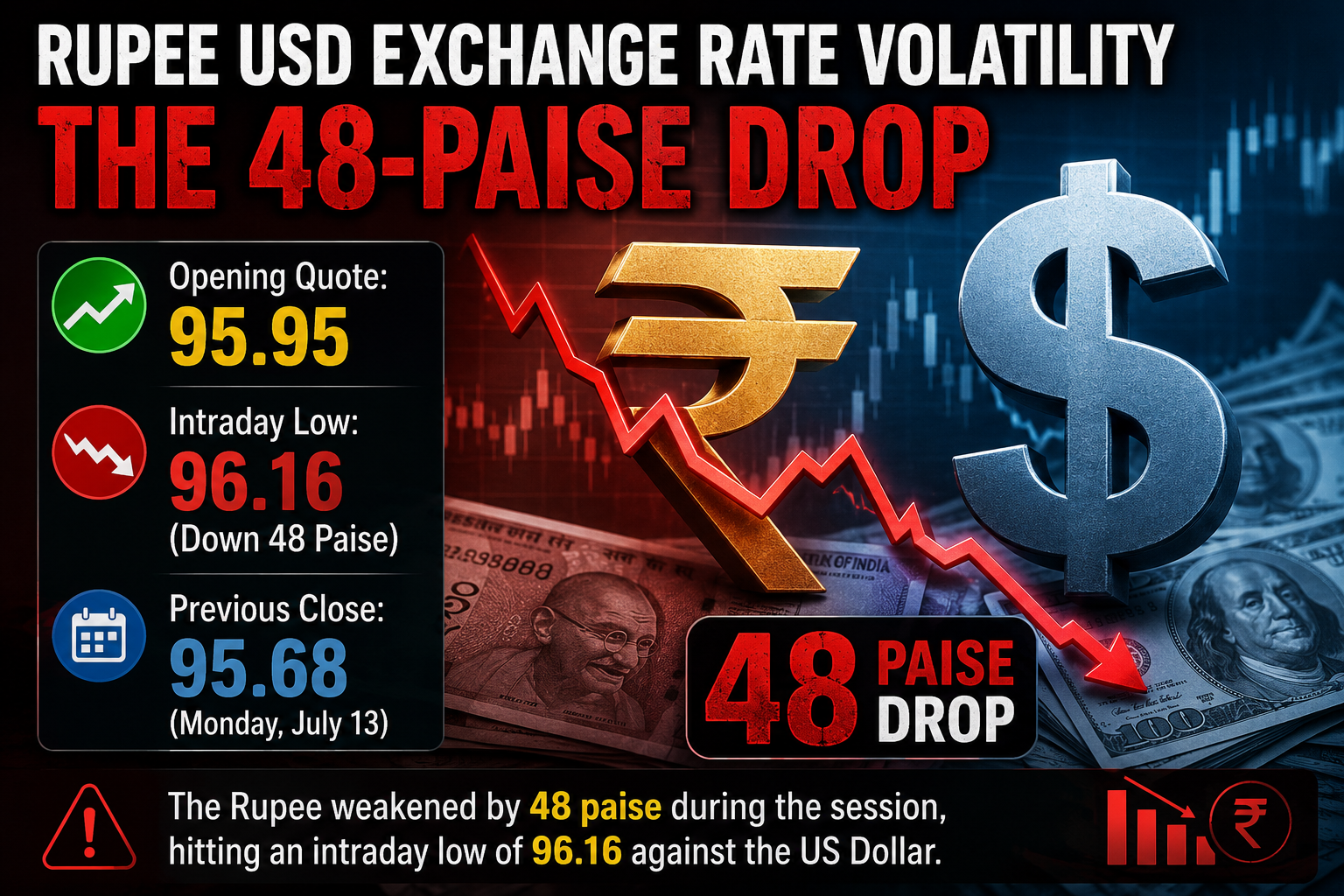
The domestic currency opened at 95.95 and hit an intraday low of 96.16 in early trade, down 48 paise from Monday’s close of 95.68. Forex dealers in Mumbai reported heavy dollar demand from state-run oil marketing companies, which quickly overwhelmed the mild capital inflows seen earlier this month.
Monday’s session had already seen the rupee slide by 30 paise, reflecting how quickly emerging market currencies are reacting to the changing risk environment.
USD/INR INTRADAY SNAPSHOT (JULY 14, 2026)
─────────────────────────────────────────────
▶ Opening Quote: 95.95
▶ Intraday Low: 96.16 (Down 48 Paise)
▶ Previous Close: 95.68 (Monday, July 13)
The Oil Trigger and Strait of Hormuz Risks
The primary catalyst for Tuesday’s slide was the sudden rise in international energy benchmarks. Following the US administration’s announcement to terminate its ceasefire agreement with Iran, Brent crude futures surged 2.02% to $84.98 per barrel.
Because India imports over 80% of its crude requirements, a sustained run-up in oil prices puts direct pressure on the country’s trade balance.
“India being a major oil importer, higher crude prices remain fundamentally negative for the rupee,” said Anil Kumar Bhansali, Head of Treasury and Executive Director at Finrex Treasury Advisors LLP. He added that rising oil import bills are raising immediate concerns about the country’s current account trajectory.
Underlying Trade Pressures
While geopolitical developments acted as the immediate trigger, the rupee has been under structural pressure since late June due to a widening trade gap.
According to recent government data, India’s merchandise imports for June scaled to $70 billion, driven heavily by electronics and defense procurements, while exports stagnated at $40 billion. This left a massive $30 billion monthly trade deficit, creating a constant structural demand for physical dollars in the interbank market.
Furthermore, secondary capital buffers like Non-Resident Indian (NRI) deposits have slowed down. Bankers attribute this to several international policy headwinds:
A new 1% administrative tax on outbound remittances implemented in the US.
High tax rates (ranging between 40% and 45%) on global income for UK-based NRIs.
A narrowing yield spread between Indian bank deposits and global interest rates, which has reduced the arbitrage incentive for overseas depositors.
RBI’s Reserve-Building Strategy
Interestingly, the rupee’s decline comes despite steady foreign portfolio inflows into Indian debt over the last month. Market participants point out that the Reserve Bank of India (RBI) has been choosing to absorb these dollar inflows to rebuild its foreign exchange reserves rather than aggressively defending the rupee’s spot level.
The central bank’s weekly data showed an addition of $4.5 billion to its reserves for the week ended July 3, while its outstanding forward oversold book remains above $100 billion.
Kunal Sodhani, Treasury Head at Shinhan Bank, noted that this deliberate absorption by the RBI explains why the rupee has not appreciated despite strong debt inflows. “If the mobilization continues over the coming months, cumulative FCNR(B) and ECB inflows could reach $20 billion to $30 billion, though the final outcome will depend on global interest rates,” Sodhani said.
RBI Strategic Overview:
• Forward Oversold Position: Greater than $100 Billion
• Recent Weekly Reserve Purchase: $4.5 Billion Added
• Primary Goal: Rebuilding long-term national buffers over short-term spot targets
Equity Market Reaction
The weakness in the currency market quickly spilled over to Dalal Street. The BSE Sensex fell 0.42% to 77,294.12, while the broader NSE Nifty dropped 0.64% to 24,144.60 during early trade on Tuesday. This followed a heavy sell-off on Monday, where foreign institutional investors (FIIs) net sold domestic equities worth ₹3,062.27 crore.
Notably, the global Dollar Index (DXY) remained relatively flat, easing slightly by 0.06% to 101.17. Analysts say this divergence indicates that the rupee’s current underperformance is driven primarily by localized energy import pressures and capital flight rather than a broad-based, global dollar rally.
Treasury desks are advising corporate clients and importers to keep their short-term dollar exposures hedged, expecting the USD/INR pair to trade in a volatile 95.80–96.40 range in the near term.