
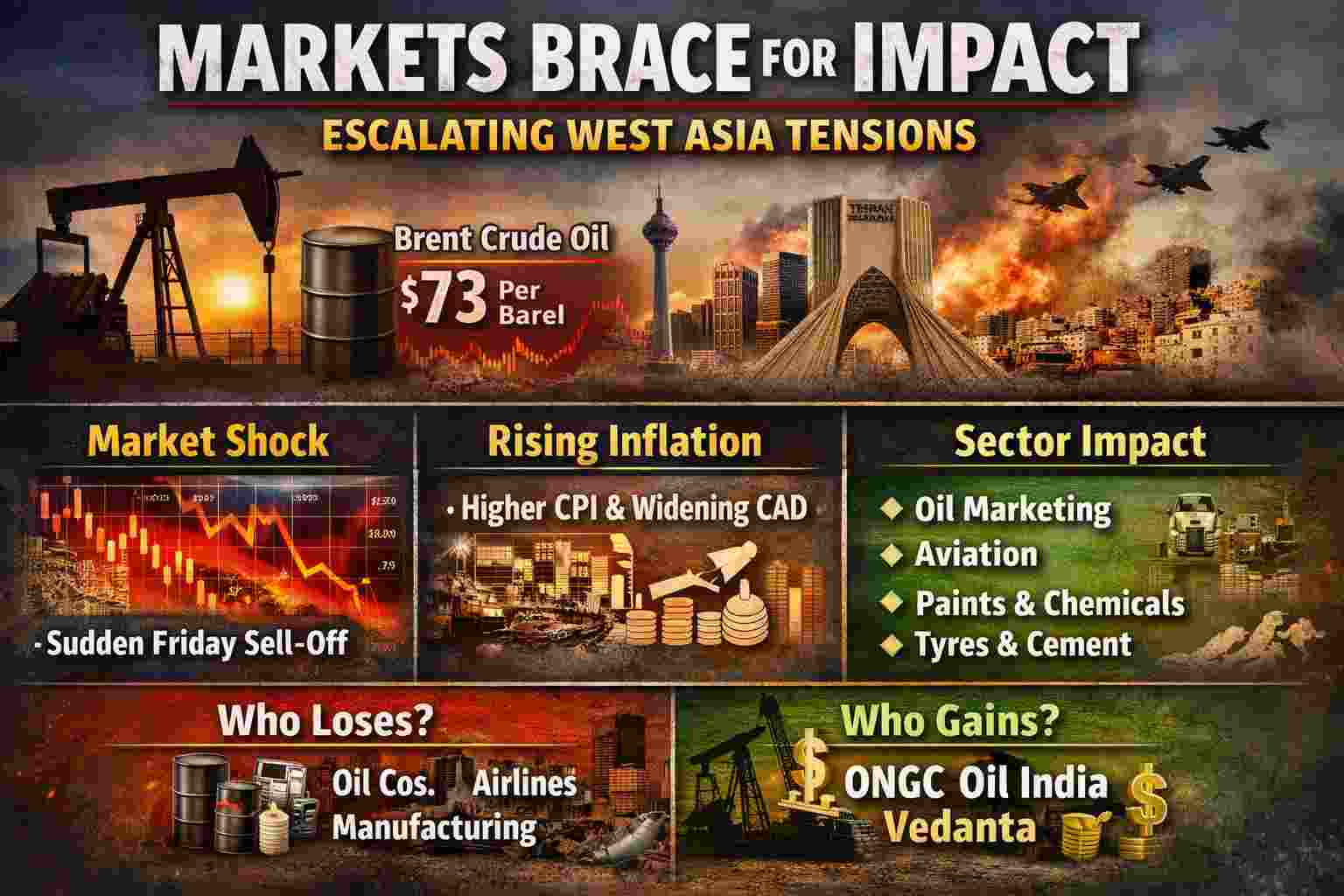
The Friday Foreshadowing: The global financial landscape is currently navigating a period of unprecedented volatility. As the smoke clears from the targeted strikes in Tehran and the subsequent retaliatory “Operation Truthful Promise 4,” investors are looking back at the final trading hours of last week with a sense of eerie realization.
The question haunting trading floors from Mumbai to New York is simple: Did the markets know what was coming before the first missile was even fueled?
The Friday Foreshadowing: A Premonition in the Pits?
On Friday, February 27, 2026, the Indian equity markets experienced a sudden, violent convulsion. At approximately 3:00 PM IST, just as the weekend was approaching, a wave of aggressive selling hit Dalal Street. The BSE Sensex plummeted 961 points, while the Nifty50 tumbled 1.25% to settle at 25,178.65.
At the time, traders scrambled for a catalyst. Several technical theories were floated:
- MSCI Rebalancing: Some pointed to scheduled outflows related to index weightage changes.
- FII Exodus: Reports showed Foreign Institutional Investors (FIIs) offloaded equities worth ₹3,466 crore.
- The “US Embassy” Signal: Perhaps the most chilling factor was a quiet update from the U.S. Embassy in Jerusalem, which authorized the departure of non-emergency personnel and families on Friday morning.
In the cold light of Sunday’s military escalations, it appears “smart money” was already pricing in a massive geopolitical risk premium. Informed capital often moves ahead of the news, and the 3 PM sell-off now looks less like a technical glitch and more like a strategic retreat.
Oil: The 85% Macro Vulnerability
While headlines focus on the “decapitation strike” in Tehran, the real economic weapon in this conflict is Brent Crude. Currently trading around $73 per barrel, analysts warn that this price is a relic of a pre-war environment. With the Strait of Hormuz—the transit point for 20% of the world’s oil—now a potential combat zone, the risk of a spike to $100 per barrel is no longer a fringe theory.
For India, this is a macroeconomic emergency. India imports nearly 85% of its energy requirements, making the economy hyper-sensitive to the pump:
Economic Metric Impact of a 10% Rise in Brent
CPI Inflation +30–40 basis points
WPI Inflation +40–80 basis points
Current Account Deficit +30 basis points
Higher crude prices act as an invisible tax on the Indian consumer, squeezing disposable income and forcing the Reserve Bank of India (RBI) into a hawkish corner, potentially delaying interest rate cuts for the remainder of 2026.
The Sectoral Battlefield: Winners and Losers
If the West Asia conflict enters a prolonged phase, the ripple effects will move through the Nifty sectors like a shockwave.
1. The “Red Zone”: High Sensitivity Sectors
Aviation (IndiGo, SpiceJet): Fuel accounts for nearly 40% of operating costs. With Middle Eastern hubs like Dubai and Doha shuttered and ATF prices set to soar, airline margins are under immediate threat.
Paint & Chemicals (Asian Paints, Berger): These industries are “oil plays” in disguise. Roughly 40% of their raw materials are crude derivatives.
Tyres & Lubricants (Castrol, MRF): From synthetic rubber to base oils, these companies see nearly 50% of their cost structure tied to the oil barrel.
2. The “Green Zone”: The Upstream Beneficiaries
ONGC, Oil India, and Vedanta: These “Upstream” explorers stand to gain immensely. Every $5 increase in Brent crude can boost their Earnings Per Share (EPS) by 7% to 12%. These stocks often act as a natural hedge for an Indian portfolio during geopolitical strife.
Structural Resilience vs. Short-Term Panic
The pivotal question for the coming weeks is: Is this a spike or a structural shift?
If the conflict remains localized—a “tit-for-tat” that cools after the initial shock—India’s fundamental strengths could spark a recovery. India’s banking sector is at its healthiest in a decade, and steady domestic SIP (Systematic Investment Plan) flows—which reached over ₹5,000 crore on Friday alone—provide a formidable cushion against FII selling.
However, if the Strait of Hormuz is closed for months, the “imported inflation” will be difficult to manage. Market sentiment for Monday’s opening is expected to be deeply bearish, with GIFT Nifty signals suggesting a massive gap-down.
The Investor’s Playbook: Strategy Over Emotion
In times of war, the loudest voice in the room is often Panic. But history shows that markets eventually “digest” geopolitical shocks.
What should you monitor?
The $80 Mark: If Brent Crude sustains above $80, defensive positioning is mandatory.
Gold and the Dollar: Watch for a flight to safety. Gold is already beginning its ascent as a “crisis insurance.”
FII Flows: If foreign selling accelerates, it could test the resolve of domestic institutional investors.
The Bottom Line: Monday’s opening bell will be a trial by fire. While caution is warranted, investors should avoid knee-jerk reactions. India’s long-term growth story remains intact, and for the disciplined investor, extreme volatility often presents the best entry points for high-quality assets.
The Middle East is teetering on the edge of total war—and the markets are finally waking up to that reality.
Disclaimer: This information is based on various inputs from news agency.