
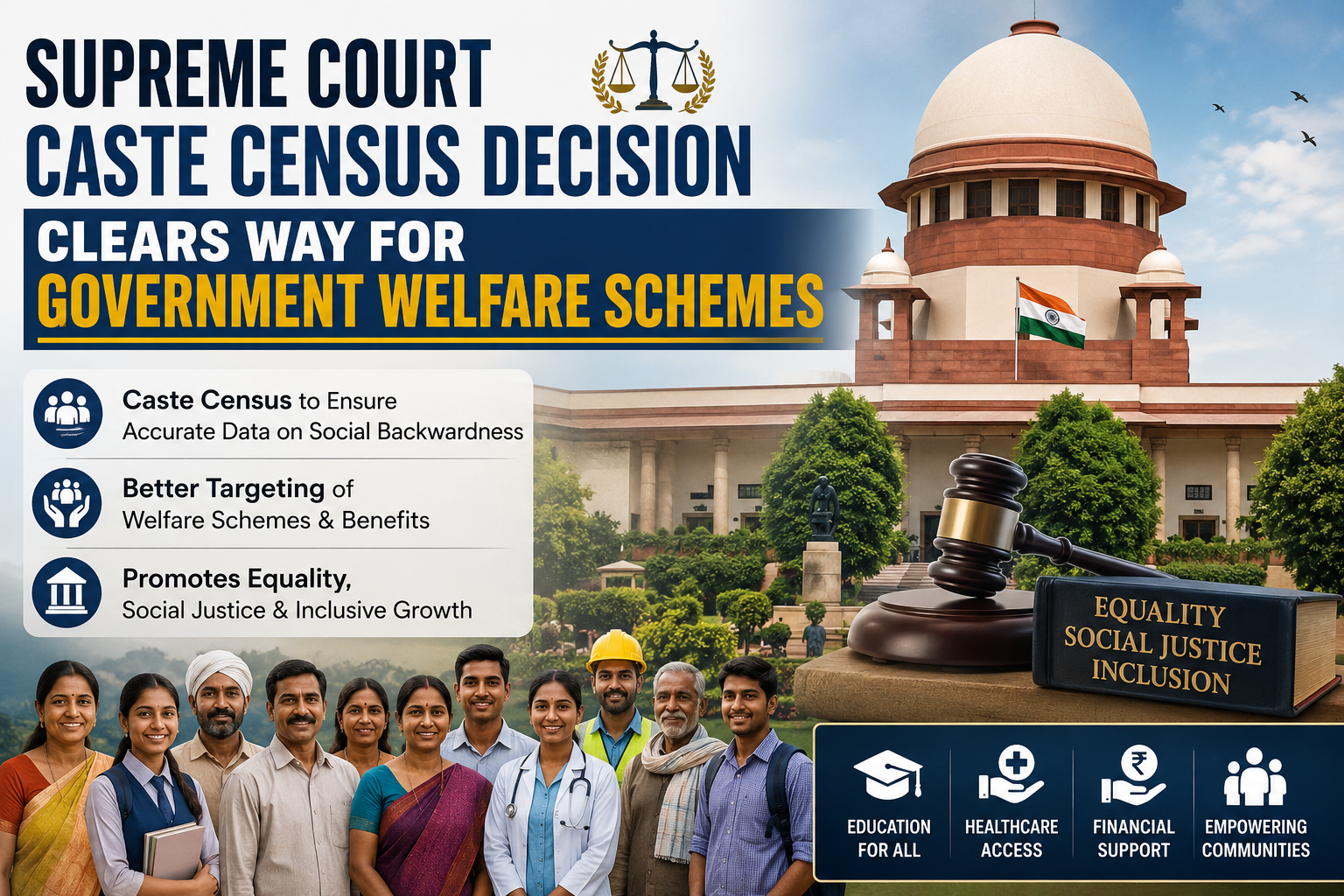
In a definitive ruling that will shape the future of governance and social engineering in India, the Supreme Court Caste Census Decision has firmly established that the judiciary will not interfere with the Union Government’s policy choices regarding population enumeration. On Wednesday, the apex court dismissed a Public Interest Litigation (PIL) that sought to stop the government from collecting caste-based data in the upcoming census.
The decision marks a pivotal moment in the ongoing national debate surrounding identity, governance, and affirmative action. By explicitly stating that the administration must know the numerical reality of backward classes to design effective welfare measures, the top court has effectively handed the policy reins back to the executive, underlining the boundaries of judicial review.
The Court Room Drama: Policy Over Judiciary
The legal challenge was brought forward by a petitioner-in-person, Sudhakar Gummula, who approached the apex court with concerns over the societal fallout of gathering such granular social data. The matter was heard by a heavyweight three-judge bench comprising:
Chief Justice of India (CJI): Justice Surya Kant
Associate Justice: Justice Joymalya Bagchi
Associate Justice: Justice Vipul Pancholi
From the very beginning of the short but impactful hearing, the bench made its stance clear: the determination of how a census is conducted is not for the courts to decide.
“Whether a census should be caste-based or not is a policy decision. The Government has to know how many people are backward for welfare measures and similar initiatives,” remarked Chief Justice Surya Kant during the proceedings.
With those words, the bench reiterated a foundational principle of Indian constitutional law—the separation of powers. The bench emphasized that the judiciary cannot step into the shoes of the executive branch to dictate governance strategies, especially when those strategies are tied directly to constitutional mandates of uplifting historically marginalized groups.
Understanding the Petitioner’s Core Arguments
Sudhakar Gummula’s public interest litigation was built on the premise that data, when weaponized, can cause deep societal fractures. Appearing in person, Gummula raised several crucial points that have often been echoed by critics of caste enumeration across the country:
1. The Risk of Corporate and Political Misuse
The petitioner argued that in the digital age, large datasets are highly vulnerable. He expressed deep anxiety that caste-specific data could easily fall into the hands of corporate entities and political strategists. While politicians could use it to fine-tune identity-based voting banks, corporate bodies might exploit the data for targeted commercial profiling, further deepening social divisions.
2. The Potential for Social Complications
Gummula contended that officially documenting the exact population numbers of various castes could lead to competitive radicalization among communities. With precise numbers out in the open, different groups might begin demanding altered quotas in education and employment, potentially destabilizing the current social equilibrium.
3. Lack of Absolute Justification
According to the petitioner, the state already possesses various proxy indicators for poverty and backwardness, such as income levels, educational attainment, and regional development markers. Therefore, he argued, there was no logical justification for gathering such a massive, sensitive tract of data explicitly based on caste.
Why the Supreme Court Dismissed the Plea
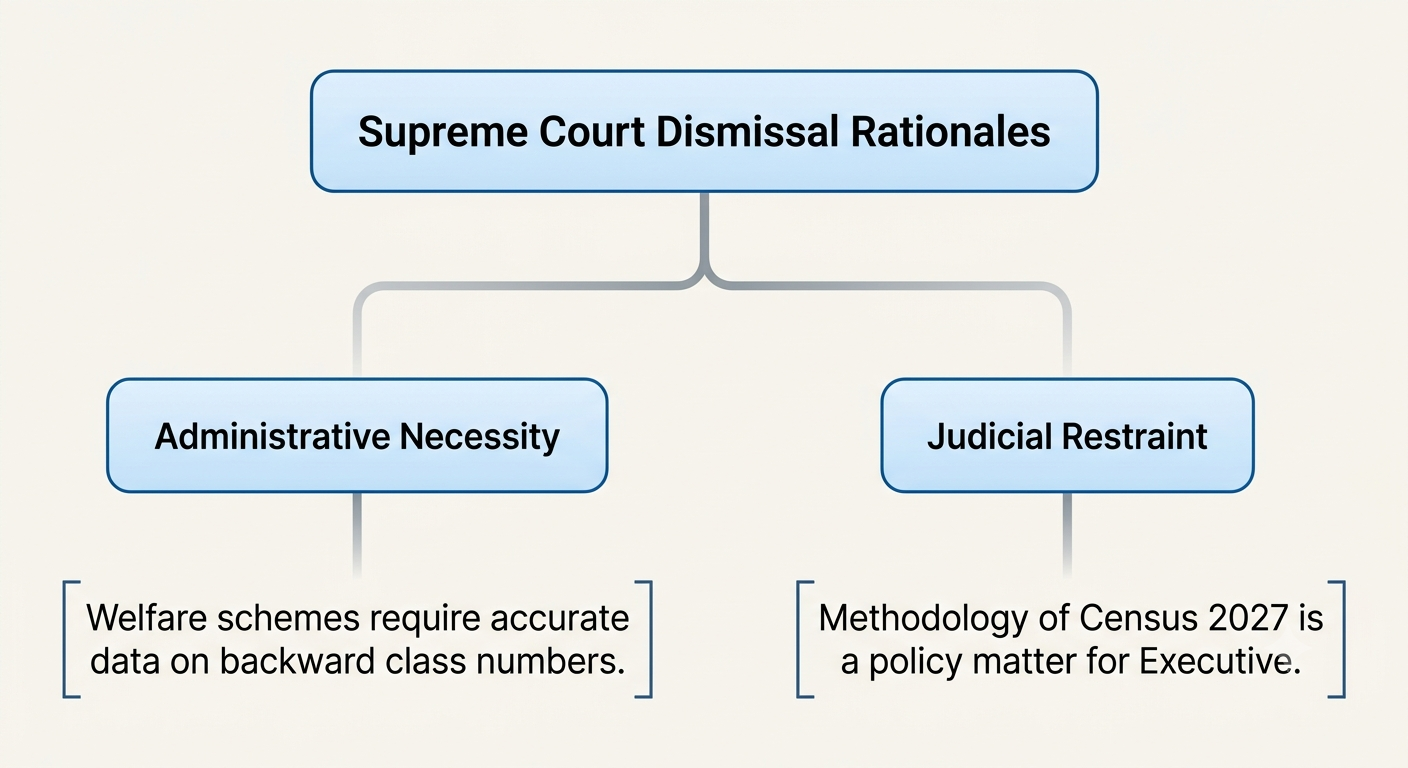
The three-judge bench was entirely unconvinced by the petitioner’s arguments, viewing them as apprehensions rather than legal grounds for striking down an executive decision. The Supreme Court Caste Census Decision rested heavily on two primary pillars: administrative necessity and judicial restraint.
Data as the Fuel for Welfare Schemes
The court highlighted that modern governance cannot function in a data vacuum. If the state is constitutionally obligated to provide reservation, financial aid, subsidies, and specialized development programs to the Backward Classes, it must know who these people are and where they reside. Without accurate data, welfare schemes risk becoming shots in the dark—either under-serving the needy or over-allocating resources to advanced groups.
The Domain of Executive Policy
The bench repeatedly stressed that the methodology of Census 2027 is a pure policy matter. Courts are equipped to check if a law violates the Constitution or if an executive action is overtly malicious. However, they are not equipped to decide what questions should or should not be included in a national census form.
“This issue exclusively comes within the policy domain,” the CJI reiterated before signing the order to dismiss the petition. The court found absolutely no ground for judicial interference, making it clear that policy considerations are beyond the scope of judicial review in this scenario.
The Broader Implications of Census 2027
Now that the legal hurdle has been cleared by the Supreme Court, the path is wide open for the Union Government to structure the upcoming Census 2027 with specific caste enumeration metrics. This decision will have far-reaching impacts across India’s political, economic, and social landscapes.
| Impact Area | Anticipated Outcome |
| Welfare Precision | Direct benefit transfers and state resources can be targeted with surgical precision to sub-castes that have historically missed out on development. |
| Legal Disputes | Future legal battles regarding the 50% cap on reservations will now have hard demographic data to rely upon, potentially altering reservation policies. |
| Political Alignment | Political parties will have access to undeniable data, which could shift the focus from speculative identity politics to data-driven governance. |
Moving Beyond Guesswork in Governance
For decades, Indian policy-makers have relied on demographic projections calculated from the 1931 census—the last time a comprehensive caste census was conducted across British India. Critics have long argued that relying on century-old data to manage a 21st-century superpower is absurd. The upcoming enumeration will finally replace guesswork with concrete empirical evidence, changing how national resources are distributed.
Balancing Privacy with Public Good
While the Supreme Court has rightly emphasized the governance benefits of the census, the petitioner’s concerns regarding data security are not entirely baseless in the modern digital ecosystem. As the government prepares for this massive data-gathering exercise, it will face the monumental task of ensuring that this sensitive information is shielded from leaks and commercial exploitation.
Strict data localization, anonymization of public datasets, and stringent access controls will be absolutely vital. The success of Census 2027 will depend not just on how thoroughly the data is collected, but on how securely it is stored and how ethically it is utilized.
Final Thoughts
The Supreme Court Caste Census Decision serves as a reality check for those looking to use public interest litigations to alter executive trajectories. By prioritizing data-driven governance over theoretical anxieties, the apex court has cleared the decks for a transparent, updated assessment of India’s social fabric.
Ultimately, knowing the exact composition of the populace is not about deepening divisions—it is about mapping out where the light of development has yet to reach. As the country inches closer to the next census cycle, the focus must now shift from whether we should collect this data, to how we can use it to build a more equitable society.