
Supreme Court Ruling: In a definitive judgment delivered on March 24, 2026, the Supreme Court of India has settled a long-standing legal debate regarding the eligibility of converts for Scheduled Caste (SC) benefits. The ruling, which upholds a previous decision by the Andhra Pradesh High Court, clarifies that individuals who convert to religions other than Hinduism, Sikhism, or Buddhism immediately and completely lose their Scheduled Caste status.
This judgment does not merely impact reservations in jobs or education; it fundamentally alters the legal protection available to millions under the Scheduled Castes and Scheduled Tribes (Prevention of Atrocities) Act.
1. Supreme Court Ruling-The Core Ruling: An “Absolute Bar”
The Bench, comprising Justice Prashant Kumar Mishra and Justice Manmohan (with references to Justice NV Anjaria), ruled that the Constitution (Scheduled Castes) Order, 1950, serves as an exhaustive and absolute guideline.
Under Clause 3 of this 1950 Order, the law is clear:
“No person who professes a religion different from the Hindu, the Sikh or the Buddhist religion shall be deemed to be a member of a Scheduled Caste.”
The Supreme Court emphasized that this bar admits no exceptions. Whether a person was born into a Scheduled Caste community is irrelevant once they “actively profess and practice” a faith like Christianity or Islam, which the court noted does not traditionally recognize the caste system.
2. The Catalyst: The Case of the Pastor
The case reached the apex court following a dispute involving a Christian Pastor in Andhra Pradesh. The individual had filed a complaint under the SC/ST Prevention of Atrocities Act, alleging that he was subjected to physical assault, death threats, and caste-based abuse.
The Conflict
The Complainant: Argued that he held a valid “Hindu-Madiga” caste certificate issued by the Tahsildar and should therefore be protected by the SC/ST Act.
The Accused: Challenged the charges, arguing that the complainant had been a practicing Christian and a Pastor for over a decade. They contended that Christianity does not recognize caste, and thus, the SC/ST Act could not be invoked.
The Judicial Findings
The Supreme Court noted that the Pastor had been conducting Sunday prayers and functioning as a religious leader for more than ten years. On the day of the alleged incident, he was performing a prayer meeting. This “active profession” of Christianity was the deciding factor.
3. The Legal Ripple Effect: Loss of Protection
Perhaps the most significant aspect of this ruling is the clarification regarding the SC/ST (Prevention of Atrocities) Act.
The Court held that because the Pastor was no longer “deemed” to be a member of a Scheduled Caste due to his conversion, he could not invoke the special protections of the Atrocities Act. While he can still file charges under the Indian Penal Code (IPC) for assault or threats, the harsher penalties and specialized procedures of the SC/ST Act are now legally off-limits to converts.
4. Why Only Hinduism, Sikhism, and Buddhism?
To understand this ruling, one must look at the historical evolution of the 1950 Order:
1950: Originally, only Hindus were eligible for SC status.
1956: The order was amended to include Sikhs.
1990: The order was amended again to include Buddhists (following the Navayana movement).
The logic used by the legislature, and upheld by the courts, is that these three religions are viewed as having roots in the Indian social structure where caste-based disabilities (like untouchability) originated. Religions like Christianity and Islam are viewed as “egalitarian” in their theology, meaning they do not doctrinally recognize the caste hierarchy. Therefore, the law assumes that once a person joins these faiths, they have moved beyond the social umbrella of “Scheduled Castes.”
5. The “Caste Certificate” Dilemma
A critical point addressed by the Court was the possession of a physical Caste Certificate. The complainant in this case still possessed a certificate stating he was “Hindu-Madiga.”
The Supreme Court ruled that mere possession of a certificate does not override the reality of religious practice. * If a person continues to practice Christianity, the certificate becomes invalid for the purposes of the SC/ST Act.
The Court noted that the cancellation of such certificates is a separate administrative matter, but for the purpose of criminal law and constitutional benefits, the act of conversion is the “decisive factor.”
6. Comparison: The 2025 High Court Precedent
The Supreme Court’s decision was an affirmation of the April 30, 2025, ruling by Justice Harinath N of the Andhra Pradesh High Court. That court had famously stated:
“The caste system is alien to Christianity.”
By upholding this, the Supreme Court has sent a clear message to all High Courts across India: the religious identity of the victim is a “pre-condition” for filing a case under the SC/ST Act.
7. Socio-Political Implications
This ruling is expected to have a massive impact on the ground, particularly in states with high conversion rates.
The Challenges for Converts
Loss of Reservation: Converts lose access to reserved seats in legislatures, government jobs, and educational institutions.
Legal Vulnerability: Without the SC/ST Act, victims of discrimination in rural areas may find it harder to seek justice against dominant-caste oppressors.
Identity Crisis: Many individuals practice Christianity while maintaining their cultural caste ties. This ruling forces a strict legal choice between religious freedom and constitutional protection.
The Arguments for the Ruling
Supporters of the judgment argue that:
It prevents “double dipping,” where individuals enjoy the benefits of a minority religion and a scheduled caste simultaneously.
It maintains the integrity of the 1950 Order.
It encourages transparency in religious identity.
8. Summary of Key Legal Principles Established
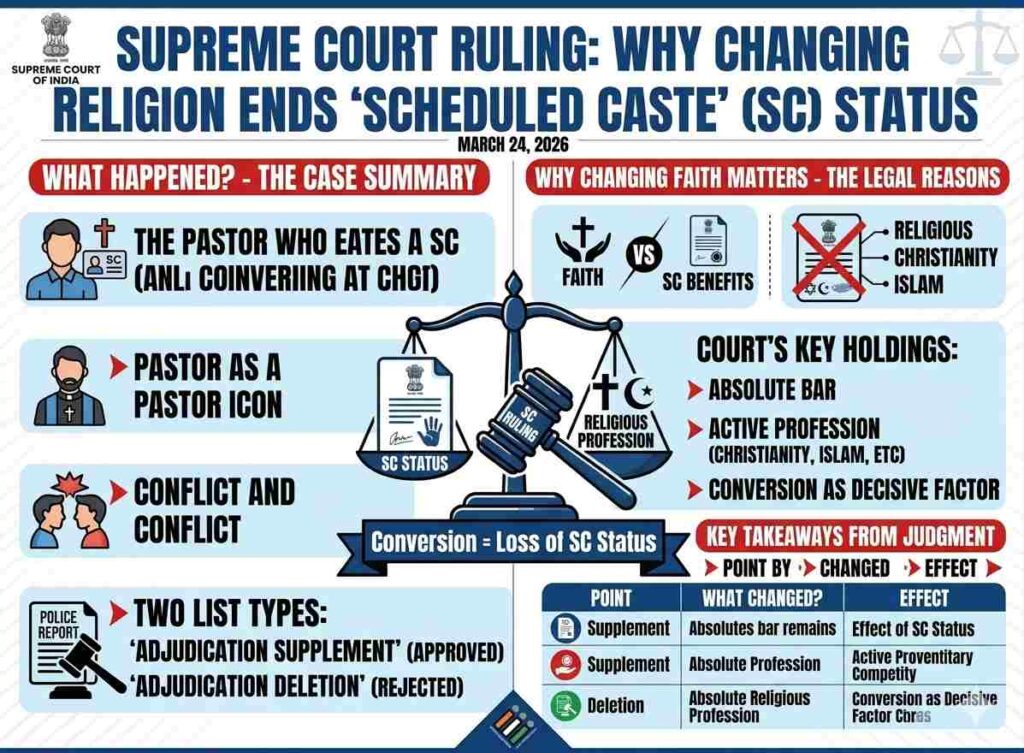
| Legal Point | Court’s Position |
| Eligibility | Only Hindus, Sikhs, and Buddhists qualify for SC status. |
| Conversion Impact | Result in “immediate and complete loss” of SC status. |
| Atrocities Act | Cannot be invoked by Christian or Muslim converts. |
| Role of Profession | “Actively professing” a religion is more important than birth records. |
| Re-conversion | SC status can only be regained if the person “re-converts” and is accepted back by the original community. |
9. Conclusion: A Defined Boundary
The Supreme Court has drawn a hard line in the sand. By labeling the bar under the 1950 Order as “absolute and admitting no exception,” the judiciary has effectively ended the ambiguity surrounding the “Dalit Christian” and “Dalit Muslim” identity in the eyes of the law.
As India moves forward, this judgment will likely spark renewed debates in Parliament regarding whether the 1950 Order needs a 21st-century update, or if the “egalitarian” nature of Abrahamic religions should continue to be a legal barrier to SC status.
For now, the law is clear: Faith has a price, and that price is the loss of Scheduled Caste status.
Disclaimer: This information is based on various inputs from news agency