
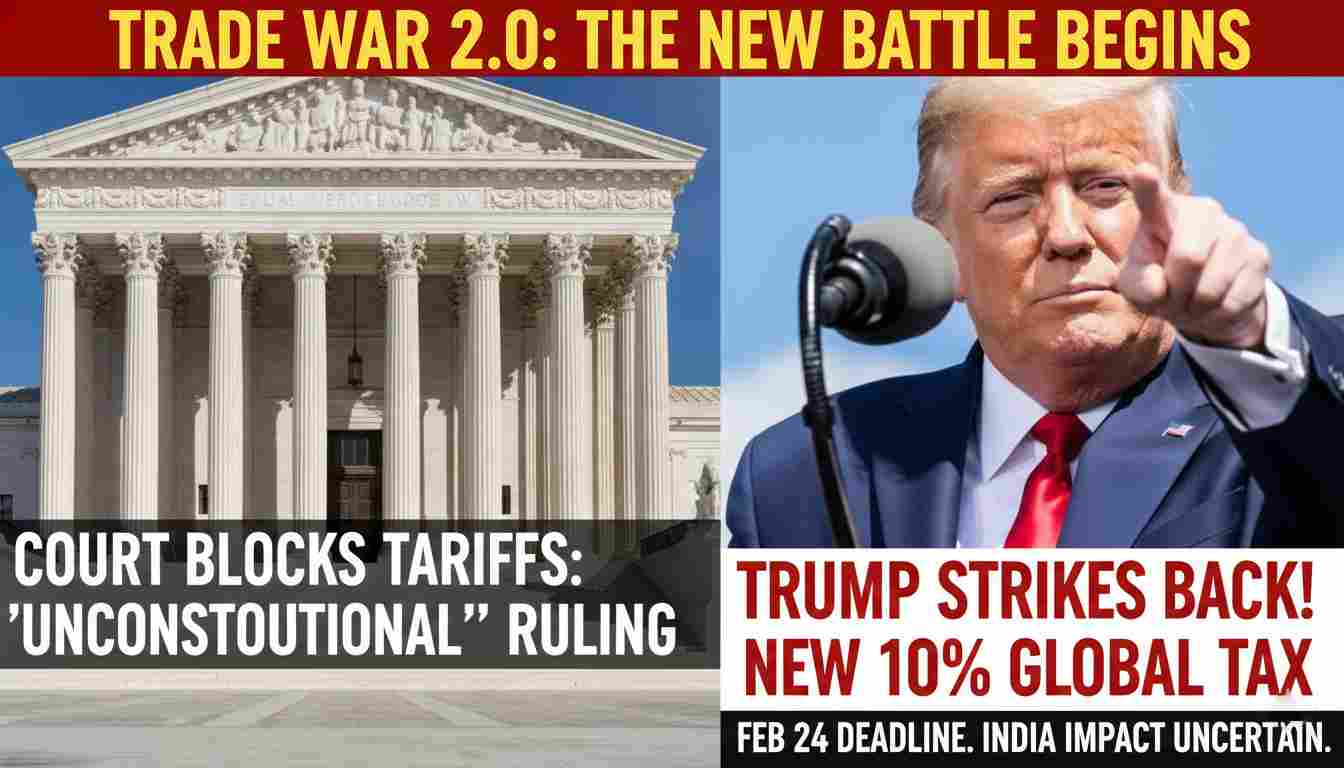
Washington D.C. —The Great Tariff Reset: In a landmark decision that has sent shockwaves through global financial markets and diplomatic corridors, the United States Supreme Court has delivered a stinging judicial rebuke to President Donald Trump’s “America First” trade agenda. On Friday, February 20, 2026, the Court ruled 6-3 to strike down the administration’s sweeping global tariff program, labeling the use of emergency powers for trade as a massive overreach of executive authority.
However, the “Tariff Man” has not retreated. Within 24 hours of the ruling, a defiant President Trump signed a new executive order under a rarely used 1974 trade law, imposing a fresh 10% flat tariff on nearly all imports, effective February 24.
The Great Tariff Reset: Judicial Hammer Why the Supreme Court Ruled Against Trump
The legal battle centered on the International Emergency Economic Powers Act (IEEPA) of 1977. For the past year, the Trump administration had used this law—typically reserved for national security threats and sanctions against rogue states—to unilaterally impose massive duties on everything from French wine to Indian textiles.
The 6-3 Verdict
The Supreme Court upheld a lower court’s decision, siding with a coalition of 12 U.S. states and hundreds of affected businesses. The majority opinion argued that the President cannot use “peacetime emergency powers” to bypass Congress on taxation and trade policy.
“I have the best legal team,” remarked noted lawyer Neal Katyal following the win. “This ruling restores the Constitutional balance of power and prevents the executive branch from treating the global economy as a personal chessboard.”
The $175 Billion Refund Headache
The fallout of this ruling is not just legal; it’s fiscal. According to the Penn-Wharton Budget Model, the Trump administration has collected over $175 billion in duties under the now-defunct IEEPA framework. Because the Court ruled the collection unauthorized, the U.S. government may now be legally obligated to refund these billions to the corporations and importers who paid them—a potential nightmare for the federal budget.
The “Section 122” Pivot: Trump’s Immediate Counter-Attack
President Trump, true to form, wasted no time in pivots. Hours after the verdict, he took to social media to announce that the ruling changed “nothing” and immediately signed a new order invoking Section 122 of the Trade Act of 1974.
What is Section 122?
Section 122 allows a President to impose temporary import surcharges (up to 15%) for a period of 150 days to address “serious balance of payments deficits.”
The Rate: 10% across the board.
Duration: 150 days (unless extended by Congress).
Effective Date: February 24, 2026.
Exemptions: Sectors currently under separate investigations, such as pharmaceuticals and goods under the USMCA (US-Mexico-Canada Agreement).
The India Paradox: 18%, 10%, or 13.5%?
For New Delhi, the Supreme Court ruling has created a mathematical labyrinth. Before the court order, India was navigating a complex trade deal with Washington.
The Original Math
Earlier this month, Trump had reduced tariffs on Indian goods from 50% to 18% as part of an interim trade deal. This was contingent on India halting energy trade with Russia.
The Current Confusion
With the IEEPA-based 18% tariff now legally void, the situation has split into two likely scenarios:
| Factor | Rate | Note |
| MFN Status Base | 3.5% | The standard rate before the trade war. |
| New Section 122 Levy | 10.0% | The “emergency” surcharge added by Trump on Saturday. |
| Total Effective Rate | 13.5% | The current technical rate for Indian exporters. |
The Trump Claim: Despite the legal shifts, Trump insisted on Friday that the 18% rate remains in effect. “The India deal is on… they’ll be paying tariffs, and we will not be paying tariffs. We did a little flip,” Trump told reporters.
The White House Reality: A White House official later clarified that, legally, all countries with existing trade agreements (including India) will drop to the 10% temporary rate for the next 150 days while the administration seeks “new legal avenues” to reinstate higher negotiated rates.
Sectoral Impact: What Stays and What Changes?
It is crucial for global traders to note that the Supreme Court ruling does not apply to all tariffs. The President’s authority under other specific laws remains untouched:
Steel and Aluminum (Section 232): The 50% duties on steel and aluminum remain in place as they are based on national security grounds.
Auto Parts: The 25% tariff on specific automotive components remains active.
The “Russian Oil” Surcharge: The extra 25% penalty Trump threatened for purchasing Russian oil is currently in limbo, pending the final signing of the bilateral trade deal.
The Road Ahead: Diplomacy and Defiance
The next week will be critical for global trade. An Indian government delegation is slated to arrive in Washington D.C. to seek clarity on the “New Math” of 13.5% vs. 18%.
Market Reaction
Financial markets have reacted with extreme volatility. While the Supreme Court ruling offered a brief moment of hope for lower prices, the immediate 10% replacement levy has signaled that the trade war is far from over.
Congressional Battle
Because Section 122 only lasts for 150 days, Trump will eventually need Congressional approval to keep the 10% levy alive. With a divided Congress, this sets the stage for a massive legislative showdown in mid-2026.
Conclusion: A Pyrrhic Victory for Free Trade?
While the Supreme Court has successfully reined in the use of “emergency” laws for trade, the President’s quick pivot to Section 122 proves that the administration’s commitment to protectionism remains unshaken. For India and other trading partners, the “relief” of the court ruling is tempered by the reality of a fresh, 10% barrier.
The global economy now enters a 150-day “holding pattern” where the only certainty is uncertainty. As Trump noted, “all the deals are on,” but the legal ground they stand on has never been more unstable.
Disclaimer: This information is based on various inputs from news agency.