
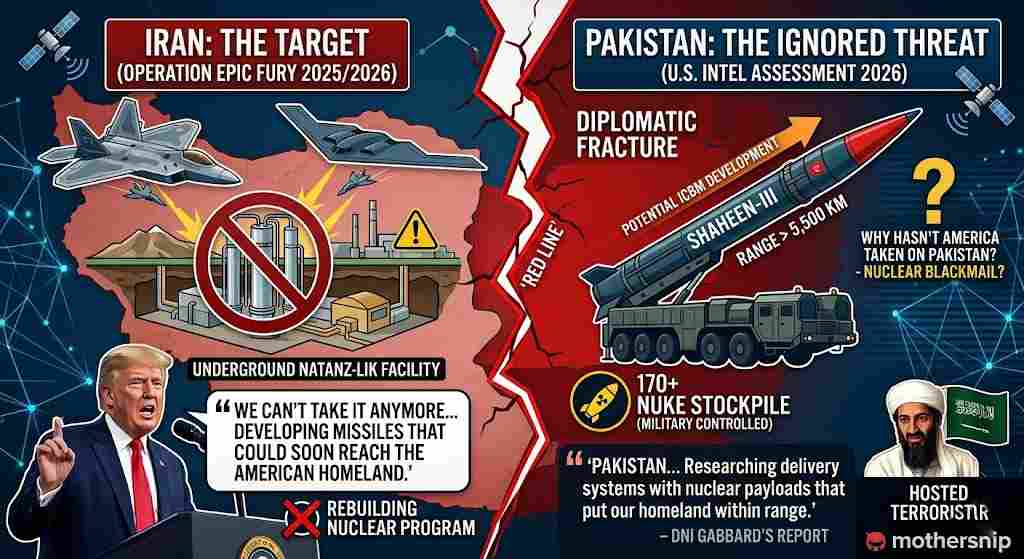
Trump’s Nuclear Blind Spot: In a series of recent addresses that have sent shockwaves through the corridors of global diplomacy, President Donald Trump has drawn a thick, red line in the sand. But it isn’t where many expected it to be. While the administration has launched Operation Epic Fury to dismantle Iran’s nuclear ambitions, a much larger, more established nuclear power remains largely unchecked, despite its own growing threat to the American homeland.
What did Donald Trump consider to be a threat? Let’s listen to his own words.
“The regime is armed, trained, and funded terrorist militias that have soaked the earth with blood and guts, and we can’t take it anymore. Instead, they attempted to rebuild their nuclear program and to continue developing long-range missiles that can now threaten our very good friends and allies in Europe, our troops stationed overseas, and could soon reach the American homeland.”
On the surface, this is a textbook indictment of Iran. The “sponsor of terrorism,” the “maker of long-range missiles”—it all fits the narrative used to justify the June 2025 strikes on Iranian nuclear facilities and the ongoing 2026 military campaign. But if we peel back the rhetoric and look at the raw intelligence, there is another country that fits this bill—perhaps even more perfectly.
The Intelligence Assessment: A New “Club of Five”:
Trump’s Nuclear Blind Spot: Why the U.S. Targets Iran While Pakistan Builds ICBMs:
For decades, Pakistan was treated as a “Major Non-NATO Ally,” a strategic partner in the War on Terror despite its well-documented history of playing both sides. However, the 2026 Annual Threat Assessment, presented by Director of National Intelligence (DNI) Tulsi Gabbard to the Senate Intelligence Committee on March 18, has officially ended that charade.
In a landmark shift, the U.S. Intelligence Community (IC) has now “clubbed” Pakistan with America’s most prominent adversaries. The report identifies five nations—Russia, China, North Korea, Iran, and Pakistan—as the primary developers of advanced missile delivery systems that put the U.S. homeland within range.
According to DNI Gabbard:
“Pakistan’s long-range ballistic missile development potentially could include ICBMs with a range capable of striking the homeland.”
This isn’t just a minor update; it is a fundamental reclassification. Pakistan is no longer just a regional security concern; it is being tracked as a direct threat to American soil.
The ICBM Reality Check: Trump’s Nuclear Blind Spot: Why the U.S. Targets Iran While Pakistan Builds ICBMs:
To understand the gravity of this, we have to look at the numbers. An Intercontinental Ballistic Missile (ICBM) is defined as a missile with a range exceeding 5,500 kilometers.
| Missile | Type | Estimated Range | Status |
| Shaheen-III | MRBM | 2,750 km | Operational |
| Ababeel | MRBM (MIRV) | 2,200 km | In Testing |
| New ICBM Project | ICBM | > 5,500 km | Under Development |
Currently, Pakistan’s longest-range operational missile is the Shaheen-III, which can fly roughly 2,750 kilometers. While this allows Islamabad to strike any point in India and reach deep into the Middle East, it is not enough to hit the United States.
However, U.S. intelligence suggests that the National Development Complex (NDC) in Islamabad has been working on larger rocket motors and solid-fuel systems that bridge the gap between regional deterrence and intercontinental reach. These are the same facilities that the Biden administration sanctioned in December 2024, yet the program has only accelerated under the shadow of regional instability.
The Great Hypocrisy: Iran vs. Pakistan
The disparity in how the Trump administration treats these two nations is staggering.
- Nuclear Status: The U.S. just launched a massive military operation against Iran to prevent it from getting a bomb. Pakistan already has 170 of them.
- Terrorism: While Iran funds regional proxies like Hezbollah, Pakistan has been the “mothership” for global terror. This is the country that hosted Osama bin Laden for years, supported the Afghan Taliban as they killed American soldiers, and continues to harbor sanctioned terrorists through its spy agency, the ISI.
- Command and Control: In Iran, the regime is radical, but there is a clear chain of command. In Pakistan, the civilian government is a mere facade. The nuclear button is held by the military—a military that has been infiltrated by radical elements and has faced numerous mutiny attempts.
Despite this, the Trump administration’s response has been a study in contradictions. While bombs drop on Isfahan and Natanz, the Pakistani leadership—including Prime Minister Shehbaz Sharif, who recently hailed Trump as the “savior of South Asia”—is still occasionally afforded the red-carpet treatment in Washington.
India’s Reaction: “Tell Us Something New”
The Indian government has watched this play out with a mixture of vindication and weariness. For years, New Delhi has warned that Pakistan’s nuclear program was never “India-centric,” as Islamabad claims.
Following the 2026 U.S. report, Indian officials essentially shrugged. Their stance is clear: Pakistan’s history of clandestine nuclear proliferation (remember the A.Q. Khan network?) is public knowledge. The risk it poses to the international community has always been there; it’s just that the United States is finally realizing that “mainland America” is on the menu.
In May 2025, the two nations engaged in a four-day conflict, Operation Sindoor, which nearly escalated to a nuclear exchange. This event proved that the “nuclear umbrella” in Pakistan isn’t just for defense—it’s a shield used to protect the state while it exports terror.
The “Nuclear Blackmail” Strategy
Why hasn’t America taken on Pakistan with the same ferocity it shows Iran? The answer lies in a dark form of diplomacy known as nuclear blackmail.
The Pakistani military has weaponized its own vulnerability. They have convinced the world that the only thing standing between 170 nuclear warheads and a group like the Pakistani Taliban is a strong, well-funded Pakistani Army.
- “If you sanction us too hard, the state collapses.”
- “If the state collapses, the nukes fall into the hands of terrorists.”
Even Joe Biden admitted this, calling Pakistan “one of the most dangerous nations in the world” because its nuclear weapons lack “cohesion.” Trump, for all his “Peace Through Strength” rhetoric, appears to have surrendered to this blackmail, choosing to hit the easier target (Iran) while ignoring the more dangerous one.
A Message to the White House
If Donald Trump is serious about actual peace—and not just projecting power for the cameras—he needs to look toward Islamabad.
The strategy of “managing” Pakistan has failed for forty years. It’s time for a fundamental shift:
- Total Arms Embargo: Stop the flow of western technology that is being diverted into the ICBM program.
- Targeted Sanctions: Don’t just sanction private shell companies; sanction the generals and the ISI leadership directly.
- aAs long as Pakistan is allowed to hide its “reign of terror” behind a nuclear umbrella, there will be no peace in South Asia, and eventually, no safety for the American homeland. The window of action is closing. Once those ICBMs are flight-tested and operational, the blackmail will be complete.
Trump calls himself a deal-maker. It’s time he stopped letting the Pakistani military dictate the terms of the most dangerous deal on the planet.
Disclaimer: This information is based on various inputs from news agency.