
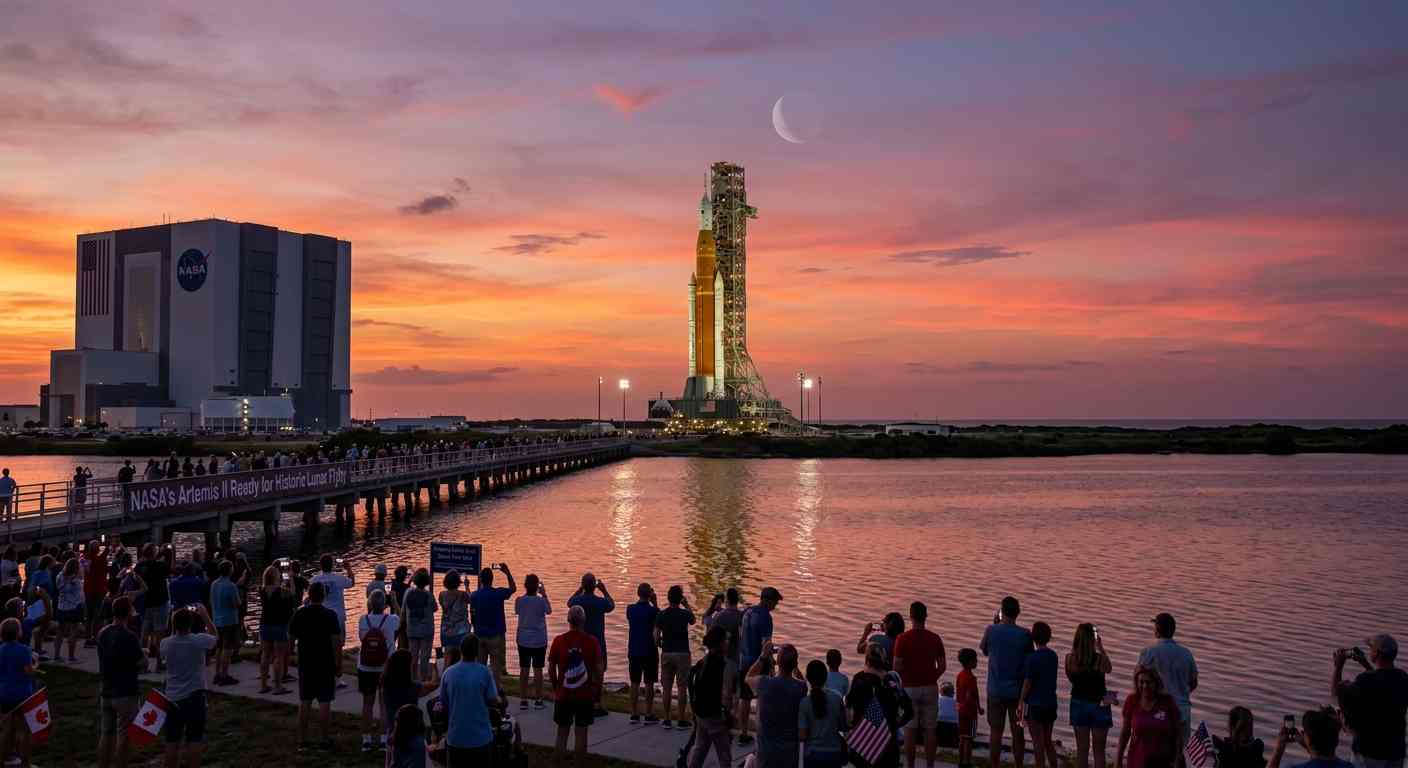
NASA’s Artemis II Ready for Historic Lunar Flyby: The eyes of the world are once again fixed on Florida’s Space Coast as NASA prepares for its most ambitious crewed mission in over half a century. The Space Launch System (SLS) rocket, the most powerful launch vehicle ever built, has officially returned to Launch Pad 39B at the Kennedy Space Center. With a launch window opening as early as April 1, 2026, the Artemis II mission represents a pivotal moment in human space exploration—marking the first time since 1972 that humans will journey to the vicinity of the Moon.
For space enthusiasts, photographers, and travelers, the period leading up to the launch offers a rare opportunity to see the massive moon rocket in its vertical flight configuration. Unlike many aerospace milestones that happen behind closed doors, the Artemis II stack is currently standing tall on the horizon, visible to the public from several vantage points across the Indian River.
The Journey Back to the Pad: Overcoming Technical Hurdles
NASA’s Artemis II Ready for Historic Lunar Flyby: How to Witness the SLS Rocket Before its April 1 Liftoff
The path to the launch pad has been a masterclass in precision engineering and rigorous safety protocols. The SLS rocket originally rolled out to the pad in late January, but the mission faced a series of technical challenges that necessitated a temporary retreat to the Vehicle Assembly Building (VAB).
Addressing Hydrogen and Helium Anomalies
During pre-launch testing, engineers identified hydrogen leaks—a common but complex issue when dealing with super-cooled cryogenic propellants. Additionally, an obstruction in the helium flow system was detected, which is critical for maintaining pressure within the fuel tanks. NASA and lead contractor Lockheed Martin made the strategic decision to roll the rocket back to the VAB in late February to ensure the integrity of the Orion spacecraft and the SLS boosters.
The Final Rollout
Following successful repairs and exhaustive system checks, the 322-foot-tall rocket began its slow, iconic crawl back to Pad 39B on March 20. By March 21, the “stack” was hard-down on the launch mount. This successful return to the pad resets the countdown for the historic mission, with teams now focused on final integrated functional tests and propellant loading preparations.
Meet the Crew: The Faces of Artemis II
NASA’s Artemis II Ready for Historic Lunar Flyby: How to Witness the SLS Rocket Before its April 1 Liftoff
Artemis II is not just a test of hardware; it is the debut of a new generation of lunar explorers. The 10-day mission will carry a diverse crew of four astronauts who will test the Orion spacecraft’s life-support systems in the deep-space environment.
Commander Reid Wiseman (NASA): An experienced naval aviator and astronaut who will lead the mission through its complex orbital maneuvers.
Pilot Victor Glover (NASA): Making history as the first person of color to participate in a lunar mission, Glover will be responsible for piloting the Orion spacecraft.
Mission Specialist Christina Koch (NASA): The record-holder for the longest single spaceflight by a woman, Koch will become the first woman to fly to the Moon.
Mission Specialist Jeremy Hansen (CSA): Representing the Canadian Space Agency (CSA), Hansen’s inclusion highlights the international collaboration at the heart of the Artemis program.
This crew will perform a “figure-eight” trajectory around the Moon, using lunar gravity to slingshot back toward Earth, reaching speeds and distances that no human has experienced in over 50 years.
Where to See the SLS Rocket: Top Public Viewing Spots
You do not have to wait for the engines to ignite to witness the scale of the Artemis II mission. Because Pad 39B is situated near the coast, several public parks in Titusville, Florida, offer unobstructed views of the rocket across the Indian River.
1. Space View Park
Located at 8 Broad St., this is perhaps the most famous spot for space fans. The park features monuments dedicated to the Mercury, Gemini, and Apollo programs. It offers a direct line of sight to the Kennedy Space Center launch pads and is equipped with speakers that often broadcast NASA’s live launch audio.
2. Rotary Riverfront Park
Situated at 4141 S. Washington Ave., this park provides a slightly quieter atmosphere but equally stunning views. It is an ideal spot for long-exposure photography of the SLS bathed in the floodlights of the launch pad at night.
3. Kennedy Point Park
Located at 4915 S. Washington Ave., this park is a favorite for locals. It offers plenty of shoreline space to set up chairs and telescopes to get a closer look at the orange core stage and white solid rocket boosters of the SLS.
4. Parrish Park at Titusville
Found at 1 A. Max Brewer Memorial Pkwy, this park sits right at the foot of the bridge leading toward the Merritt Island National Wildlife Refuge. Its elevation and proximity make it one of the premier “glimpse of history” spots for the general public.
The Ultimate “Close-Up” Experience
For those who want to get as close as legally possible to the moon rocket, the Kennedy Space Center Visitor Complex offers an immersive experience.
The standard bus tour, included with the price of admission, takes visitors past the VAB and drops them off at the Gantry at 39A. From this observation tower, you are approximately one mile away from Pad 39B. Standing at this distance, the sheer scale of the SLS—which produces 8.8 million pounds of thrust—becomes breathtakingly apparent.
Following the gantry visit, the tour proceeds to the Apollo Saturn V Center. This allows visitors to stand beneath a real Saturn V rocket, the predecessor to the SLS, bridging the gap between the heroes of the 1960s and the pioneers of the 2020s.
Ticketing Information:
Single Day Tickets: $77 per adult / $67 per child.
Annual Passes: Starting at $149 for adults (a great option for locals monitoring potential launch scrubs).
Economic and Investment Implications: The Canadian Factor
The Artemis II mission is more than a scientific endeavor; it is a significant economic catalyst, particularly for the Canadian aerospace sector. With Jeremy Hansen securing a seat on the mission, Canada’s role as a tier-one space nation is solidified.
Impact on Canadian Markets
Investors are closely watching the countdown. A successful, on-time launch is expected to lift sentiment across Canadian aerospace suppliers, avionics manufacturers, and space communication firms. For Canadian investors, the mission serves as a “proof of concept” for domestic technologies integrated into the Orion stack.
Key sectors to monitor include:
Aerospace Manufacturing: Companies providing specialized composites and hardware.
Testing and Inspection Services: Firms involved in the rigorous qualification of space-grade components.
Space Communications: Ground systems and satellite link providers that will support deep-space data transmission.
Long-Term Growth and the Lunar Gateway
The success of Artemis II paves the way for the Lunar Gateway, a small space station that will orbit the Moon. Canada has already committed to providing “Canadarm3,” a highly advanced robotic system, for this project. On-time execution of the current mission reduces perceived program risk and strengthens the negotiation position for Canadian vendors in future Artemis phases.
Risks, Catalysts, and the Launch Window
While the April 1 target is the current goal, spaceflight is notoriously subject to the whims of weather and technology.
Tactical Risks to Watch
Cryogenic Leak Checks: The “loading” process involves filling the rocket with super-cold liquid hydrogen and oxygen. Any sign of a leak will result in an immediate scrub.
Range Availability: The Eastern Range must be clear of other traffic and weather hazards (such as lightning or high-altitude winds) to give the “Go” for launch.
Heatshield Performance: NASA and Lockheed Martin have spent months investigating the Orion heatshield issues seen during the uncrewed Artemis I mission in 2022. Final data reviews will continue right up until the terminal countdown.
The Path Forward: Artemis IV and Beyond
Artemis II is the final “test flight” before NASA attempts to land humans on the lunar surface. If this mission succeeds, it sets a clear trajectory for Artemis IV, currently targeted for 2028, which will see humanity return to the lunar soil for the first time in over half a century.
Conclusion: A Moment of National and Global Pride
The return of the SLS to the pad is a signal that humanity is ready to leave Low Earth Orbit behind. Whether you are a resident of Florida heading to a riverfront park, a Canadian investor tracking aerospace stocks, or a global citizen watching the livestream, Artemis II represents the peak of human ingenuity.
The mission reminds us that while space is difficult and delays are inevitable, the pursuit of the unknown remains a fundamental human drive. As the April 1 window approaches, the world waits for the roar of the SLS to echo across the Florida coast, carrying the dreams of a new generation toward the Moon.