
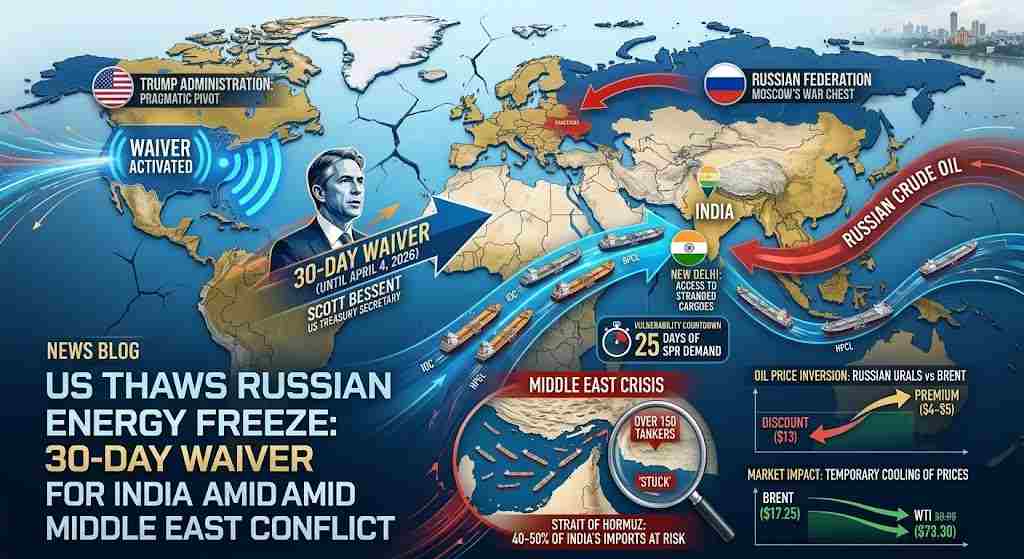
US Thaws Russian Energy Freeze: 30-Day Waiver for India Amid Middle East Conflict. In a major shift of geopolitical strategy, the United States has granted India a temporary 30-day waiver to purchase Russian crude oil cargoes currently stranded at sea. This emergency “relief valve” comes as the escalating conflict in the Middle East threatens to choke global energy arteries, specifically the vital Strait of Hormuz.
The move, announced by US Treasury Secretary Scott Bessent on Thursday, March 5, 2026, marks a pragmatic pivot for the Trump administration. After months of pressuring New Delhi to abandon Russian barrels, Washington is now prioritizing global market stability over its campaign to drain Moscow’s war chest—at least for the next month.
The “Stopgap” Strategy: Why Now?
US Thaws Russian Energy Freeze: 30-Day Waiver for India Amid Middle East Conflict: The global energy landscape has been upended by the deepening war involving Iran, Israel, and the United States. With over 150 tankers anchored outside the Strait of Hormuz and insurance costs for Gulf transits surging by 300%, the threat of a massive supply crunch became undeniable.
“To enable oil to keep flowing into the global market, the Treasury Department is issuing a temporary 30-day waiver to allow Indian refiners to purchase Russian oil,” Secretary Bessent posted on X.
He clarified that the measure is strictly time-bound, applying only to cargoes that were already loaded and “stranded at sea” as of March 5, 2026. The waiver is set to expire at 12:01 a.m. Washington time on April 4, 2026. By limiting the scope to existing transit, the US argues it is preventing a price explosion without providing a long-term financial windfall for the Kremlin.
India’s Vulnerability: The 25-Day Countdown
India’s scramble for these Russian “molecules” is driven by sheer necessity. As the world’s third-largest oil importer, India is highly exposed to Middle Eastern disruptions.
The Math of Energy Security:
- Regional Dependence: Roughly 40% to 50% of India’s crude imports transit through the Strait of Hormuz.
- Strategic Reserves: India’s commercial and strategic petroleum reserves (SPR) currently hold approximately 100 million barrels.
- The “Safety Net”: While top government sources suggest total inventories (including refined products like petrol and diesel) could stretch for 6 to 8 weeks, the crude-specific reserve covers only about 25 to 45 days of demand.
With traffic through Hormuz at a “de facto standstill,” according to analysts at Kpler, the arrival of prompt Russian cargoes is critical to ensuring that Indian refineries do not run dry by mid-April.
Refiners Dive Back In: Urals at a Premium
The waiver has triggered a flurry of activity at India’s state-run and private refineries. Indian Oil Corp (IOC), Bharat Petroleum (BPCL), Hindustan Petroleum (HPCL), and Mangalore Refinery (MRPL) have reportedly entered talks with traders to secure up to 20 million barrels of Russian oil.
Even private giant Reliance Industries is back in the market for Russian barrels. However, the pricing landscape has changed dramatically.
Price Inversion: From Discount to Premium
| Month | Russian Urals vs. Brent | Market Sentiment |
| February 2026 | -$13.00 (Discount) | Sanctions pressure; High availability |
| March 2026 | +$4.00 – $5.00 (Premium) | Crisis sourcing; Supply crunch |
In a startling reversal, Russian Urals—once the “cheap” alternative—is now being offered at a premium. As one trader involved in the sales noted: “Nowadays, more than prices, the availability of molecules is the issue.”
Market Impact: A Temporary Cooling of Prices
The announcement had an immediate, if modest, impact on global benchmarks. After Brent crude surged past $85 per barrel following reports of drone strikes on Qatari LNG facilities, the news of the US waiver acted as a dampener.
- Thursday Closing: WTI surged 8.5% to $81.01; Brent hit $85.41.
- Friday Early Trade: Both benchmarks retreated roughly 1.5% as the market priced in the additional supply from “stuck” Russian cargoes.
However, energy analysts like Vandana Hari, CEO of Vanda Insights, warn that this is “a band-aid on a gunshot wound.” With the potential for a prolonged blockade of the Strait of Hormuz, many believe Brent could still test the $100 to $120 range if Middle Eastern production remains offline.
The Trade-Off: US Tariffs and Strategic Ties
For New Delhi, the waiver is a diplomatic win after a rocky few months. In late 2025, India was hit with 25% “penalty” tariffs by the US for its continued Russian energy ties. Those were revoked only last month on the condition that India ramp up purchases of American oil.
While Washington expects India to eventually replace Russian barrels with US crude, logistics remain a challenge. US shipments take nearly a month to reach Indian shores, making the “stranded” Russian cargoes—many of which are already in the Indian Ocean or nearby—the only viable solution for immediate shortages.
What Happens Next?
The 30-day window is a race against time. Indian refiners must offload and process these cargoes before the April 4 deadline, or risk falling back under the shadow of US sanctions.
Meanwhile, the Indian government has established a 24×7 control room to monitor stock positions. Oil Minister Hardeep Singh Puri has assured the public that the country is “well-stocked,” but the reliance on a temporary US waiver suggests the margin for error is razor-thin.
As President Trump noted on Thursday, “further action to reduce pressure on oil is imminent.” Whether that means more waivers, military escorts for tankers, or a diplomatic breakthrough remains the multi-billion dollar question for the global economy.
Disclaimer: This information is based on various inputs from news agency.