
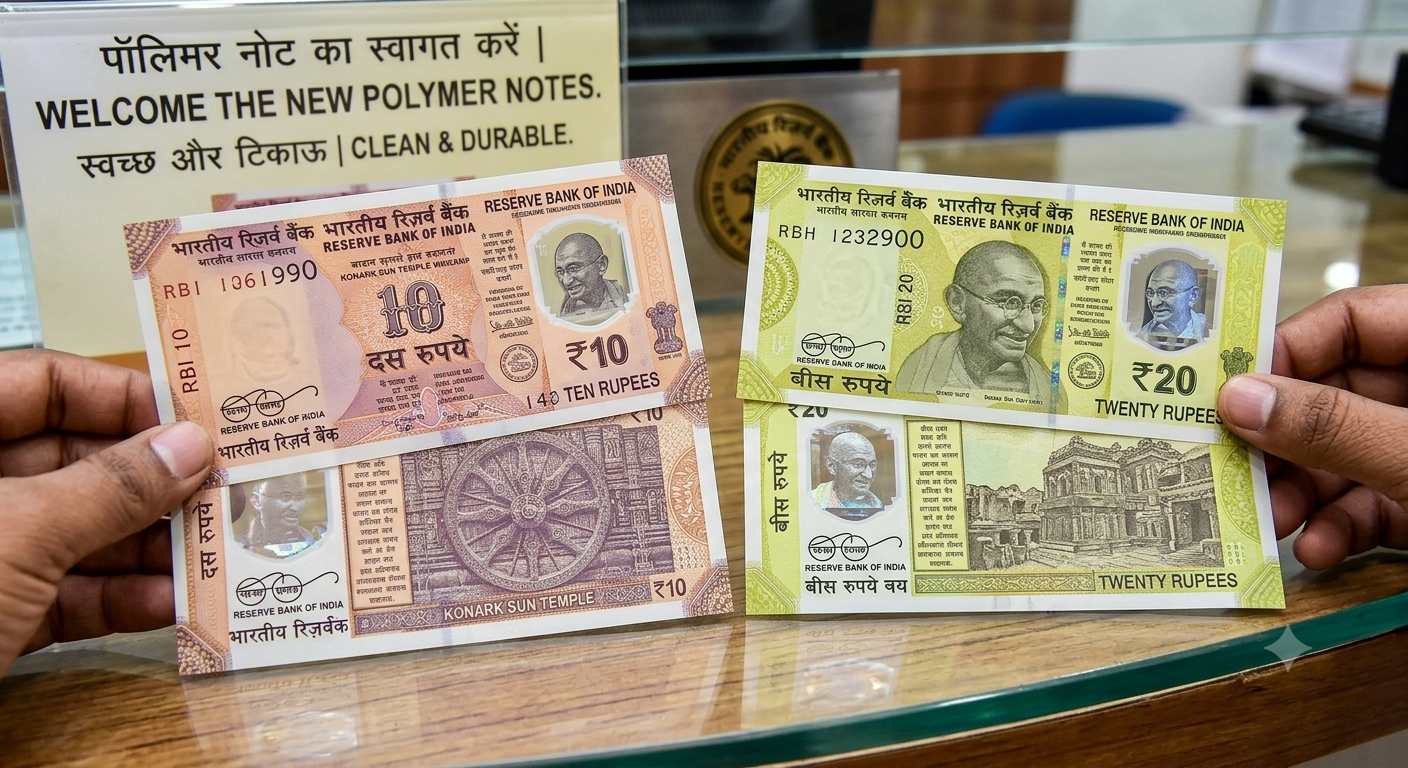
The Polymer Rupee Notes (RBI) is quietly moving forward with one of the most significant structural changes in the history of Indian currency. After running the country’s economy on cotton-rag paper banknotes for nearly a century, the central bank is creating the operational groundwork to introduce polymer currency notes, commonly known as plastic money.
Through its primary currency-printing subsidiary, Bharatiya Reserve Bank Note Mudran Private Limited (BRBNMPL), the RBI has issued a formal Global Expression of Interest (EOI). This tender invites specialized global manufacturers to supply opacified polymer substrate sheets that come pre-embedded with heavy industrial security features. If these upcoming industrial field trials clear validation, the physical cash moving through Indian markets could look, feel, and wear completely differently by early 2027.
1. The Pilot Project: Starting Small with High-Volume Cash
The central bank is using a cautious, multi-phase rollout strategy for this massive operational shift. According to early details from the tender documentation, the initial phase will focus strictly on the lowest denominations: the ₹10 and ₹20 notes.
[Traditional Cotton Paper] ➔ [₹10 & ₹20 Polymer Pilot] ➔ [National Field Testing] ➔ [Higher Denominations]This choice is highly tactical. Lower-value currency notes circulate at a significantly higher speed than larger bills. They are continuously passed between street vendors, public transport conductors, small retail shops, and local weekly markets. Because they are handled constantly in highly varied daily environments, these notes face the highest rate of physical wear, tearing, and soiling. This rapid turnover makes them the perfect testing ground to see how a synthetic polymer note handles the realities of the Indian marketplace compared to standard paper.
2. Analyzing the Numbers: The Scale of Procurement
The sheer volume specified in the initial tender shows that the RBI is looking for definitive data rather than a limited surface test.
Total Target Order: 68,000 reams of Biaxially Oriented Polypropylene (BOPP)-based polymer substrate.
Denomination Distribution: Split evenly at 34,000 reams each for the two selected lower-value notes.
Total Volume: With every individual ream holding exactly 500 sheets, this first run will generate a massive quantity of notes.
BRBNMPL has clarified that this initial order is sized purely to meet the immediate laboratory and geographic field testing requirements. The central bank plans to distribute these test notes across widely differing climate zones in India—from high-humidity coastal areas to high-temperature arid regions—to test structural stability. Once the field data confirms performance, the RBI intends to scale up procurement and potentially introduce the polymer format to higher-value bills. Global suppliers have until August 18 to lock in their official bids.
3. The Financial Drivers: Currency Printing Dynamics
The timing of this polymer tender comes during an interesting shift in the RBI’s internal operational balance sheets. The push toward plastic substrates is happening even as the central bank’s overall expenditure on traditional paper currency production has seen a noticeable dip.
| Financial Parameter | Fiscal Year 2024-25 | Fiscal Year 2025-26 | Year-on-Year Trend |
| Total Currency Printing Bills | ₹6,500 crore (approx) | ₹4,875 crore | ~25% Budget Reduction |
| Total Value of Cash in Circulation | ₹36.86 lakh crore | ₹41.23 lakh crore | 12% Volume Increase |
According to the RBI’s financial statements, the cost of printing fresh banknotes dropped by nearly a quarter down to ₹4,875 crore, largely because there was less need to print massive waves of new replacement notes. Yet, this drop happened while the absolute value of cash moving through the public sector grew significantly. This highlights a core operational challenge: even when printing costs dip temporarily, the total volume of physical cash that the central bank must maintain and service continues to climb year over year.
4. Why Cash Survives in a Deeply Digital Market
Even with the rapid adoption of UPI, digital wallets, and immediate net banking systems across metropolitan and rural India, physical cash remains a cornerstone of the domestic economy. India’s currency-to-GDP ratio actually increased slightly to 12.1% by the end of March 2026, up from 11.7% the prior year. Furthermore, the ₹500 bill remains the dominant note in circulation, making up a massive 86% of the total value moving through the economy.
Because cash remains structurally essential for hundreds of millions of daily transactions, the long-term cost benefits of polymer notes become a major factor:
Longer Working Lifespan: Plastic notes typically last four to five times longer than standard cotton-rag paper currency. They do not absorb liquid, resist dirt accumulation, and do not tear during regular rough handling.
Lower Long-Term Production Cost: By keeping notes in active circulation for years instead of months, the RBI can significantly cut down the frequency of running its printing presses to replace damaged, soiled bills.
Reduced Environmental Strain: Longer production cycles mean the central bank uses less industrial water, cuts down chemical usage in paper processing, and lowers the carbon footprint of its massive supply chain.
5. High-Tech Anti-Counterfeiting and Strict Borders
Polymer material is naturally much more difficult for counterfeiters to replicate, but the RBI is adding multiple custom security layers to the technical brief. The global tender states that the raw plastic sheets must be delivered with complex security elements pre-built into the substrate. These include a perfectly clear transparent window that houses a detailed portrait, distinct metallic numerals, a specialized magnetic pseudo-thread, hidden shadow images, and color-shifting iridescent designs. The final material must run smoothly on the high-speed commercial printing presses operated by both BRBNMPL and SPMCIL.
Alongside the heavy engineering requirements, the Indian government has built strict national security firewalls directly into the commercial bidding process:
Bidders must prove complete operational separation. Any manufacturing plants, corporate links, or supply assets situated in China or Pakistan must be entirely firewalled from the execution of the Indian currency contract.
Suppliers are legally barred from buying any raw materials or chemical compounds from these two neighboring countries for the India project. Additionally, they cannot use any technicians, engineers, or security staff on this contract who have previously worked on security printing systems within China or Pakistan.
To protect the integrity of the currency, the winning firms must sign legal guarantees stating they will never sell this custom Indian substrate formulation to any third-party country. Furthermore, any firm headquartered in a country sharing a land border with India must hold active verification from the DPIIT Registration Committee and secure full clearance from the Union Government.
6. Global Case Studies and the Indian Context
Switching to plastic money is a proven approach worldwide. Australia first developed and deployed the technology in 1988 to completely halt advanced domestic counterfeiting rings. Today, over 50 nations—including the UK, Canada, Vietnam, New Zealand, and Singapore—rely entirely or partially on polymer configurations to run their cash economies.
As the August 18 deadline for initial paperwork approaches, international substrate firms are working to meet the RBI’s strict criteria. Companies must show at least three years of continuous experience supplying verified polymer sheets to an active central bank or a recognized international sovereign press. They also need to demonstrate the production capacity to deliver a minimum of 20,400 reams (30% of the entire order) immediately upon winning the contract.
Interestingly, the RBI has added a specific cultural mandate to the process. Every single plastic sheet sample submitted for review must pass independent laboratory testing certifying that the material is 100% free of any animal tallow, fats, or external DNA content. This ensures the new currency respects local religious and ethical sentiments from day one.
7. The Operational Roadmap
While RBI Governor Sanjay Malhotra has noted that the plan is currently moving through its formal evaluation and trial stages, the quick timeline of the global tender shows the central bank is serious about the transition.
If the laboratory assessments clear this coming autumn and the subsequent high-speed print tests match durability metrics, the pilot notes will move out into regional distribution channels. Indian consumers could see water-resistant, ultra-secure plastic ten and twenty-rupee notes in active circulation by early 2027.
For a broader perspective on how India’s financial leadership views economic growth and systemic stability during this transition phase, you can watch this Interview with RBI Governor Sanjay Malhotra where he discusses the overall resilience of the Indian financial ecosystem.