
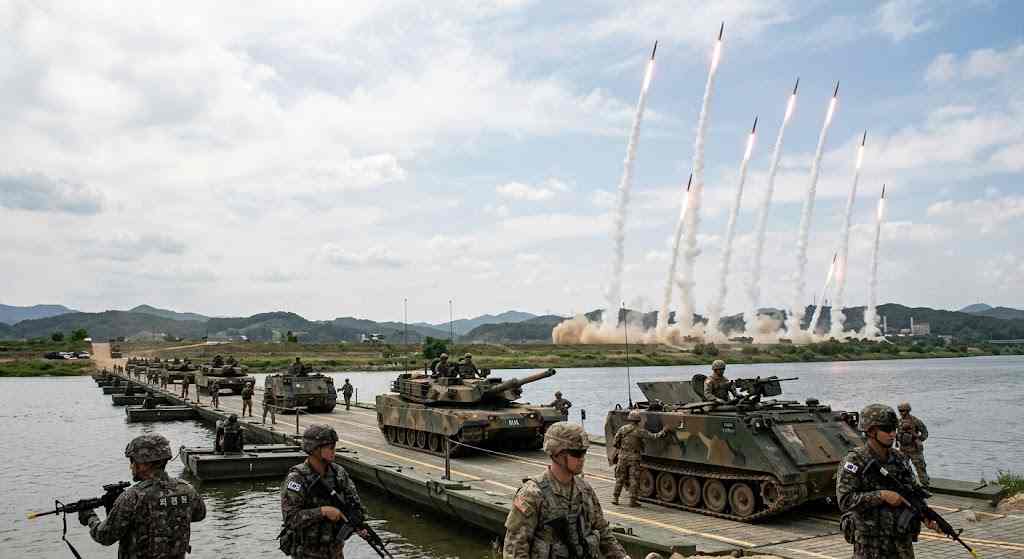
YEONCHEON, South Korea / TOKYO –North Korea In a massive display of military defiance, North Korea fired more than 10 ballistic missiles into the eastern sea on Saturday afternoon. The coordinated launch occurred while U.S. and South Korean forces conducted large-scale river-crossing exercises, and just as surprising new diplomatic channels appeared to be opening between Washington and Pyongyang.
The salvo, detected at approximately 1:20 p.m. local time (0430 GMT), originated from the Sunan area near the capital, Pyongyang. South Korea’s Joint Chiefs of Staff (JCS) confirmed the missiles traveled roughly 350 kilometers (220 miles) before splashing down in the waters between the Korean Peninsula and Japan.
A Sharp Escalation in the Sea of Japan
North Korea Unleashes Barrage of 10 Ballistic Missiles Amid Allied Drills and Diplomatic Overtures :While North Korea frequently conducts missile tests to signal its displeasure with regional events, the sheer volume of Saturday’s launch—at least 10 missiles fired in a single barrage—represents a significant escalation in the North’s “show of force” tactics.
Japan’s Coast Guard and Ministry of Defense were quick to issue emergency alerts as the projectiles took flight. Public broadcaster NHK reported that the missiles appeared to have fallen outside Japan’s Exclusive Economic Zone (EEZ), and no damage to vessels or aircraft was reported. Nevertheless, the administration of Japanese Prime Minister Sanae Takaichi—who recently took office following a landslide victory—immediately activated emergency protocols at the Prime Minister’s Office to monitor the situation.
“The military has stepped up surveillance and is maintaining high readiness against possible additional launches while closely sharing information with the U.S. and Japan,” the South Korean JCS stated.
Drills on the DMZ: “Freedom Shield” and “Warrior Shield”
North Korea Unleashes Barrage of 10 Ballistic Missiles Amid Allied Drills and Diplomatic Overtures : The launches coincided with the ongoing Freedom Shield 26 exercises, an 11-day joint military program between the United States and South Korea. On the same day as the missile fire, hundreds of U.S. and South Korean troops were seen in Yeoncheon, near the demilitarized zone (DMZ), conducting high-stakes river-crossing maneuvers.
The drills involved heavy hardware, including:
- K1A2 Main Battle Tanks
- Armored combat vehicles
- Tactical bridge-laying equipment
- Fighter jet squadronsproviding simulated air cover
While the allies maintain that these exercises are “purely defensive” and essential for testing readiness against potential aggression, Pyongyang views them as “dress rehearsals” for an all-out invasion. Earlier this week, Kim Yo Jong, the powerful sister of leader Kim Jong Un, warned that the drills would bring “terrible consequences,” citing the current instability of global security.
The Trump Factor: A Return to Personal Diplomacy?
Adding a layer of complex irony to the day’s military tension, the launches occurred just as news broke of a potential diplomatic thaw. On Thursday, South Korean Prime Minister Kim Min-seok met with U.S. President Donald Trump in Washington to discuss reopening the long-stalled dialogue with the North.
Prime Minister Kim told reporters that President Trump remains “eager” for an opportunity to sit down once more with Kim Jong Un. This potential “Trump-Kim 4.0” summit would be the first such high-level contact since the 2019 Hanoi summit ended without a deal.
The political landscape in 2026 is markedly different, however. While Trump seeks to revive his signature “personal diplomacy,” his administration is simultaneously navigating a volatile conflict in the Middle East. This has led to domestic speculation in Seoul regarding the movement of U.S. military assets, such as the THAAD (Terminal High Altitude Area Defense) system, to other theaters—a concern that South Korean President Lee Jae Myung’s office has sought to downplay.
Two Decades of Defiance
North Korea’s missile program has evolved from primitive Scud variants to sophisticated solid-fuel missiles capable of reaching the continental United States. Despite being under heavy United Nations Security Council sanctions since its first nuclear test in 2006, Pyongyang has remained defiant.
The 10-missile barrage suggests that North Korea has moved beyond mere development and into the stage of mass-production and operational saturation tactics. By firing multiple missiles at once, the North demonstrates a capability to overwhelm regional missile defense systems, such as the Patriot batteries and Aegis-equipped destroyers operated by the U.S. and its allies.
Regional Reactions and the Path Ahead
The international response has been swift:
- Seoul:President Lee Jae Myung convened an emergency meeting of the National Security Council, reaffirming that the ROK-U.S. alliance remains “ironclad” despite the North’s provocations.
- Tokyo:Prime Minister Takaichi called the launches a “serious challenge to the peace and security of the region” and vowed to work closely with Washington and Seoul.
- Washington:The White House issued a statement condemning the launches but notably did not rescind President Trump’s recent comments regarding his willingness to meet with Kim Jong Un.
As the “Freedom Shield” exercises continue through March 19, the Korean Peninsula remains on a knife-edge. The duality of “missiles and meetings”—where high-end military hardware is tested alongside the prospect of historic summits—defines this new era of 2026 geopolitics.
For now, the world waits to see if Kim Jong Un will respond to Trump’s renewed overtures or if the “terrible consequences” promised by his sister will manifest in further military escalations.