
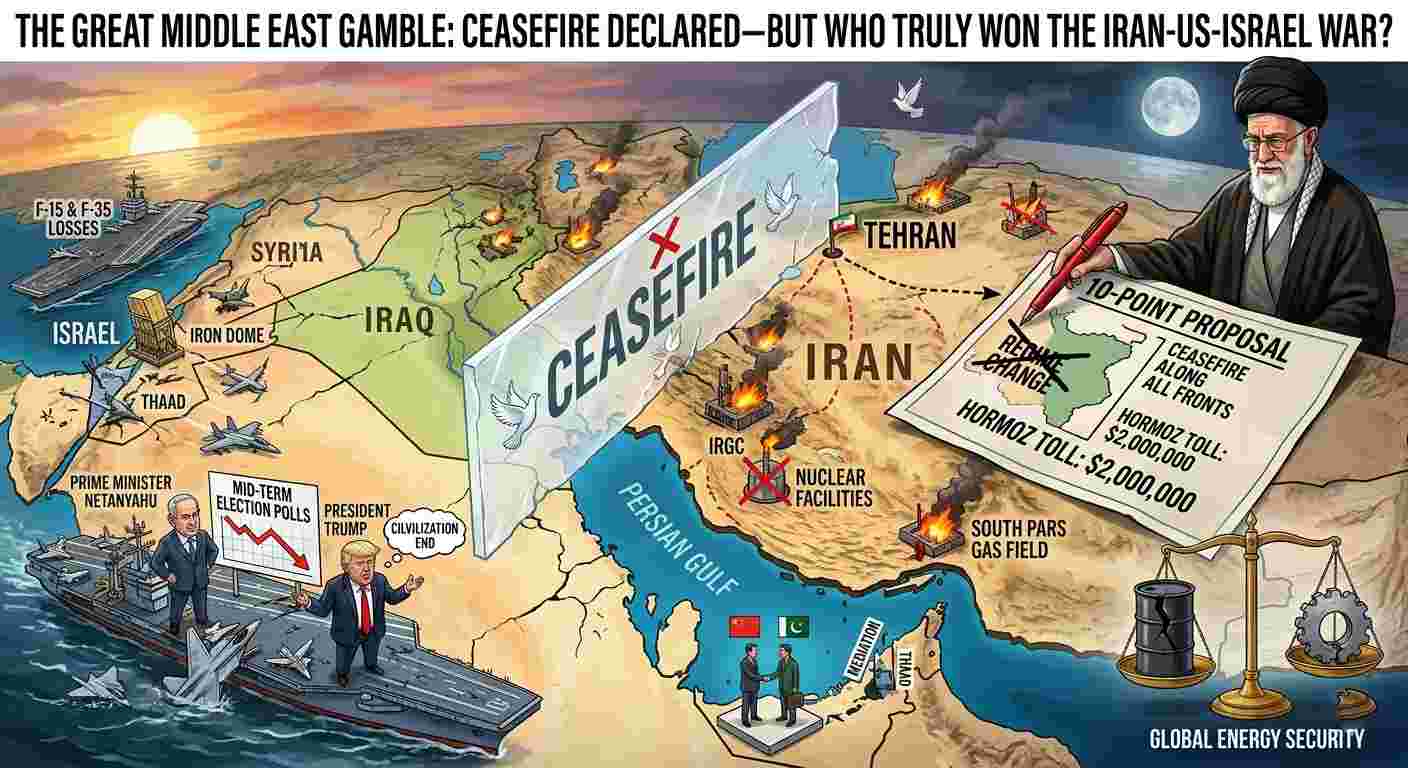
The Great Middle East Gamble: After 40 days of relentless kinetic warfare that pushed the world to the brink of a global energy collapse, a fragile two-week ceasefire has finally taken hold. Brokered through the intense diplomatic efforts of Pakistan and China, the pause in hostilities marks a pivotal moment in the 2026 Middle East conflict.
As the dust settles over the desert, the world is asking one question: In this brutal “Game of Thrones,” who emerged as the ‘Bazigar’ (The Ultimate Player)?
The Great Middle East Gamble Ceasefire: A Diplomatic Lifeline
The announcement came late Tuesday after President Donald Trump and Iran’s leadership, under the guidance of newly ascended Supreme Leader Mujtaba Khamenei, agreed to halt all military actions for 14 days.
The United Nations Secretary-General, António Guterres, hailed the move, thanking Pakistan for facilitating the dialogue. India’s Ministry of External Affairs (MEA) also welcomed the de-escalation, emphasizing the need for unhindered navigation through the Strait of Hormuz to stabilize global trade.
However, beneath the diplomatic pleasantries lies a grim tally of losses and a complex web of claims regarding who achieved their strategic objectives.
The Narrative of ‘Victory’: Two Sides, Two Truths
The US & Israel: A Military Setback for Regime Change?
The primary objective of Washington and Jerusalem was “Regime Change.” Following the passing of Ayatollah Ali Khamenei, the US and Israel anticipated a collapse of the Iranian state. They hoped a vacuum of power would lead to a civil uprising, allowing for the installation of a more compliant government.
The Reality Check:
Failed Uprising: No civil rebellion occurred. Instead, Iran fought back with unexpected cohesion and intensity.
Leadership Continuity: Mujtaba Khamenei took the helm effectively, proving that the Iranian “Deep State” remained intact despite the heavy bombardment.
Strategic Failure: The goal of overthrowing the Islamic Republic remains unachieved, which many analysts view as a strategic defeat for the Trump administration.
Iran: The David vs. Goliath Resilience
Iran is projecting this ceasefire as a “surrender” by the United States. Tehran claims that President Trump accepted their 10-point proposal as the basis for negotiations.
The Strategic Win:
Targeting Assets: Iran successfully struck US bases in the Gulf and Israeli targets, proving its reach.
Asymmetric Warfare: By using low-cost Shahed drones, Iran forced the US and Israel to expend multi-million dollar missiles from systems like Thaad and Iron Dome.
The “Hormuz Toll”: In a bold move, Iran is now demanding a $2 million “transit fee” from ships passing through the Strait of Hormuz during the ceasefire—a move aimed at asserting absolute control over the world’s oil vein.
The Cost of War: Broken Shields and Fallen Hawks
While the political “spin” continues, the military losses provide a more objective picture of the damage.
1. The Myth of Invincibility: F-35s vs. Drones
One of the biggest shocks of this war has been the vulnerability of advanced Western hardware. Iran utilized inexpensive drone swarms to target and destroy several F-15 and F-35 fighter jets, along with KC-135 tankers.
Image Crisis: The US markets these jets as “invincible.” Seeing them downed by “cheap” Iranian tech has dealt a massive blow to the US defense industry’s prestige.
Air Defense Reliability: The Iron Dome and Thaad systems, while effective, were overwhelmed. This stands in stark contrast to India’s ‘Operation Sindoor’ against Pakistan, where indigenous systems and the S-400 reportedly intercepted nearly 800 projectiles with near-perfect accuracy.
2. Iran’s Scarred Infrastructure
Despite its military resilience, Iran’s economy has been pushed back decades.
Energy Sector: US and Israeli strikes targeted the South Pars gas field—the world’s largest—and numerous oil depots.
Nuclear Setback: Strategic bombings of nuclear facilities have reportedly delayed Iran’s atomic ambitions by decades. This is a massive “win” for Israel, though it came at a high military and reputational cost.
The Domestic Fallout: Is Trump Losing Ground?
The timing of this war could not be worse for President Trump, with mid-term elections looming.
The “Civilization” Threat
Under pressure from declining poll numbers and a rising number of Americans who view the war as an “unnecessary expense,” Trump issued a chilling threat: to “end Iranian civilization forever.”
Global Condemnation: This statement sparked outrage even within the Republican Party.
The “Threat” Strategy: Some argue this threat actually forced Iran to the table, but others believe it has permanently damaged Trump’s image as a global statesman.
Internal Fractures: The Pentagon vs. The White House
In a surprising move during the height of the war, Defense Secretary Pete Hegseth demanded the resignation of Army Chief of Staff Randy George. This purge of high-ranking officials during an active conflict suggests a deep rift between the Trump administration and the military establishment regarding the war’s endgame.
The Geopolitical Shift: Enter China and Pakistan
The ceasefire highlights a shift in global power dynamics.
China’s Influence: President Trump himself admitted that China likely convinced Iran to agree to the truce. This positions Beijing as the new “Peace Broker” in a region traditionally dominated by US influence.
Pakistan’s Role: Pakistan’s diplomatic mediation has been acknowledged by both Tehran and Washington, earning Islamabad significant diplomatic capital.
Conclusion: Who is the ‘Bazigar’?
If the goal was to survive and remain relevant, Iran has emerged as the “Bazigar” of the streets. It stood its ground against two superpowers and is now attempting to tax the world’s oil supply.
However, if the goal was to neutralize a nuclear threat, Israel and the US have achieved a functional victory by setting back Iran’s energy and atomic programs.
The Final Verdict: This is a “Phyrric Victory” for all.
America has lost the aura of its military technology and domestic unity.
Israel faces a long, expensive road to restoring its total security.
Iran is economically crippled and faces a daunting reconstruction task.
As the 14-day clock ticks, the world waits to see if this is a true peace or just the “eye of the storm” before an even more catastrophic escalation.
Casualty and Asset Loss Summary
| Metric | US/Israel (Est.) | Iran (Est.) |
| Advanced Jets Lost | F-15s, F-35s, KC-135s | Mig-29s, Su-24s |
| Primary Loss Factor | Cheap Drone Swarms | Precision Missile Strikes |
| Key Infrastructure | Military Bases in Gulf | South Pars Gas Field, Nuclear Sites |
| Strategic Outcome | Failed Regime Change | Economic Devastation |