
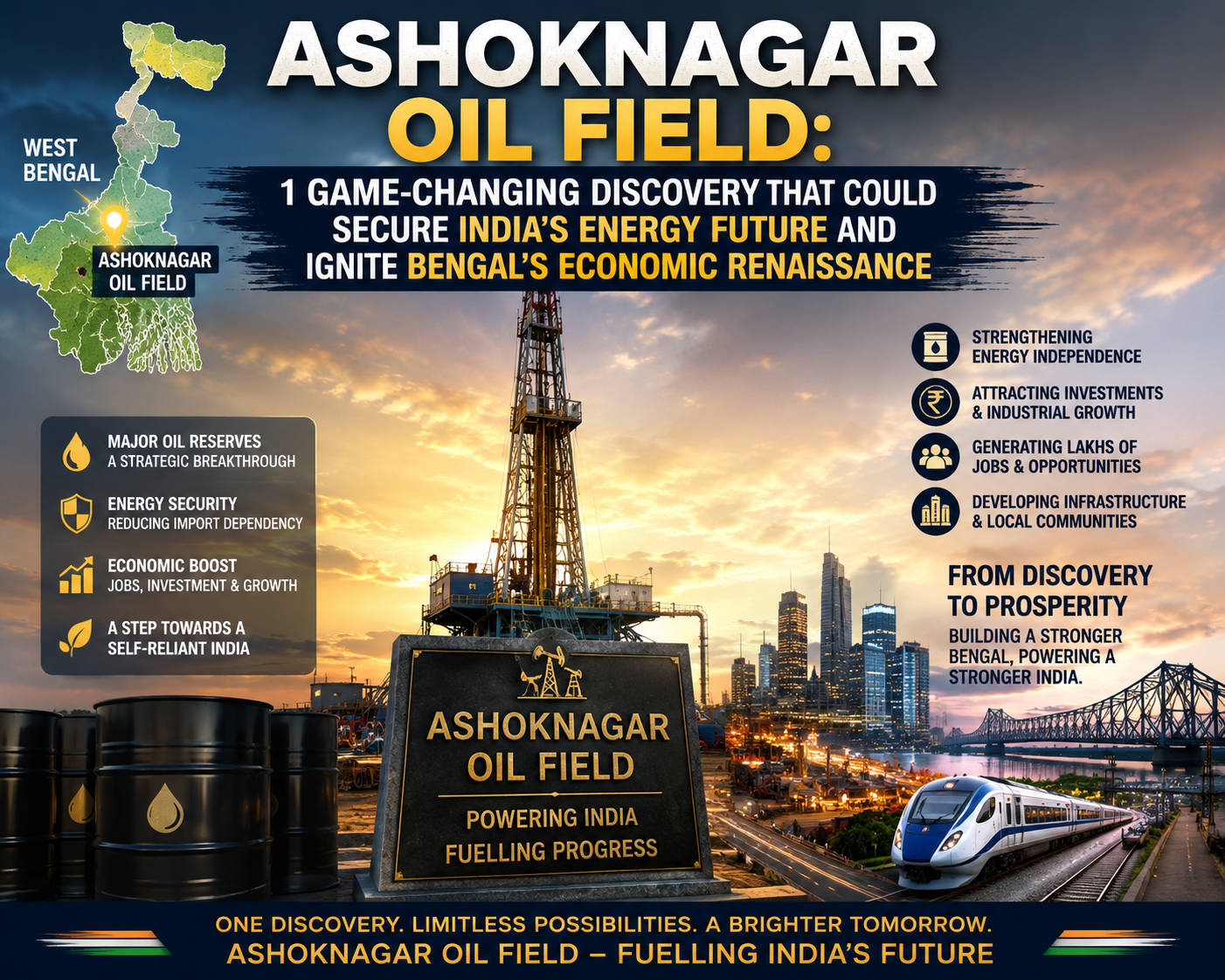
The Ashoknagar oil field in West Bengal is back in the national spotlight. With growing conflicts in the Middle East causing worries about global oil supplies, rising prices, and national security, India is looking at its own resources for safety. The answer to the country’s heavy dependence on imported oil and diesel might lie right beneath the soil of the North 24 Parganas district.
With new support from both central and state leaders, a clear plan is being made to unlock eastern India’s first major oil and gas reserve. This project is not just a technical victory for the energy sector—it is a massive step forward that promises to rebuild West Bengal’s industries and strengthen India’s economy.
The Strategic Re-Emergence of Bengal’s Hidden Wealth
For decades, West Bengal’s economic narrative was dominated by its agrarian achievements, historical manufacturing units, and its service sector. However, the discovery of massive hydrocarbons shifted the paradigm entirely. Located approximately 48 kilometers from the capital city of Kolkata, the Ashoknagar region was identified nearly eight years ago as a massive basin rich in high-quality petroleum and natural gas reserves.
The initial breakthrough came in 2018 when the state-run Oil and Natural Gas Corporation (ONGC) successfully discovered the commercial viability of the site. It was hailed as a historic milestone, establishing the region as eastern India’s first legitimate oil and gas-producing hub. Geological assessments and initial exploratory data suggest that the field holds an estimated reserve of over 240 million barrels of crude oil, alongside a significant volume of natural gas.
Despite the initial euphoria, the path to commercial extraction has been anything but smooth. Bureaucratic bottlenecks, logistical hurdles, and intense local disputes previously brought operational activities to a complete standstill. However, the combination of a shifting political climate and an increasingly hostile global energy market has forced policy planners to clear the path for immediate extraction.
Big Meeting in Delhi: Pushing for Bengal's Oil and EconomyThe plan to get oil out of Ashoknagar moved faster after a big meeting in New Delhi on Saturday. BJP Member of Parliament (MP) Samik Bhattacharya met with India’s Finance Minister, Nirmala Sitharaman. They talked about two main goals: starting oil production quickly at the Ashoknagar oil field and building a plan to fix West Bengal’s struggling economy.
During the meeting, Bhattacharya asked the central government to step in immediately, help clear local problems, and restart drilling. He explained that West Bengal’s industries have been stuck for a long time, with major companies leaving and new investments drying up. He believes that tapping into these massive oil and gas reserves in the North 24 Parganas district is exactly what the state needs to bring big industries back.
Finance Minister Nirmala Sitharaman agreed that Bengal’s economy needs help. She promised that the central government will provide the necessary money, permissions, and teamwork to turn Ashoknagar from just a testing site into a busy, working oil field. Bhattacharya added that if different government departments work together smoothly, West Bengal can successfully regain its strong economic position.
The Geopolitical Catalyst: Escalarating Tensions in West Asia
To truly understand why the Ashoknagar oil field has suddenly captured national urgency, one must look at the broader global chessboard. India is currently the world’s third-largest consumer and importer of crude oil, relying on foreign nations to satisfy more than 85% of its total domestic demand. A massive chunk of these imports originates from the volatile West Asian (Middle Eastern) corridor.
With ongoing regional tensions, shipping disruptions in vital maritime channels like the Red Sea, and sudden fluctuations in OPEC production quotas, India’s energy security is constantly exposed to external shocks. Every single dollar increase in the price of a crude barrel widens India’s current account deficit, puts immense pressure on the rupee, and triggers domestic inflation—directly hitting the pockets of everyday citizens through inflated petrol and diesel prices.
In this context, finding a localized, domestic reserve containing over 240 million barrels is nothing short of a geopolitical shield. While domestic production from a single field cannot completely replace global imports overnight, it offers a crucial buffer. It strengthens India’s negotiating power on the international stage, guarantees an uninterrupted supply line to regional refineries (such as the Haldia Refinery in Bengal), and reduces the immediate financial drain caused by import dependencies.
Overcoming the Past: Local Disputes and the Roadblocks to Extraction
The journey from discovery to production is rarely a straight line in India’s complex socio-political landscape. Following the 2018 discovery, ONGC had actively deployed state-of-the-art machinery and commenced exploratory drilling operations. However, just a few months prior to the highly charged West Bengal State Assembly elections, the project hit a brick wall.
Operations were abruptly halted due to intense local disputes, land acquisition anxieties, and organized resistance from regional groups. In a densely populated state like West Bengal, balancing industrial development with agrarian interests and local communities is a delicate act. Political opportunism and a lack of clear communication left local residents fearful of displacement, environmental degradation, and inadequate compensation, leading to protests that forced ONGC to pause its heavy machinery.
However, the political landscape has shifted. Political analysts note that with the BJP securing a stronger organizational and electoral foothold across various pockets of the state, the central government now feels empowered to resolve these disputes constructively. Insiders indicate that ONGC, backed by central security agencies and a transparent community engagement plan, is preparing a comprehensive corporate social responsibility (CSR) framework. This strategy aims to directly involve local communities by offering fair land compensation, modern community infrastructure, and direct employment opportunities, effectively dismantling the core causes of past resistance.
The ‘Sonar Bangla’ Vision and the Double-Engine Roadmap
The revitalization of the Ashoknagar oil field is deeply intertwined with the BJP’s overarching political ideology for the region. MP Samik Bhattacharya explicitly connected the project to Prime Minister Narendra Modi’s vision of building a Sonar Bangla (Golden Bengal).
“The Prime Minister has envisioned a prosperous, industrialized, and socio-economically vibrant Bengal. We have created a dedicated, meticulous roadmap to turn this vision into reality,” Bhattacharya stated to reporters post his Delhi visit.
This vision relies heavily on the concept of a “double-engine government”—an administrative model where aligned leadership at both the Central and State levels ensures friction-free execution of mega-infrastructure projects. BJP leaders argue that West Bengal’s long-term economic recovery cannot happen in a vacuum or through populist doles; it demands massive capital expenditure, structural reforms, and heavy industrialization backed entirely by the economic muscle of the Union Government.
The strategic planning goes beyond just pumping oil out of the ground. The roadmap involves:
Establishing secondary and tertiary chemical industries around the extraction zones.
Setting up advanced pipeline networks connecting North 24 Parganas to primary industrial zones.
Creating dedicated skill-development centers to train local youth in petroleum engineering, safety management, and heavy equipment operation, turning the region into a specialized employment hub.
A Multi-Tiered Political Alignment in the Capital
The timing of Samik Bhattacharya’s meeting with Finance Minister Nirmala Sitharaman is highly significant. It occurred just 48 hours after Leader of the Opposition in the West Bengal Assembly, Suvendu Adhikari, led a high-powered delegation to Delhi. Adhikari held critical meetings with Prime Minister Narendra Modi, Union Home Minister Amit Shah, and several other top-tier national leaders.
While Adhikari’s discussions primarily focused on the macroeconomic governance challenges, law and order situations, and future political strategies for West Bengal, Bhattacharya’s subsequent meeting served as the economic follow-through. This multi-tiered approach demonstrates that the central leadership is viewing Bengal through a dual lens: keeping a close eye on political developments while simultaneously pushing structural, high-impact economic projects that can win the trust of the state’s electorate.
Bhattacharya expressed absolute confidence that this combined political will from the highest echelons of the Indian government—the PM, the Home Minister, and the Finance Minister—will provide the necessary momentum to break through any administrative deadlock holding West Bengal back.
| Feature / Detail | Specification / Metric |
| Location | Ashoknagar, North 24 Parganas, West Bengal (48 km from Kolkata) |
| Discoverer & Year | Oil and Natural Gas Corporation (ONGC), 2018 |
| Estimated Reserves | Over 240 Million Barrels of Crude Oil & Significant Natural Gas |
| Historical Status | Eastern India’s First Oil and Gas Producing Basin |
| Primary Current Bottleneck | Resolving past local land disputes & resuming halted drilling |
| Key Political Proponents | MP Samik Bhattacharya, FM Nirmala Sitharaman, Leader of Opposition Suvendu Adhikari |
Economic Impact Analysis: What This Means for Everyday Indians
The macro-economic implications of successfully commercializing the Ashoknagar oil field are vast and far-reaching. Let’s look closely at how this project affects various stakeholders across the economic spectrum:
1. Lowering Logistics and Transportation Costs
Currently, crude oil imported at western ports must travel across extensive pipeline networks or via coastal shipping to reach eastern refineries and consumers. Producing crude oil right in West Bengal drastically minimizes domestic transport logistics. This efficiency can result in optimized supply chains, potentially leading to more stable and competitive retail pricing for petrol and diesel across West Bengal, Bihar, Odisha, and the entire North-Eastern frontier.
2. Job Creation and the Industrial Ripple Effect
Oil fields are massive job multipliers. The resumption of drilling activities by ONGC will require civil engineers, geologists, technicians, security personnel, and administrative staff. Beyond direct employment, the secondary economic boom will be substantial. Local businesses, catering services, transport vendors, and housing markets in North 24 Parganas will see immediate growth. Furthermore, the availability of local natural gas can power nearby fertilizer plants, manufacturing units, and power stations at highly subsidized, sustainable rates.
3. Boosting State Revenues through Royalties
Under India’s federal structure, the state government stands to gain significant financial royalties and tax revenues from local hydrocarbon production. This influx of fresh capital can provide West Bengal with much-needed non-tax revenue, which can be directly reinvested into public healthcare, rural roads, education, and modernizing urban infrastructure.
The Environmental and Technological Blueprint for Resuming Operations
One of the primary lessons learned from the previous suspension of operations at Ashoknagar is that modern industrialization must co-exist responsibly with local ecology. ONGC is reportedly adopting a highly advanced, low-impact technological framework for the upcoming extraction phase.
Eco-Friendly Drilling Technologies
To address local concerns regarding groundwater contamination and agricultural damage, ONGC plans to utilize closed-loop drilling systems. This technology ensures that drilling fluids are recycled and cleaned internally, preventing any toxic runoff into nearby water bodies or farming fields. Furthermore, advanced directional drilling techniques will allow extraction from multiple underground pockets through a single localized surface wellhead, minimizing the overall surface land footprint.
Phased Extraction and Pipeline Safety
The extraction project will follow a strictly phased timeline. The initial phase will focus on stabilizing the existing wells and conducting pressure tests to ensure long-term structural safety. Following stabilization, a secure, underground pipeline infrastructure will be laid down to transport the crude directly to processing facilities. This approach eliminates the need for fleets of heavy tankers on local roads, reducing traffic congestion and localized air pollution.
An Inside Look into ONGC’s Strategic Mission
As a premier Maharatna public sector undertaking, ONGC views the Ashoknagar oil field as a vital component of its ‘Perspective Plan 2030’. This plan aims to dramatically scale up India’s self-reliance in energy production. Company sources indicate that internal technical teams have already updated their field development plans (FDP) to integrate modern digital automation.
By utilizing artificial intelligence and machine learning algorithms to monitor well pressure, flow rates, and structural integrity in real-time, ONGC aims to achieve maximum extraction efficiency while maintaining a flawless safety record. The corporation is merely waiting for the final administrative green light and local security alignments to mobilize its heavy-duty rigs back to the site.
The Road Ahead: Challenges and High ExpectationsWhile the political will is strong and the economic benefits are undeniable, the road ahead requires careful navigation. The central government and corporate stakeholders must approach the resumption of work with high transparency.
Key actions for a smooth rollout include:
Active Local Communication: Setting up public information kiosks to directly answer residents’ questions and dispel myths surrounding oil extraction.
Fast-Tracked Compensation: Ensuring all land-losing families receive immediate financial payouts and guaranteed vocational training.
Political Cooperation: Ensuring that ideological differences between the ruling party at the Center and the ruling party in the State do not lead to bureaucratic delays on the ground.
India’s energy security is a national priority that transcends local politics. As global supply lines face continuous volatility, every barrel of oil pumped from Ashoknagar directly strengthens the nation’s economic independence.
Conclusion: A New Chapter for West Bengal and India
The Ashoknagar oil field is more than just an underground oil reserve—it is a major turning point. It brings hope for West Bengal’s industrial growth and helps protect India from global energy crises.
Recent high-level talks between government leaders show that this valuable asset will no longer sit unused. By resolving local disputes, using advanced eco-friendly drilling technology, and supporting the community, the government is ready to unlock Bengal’s hidden wealth.
As drilling restarts, the whole nation is watching. The success of the Ashoknagar project could mark the start of a self-reliant energy era, powering India’s growth and leading West Bengal toward a highly industrialized and prosperous future.