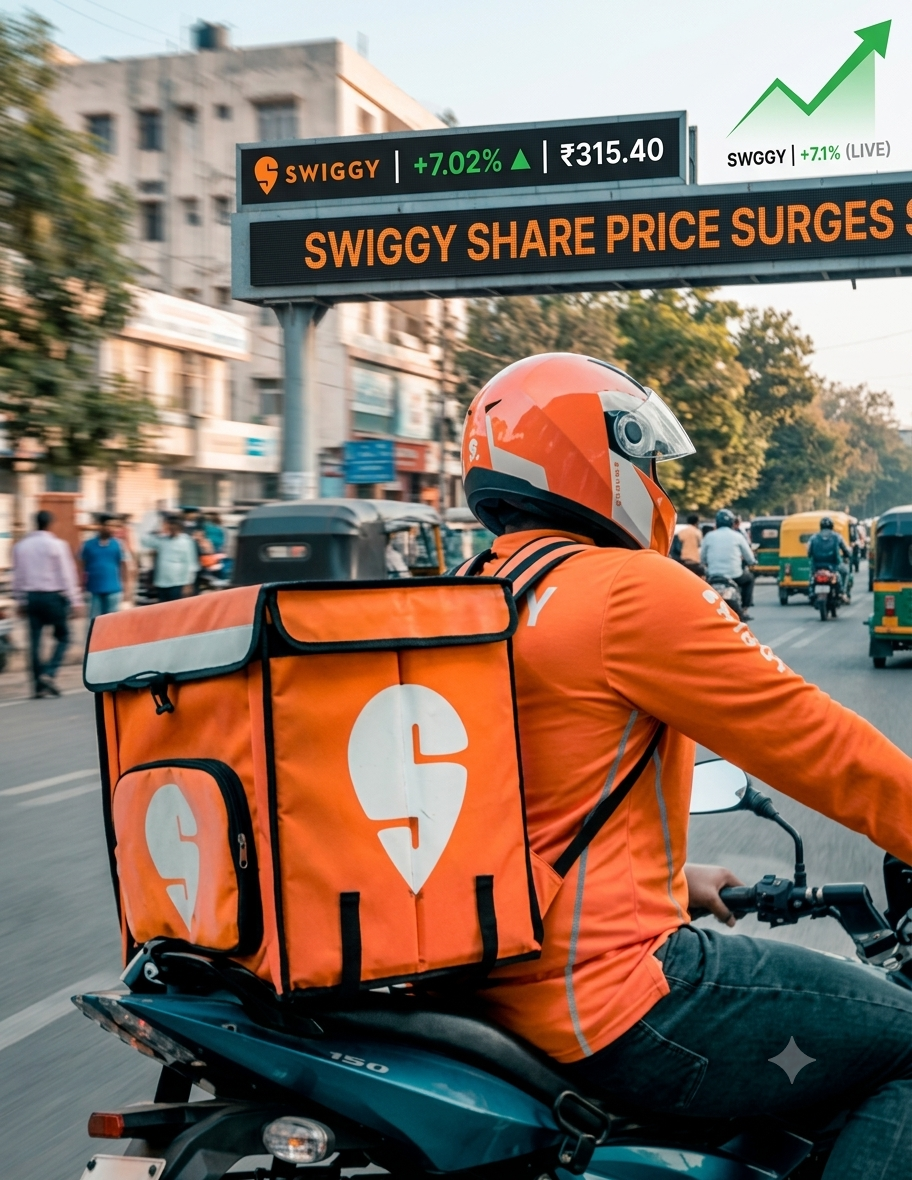
On Tuesday, July 7, 2026, Swiggy Share Price jumped nearly 7% to reach ₹266 on the Bombay Stock Exchange (BSE). This surge made it the third-biggest gainer on the BSE 500 index for the day.
The sudden rise happened because Swiggy announced that its Indian (domestic) ownership has crossed the halfway mark, reaching 50.24%. This means total foreign investments have dropped down to 49.76%.
Even though Swiggy clarified that this change does not immediately change its daily management or voting rights, investors are highly excited. This shift brings Swiggy much closer to becoming an official Indian Owned and Controlled Company (IOCC).
Getting IOCC status is a major win for Swiggy. Under India’s strict investment rules, it will allow its quick-commerce platform, Instamart, to switch to an inventory-led model. This means Instamart can directly own and manage its stock rather than just running a tech marketplace, helping it save costs and compete much better against rivals like Blinkit.
Swiggy Stock Performance & Specification Toolbar
To understand the current valuation landscape following this regulatory announcement, here is a detailed breakdown of the stock’s core metrics and trading architecture:
| Stock Metric | Current Market Data (As of July 7, 2026) |
| Current Market Price (CMP) | ₹264.00 – ₹266.00 |
| Intraday Gain | ~6.7% to 7.0% |
| 52-Week High | ₹473.00 |
| 52-Week Low | ₹235.85 (Touched in June 2026) |
| Distance from 52-Week High | Down ~44% |
| 1-Month Performance | Up ~5% |
| 6-Month Performance | Down ~27% |
| Year-to-Date (YTD) 2026 Performance | Down ~29.3% (vs. Nifty 50 down 6.5%) |
| Domestic Ownership Structure | 50.24% (Majority) |
| Aggregate Foreign Investment | 49.76% (FDI, FPI, and Indirect) |
Decoding the 50.24% Domestic Shift: Why It Matters
To the casual observer, a fractional shift in equity holding from foreign hands to domestic institutions or retail players might seem like minor back-office arithmetic. However, in the heavily regulated corridors of the Indian internet economy, this shift represents a tectonic structural alignment.
Total Capital Structure (Fully Diluted Paid-up Equity)
├── Domestic Ownership: 50.24% (Indian Institutional & Retail)
└── Aggregate Foreign Investment: 49.76% (FDI, FPI, Indirect)
By ensuring that more than 50% of its fully diluted paid-up equity capital is held natively, Swiggy has cleared the first major hurdle of the Foreign Exchange Management (Non-Debt Instruments) Rules, 2019. Under these guidelines, for an enterprise to be legally categorized as an IOCC, it must satisfy two simultaneous conditions:
Ownership: More than 50% of the equity must be beneficially owned by Indian citizens or entities owned and controlled by Indian citizens.
Control: The power to appoint the majority of directors or control management decisions must reside firmly with Indian entities.
While Swiggy’s board explicitly noted that crossing the 50% domestic ownership mark does not by itself instantly trigger the legal transition of control or modify current voting configurations, it serves as an indispensable prerequisite. Without majority domestic capital ownership, any boardroom or governance restructuring aimed at achieving IOCC compliance would be entirely dead on arrival.
The most crucial strategic move: Shifting Instamart to an Inventory-Led Model
The underlying reason investors responded so aggressively to this development lies in the operational economics of quick commerce. Currently, India’s e-commerce FDI policy draws a sharp, uncompromising line between two operational frameworks: the Marketplace Model and the Inventory-Led Model.
The Marketplace Model: Foreign-funded e-commerce and quick-commerce entities are strictly mandated to operate solely as technology facilitators. They provide a digital platform connecting independent third-party vendors to end consumers. They are legally barred from owning the warehouses (dark stores), purchasing the goods directly, or exercising direct control over product pricing and stock levels.
The Inventory-Led Model: In stark contrast, 100% domestic companies—or companies certified as IOCCs—enjoy the operational luxury of owning their stock, managing their supply chains top-to-bottom, purchasing goods directly from fast-moving consumer goods (FMCG) brands at deep bulk discounts, and structuring their fulfillment pipelines natively.
The Hidden Margin Leak in Marketplace Quick Commerce
For an ultra-fast delivery service like Instamart, relying purely on a fragmented marketplace model introduces massive operational friction and cuts deeply into margins. Under a pure marketplace setup, dark stores must be legally owned or leased by independent domestic sellers, who take their own cut of the profits. This structure introduces significant hurdles:
Slower Supply Chain Optimization: Direct bulk procurement from large consumer brands becomes highly complex when routed through intermediary sellers.
Fulfillment Friction: Any delay or inventory mismatch at the seller’s end directly impacts delivery speeds, threatening the core value proposition of quick commerce.
Compressed Profit Margins: Margins are split between the technology platform and the licensed vendor, making it exceptionally difficult to achieve unit-level profitability.
During recent corporate earnings calls, Swiggy’s Chief Financial Officer, Rahul Bothra, explicitly framed the transition toward an inventory-led model as a “natural evolution” for the hyper-growth quick commerce segment. While transitioning dark stores into fully owned corporate infrastructure demands a significantly higher upfront capital outlay, the long-term rewards are highly lucrative: vastly superior gross margins, absolute control over product quality and availability, and optimized dark store layout designs that shave vital minutes off packing and fulfillment cycles.
To prepare for this specific operational pivot, Swiggy has already quietly completed the internal groundwork by structurally carving out and restructuring Instamart into a distinct step-down subsidiary. The company is poised to flip the switch on an inventory-led model the moment the overarching corporate legal structure secures final IOCC certification.
The Competitive Moat: How Swiggy Is Shadowing “Eternal” (Blinkit)
The urgency behind Swiggy’s relentless push for IOCC status becomes entirely clear when analyzing the competitive landscape of the Indian quick commerce arena. Swiggy’s primary rival, listed under the umbrella entity Eternal (popularly known to consumers and markets as Zomato, which operates Blinkit), has already brilliantly exploited these regulatory nuances.
Eternal successfully entrenched its legal IOCC status early on by strategically capping its aggregate foreign shareholding tightly at 49.5%. By keeping foreign equity below the critical threshold, Blinkit has long operated with the massive flexibility that comes with being a genuinely Indian-owned and controlled corporate structure. This structural flexibility enabled Blinkit to build an incredibly integrated, margin-efficient supply chain model, contributing heavily to its current position at the front of the market share race.
Quick Commerce Regulatory Comparison:
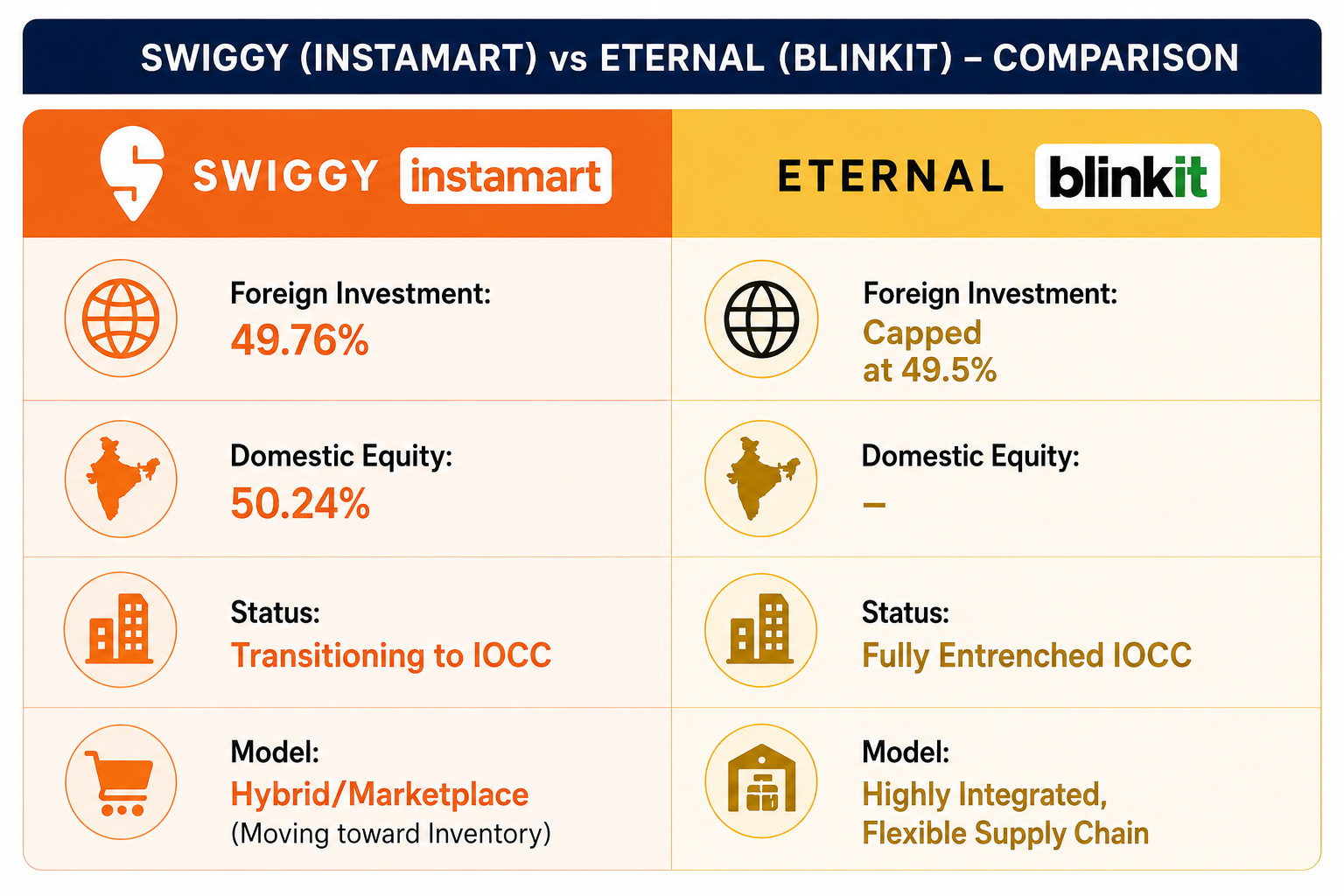
For a long time, Swiggy operated at a distinct regulatory disadvantage, forced to maintain more complex corporate arrangements to comply with marketplace rules due to its historically heavy foreign venture capital backing. By shifting the equity balance back to domestic territory, Swiggy has effectively leveled the playing field. The 7% stock market pop reflects widespread institutional relief that Swiggy is finally dismantling the structural asymmetries that kept it at an operational disadvantage against its closest peer.
The Corporate Governance Catch: The Failed AoA Shareholder Vote
While the equity numbers have realigned in Swiggy’s favor, the road to absolute IOCC status remains a complex corporate chess match. This disclosure follows closely on the heels of a minor corporate governance setback that initially dampened investor sentiment in June 2026.
Swiggy had previously floated a special resolution proposing comprehensive amendments to its Articles of Association (AoA). These specific amendments were meticulously designed by corporate legal teams to structurally alter the definition of governance, board representation, and operational “control” to fulfill the second half of the government’s IOCC mandates perfectly.
However, when put to a shareholder vote, the special resolution secured a favorable nod from 72.36% of the voting equity. While this represents an overwhelming majority of the company’s shareholder base, it fell just short of the strict 75% supermajority threshold legally required to pass a special resolution under the Indian Companies Act.
A significant portion of institutional shareholders apparently exercised caution, demanding deep clarity on whether the proposed amendments could accidentally lead to an unintended concentration of power or enhance founder-led control structures at the cost of public equity holders. Swiggy’s corporate communications teams immediately launched an extensive outreach campaign, clarifying that the proposed governance changes were strictly aimed at satisfying Indian foreign exchange laws and regulations, rather than altering the core equilibrium of internal shareholder power.
The company’s spokesperson re-emphasized this long-term view following the July 7 disclosure:
“The proposed amendment reflects our long-term commitment to ensuring management representation on the Board and advancing our transition toward becoming an Indian Owned and Controlled Company (IOCC) under applicable Indian foreign exchange laws and regulations. These remain enduring priorities for us.”
The fact that domestic ownership has naturally expanded past 50% via standard public market asset reallocation gives the management immensely powerful leverage. Armed with these fresh shareholding metrics, the board can confidently head back to the table, refine the governance language of the AoA amendments, and present a more polished resolution to institutional proxy advisory firms and shareholders for an upcoming vote with a significantly higher probability of seamless passage.
Financial Health Check: Analyzing Swiggy’s 2026 Performance Runway
Here is a simple breakdown of Swiggy’s current financial situation:
Big Drop in 2026: Even after the recent rally, Swiggy’s stock is still down 29.3% since January 2026. In comparison, the broader Indian market (Nifty 50) only dropped 6.5%, meaning Swiggy’s struggles are mostly due to its own business challenges.
Far Below Its Peak: The stock is currently trading around 44% lower than its highest point of ₹473 per share, showing it still has a long way to go to fully recover.
The Cash Burn Dilemma: While Swiggy’s core food delivery business is stable and making steady money, its quick-commerce branch (Instamart) is burning through massive amounts of cash to quickly build out “dark stores” (delivery warehouses) across Tier-1 and Tier-2 cities.
Signs of a Turnaround: The tide might finally be turning. The stock has bounced back by about 5% from its lowest point of ₹235.85, which it hit just a month ago in June 2026.
Domestic Investors Buying the Dip: Crossing the 50% domestic ownership mark shows that major Indian mutual funds and insurance companies are actively buying up these cheaper shares as foreign venture funds exit.
The Verdict: A Structural Turning Point for Instamart
The latest equity disclosure from Swiggy marks a major turning point in its journey as a public entity. While it is vital to remember that the technical legal definition of “control” will require a successful, rewritten shareholder vote on the Articles of Association, the data proves that the foundational capital structure is now firmly in place.
For Instamart, the operational benefits of this shift are massive. If the platform successfully transitions into a fully optimized, inventory-led framework, it will immediately gain the agility needed to completely re-engineer its unit economics. It can negotiate directly with consumer goods giants, wipe out intermediary margin leaks, and drastically improve fulfillment speeds across its dark store network.
For public market investors tracking the hyper-competitive quick commerce landscape, the closing of the regulatory gap between Swiggy and Eternal makes the sector far more dynamic. With a stable domestic equity floor established at ₹235 and a massive operational transformation on the horizon, the Swiggy Share Price has laid the structural groundwork for a compelling long-term recovery story through the remainder of 2026 and beyond.
Disclaimer: The information provided above is for educational purposes only. We strongly advise investors to consult with SEBI-certified financial experts before making any investment decisions.