
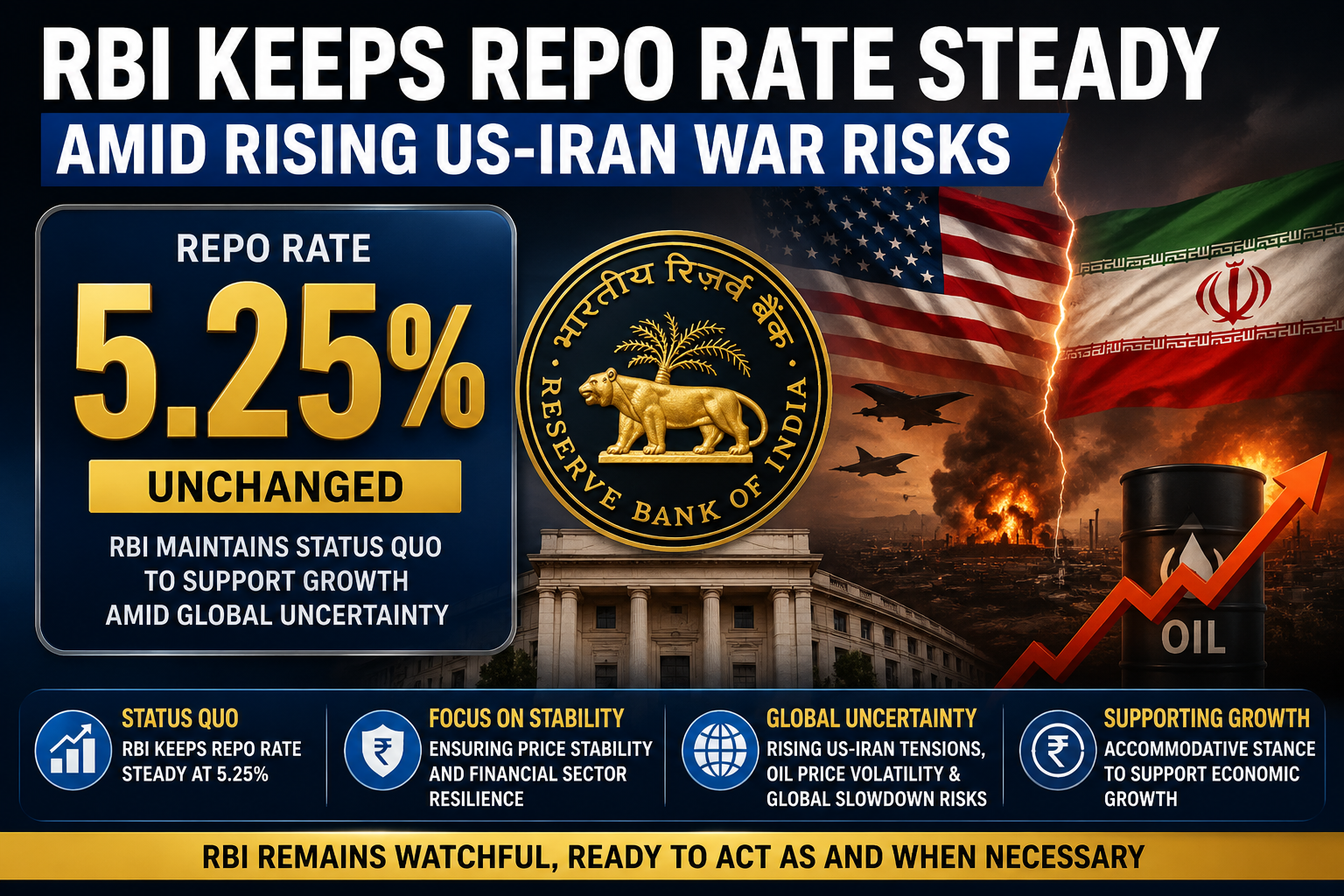
The Reserve Bank of India (RBI) chose to leave the interest rate at 5.25% after its most recent three-day meeting of the Monetary Policy Committee (MPC) on August 5 2026. The central bank faced global worries caused by the conflict between the United States and Iran and the changing prices of oil. Because of this the bank decided to go with stability and kept its approach of being neutral when it comes to money policy.
In addition to the interest rate the rate for the Standing Deposit Facility (SDF) is still 5.00%. The rate for the Marginal Standing Facility (MSF) and the rate for the Bank Rate are both, at 5.50%. All members of the committee agreed on this decision.
The market did not change much after the announcement. Indias main stock indexes showed strength. The Nifty did not move much. The Sensex kept its gains as people who invest in the market tried to understand what the new policy meant.
Key Decisions at a Glance
| Policy Instrument | Rate |
| Repo Rate | 5.25% |
| Standing Deposit Facility (SDF) | 5.00% |
| Marginal Standing Facility (MSF) | 5.50% |
| Bank Rate | 5.50% |
| Policy Stance | Neutral |
Growth Outlook Surges Despite Global Headwinds
Addressing the press, RBI Governor Sanjay Malhotra highlighted that domestic economic activity has shown remarkable resilience despite sharp global headwinds.
While acknowledging that global trade policies and geopolitical risks create a hazy near-term outlook, the central bank upgraded India’s real GDP growth projection for FY27 from 6.6% to 6.7%.
“Growth, although resilient, is expected to be lower in this financial year,” stated Governor Sanjay Malhotra. “The outlook, however, is hazy because of the uncertainties regarding global trade policy. There is a need for greater clarity to emerge, especially regarding inflation, its path, and composition before taking any policy action.”
The central bank noted that strong private consumption—driven by upbeat consumer spending—and robust Q1 manufacturing performance helped the domestic economy perform better than expected.
Inflation Dynamics: Fuel and Food Pressures Take Center Stage
Headline inflation has edged higher in recent weeks, driven primarily by external supply shocks and rising energy costs following the re-escalation of the Iran conflict in early July. However, the RBI offered a reassuring outlook by trimming the FY27 retail inflation forecast to 5.0% (down from the earlier estimate of 5.1%).
Governor Malhotra emphasized that price pressures remain concentrated in specific sectors:
Core Inflation: Core inflation (excluding food and energy) remains benign and is expected to cool down further after peaking in Q3.
Underlying Inflation: Excluding precious metals, overall price growth remains aligned with long-term projections.
Monsoon & El Niño Risks: The spatial distribution of monsoon rainfall amidst potential El Niño impacts remains a primary domestic risk factor.
Second-Round Effects: While generalized inflation pressures stay modest, the RBI remains cautious about higher fuel and food input costs bleeding into the broader economy.
Why the RBI Paused: Expert Financial Analysis
Industry experts view the rate pause as a strategic move to safeguard economic growth while keeping a tight lid on potential inflationary spillover.
Vivek Iyer, Partner and Financial Services Risk Advisory at Grant Thornton Bharat, noted that the central bank executed a delicate balancing act:
The Stance Drivers: “Benign core inflation combined with marginally higher headline inflation and anchored inflation expectations resulted in the decision. It’s a tightrope walk between growth and stability that the RBI has done again with dexterity,” Iyer explained.
The Energy & Climate Factor: “Food and fuel inflation continue to be variables that will be closely watched, given agricultural dependencies on climate factors and external supply chain challenges from an energy security standpoint.”
Interplay of Metrics: Iyer added that any rate shift depends on the interplay between core inflation, headline rates, and public inflation expectations. Stable core numbers allowed the committee to hold rates steady while remaining vigilant.
What This Means for Borrowers and Investors
Loan Interest Rates: With the repo rate holding at 5.25%, existing home, auto, and personal loan interest rates tied to external benchmark lending rates (EBLR) will remain stable for now, providing relief to borrowers.
Fixed Deposits: Fixed deposit rates are expected to hover around current levels, giving savers a predictable yield environment.
Stock Markets: Equity markets welcomed the lack of negative surprises. The pause reassures investors that monetary policy will remain supportive of corporate earnings despite international conflicts.
Looking Ahead
The Reserve Bank of India has signaled that future policy actions will depend heavily on how global energy prices evolve and whether domestic food supply chains stabilize post-monsoon. Until global geopolitical tensions subside, the central bank intends to maintain its neutral stance, ready to act if headline inflation risks widening into broad-based price pressures.