
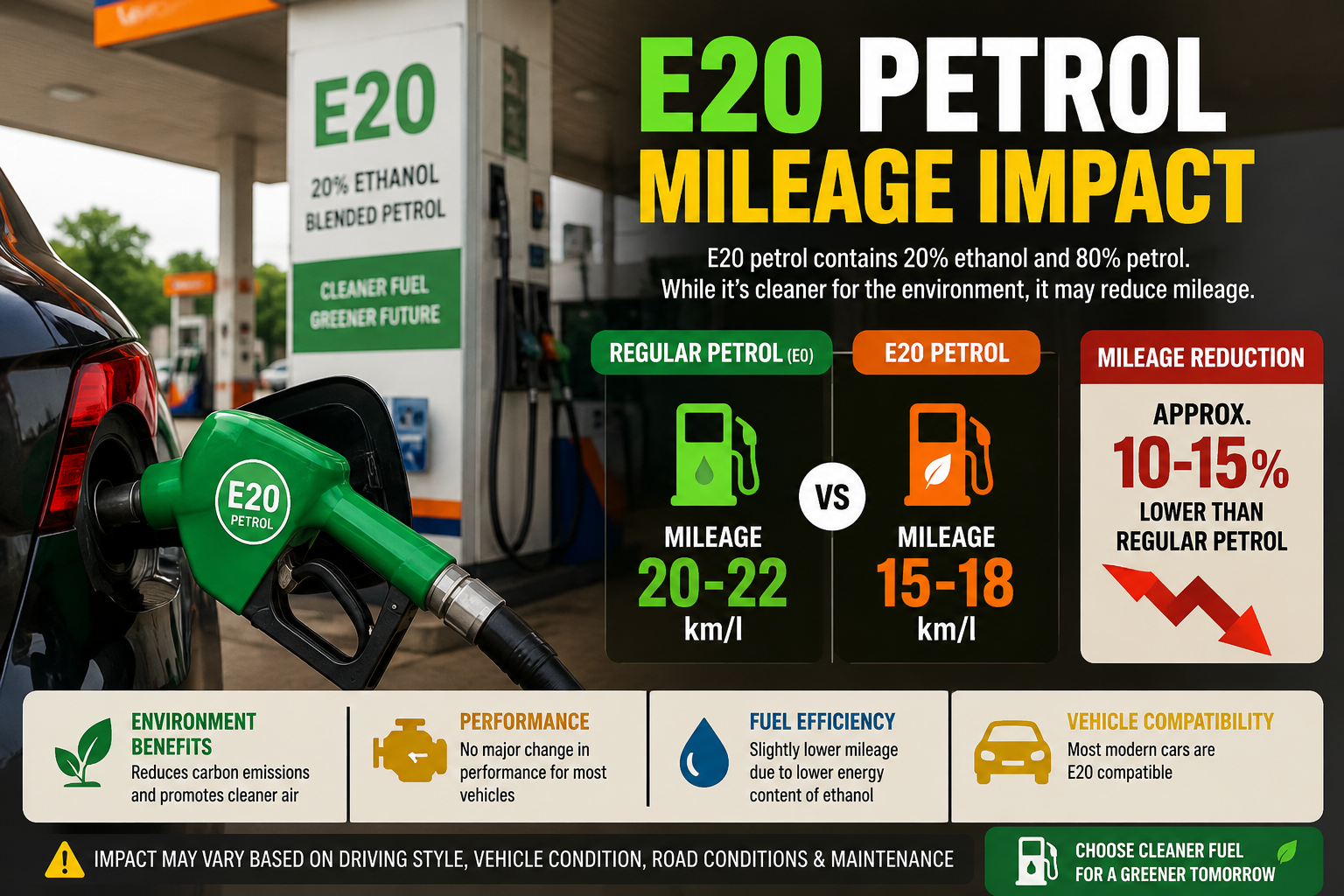
The E20 petrol mileage impact has caused a lot of discussion among vehicle owners. This is because 20% ethanol-blended fuel is now being used at fuel stations over the country. People who own vehicles are getting worried about how their vehicles can go on one tank of fuel. They are also concerned, about how their engines will last and if their vehicles will get damaged in the long run.
The Ministry of Petroleum and Natural Gas has responded to these concerns. They said that E20 petrol is not the reason why vehicles are not going as far as they used to. The Ministry of Petroleum and Natural Gas pointed out that the way people drive and the condition of their vehicles are factors that affect how much fuel is used.
1. Government Clarification: Is E20 Petrol Alone Causing Low Mileage?
In an official statement published on social media platform X (formerly Twitter), the Ministry of Petroleum and Natural Gas clarified that real-world mileage is driven by a combination of operating conditions, driver behavior, and mechanical status—not merely the chemical composition of the fuel.
“Mileage depends on more than fuel alone. Driving habits, traffic, vehicle maintenance, tyre pressure, and AC usage all play a role. E20 has undergone extensive testing and validation, while real-world mileage depends on the overall driving and vehicle conditions.” — Ministry of Petroleum and Natural Gas
While the government previously acknowledged that E20 fuel can lead to a slight 3% to 5% drop in overall fuel economy due to ethanol having a lower energy density compared to pure gasoline, officials emphasized that this minor drop is often overshadowed by poor driving practices or unmaintained vehicle hardware.
2. Rigorous Testing and Material Compatibility: “Tested, Validated, Ready”
To get rid of peoples worries about how safe vehiclesre how materials get worse over time and problems with starting the car when it is cold the government said that they did a lot of tests on E20 petrol before it was available everywhere.
The ministry said that they checked some things to see how well vehicles would work, including:
* Engine Durability: They wanted to make sure that the parts in the engine would last a long time even with more ethanol in the petrol.
*. Acceleration: They checked to see if the car would move smoothly and quickly when they pressed the gas pedal no matter how fast or slow they were going.
* Startability: They tested to see if the car would start when it was cold. They did this in many different temperatures.
* Material Compatibility: They looked at how the rubber, plastic and metal parts in the fuel system would hold up over time.
* Corrosion Resistance: They made sure that the parts that carry fuel would not get rusty or damaged.
After all these tests the Ministry said that E20 petrol is completely safe and meets all the standards, for cars so people do not have to worry about E20 petrol. The government is telling people that E20 petrol is safe because they did many tests on E20 petrol. They want people to know that E20 petrol is okay to use in their cars.
3. Addressing Fuel Contamination and Moisture Concerns
People are complaining about the mileage of their cars. There are also reports on media that the fuel is contaminated. Apparently there is much chloride in the fuel and water is getting into the storage units at fuel stations. The companies that sell fuel like Indian Oil Corporation, Bharat Petroleum Corporation Limited and Hindustan Petroleum Corporation Limited say this is not true.
They did some tests to prove it. They checked the fuel at the refineries. Found that the chloride levels were very low. They also checked the ethanol. Found that it was fine too.
The companies checked 90,000 fuel stations and did not find any big problems with water getting into the storage tanks.
The Union Petroleum Minister Hardeep Singh Puri said that the tests showed that there were a few small problems with the fuel and these were fixed right away. He said that there are no problems with the quality of the fuel, across the country. Indian Oil Corporation, Bharat Petroleum Corporation Limited and Hindustan Petroleum Corporation Limited are all saying that the fuel is fine.
4. Economic Perspective: Shielding Consumers from Price Spikes
The central government strongly defended the E20 ethanol-blending initiative as an essential economic cushion against global oil market volatility.
According to Ministry calculations:
During peak market surges, when the Indian crude basket approached $135 per barrel, traditional 100% fossil-fuel petrol could have spiked retail costs in Delhi to approximately ₹125 per litre.
Thanks to the 20% ethanol substitution program, actual pump prices were stabilized at ₹94.77 per litre.
By substituting imported crude oil with domestically produced ethanol derived from agricultural sources like sugarcane and surplus grains, the blending initiative reduces foreign exchange outflows while providing a price cushion for retail consumers.
5. Beyond E20: 7 Critical Factors That Secretly Cost You More Fuel
While ethanol mixing has a measurable effect on how much energy is produced per liter factors like how the car is driven and environmental conditions have a much bigger effect on how much fuel is used each day. Here are seven main reasons your car might be using much fuel:
Ethanol blending has a small measurable effect on how much energy is produced per liter. Mechanical and environmental factors have a bigger effect on how much fuel is used each day. Here are seven main reasons your car might be using much fuel:
A. Aggressive Driving Habits
Rapid acceleration, quick braking and driving at high speeds increases fuel use a lot. Keeping a speed and expecting what the traffic will do can make fuel use better by 15% to 30%.
B. Excessive Vehicle Idling
Leaving the engine running when stopped in traffic or for times uses a lot of fuel. Newer engines use little fuel when they start again compared to idling for more than 10 to 15 seconds.
C. Improper Tyre Inflation
Tyres that are not inflated enough create resistance on the road making the engine work harder. Driving with tyres that’re 5 PSI below the right pressure can make fuel use worse by 2% to 3%.
D. Continuous Air Conditioning Usage
Using the air conditioner at levels puts a constant load on the engine through the alternator and the cooling system. This can make fuel use worse by 10% to 20% in busy city traffic.
E. Delayed Vehicle Maintenance
Old spark plugs, dirty air filters, old oil and wheels that are not lined up properly hurt how the engine burns fuel and increase resistance. This causes a drop in how far the car can go on a full tank.
F. Congested Traffic Conditions
Stopping often switching to gears and waiting in traffic uses a lot more fuel, than driving smoothly on the highway.
G. Carrying Excess Cargo Mass
Putting weight in the back of the car makes the whole car heavier. This means the engine has to use energy to speed up and keep moving.
Summary Overview: E20 Fact vs. Factors
| Feature / Variable | Government Finding / Impact |
| Direct E20 Mileage Impact | 3% – 5% expected baseline reduction due to lower energy density |
| Material & Engine Safety | Validated across durability, drivability, startability, and corrosion resistance |
| Fuel Quality Standard | Chloride levels confirmed below 1-3 ppm across refinery and retail samples |
| Impact of Driving Habits | Aggressive driving can degrade fuel economy by up to 30% |
| Impact of AC & Idling | Heavy AC load and city idling reduce mileage by up to 20% |
Conclusion
The governments detailed answer shows that E20 fuel naturally has a 3% to 5% drop in energy efficiency compared to regular petrol but this is not the only reason for sudden drops in fuel efficiency. Driver behavior, the amount of traffic using the air conditioning and regular vehicle maintenance are the reasons for how much fuel a car uses in real life. By taking care of maintenance tasks and changing daily driving habits car owners can easily deal with the small differences, in efficiency caused by ethanol-blended petrol while also enjoying stable prices at the gas station.