
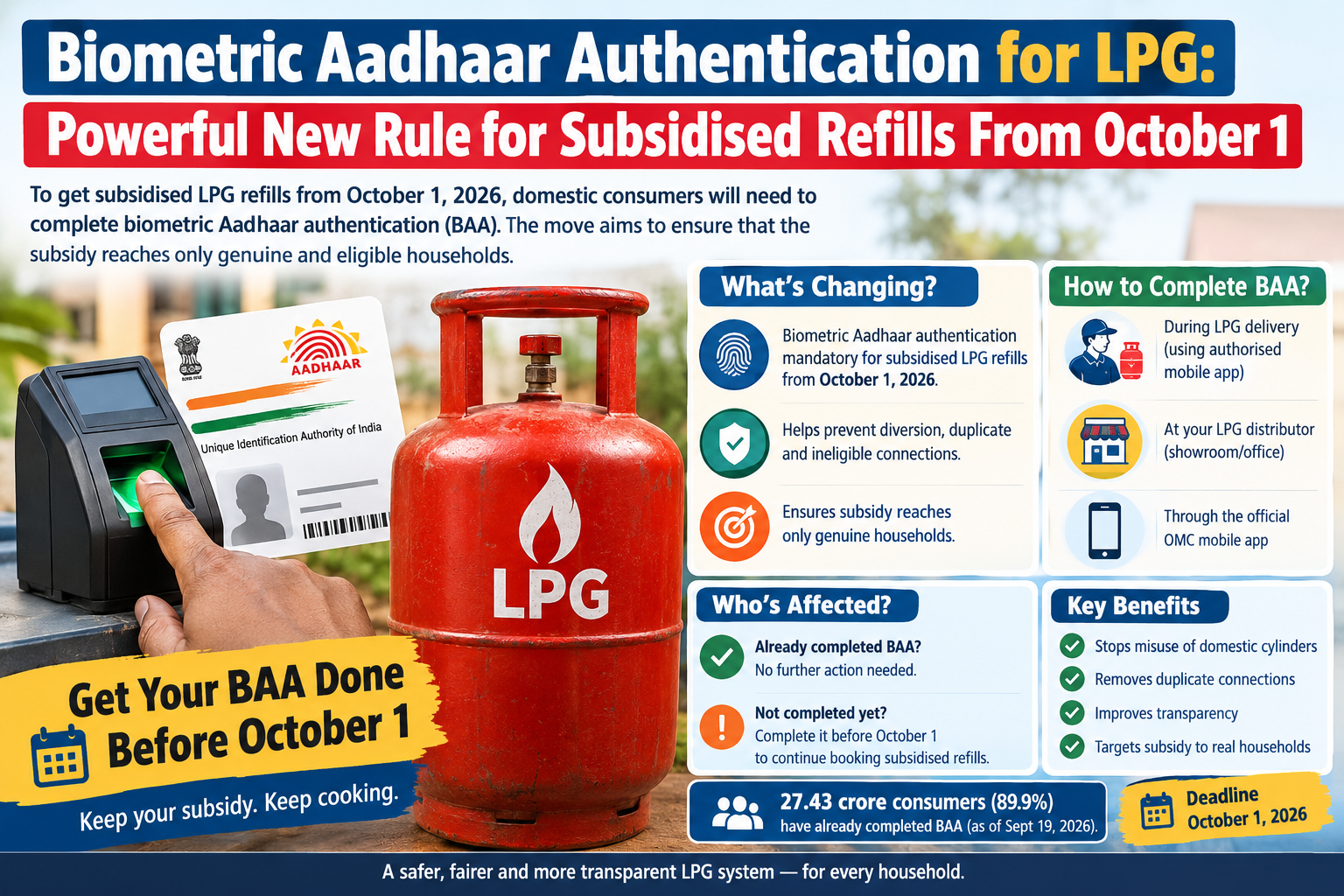
Biometric Aadhaar authentication for LPG will become a rule for households that wish to order subsidised LPG refills starting on 1 October 2026. The government says that people using LPG connections must finish biometric Aadhaar authentication also called e‑KYC to keep being able to book subsidised refills.
This step is meant to make the LPG subsidy scheme more precise and to cut the chance that duplicate, inactive or ineligible connections get benefits. The government says that tying an LPG connection to a consumer can also stop household cylinders from being used for commercial or industrial work.
For families the real concern is: What if biometric authentication is not done before 1 October?
The government says the rule is not meant to keep households from getting LPG.. People who have not finished authentication must do it before they can book a subsidised refill.
Authentication can be done in ways, such as during cylinder delivery at an LPG distributor’s office or through the mobile apps of oil marketing companies.
What Is Biometric Aadhaar Authentication for LPG?
Biometric Aadhaar authentication is a check that links an LPG customer’s identity with their Aadhaar details using verification.
In the LPG system the goal is to prove that the person using a household LPG connection is a real and eligible customer.
The government has urged LPG customers to finish e‑KYC and biometric authentication to clean up the customer list and make subsidies reach the people.
Unlike a mobile‑number check biometric authentication confirms identity through Aadhaar‑linked biometric data. Depending on how it’s done customers can finish the process with help, from an LPG delivery person, a distributor or an official oil marketing company app.
If a customer has already done the biometric authentication there is no need to do it again.
LPG Biometric Authentication Becomes Important From October 1
The key change takes effect on October 1, 2026.
From that date, consumers who want to book a domestic LPG refill at the regulated retail selling price with the applicable subsidy will need to have completed biometric Aadhaar authentication.
This does not mean that every LPG customer will suddenly lose access to LPG.
The distinction between LPG supply and subsidised refill eligibility is important.
Consumers who have already completed authentication can continue booking their refills normally. Those who have not completed the process may need to finish authentication before subsidy-linked refill booking is enabled.
This distinction is particularly important for households that depend on LPG for regular cooking and may not have checked their e-KYC status recently.
Why Is the Government Introducing This Requirement?
The main argument behind biometric authentication is better targeting of government benefits.
India has one of the world’s largest domestic LPG consumer bases. With such a large network, maintaining an accurate database of active and eligible connections is a significant administrative challenge.
Over time, LPG databases can contain connections that may be duplicated, inactive or no longer eligible for particular benefits.
The government’s stated objectives include:
- Reducing duplicate LPG connections
- Identifying ineligible or inactive consumers
- Limiting diversion of domestic LPG cylinders
- Improving subsidy targeting
- Linking benefits with verified consumers
- Increasing transparency in subsidy delivery
The government has also highlighted the possibility of reducing the diversion of subsidised domestic LPG cylinders for commercial and industrial use.
The broader policy logic
The authentication requirement should be viewed as part of a broader shift toward digitised welfare delivery.
India has increasingly used Aadhaar-based verification to identify beneficiaries and reduce duplication across government programmes. LPG is another area where the government wants the benefit to reach the intended household rather than an unidentified or duplicate connection.
From a policy perspective, better identification can make subsidy expenditure easier to monitor.
For consumers, however, the success of the system depends heavily on how easily authentication can be completed and whether genuine users face difficulties because of technical, biometric or documentation issues.
How Many LPG Consumers Have Completed Authentication?
The government said that 27.43 crore active domestic LPG consumers had completed biometric authentication as of September 19, 2026.
That represented approximately 89.9% of the total consumer base, according to the government information provided.
The figure indicates that the overwhelming majority of active domestic LPG consumers had already completed the process before the October 1 requirement.
However, the remaining percentage still represents a very large number of households because India’s LPG consumer base is measured in hundreds of millions.
That makes the final phase of authentication particularly important.
Consumers who have not completed the process should check their status rather than assuming that authentication has already been recorded against their connection.
What Happens If You Have Already Completed BAA?
If biometric Aadhaar authentication has already been completed successfully, consumers generally do not need to repeat the process.
Their refill booking will continue under the existing system, including the applicable subsidy arrangements.
This is one of the most important points for consumers who have already completed e-KYC.
There is no reason to undergo the same authentication process repeatedly simply because the October 1 deadline is approaching.
Consumers who are uncertain about their status can check with their LPG distributor or through the relevant official oil marketing company platform.
What Happens If BAA Has Not Been Completed?
For people who have not completed authentication the governments new rule becomes more important.
Starting from October 1 subsidized refill booking will be connected to finishing the authentication process.
In life a person who has not completed BAA might need to finish the verification before being able to book a refill with the subsidy.
This is why the government has asked people who still need to complete the process to do it before the deadline of waiting until the last day.
For families that use LPG a lot not finishing the authentication on time can cause problems when the next cylinder is needed.
How Can Consumers Complete LPG e-KYC?
The government has given a ways to finish the authentication.
1. Authentication During LPG Delivery
One of the choices might be to finish the process when the LPG cylinder is delivered.
The delivery person can use the oil marketing companys approved application to do the authentication.
This option can be helpful for people who do not want to go to an LPG distributor.
People should make sure that the authentication is being done through a correct way and that they know what information is being asked for.
2. Go to the LPG Distributor
People can also go to the LPG distributors store or office.
This can be helpful for those who are not used to using apps or who have trouble doing it online.
The distributor can help the person through the authentication steps. Check if the LPG connection is properly linked to the person.
3. Use the OMC Mobile Application
People can also do it themselves using the mobile app from their oil marketing company, where the authentication feature is available.
This method can be very easy, for people who are used to using tools.
Before putting in Aadhaar details users should check that they are using the app and not a fake website a third-party app or a suspicious link.
Why Consumers Should Not Wait Until the Last Day
The October 1 deadline creates a relatively simple choice for consumers who have not yet completed authentication: complete it before the requirement takes effect.
Waiting until the final day can create avoidable problems.
For example, consumers could encounter:
- High demand at distributor offices
- Technical problems with mobile applications
- Authentication failures
- Biometric verification difficulties
- Incorrect LPG account information
- Aadhaar-related data mismatches
- Delays in updating consumer records
Not every authentication problem will necessarily occur, but completing the process earlier gives consumers more time to resolve an issue if one appears.
This is especially relevant for elderly consumers or households that depend heavily on LPG for daily cooking.
Will True LPG Users Lose Their LPG Connection?
The government has made it clear that biometric authentication is not meant to stop households from getting LPG.
The main policy point now is who is eligible to book a subsidised refill.
This difference is important because news about requiring Aadhaar authentication can sometimes make people think that an LPG connection will be taken away automatically.
Consumers should therefore understand the difference between:
LPG connection: The households LPG connection at home.
Biometric authentication: Checking identity linked to the connection.
Subsidy eligibility: Whether the consumer gets the government subsidy or the controlled price benefit.
The October 1 rule is mainly about being able to book a refill for people who have not done the needed authentication.
What Does the ₹968 LPG Cylinder Price Mean?
The price of a 14.2-kg LPG cylinder in Kolkata was said to be ₹968 in the information that came with the governments announcement.
Consumers should know that LPG prices can be different in different places and can change when the government changes pricing or subsidy rules.
The actual amount a person pays can also depend on the subsidy they get and the current retail price where they live.
So consumers should look up the price that’s current, for their area instead of using an older number.
LPG Subsidy and Aadhaar: Why the Link Matters
The LPG subsidy system has undergone major changes over the years.
The government has attempted to move toward a system in which benefits are directed to eligible consumers rather than being distributed through a broad price subsidy that applies equally to everyone.
Aadhaar-based authentication can support this model by creating a verified identity link between the consumer and the LPG connection.
The expected advantages include better identification of genuine consumers and improved control over duplicate records.
But there is another side to the issue.
Any large-scale digital authentication programme needs strong safeguards for consumers who face genuine difficulties with biometric verification, documentation or technology.
A policy can be administratively efficient while still requiring effective grievance mechanisms for people who encounter authentication problems.
That is why implementation at the distributor and delivery level will be important.
What If Biometric Authentication Fails?
Biometric authentication does not always work perfectly.
Fingerprint recognition, for example, can sometimes be affected by factors such as worn fingerprints, device quality or technical connectivity.
If a consumer cannot complete authentication through one route, the existence of multiple channels becomes important.
A consumer may try another authorised route, such as:
- Visiting the LPG distributor
- Using the official OMC application
- Completing authentication during delivery
- Seeking assistance from the LPG distributor
Consumers should retain relevant transaction or authentication confirmation details wherever available.
If an authentication attempt fails repeatedly, asking the LPG distributor for assistance can help determine whether the problem is related to the LPG account, Aadhaar details or the authentication system.
What Consumers Should Check Before October 1
A simple checklist can help domestic LPG users avoid last-minute problems.
LPG Authentication Checklist
Step 1: Check whether biometric Aadhaar authentication has already been completed.
Step 2: If it is incomplete, use an authorised authentication method.
Step 3: Keep the Aadhaar details and LPG consumer information available.
Step 4: If using an app, make sure it is the official oil marketing company application.
Step 5: If digital authentication is difficult, visit the LPG distributor.
Step 6: Confirm that the authentication has been successfully recorded.
Step 7: Do not wait until you urgently need a refill to complete the process.
This process can potentially save consumers from last-minute confusion after the October 1 implementation date.
What the 89.9% Authentication Rate Tells Us
The reported 89.9% completion rate is significant because it shows that most active domestic LPG users have already gone through the authentication process.
It also suggests that the government is now moving from a broad awareness and compliance phase toward enforcement for subsidised refill eligibility.
The remaining consumers are not necessarily concentrated in one demographic or geographic group. Some may simply have postponed the process, while others may face difficulties related to technology, documentation or access.
Therefore, the final stage of implementation could be more complicated than the first 90%.
The policy’s effectiveness will ultimately depend not only on how many consumers are authenticated but also on how smoothly genuine households can resolve exceptions.
Potential Impact on LPG Consumers
The immediate impact will be different for different groups.
Consumers Who Have Completed BAA
For these households, there should be little practical change. Refill booking can continue as before, subject to the applicable subsidy rules.
Consumers Who Have Not Completed BAA
These households need to complete authentication to access subsidised refill booking.
Consumers Who Face Technical Problems
These consumers may need help from an LPG distributor or another authorised channel.
Consumers With Duplicate or Ineligible Connections
The authentication process could bring such records under greater scrutiny, consistent with the government’s objective of removing duplicate and ineligible connections.
Why This Move Matters for India’s LPG System
The importance of the October 1 rule goes beyond one authentication deadline.
India’s LPG network serves a massive number of households, and government spending on LPG support is therefore a major public-policy issue.
A more accurately verified consumer database can potentially improve the government’s ability to direct support toward eligible households.
At the same time, the system needs to maintain accessibility.
For a household that depends on LPG for everyday cooking, authentication should be straightforward, affordable and available through multiple channels.
The government has attempted to address this by allowing authentication through delivery personnel, distributors and mobile applications.
Whether that approach works smoothly across different consumer groups will depend on implementation on the ground.
Key Difference Between e-KYC and Biometric Authentication
The terms e-KYC and biometric Aadhaar authentication are sometimes used together, but consumers should understand that they refer to related verification processes rather than necessarily identical technical steps in every situation.
e-KYC broadly refers to electronic customer identity verification.
Biometric authentication involves confirming identity using biometric credentials associated with Aadhaar.
For the LPG consumer, the important practical issue is whether the required authentication has been successfully completed and recorded against the connection.
Consumers should therefore focus less on terminology and more on confirming their actual authentication status.
Frequently Asked Questions
Is biometric Aadhaar authentication mandatory for LPG from October 1, 2026?
The government has said that biometric Aadhaar authentication will be mandatory for domestic consumers seeking subsidised LPG refills from October 1, 2026.
Do consumers who have already completed BAA need to do it again?
No. Consumers who have already completed the required biometric authentication do not need to repeat the process.
Can LPG authentication be completed during delivery?
Yes. According to the government, the delivery person can facilitate authentication using the authorised oil marketing company mobile application.
Can I complete LPG e-KYC at the distributor?
Yes. Consumers can visit their LPG distributor to complete the authentication process.
Can authentication be completed through a mobile app?
Yes. Consumers can use the relevant official oil marketing company mobile application where the authentication facility is available.
What if I have not completed BAA before October 1?
You should complete the authentication as soon as possible. The government’s new requirement links subsidised refill booking to completion of the authentication process.
Will every genuine household lose LPG after October 1?
The government has stated that the process is not intended to deny LPG to genuine households. The requirement concerns eligibility for subsidised refill booking.
How many consumers had completed authentication by September 19?
The government said 27.43 crore active domestic LPG consumers had completed biometric authentication by September 19, representing about 89.9% of the consumer base.
Final Analysis
The biometric authentication requirement set for October 1 2026 is another move by the government to make LPG subsidy delivery more targeted and based on identity.
For consumers who already finished BAA, the practical impact of the biometric authentication requirement will be small. The important group is the rest of the consumer base that still has not finished authentication.
The governments approach offers ways to finish the process. Consumers can authenticate when LPG is delivered visit the distributor or use mobile apps. That flexibility matters because LPG consumers across India have different levels of digital access.
The policy also points to a challenge, in Indias welfare system: cutting leakage and duplication while not putting obstacles in front of real beneficiaries.
If authentication works smoothly the government will have an more reliable LPG consumer database. For consumers the steps are simple: check their authentication status finish the process through a channel if needed and do not wait until a refill is urgently required.
With the October 1 deadline coming LPG users who are not sure of their status should check it now instead of assuming that their connection is already authenticated.