
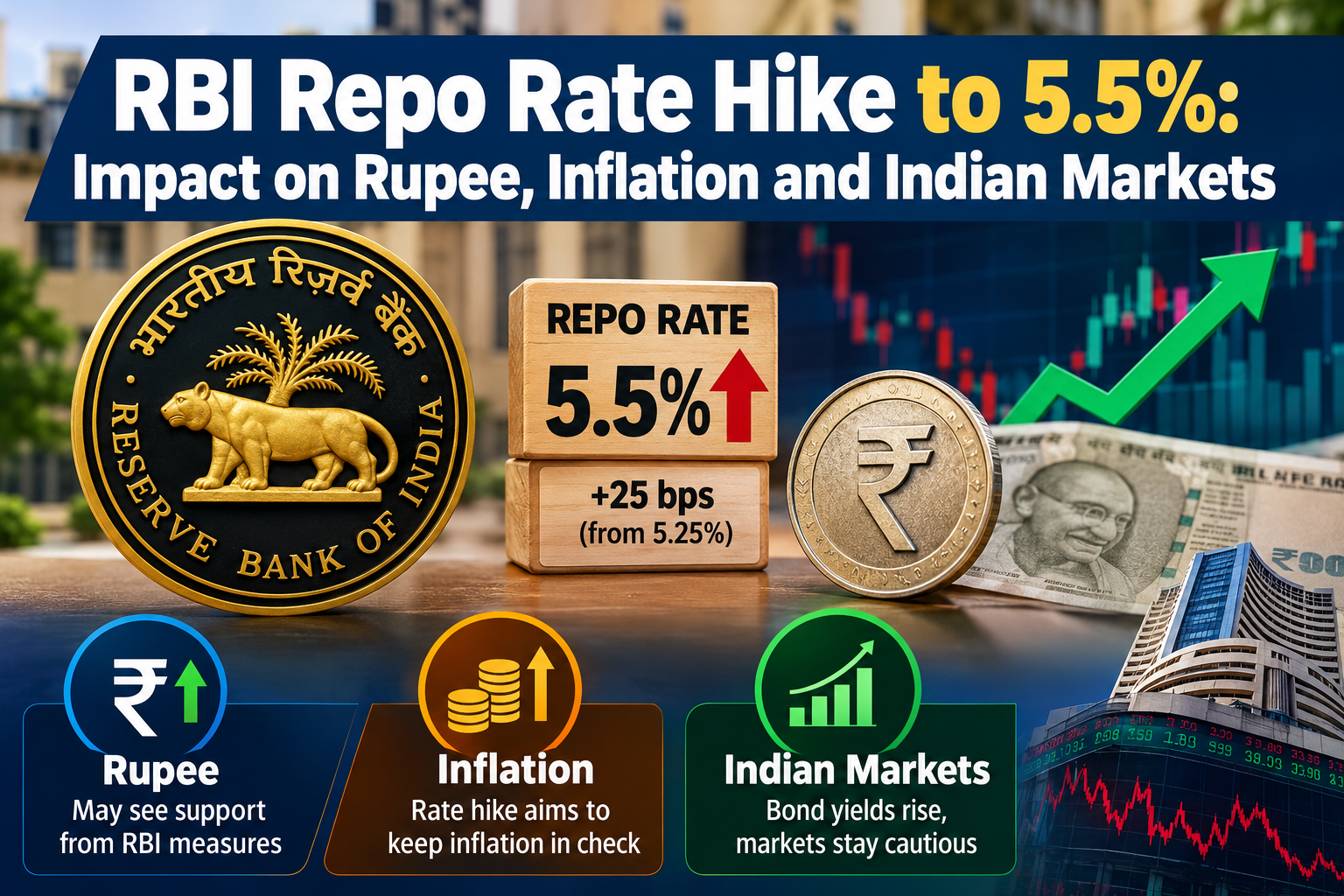
The RBI repo rate hike has brought attention to Indias inflation outlook, currency pressure and financial markets. The Reserve Bank of India (RBI) has raised the repo rate by 25 basis points to 5.5% according to the information provided. The decision was taken unanimously by the Monetary Policy Committee (MPC) headed by Governor Sanjay Malhotra.
The move comes at a time when the Indian rupee is facing pressure from oil prices foreign investment outflows and global uncertainty. The central bank is also taking steps to reduce pressure on the currency.
The rupee showed a recovery after the latest measures. However the rise in the currency does not necessarily mean that the problem has been solved. Higher borrowing costs, rising bond yields and continued pressure, on foreign exchange reserves remain concerns.
The main question is whether the RBIs actions can provide lasting support to the rupee or only offer relief.
RBI Repo Rate Hike: What Has Changed?
The interest rate that the RBI charges when it gives short-term money to banks is called the repo rate. This rate affects how much it costs to borrow money in the economy.
When the RBI increases the repo rate it can make it more expensive for banks to borrow. This can slowly lead to costs for home loans, business loans, car loans and other types of credit.
The recent change from 5.25% to 5.5% is a rise of 0.25 percentage points, which is also known as 25 basis points.
The main reasons for increasing the rate usually are:
- Controlling the pressure that causes prices to go up.
- Helping people trust the rupee more.
- Keeping situations and the growth of loans, under control.
- Stopping prices from going up and staying high.
- Keeping the economy stable.
Raising the rate also has downsides. Companies might have to pay more to borrow money. People might have to pay more for their loans if the rates go up.
The final result will depend on how the banks act, how inflation changes and whether the RBI decides to do anything.
Why Is the RBI Trying to Support the Rupee?
The Indian rupee has been under pressure against the US dollar. According to the report that was provided the rupee fell by than six percent during the year and got close to the 97-per-dollar level.
Several factors have caused this weakness in the rupee.
1. High Crude Oil Prices
India takes in a share of the crude oil that it uses. When the price of oil on the world market goes up Indian importers must spend dollars to buy energy. This can raise the demand for currency and put pressure on the rupee. Higher oil prices can also lift the costs of transport, manufacturing and distribution. If firms pass these costs onto consumers inflation could rise more.
2. Foreign Investment Outflows
Foreign investors can affect the movement of the rupee through their choices to invest. When overseas investors sell shares or bonds and shift their money to other places they may turn rupees into foreign currencies. This can raise the demand for dollars. Global geopolitical risks and higher yields in markets can make India less attractive to some investors for a short time.
3. Higher US and Global Yields
Investors compare the returns in countries. When the yields in international markets go up some investors might choose those markets over emerging economies. This can lower the capital that flows into India and make it harder for the rupee to recover.
4. A Wider External Deficit
India’s external balance can feel pressure when the value of its imports rises faster, than its export earnings and other foreign currency receipts. Expensive energy imports can make this situation harder.
These factors explain why the rupee’s weakness is not a currency‑market problem. It is also tied to oil prices, capital flows and India’s external trade position.
Rupee Gains as RBI Introduces New Measures
The RBI has introduced additional foreign exchange measures to reduce pressure on the rupee.
According to the supplied report, the currency strengthened by around 1% to ₹95.7575 per US dollar on Monday. The report described this as its strongest daily gain in approximately six months.
The recovery followed measures announced by the central bank to manage foreign exchange demand and limit excessive speculative positions.
Two important measures stand out.
Special Dollar Window for State-Owned Oil Companies
The RBI has introduced a special arrangement to meet the dollar requirements of state-run oil companies.
Oil companies need dollars to pay for crude oil and other energy imports. Providing a dedicated arrangement can help the authorities manage this demand more directly.
The aim is to reduce sudden pressure on the foreign exchange market.
However, this measure cannot remove India’s dependence on imported energy. If crude oil prices remain high, the demand for dollars may continue to increase.
Foreign Exchange Risk Reserve
The RBI has also introduced a foreign exchange risk reserve requirement for certain derivative transactions.
As described in the supplied report, banks must maintain a reserve with the central bank equivalent to 20% of the notional value of qualifying foreign exchange derivative transactions above $2 million.
The measure is intended to make certain currency positions more expensive and discourage excessive speculative activity.
However, it has also raised concerns about the cost of legitimate hedging.
Businesses often use foreign exchange derivatives to protect themselves against currency movements. If hedging becomes more expensive, companies may face additional financial costs.
The RBI therefore faces a difficult balance: reducing excessive speculation without making it unnecessarily costly for genuine businesses to manage currency risk.
Why the Rupee’s Recovery May Not Last
The recent improvement is news but a stronger rupee in just one day is not enough to create a long-lasting change.
The rupee will keep reacting to economic and financial factors.
First oil prices are still important. If oil prices go up more Indias need for dollars could go up.
Second how foreign investors act will be important. If more money comes in from overseas the rupee could get stronger. If money keeps leaving the rupee could get weaker again.
Third how strong the US dollar is will affect the rupee. If investors around the world keep choosing dollar assets other currencies may stay weak.
Finally how well the RBIs actions work depends on how people in the market react. Making it more expensive to take bets may help a little but it can’t fix all the deeper issues.
Experts mentioned in the report think the rupee will keep facing pressure. YES Bank experts said they expect the rupee to be between 96.75 and 97.25 against the dollar, by the end of March 2027. This is a prediction, not a promise of what will happen.
What Does the Repo Rate Hike Mean for Ordinary People?
The decision made by the RBI can have effects on families and companies. The result will depend on their loans how much they save how they spend money and how easy it is for them to get credit.
Home Loan Borrowers
People who have loans that change interest rates based on a benchmark that is affected by the policy rate might end up paying money in interest when their loan rates go up.
For some people the amount they pay each month could go up. For others the time it takes to pay off the loan might get longer.
What actually happens depends on the loan agreement the banks way of setting rates and when the rates change.
Personal and Vehicle Loans
Higher interest rates can make it more expensive for people to borrow money.
People who want to buy a car fix up their house. Get a personal loan should look at the interest rate the fees and how much they will pay in total before deciding to take the loan.
Bank Deposits and Savings
Higher policy rates might eventually lead to rates for people who save money but banks do not always raise their rates right away or by the same amount.
Savers should look at the interest rate how they want to keep the money in the bank the rules for taking the money out and the taxes that apply before choosing a savings option.
Businesses and Small Companies
Businesses that depend a lot on loans from the bank might have to pay more to borrow money.
Small companies can be especially affected by these changes because they might not have a lot of money saved up and might not have access, to ways to get money.
At the time keeping inflation under control can help businesses plan their costs better over a longer period of time.
Bond Market Signals Rising Borrowing Costs
The money recovery happened along with stress in the government bond market.
According to the report that was given the main 10-year government bond yield went up by much as seven basis points to 7.37%, which is the highest number since October 2023.
Bond prices and yields usually go in directions. When bond prices drop yields go up.
An increase in government bond yields can show thoughts about inflation, interest rates, government borrowing and how much people want to buy government bonds.
Higher yields can also affect the cost of borrowing throughout the economy. Government securities are an example, for setting the price of other types of debt.
One days change does not prove a long-term pattern. Investors will still look at inflation numbers RBI policy hints and how much people want government bonds.
Forex Reserves: A Strong Buffer Under Pressure
I believe foreign exchange reserves are a source of protection during periods of currency volatility.
I see that the report states that a diaspora deposit programme raised $133 billion and helped push foreign exchange reserves to $800 billion in early September. I also see that approximately $51 billion was drawn from foreign exchange reserves over the following four weeks.
I think it is important to check these figures against RBI data before publication especially because changes in foreign exchange reserves can reflect several factors, including valuation movements, intervention and other transactions.
I think adequate foreign exchange reserves help a central bank manage shortages of foreign currency and respond to disorderly market conditions. However foreign exchange reserves are not unlimited. Using foreign exchange reserves repeatedly to defend an exchange rate can reduce the buffer available, for future shocks. The RBI must therefore balance currency support against the need to preserve financial stability over time.
Can the RBI Prevent Further Rupee Weakness?
The RBI can influence currency movements through monetary policy, foreign exchange intervention and regulations. However, it cannot fully control the exchange rate when major external factors are working against the domestic currency.
A lasting recovery would become more likely if several conditions improved together.
- International crude oil prices stabilise or decline.
- Foreign investment flows into India improve.
- Export earnings and other foreign currency receipts strengthen.
- Inflation moves towards a sustainable level.
- Global financial conditions become more supportive of emerging markets.
If these conditions do not improve, the central bank may continue to face pressure even after introducing additional restrictions.
The RBI also needs to consider the effect of tighter monetary conditions on economic growth. Interest rates that remain high for too long can reduce credit demand and delay business investment.
The challenge is to support the rupee and control inflation without creating unnecessary pressure on economic activity.
Analysis: Tactical Relief or a Long-Term Solution?
The latest steps may help reduce changes in the value of the currency and stop some types of risky bets. They may also allow the RBI more control over short-term pressure in the foreign exchange market.
The bigger problems are still there.
Indias need to buy oil from countries changes in interest rates around the world and the flow of money from other countries can’t be solved just by controlling the currency market.
The new rule, about using derivatives also brings up a question: how much extra cost should real companies take in order to stop people from making risky bets?
If the cost of protecting against currency changes goes up a lot companies that export companies that import and other businesses may need to think about how they handle currency risks.
At the time raising interest rates can help keep inflation from getting worse but it doesn’t directly bring more dollars into the country or lower the cost of buying oil.
A real solution will need a mix of inflation more money coming in from other countries, better performance when selling goods abroad and careful handling of outside risks.
For people who invest the key thing is not to think that one day when the rupee goes up means the currency is starting a long-term recovery.
What Should Investors Watch Next?
Investors should focus on a few important indicators in the coming weeks and months.
1. USD/INR movement: A sustained decline in the dollar-rupee exchange rate would indicate a stronger rupee. A short-lived fall may simply reflect temporary market support.
2. Crude oil prices: Higher oil prices can increase India’s import bill and create additional currency pressure.
3. Inflation data: Consumer price inflation will help determine whether further monetary tightening is necessary.
4. Foreign investment flows: A return of overseas investors could improve demand for Indian assets and support the currency.
5. Government bond yields: Further increases could indicate changing expectations about inflation, borrowing costs or monetary policy.
6. RBI announcements: Any changes to foreign exchange rules, liquidity management or interest rate guidance could influence market sentiment.
Investors should assess these indicators together rather than relying on one market movement or a single forecast.
Final Thoughts
The RBI repo rate hike and the newest foreign exchange measures show that the central bank is reacting to pressure on the rupee and worries about inflation.
The quick rebound in the rupee gives some relief. Still the future is uncertain because oil prices, global yields and foreign investment flows keep affecting India’s markets.
Higher interest rates may help control inflation. Higher interest rates can also raise borrowing costs for households and businesses. Likewise currency restrictions may cut some positions but currency restrictions cannot lift the underlying economic pressures.
The real test will be whether the rupee can stay steady without use of foreign exchange reserves or an unnecessary slowdown, in economic activity.
For now investors should watch inflation, crude oil prices, bond yields and foreign investment flows closely. These factors will give a picture of whether the RBI’s actions are producing lasting results.
Disclaimer: This article is for informational and educational purposes only. It is not investment advice. Exchange rates, reserve figures and policy details should be verified against the latest RBI releases and market data before publication or use in financial decisions.