
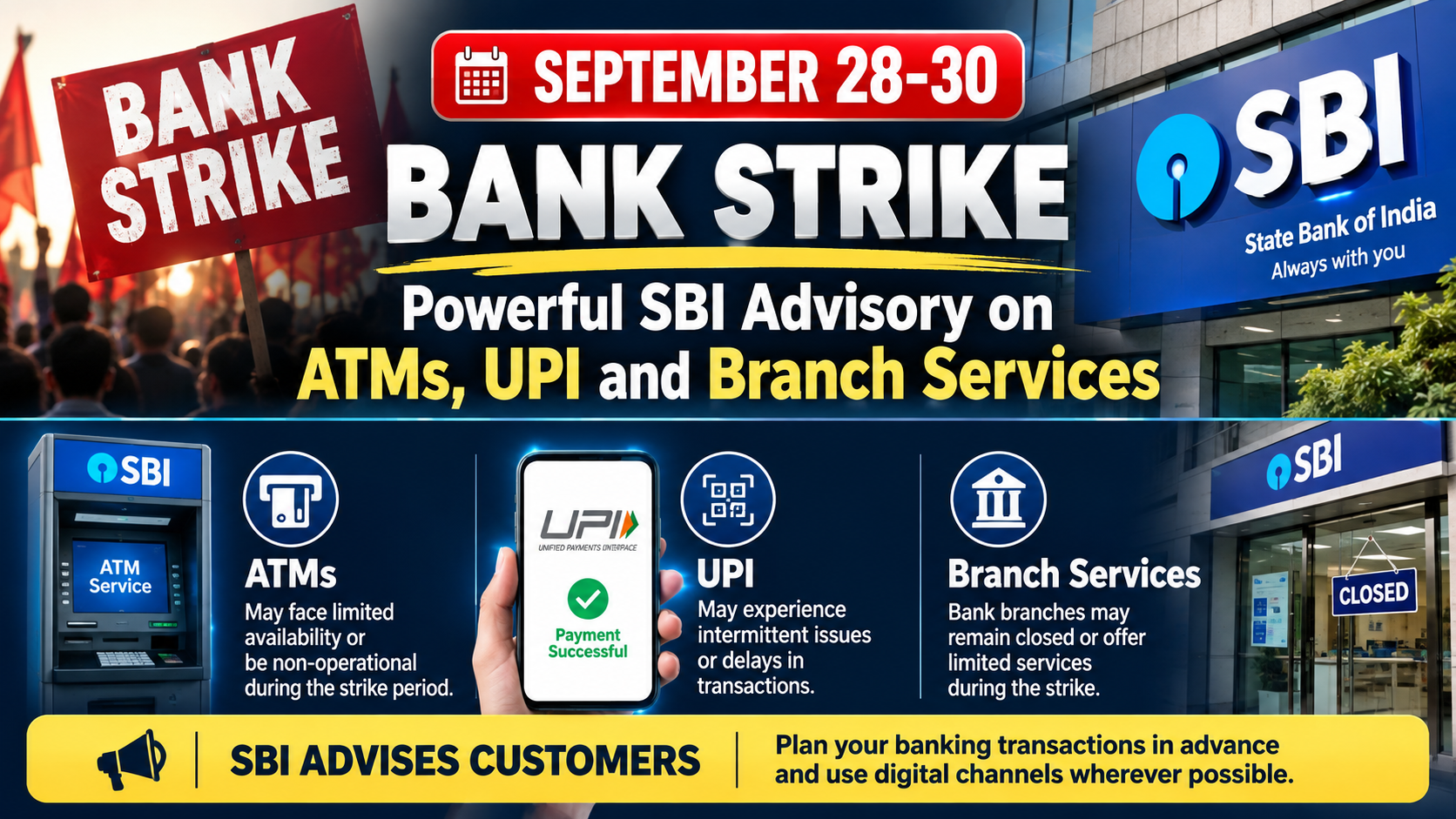
I wanted to let you know that the Bank Strike September 28-30 is expected to affect branch banking across India. The United Forum of Bank Unions (UFBU) has proposed a strike from September 28 to September 30 2026. The State Bank of India (SBI) has issued an advisory. SBI asks customers to finish work that depends on a branch before the strike dates and to use digital and alternative banking channels more.
This development matters for customers who need services that involve physical documents, cheque processing, branch staff or other in-person help.
SBI has said that SBI is taking steps to keep banking services running during the proposed strike. However the extent of disruption, at branches could depend on how many employees participate.
Why is there a bank strike from September 28 to 30?
The proposed three-day strike has been announced by the United Forum of Bank Unions (UFBU), an umbrella organisation representing bank employee and officer unions.
The proposed action is part of the unions’ ongoing industrial and organisational demands. The UFBU had also called a nationwide strike earlier in September, while further protest action has been announced for later in the year.
For customers, the immediate issue is less about the union’s demands and more about how the proposed strike could affect everyday banking.
If employees participate at a particular branch, services that normally require staff assistance may operate with reduced capacity or remain unavailable for the duration of the strike.
SBI issues advisory ahead of the proposed strike
SBI has asked customers not to wait until the strike begins to complete important branch-related transactions.
The bank’s advisory recommends completing pending work in advance, particularly transactions or documentation that require a visit to a physical branch.
Customers who have time-sensitive banking requirements should therefore check with their branch beforehand rather than assuming that every service will be available during the strike.
SBI has also advised customers to use alternative channels such as ATMs, Automated Deposit and Withdrawal Machines (ADWMs), Customer Service Points (CSPs), internet banking, YONO, mobile banking and UPI wherever applicable.
Will SBI branches remain open during the strike?
Branch availability could vary depending on employee participation.
This is an important distinction because a nationwide strike does not necessarily mean that every banking facility will operate in exactly the same way.
SBI has indicated that it will make efforts to keep essential services available, but branch-level operations could be affected.
Customers requiring staff-assisted services should therefore complete their work before September 28 wherever possible.
For routine digital transactions, customers can use SBI’s online banking channels instead of visiting a branch.
Which banking services are expected to remain available?
Several commonly used banking facilities can continue to be accessed through alternative channels.
ATM services
Customers can use ATMs for eligible transactions, including cash withdrawals.
ATM availability can, however, depend on factors such as cash availability, technical issues and network connectivity. Customers who know they will require cash during the strike period may therefore want to plan ahead.
Automated Deposit and Withdrawal Machines
SBI has also advised customers to use Automated Deposit and Withdrawal Machines (ADWMs) for eligible services.
These machines can provide an alternative to certain branch-based transactions, although the exact services available may vary by machine and location.
Customer Service Points
Customer Service Points (CSPs) will also remain an alternative channel for selected banking services.
The availability of specific facilities can vary, so customers should check what services are offered at their nearest CSP before relying on it for a particular transaction.
Internet banking
SBI’s internet banking platform can be used for many routine financial transactions without visiting a branch.
Customers can use online banking for activities such as eligible fund transfers, account-related services and bill payments.
For people who normally visit branches for routine transactions, moving these activities online can help reduce the impact of the proposed strike.
YONO and mobile banking
SBI customers can also use YONO and mobile banking services for eligible transactions.
These platforms provide access to several everyday banking facilities through a smartphone, reducing the need for physical branch visits.
UPI payments
UPI-based payments are also expected to remain an important option for customers during the strike.
UPI can be used for eligible person-to-person payments, merchant transactions and other supported digital payments.
However, customers should remember that UPI availability does not replace every branch service. Transactions involving physical documentation or specific banking procedures may still require assistance from bank staff.
Which banking services could be affected?
The main risk is for services that depend on physical branch infrastructure or employee assistance.
These may include certain documentation requirements, cheque-related processes and other transactions that cannot be completed entirely through digital channels.
The precise impact could vary from one location to another because branch operations depend on employee participation.
Customers with pending paperwork, account-related documentation or time-sensitive cheque requirements should therefore avoid leaving these tasks until the strike period.
Five-day disruption window for some customers
The timing of the proposed strike is particularly important.
September 28, 29 and 30 fall on Monday, Tuesday and Wednesday in 2026. They follow the weekend of September 26 and 27.
This means customers who depend on physical bank branches could potentially face a five-day period from September 26 through September 30 with limited access to normal branch operations.
This does not mean that all banking services will stop for five days.
Digital banking, UPI, ATMs and other alternative channels can continue to provide access to many routine services. The five-day period is mainly significant for customers who specifically require physical branch assistance.
What should SBI customers do before September 28?
Customers can take a few practical steps before the proposed strike begins.
1. Complete branch-dependent transactions early
If a transaction requires physical documentation or assistance from bank employees, completing it before September 28 can reduce the possibility of delays.
2. Check cheque-related requirements
Customers with important cheque transactions should avoid waiting until the strike period.
Where a cheque-related process has a deadline, it is sensible to confirm the expected processing timeline with the bank beforehand.
3. Keep sufficient cash for planned needs
ATMs are expected to remain an alternative during the strike, but customers with specific cash requirements may prefer to withdraw money before the strike begins rather than depending entirely on ATM availability.
4. Check digital banking access
Customers who rarely use internet banking, mobile banking or YONO should make sure their login credentials and required authentication methods are working before the strike.
This can prevent unnecessary problems when a branch is less accessible.
5. Use UPI for routine payments
For everyday purchases and eligible transfers, UPI can reduce the need to visit a bank branch.
Customers should nevertheless keep alternative payment options available for situations involving network or technical problems.
What does the SBI advisory mean for customers?
The key point from SBI’s advisory is that customers should plan around branch-dependent services rather than assume that every banking facility will be unavailable.
The proposed strike primarily creates uncertainty around physical branch operations. Digital banking and self-service channels can continue to handle many routine transactions.
This creates two different experiences for customers.
A person who primarily uses UPI, mobile banking and internet banking may notice relatively little disruption.
By contrast, someone who needs documentation, staff assistance or a physical branch service could face delays.
The practical impact will also depend on the level of employee participation at individual branches.
SBI customers should distinguish digital services from branch services
One of the easiest ways to understand the situation is to divide banking activities into two categories.
Digital or self-service transactions can generally be attempted through:
- UPI
- Internet banking
- YONO
- Mobile banking
- ATMs
- ADWMs
- Eligible CSP services
Branch-dependent activities may face disruption if employees participate in the strike. These can include:
- Certain documentation processes
- Staff-assisted transactions
- Specific cheque-related services
- Other services requiring physical branch infrastructure
The exact availability of a service should be confirmed with SBI when the transaction is important or time-sensitive.
What happens after September 30?
The proposed three-day strike is scheduled to end on September 30.
However, the unions have also announced further industrial action later in October, including a proposed continuous strike beginning October 26.
That means customers should pay attention to subsequent announcements rather than treating September 30 as necessarily the end of all proposed protest-related disruptions.
For the September strike specifically, the immediate priority is to complete important branch work early and use alternative channels for routine transactions.
Bank Strike September 28-30: Key takeaway
The Bank Strike September 28-30 could affect normal branch operations across India if employees participate in the proposed nationwide action.
SBI’s advisory does not mean that all banking services will stop. The bank has asked customers to complete important branch-related work beforehand and use ATMs, ADWMs, CSPs, internet banking, YONO, mobile banking and UPI for eligible services.
The biggest potential inconvenience is for customers whose transactions require physical documents or assistance from branch employees.
With the strike following the September 26-27 weekend, customers who need branch services should plan ahead rather than waiting until the last working day.
For routine digital payments and transfers, customers can continue using available electronic banking channels. However, where a transaction is time-sensitive or branch-dependent, confirming the service availability with SBI in advance remains the safer approach.
Disclaimer: This article is based on the SBI advisory and information supplied about the proposed UFBU strike. Service availability may vary by branch, location, employee participation and technical conditions. Customers should check the latest communication from SBI before undertaking time-sensitive banking transactions.