
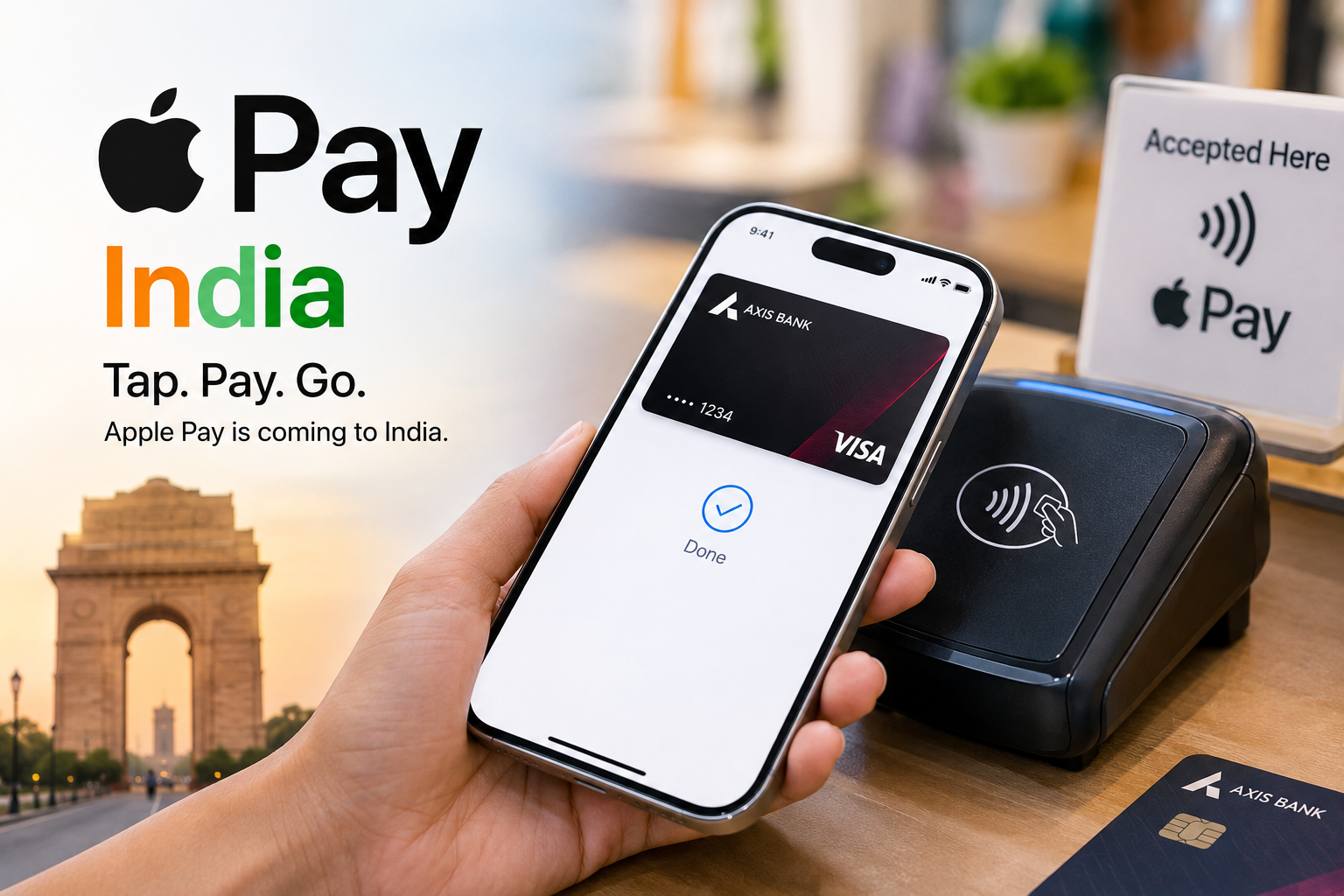
Apple Pay India might finally happen in October 2026. This would give iPhone users in the country another way to make payments without touching a card. A report from Reuters on September 18 said Apple is getting ready to start Apple Pay in India month. The company is working with Axis Bank. It will start with Axis Bank credit cards. Apple has not said anything. So the date the bank plans and the cards that work are still not confirmed.
This possible launch is important because India already has a strong digital payment system. The Unified Payments Interface or UPI is very popular. Apps like Google Pay, PhonePe and Paytm use UPI. It lets people send money instantly between bank accounts. It also works with QR codes and more ways to pay without cash.
Apple Pay would bring a way to pay. Of using UPI to move money from a bank account Apple Pay uses tokenised credit and debit cards. A card that works with Apple Pay can be added to the Wallet app. Then the user can pay by using Face ID, Touch ID or a code on the phone. The user just holds the iPhone or Apple Watch near a payment terminal that accepts contactless payments.
This means Apple Pay will not be the same as Google Pay or PhonePe. Its main customers, in India might be iPhone users who already have credit cards. These users could find Apple Pay a way to pay at places that have NFC terminals.
This is what the possible Apple Pay India launch could mean for users.
Apple Pay India launch: What is actually confirmed?
The first thing iPhone users should understand is the difference between a reported launch and an announced launch.
Reuters reported that Apple plans to launch Apple Pay in India in October. The report said Axis Bank would be the banking partner. It also mentioned that Apple has talked about expanding with major private-sector lenders, such as HDFC Bank and ICICI Bank.. The commercial terms have not been finalized yet.
Apple has not made any announcement about launching Apple Pay in India. There is no list of supported banks or cards.
So users should not assume that every iPhone, every bank card or every payment network will work right from the start.
The initial rollout is expected to be limited. More banks may be added later.
This approach matches Apples way of entering new payment markets. It relies on agreements, with financial institutions and payment networks.
How will Apple Pay work on an iPhone?
The basic process is familiar to anyone who has used Apple Pay in another country.
A user adds a bank card to the Apple Wallet app. Of simply storing the physical card number on the phone Apple Pay uses tokenisation to create a device‑specific payment credential.
When the customer makes a payment at a contactless terminal, the iPhone or Apple Watch talks to the terminal using near‑field communication commonly called NFC.
The user can then authenticate the transaction using Face ID, Touch ID or the device passcode.
The important difference is that the merchant never receives the users card number during a normal payment flow.
Apple says its payment architecture uses a device account number and transaction‑specific security information instead of exposing the underlying card number during a purchase.
This is one of the reasons Apple Pay is different, from simply taking a photograph of a credit card or entering card information into a website.
Why does Apple Pay need tokenisation?
Tokenisation is central to the Apple Pay experience.
In a traditional card transaction, the card number is an important piece of payment information. With tokenised payments, a substitute credential can be used for transactions without exposing the original card number to the merchant.
India already has a regulatory framework around card tokenisation. The Reserve Bank of India has previously required restrictions on the storage of actual card data by entities in the payment chain and has developed rules allowing tokenised card transactions.
For consumers, this can reduce the number of situations in which their actual card number needs to be shared.
However, tokenisation does not mean that payments are risk-free. Users still need to protect their Apple Account, device passcode, banking credentials and physical devices.
Why is Apple Pay coming to India only now?
Apple Pay has been around in big countries for quite some time now.. In India things have taken a different path. Of relying on foreign payment systems India built its own way with UPI and local payment networks.
The reason Apple Pay hasn’t arrived in India yet seems to come down to two areas: rules and money.
One key point is how people verify their payments. In July 2024 the Reserve Bank of India released a draft plan that allows ways to authenticate digital payments beyond just SMS-based one-time passwords. The RBI said technology has moved forward and there are options now. This change could help make paying easier and safer.
This matters a lot because Apple Pay depends heavily on device-based authentication. Things like Face ID and Touch ID are central to how it works. If India allows modern methods then Apple Pay could fit right in.
There’s also the business side. When someone uses Apple Pay with a credit card the transaction creates interchange revenue. A fee paid by the merchant’s bank to the card network. That income goes to banks and payment processors.
Reports from Reuters say Apple has been talking with banks about how this revenue would be shared. How much Apple gets and how much the banks keep is a part of the negotiations.
That’s important because banks already earn from card transactions. They aren’t going to agree to a system unless it fits into what they already make. Any deal, with Apple needs to work with the financial structure. So even if the tech is ready the economics must match too.
Which Indian bank will support Apple Pay first?
According to Reuters, Axis Bank is expected to be the initial banking partner for Apple Pay in India. The first rollout is expected to focus on Axis Bank credit cards.
This does not mean Axis Bank will necessarily be the only supported bank permanently.
Reuters reported that Apple has also held discussions with HDFC Bank and ICICI Bank. However, commercial terms with those banks had not been finalised at the time of the report.
This suggests that Apple Pay could follow a phased banking rollout.
For an iPhone owner with an HDFC Bank, ICICI Bank, SBI Card or another credit card, the practical takeaway is simple: do not assume your existing card will be supported on the first day.
The final list will need to come from Apple and the respective banks.
What about Axis Bank’s credit cards?
Axis Bank is already a major participant in India’s credit-card market.
Reuters, citing RBI data, reported that Axis Bank had around 16.26 million active credit cards in July 2026, putting it behind HDFC Bank, SBI Cards and ICICI Bank in terms of active cards.
If the reported Apple Pay arrangement goes ahead, eligible Axis Bank cardholders could be among the first Indian consumers able to add a supported credit card to Apple Wallet.
The exact eligibility could depend on the card type, payment network and Apple’s final launch arrangements.
Therefore, having an Axis Bank credit card alone should not be treated as an automatic guarantee of Apple Pay compatibility until the bank publishes its supported-card list.
Will Apple Pay support UPI?
This is one of the biggest questions surrounding Apple Pay India.
The expected initial Apple Pay rollout is centred on card payments rather than UPI.
That means Apple Pay should not be viewed as a replacement for UPI apps at launch.
UPI operates differently. It allows money to move between bank accounts through India’s real-time payment infrastructure. Users can send money to another person, pay merchants through QR codes and make other transactions without using a traditional card transaction.
Apple Pay’s initial proposition is instead based on a supported payment card stored in the Wallet app.
If Apple eventually integrates UPI into its Indian payment experience, that could substantially broaden the service. But there is currently no confirmed announcement establishing UPI support for the reported initial Apple Pay launch.
Apple Pay vs Google Pay and PhonePe: What is the difference?
The names can cause confusion because all three services can be used on smartphones.
But their payment mechanisms can be very different.
UPI apps:
Google Pay, PhonePe and Paytm can be used for UPI transactions. Money is transferred through the UPI system, normally from one bank account to another.
Apple Pay:
The reported Indian launch is centred on tokenised card payments. Instead of directly debiting a bank account through UPI, the user pays using an eligible card.
This distinction also affects rewards.
A credit-card transaction can potentially earn the rewards, cashback or benefits associated with the underlying card, depending on the bank’s rules.
The transaction also remains part of the card’s normal billing cycle.
UPI, by comparison, generally works as a bank-account payment mechanism.
So an iPhone user may end up using both services rather than choosing one exclusively.
For example, UPI could remain useful for QR-code payments and person-to-person transfers, while Apple Pay could be used for contactless credit-card payments at compatible terminals.
Is UPI already capable of tap-to-pay?
Yes.
India’s payment ecosystem is not waiting for Apple to introduce contactless smartphone payments.
NPCI has already introduced a UPI tap-and-pay capability that allows users with compatible smartphones to make contactless payments at NFC-enabled terminals. Reuters reported on September 10 that the feature can allow payments without opening the UPI app and can work in low- or no-internet situations under the supported setup.
That creates an interesting situation for Apple.
Apple Pay will arrive in a market where tap-based payments are already developing within UPI.
UPI’s scale is also enormous. Reuters reported that UPI processed 24.51 billion transactions worth ₹29.82 trillion in August 2026, highlighting the scale of India’s existing real-time payments infrastructure.
Apple therefore does not have to introduce Indian consumers to contactless digital payments from scratch.
Its challenge is more specific: providing an attractive card-based payment experience for iPhone and Apple Watch users.
Will Apple Pay work at every shop?
No.
Apple Pay’s usefulness will depend on merchant acceptance.
A shop needs a compatible contactless payment terminal capable of accepting the relevant card network.
That means Apple Pay is fundamentally different from paying through a UPI QR code.
A neighbourhood shop that accepts only UPI through a printed QR code may not be able to accept an Apple Pay card payment.
On the other hand, airports, hotels, large retail stores, restaurants, malls and other businesses with NFC-enabled card terminals could be more natural environments for Apple Pay.
This distinction is particularly important in India because QR-based payments are deeply integrated into everyday commerce.
Can Apple Pay send money to another person?
The expected Indian version of Apple Pay should not be confused with a peer-to-peer money transfer service.
Apple Pay is primarily a merchant payment system.
If someone wants to send ₹500 to a friend using an Android phone, UPI apps remain the practical route.
Apple’s Apple Cash service, which supports person-to-person payments in the United States, is a separate product and should not be assumed to be part of the Indian Apple Pay launch.
Therefore, Apple Pay does not mean that iPhone users will suddenly be able to replace UPI for every type of payment.
Will RuPay cards work with Apple Pay?
The initial rollout is expected to focus on international card networks such as Visa and Mastercard rather than offering universal support for every Indian card network.
RuPay support has not been confirmed for the reported initial launch.
This is another area where users should wait for the official compatibility list before deciding whether their existing card will work.
For consumers, the important factors could include:
- The issuing bank
- The specific credit card
- Visa, Mastercard or another network
- Apple’s eligibility requirements
- The bank’s participation in Apple Pay
Having an iPhone alone will not guarantee access to Apple Pay.
Which Apple devices will support Apple Pay?
Apple Pay is designed to work across Apple’s ecosystem, including compatible iPhones and Apple Watches.
In other countries, compatible iPads and Macs can also use Apple Pay for online payments, although the exact feature set varies by device and use case.
For India, Apple has not yet published a final device compatibility list for the reported launch.
Users should therefore check Apple’s official compatibility information once the Indian service is formally announced.
The key hardware requirement for in-store contactless payments is NFC capability, along with Apple’s security and software requirements.
Will Apple Pay work for online purchases?
Potentially, yes.
Apple Pay is not limited to physical stores.
Where merchants and apps support Apple Pay, users can select the payment option during checkout and authenticate the purchase on their Apple device.
This can remove the need to repeatedly enter card numbers, expiry dates and other card information.
However, Indian availability will depend on how Apple and participating banks configure the service.
Online support may also vary between websites, apps and subscription services.
What about App Store and Apple subscriptions?
Apple Pay could also have implications for payments within Apple’s own ecosystem.
Eligible cards may eventually provide another route for purchases such as App Store transactions and services including iCloud+ or Apple Music, subject to Apple’s final Indian payment arrangements.
But this should not be presented as a confirmed launch feature until Apple publishes its Indian terms.
Apple’s payment environment in India has already had to adapt to local rules and available payment methods.
The introduction of Apple Pay could give eligible users another card-based option if Apple integrates it into relevant billing flows.
How secure is Apple Pay?
Security is one of Apple’s main selling points for Apple Pay.
The service is built around several layers:
- Device authentication
- Tokenised card credentials
- NFC communication for contactless transactions
- Transaction-specific security information
- Apple’s Secure Element architecture on supported devices
The central concept is that the actual card number does not need to be transmitted to the merchant in the same way as a conventional card transaction.
RBI’s tokenisation framework has also been designed to reduce the storage and exposure of actual card data within the payment ecosystem. RBI rules state that entities in the card transaction chain other than card issuers and card networks should not store actual card data, subject to the framework’s provisions.
That does not eliminate every possible payment risk.
Users should still use strong device security, protect their Apple Account and report lost or stolen cards promptly to their bank.
How will Apple Pay fit into India’s changing payment market?
The timing of the reported launch is particularly interesting because India’s digital payment market is changing.
UPI has historically been associated with zero-cost transactions for many users and merchants. But Reuters reported in September 2026 that a 0.4% Merchant Discount Rate is set to apply from October 15 to certain UPI merchant transactions above ₹2,000, with exemptions and different treatment for some categories. Person-to-person UPI transfers remain free under the reported framework.
This does not mean Apple Pay is replacing UPI.
The two systems serve different purposes.
UPI’s strength is account-to-account payments, QR payments and instant transfers.
Apple Pay’s reported Indian proposition is centred on card payments and the convenience of keeping a card inside the iPhone.
For banks, the distinction is also important because credit-card transactions generate interchange economics that are different from the UPI model.
Why India matters to Apple
India has become increasingly important to Apple both as a consumer market and as a manufacturing base.
Reuters reported that Apple’s share of India’s smartphone market had reached around 8%, roughly double its level since 2022.
That creates a growing installed base of potential Apple Pay users.
Apple also has an expanding retail presence and a large ecosystem of iPhones, Apple Watches and other devices in the country.
A payment service could strengthen the connection between Apple’s hardware and services businesses.
But India is not an easy market simply because Apple has a large user base.
The country already has an established digital payments infrastructure, extremely high UPI adoption and strong local payment habits.
Apple Pay therefore has to provide a reason for iPhone users to use cards through Wallet rather than simply opening a UPI app or scanning a QR code.
What could make Apple Pay useful for Indian iPhone users?
The biggest advantage that Apple Pay could bring is convenience.
If a person already carries a credit card that Apple Pay can use Apple Pay can stop them from having to pull the card out of their wallet.
The payment could happen in a few steps:
Select the card →verify with Face ID or Touch ID →bring the iPhone close to the terminal. The payment is finished.
For people with an Apple Watch the process might be even easier because the payment tool is already on their wrist.
Credit card rewards are another reason people might like Apple Pay.
If a persons card gives cashback reward points, airport perks or other bonuses using that card with Apple Pay could keep those benefits as long as the card issuer allows it.
Therefore Apple Pay could be most appealing, to people who already use credit cards for shopping.
What Apple Pay will not replace
It is equally important to understand what Apple Pay probably will not replace at launch.
It is unlikely to eliminate the need for UPI apps.
Users will still need UPI for many QR payments, peer-to-peer transfers and transactions where card acceptance is unavailable.
Apple Pay also will not make an NFC terminal appear in every shop.
A merchant that accepts only UPI QR payments will continue to require a UPI-compatible payment method.
Similarly, an iPhone user with an unsupported bank card may have to continue using the bank’s existing app or a physical card.
The result could be a two-system payment routine rather than a complete shift from UPI to Apple Pay.
What should iPhone users do before Apple Pay launches?
There is no need to make major changes immediately.
If the reported October launch happens, users can wait for Apple and participating banks to publish official information.
Before adding a card, check:
- Whether your bank participates.
- Whether your exact card is eligible.
- Which payment network the card uses.
- Whether your iPhone is running compatible software.
- Whether the merchant accepts contactless card payments.
- What transaction limits or authentication requirements apply.
- Whether your card’s reward programme treats Apple Pay transactions normally.
Users should also be cautious about unofficial websites or messages claiming that they need to pay a fee to activate Apple Pay.
Apple Pay activation should be handled through official Apple and bank channels.
The bigger picture: Apple Pay versus India’s payment habits
The arrival of Apple Pay would be less about replacing India’s existing payment infrastructure and more about adding another layer to it.
India has developed a payment environment in which consumers are comfortable using multiple methods.
Someone might use UPI for a ₹200 local purchase, a credit card for a large retail transaction, net banking for a particular service and cash where digital payments are unavailable.
Apple Pay could fit into that existing behaviour rather than fundamentally changing it.
Its biggest opportunity may therefore be the premium credit-card segment of the iPhone user base.
Instead of asking Indian consumers to abandon UPI, Apple can potentially give existing cardholders a faster and more integrated way to use their cards.
Apple Pay India: What happens next?
The next important step is an official announcement.
Until Apple confirms the service, the October 2026 timing and Axis Bank arrangement remain based on reporting rather than a public Apple launch announcement.
If the reported rollout goes ahead, Axis Bank credit cards are expected to form the first phase, while discussions with other banks could determine how quickly Apple Pay expands across India’s banking system.
The competition will also be interesting.
UPI already handles billions of transactions every month, and NPCI has added contactless functionality of its own.
Apple Pay therefore enters India with a very specific proposition: a card-focused, device-integrated payment experience for Apple’s ecosystem.
For iPhone users, that could mean one more payment option rather than a replacement for the services they already use.
Bottom line
Apple Pay in India could bring the tap-to-pay experience to iPhone and Apple Watch users in the country as early as October 2026 with Axis Bank credit cards expected to be the first to support the service.
Many details are still not confirmed by Apple. The exact launch date is unclear. The full list of supported credit cards has not been released. It’s also unknown which payment networks will work with Apple Pay in India. Support from banks is still uncertain.. There’s no word yet on whether Apple Pay will include any UPI integration.
Now the biggest difference is this: UPI works as an account-to-account transfer system. Apple Pay as reported will focus on tokenised card payments. That means both systems can exist side by side in India.
For people, in India the real value of Apple Pay won’t come from the convenience of tapping a phone. It will come down to how banks, how many credit cards and how many merchants actually support the service. If Apple can grow beyond the few banks and make card payments work smoothly across shops, apps and online stores then Apple Pay could become an important part of India’s digital payments world.
Until Apple makes an official announcement iPhone users should keep in mind that the features and supported cards mentioned so far are not final. Things could change.