
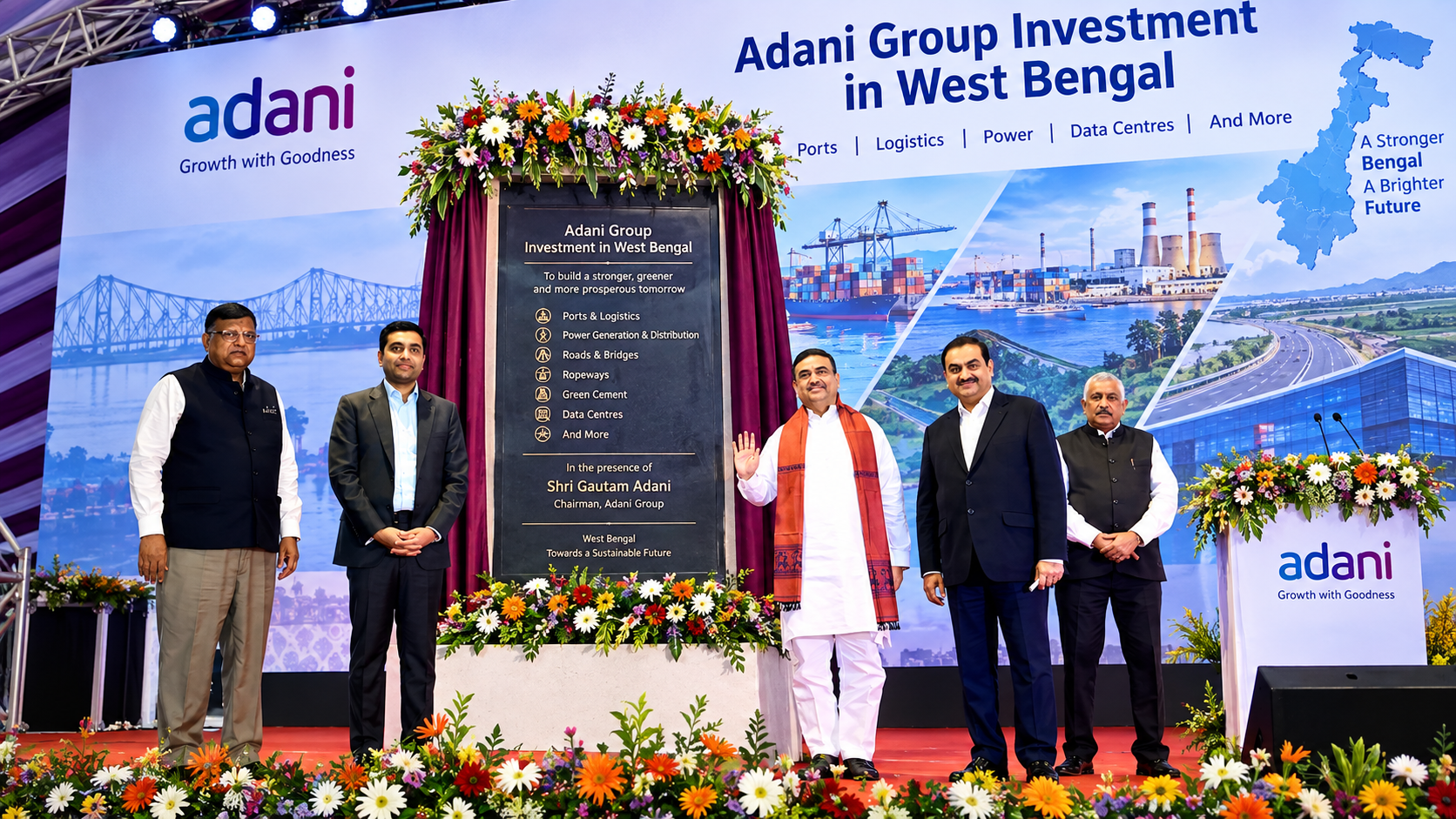
The Adani Group Investment in West Bengal will become a topic in the states plans for infrastructure and industry. After Gautam Adani said that the Adani Group will invest more than ₹1 lakh crore by 2035 people will be talking. This investment covers sectors such as ports, logistics, power generation, transmission and distribution of electricity, roads, bridges, ropeways, green cement and very large data centres.
I was surprised when the chairman of the Adani Group, Gautam Adani made this announcement while laying the foundation stone for the proposed Adani Arogya Mandir in New Town, Kolkata. In addition to the investment the Adani Group also announced a separate investment of over ₹4,000 crore for a not‑for‑profit healthcare institution. That institution will have a 2,000‑bed hospital, a college and advanced research facilities.
I worry that the investment could affect West Bengal’s infrastructure, jobs, healthcare and industry. Still the size of the investment raises questions about how long projects will take, how the investment will be put into action how much land is needed how many jobs will be created and what part private companies will play in essential services.
Let me give you a look, at the announcement the sectors involved and what the investment might mean for West Bengal by 2035.
Adani Group Announces Investment of Over ₹1 Lakh Crore in Bengal
Gautam Adani said that the Adani Group wants to spend more than ₹1 lakh crore in West Bengal by 2035. The idea is to put money into areas that help industry run. These areas include transportation, energy and digital systems.
This move shows that the group wants to grow in the state than just doing one project at a time. They want to build infrastructure that connects industries.
The investment includes:
- Ports and maritime infrastructure
- Logistics and transportation networks
- Power generation
- Electricity transmission and distribution
- Roads and bridges
- Ropeways
- Green cement
- Hyperscale data centres
These areas are connected. Ports help move things transportation systems help move materials and products and having stable electricity is needed for factories, businesses and digital tools.
The group has not given a list of each project or a full timetable, for when everything will happen.
Because of that the announcement is seen as a long-term plan. It does not mean all the money has been spent yet or that every project is already being built.
Why West Bengal Is Important for Adani Group’s Expansion
I think West Bengal sits in the east of India. West Bengal has a spot because it can reach the Bay of Bengal and has roads and rail to the northeastern part of the country.
West Bengal can also trade with countries and with markets in Southeast Asia. Because of its location West Bengal can grow port industries build warehouses move freight easily and set up factories.
Gautam Adani said that West Bengal could become a sea and road link between India’s core, the Northeast and the Bay of Bengal.
The big investment plan looks to use roads, rail and power to bring more industry into West Bengal.
Take a factory for example. A factory needs materials, steady electricity, good roads or rail and markets for its goods. If all these are there a factory can. Grow more easily.. Just being, in a good place does not mean industry will grow. The quality of roads how well projects finish the amount of land the skills of workers clear rules and how much it costs to run a business also decide if the new investments will bring lasting benefits to West Bengal.
Ports and Logistics Could Become Key Parts of the Investment Plan
Ports and logistics are parts of the Adani Groups proposed investment plan in West Bengal. Ports and logistics form the backbone of this plan.
Ports help move imported materials and exported finished products. Ports also support businesses that ship, store goods in warehouses handle cargo and transport goods. Ports and logistics help keep the flow of materials
A stronger logistics network can improve the movement of goods between centres, ports and markets, across eastern India. Logistics can make moving goods easier.
How Port Infrastructure Could Support Industry
Port-related infrastructure can create opportunities for industries that depend on the movement of large volumes of goods.
Potential areas of activity include:
- Cargo handling and freight transportation
- Warehousing and distribution centres
- Industrial supply chains
- Import and export operations
- Port-linked manufacturing and processing
If port capacity and transport connections improve together, businesses may be able to move goods more efficiently.
However, the actual benefits will depend on the location of projects, the type of cargo handled, connectivity with industrial areas and the level of demand from businesses.
The announcement does not yet provide a detailed list of port projects, their capacities or their individual investment allocations.
Power Generation and Distribution: A Significant Development
One important point in the announcement is that electricity distribution is part of the Adani Groups planned investment. The group has chosen power generation, transmission and electricity distribution as places where it might invest in West Bengal. Electricity is needed for every big industry and business. Factories, hospitals, logistics centres and data centres all rely on a power supply.
What Makes Power Distribution Important?
Electricity distribution means sending power from the grid to people to homes to businesses and to factories. In Kolkata and Howrah electricity distribution is run by CESC Ltd, the company of the RP‑Sanjiv Goenka Group. The rest of West Bengal, plus Salt Lake and New Town is served by the West Bengal State Electricity Distribution Company Limited (WBSEDCL) says the data. The plan’s mention of electricity distribution matters because it opens the door for the Adani Group to join a sector where other companies already serve customers.. The announcement does not say where the group might invest in electricity distribution how it might run the business or whether it will get a licence join a partnership or do something else. Any move, into this area would have to be looked at under the electricity rules what customers want and the existing electricity distribution network.
What Could Power Investment Mean for Businesses?
If the proposed power investments are put into place power investments could help development. Power investments do this by making electricity infrastructure and giving more power to commercial and industrial users.
Potential benefits include network capacity. Infrastructure upgrades and more support for electricity‑intensive industries also come with power investments.
Meanwhile consumers and businesses need information about tariffs, service quality, who is responsible for investment and how electricity distribution is arranged. Power investments must also consider these details.
These factors will be important, in determining the impact of any future power‑sector projects.
Roads, Bridges and Ropeways to Support Connectivity
The proposed investment plan also includes roads, bridges and ropeways.
Roads, bridges and ropeways are highlighted as a part of the plan.
Transport infrastructure is vital for connecting areas, residential centres, logistics facilities and commercial hubs. Transport infrastructure plays a role in linking these places together.
Roads and bridges can improve access to locations and reduce transportation bottlenecks. Better road connectivity also helps workers reach employment centres and lets businesses move goods efficiently. Roads, bridges and better roadways reduce delays. Ease traffic.
Ropeways are another infrastructure category included in the announcement. Depending on their proposed locations and purposes ropeways may support passenger movement or specialized transportation requirements. Ropeways could become a way to move people and goods across difficult terrain.
However the group has not disclosed locations, construction schedules or technical details, for these projects. No plans or dates have been shared yet.
The economic value of transport infrastructure depends on how individual projects connect with existing roads, railways, ports and industrial centres. Transport infrastructure, roads and railways must work together to create a network.
Green Cement and Hyperscale Data Centres Add New Dimensions
The presence of cement and hyperscale data centres shows that the proposed investment plan goes beyond normal infrastructure.
Both cement and hyperscale data centres are linked to larger shifts in industrial development, construction and digital services.
Green Cement and Construction Demand
Cement is a material used for roads, bridges, buildings, factories and many other infrastructure projects.
Green cement usually means cement or cement‑based products that are made to cut down harm, especially greenhouse gas emissions from production.
Investing in cement could help construction activities if there is a growing demand for building materials that produce fewer emissions.
However the announcement does not give details about the proposed cement projects location how much it will produce the technology it will use or how well it will perform environmentally.
Those details would be needed to judge how much the project can help construction.
Hyperscale Data Centres and Digital Infrastructure
Hyperscale data centres are buildings built to provide large computing, storage and networking capacity.
They can host cloud computing platforms, digital services, enterprise applications and other operations that need a lot of data.
West Bengals location and good links could make digital infrastructure a good area for growth. The success of data centres also needs reliable electricity, good network links, cooling systems, available land and enough customer demand.
Data centres use a lot of electricity. Their growth would therefore be linked closely to the group’s planned power infrastructure investments.
The announcement does not give details, about where the proposed data centres will be, how space they will have, when they will be built or who will use them.
Adani Arogya Mandir: A ₹4,000 Crore Healthcare Project
Alongside the broader investment plan, the Adani Group announced an investment of more than ₹4,000 crore in the proposed Adani Arogya Mandir in New Town.
The foundation stone-laying ceremony was attended by Gautam Adani, his wife Priti Adani and his son Karan Adani.
The proposed institution is planned as a 2,000-bed, not-for-profit medical facility with a medical college and advanced healthcare research infrastructure.
The project is expected to become a major part of the group’s stated healthcare commitment to West Bengal.
Key Details of Adani Arogya Mandir
| Feature | Details |
|---|---|
| Project name | Adani Arogya Mandir |
| Location | New Town, West Bengal |
| Proposed investment | More than ₹4,000 crore |
| Hospital capacity | 2,000 beds |
| Reserved beds | 1,000 beds for eligible economically weaker sections |
| Additional facilities | Medical college and advanced research facilities |
| Employment | More than 10,000 jobs expected across the healthcare ecosystem |
According to the announcement, 1,000 of the hospital’s beds will be reserved for economically weaker sections eligible under state and central government health insurance schemes.
This provision could expand access to hospital services for eligible patients, although the practical impact will depend on the hospital’s operating model, treatment availability, insurance arrangements and implementation of the eligibility rules.
The medical college and research facilities are also expected to contribute to medical education and healthcare research.
The group has not provided a detailed construction schedule, opening date or breakdown of the proposed hospital’s operating costs.
How Many Jobs Could the Investment Create?
Employment is one of the key areas of interest surrounding the proposed investment.
Gautam Adani said the healthcare project and related institutions are expected to generate more than 10,000 jobs across West Bengal’s healthcare ecosystem.
The broader infrastructure programme could also create employment opportunities if projects move forward.
Potential areas of employment include:
- Construction and civil engineering
- Port and logistics operations
- Electricity generation and infrastructure maintenance
- Transportation and warehousing
- Healthcare and medical education
- Data centre operations and technical services
- Industrial manufacturing and supporting businesses
The number and nature of jobs will depend on the projects that are ultimately implemented.
Construction projects may generate temporary employment during the building phase, while operational facilities can create longer-term positions.
The availability of local employment opportunities will also depend on the skills required, recruitment policies and the participation of local businesses in project supply chains.
At this stage, the announcement does not provide a consolidated employment estimate for the entire ₹1 lakh crore investment plan.
Therefore, the healthcare project’s stated employment expectation should not be treated as the total number of jobs expected from all proposed investments.
Writers’ Building Restoration: Support for a Historic Kolkata Landmark

The Adani Group also announced its support for the restoration of Kolkata’s historic Writers’ Building.
The building has an important place in the city’s administrative and architectural history.
It was originally used as an administrative office by the East India Company and later housed offices of the West Bengal government.
The restoration initiative adds a heritage-related element to the group’s broader announcement.
The announcement does not specify the restoration budget, project schedule, scope of work or the exact form of support that the group will provide.
Any restoration effort would need to take account of the building’s historic character and the requirements associated with preserving a significant heritage structure.
Analysis: What the ₹1 Lakh Crore Investment Could Mean for West Bengal
The proposed Adani Group investment in West Bengal brings together several sectors that can influence industrial development.
Rather than focusing on a single business, the investment plan covers infrastructure that supports the movement of goods, the supply of electricity, the construction of industrial facilities and the growth of digital services.
This creates the possibility of connections between projects.
For instance, better logistics infrastructure can help manufacturing businesses transport materials and products. Industrial expansion can increase electricity demand, while reliable power can support the operation of data centres and other commercial facilities.
The healthcare project adds a separate dimension by focusing on medical services, education and research.
However, the proposed investment’s economic impact will depend on the execution of individual projects and their ability to attract sustained demand.
1. Potential Support for Industrial Development
West Bengal could benefit if the proposed infrastructure improves the operating environment for businesses.
Ports, roads, bridges and logistics facilities can make it easier to transport goods, while power infrastructure can support industrial operations.
These improvements could help businesses consider new investments or expand existing operations.
However, investment decisions are influenced by multiple factors, including access to markets, labour availability, infrastructure reliability, financing costs and government policies.
The proposed investment alone does not establish how many new factories or industrial units will be created.
2. Potential Benefits for Local Businesses
Large infrastructure projects can create opportunities for local suppliers, contractors and service providers.
Construction companies, equipment suppliers, transport operators, maintenance firms and other businesses may be able to participate in project-related activities.
Healthcare development could also create demand for medical equipment, support services and specialised professionals.
The scale of these opportunities will depend on procurement arrangements, project design and the extent to which local businesses can meet technical and commercial requirements.
3. Healthcare Access and Medical Education
The proposed 2,000-bed Adani Arogya Mandir could become a significant healthcare facility if it is completed and operated as announced.
The planned reservation of 1,000 beds for eligible economically weaker sections is particularly relevant to access for lower-income patients.
The medical college and research facilities could also contribute to healthcare education and specialised medical services.
Nevertheless, the actual benefits will depend on the hospital’s treatment capacity, affordability, staffing, insurance arrangements and access for eligible patients.
The project’s long-term contribution cannot be measured by its planned bed count alone.
4. Infrastructure Development Will Require Coordination
The proposed investment covers sectors that depend on one another.
A new logistics facility may need road access, electricity and industrial demand to operate efficiently.
A data centre requires reliable power and strong digital connectivity, while manufacturing facilities need transportation links and access to workers.
Coordination between infrastructure projects, local authorities and service providers will therefore be important.
Without appropriate planning, individual projects may face delays or struggle to achieve their intended commercial objectives.
5. Investment Commitments Need Clear Implementation Details
The ₹1 lakh crore figure is a substantial long-term commitment, but its practical significance will become clearer as the group announces specific projects.
Important details include the amount allocated to each sector, the financing structure, construction schedules, land requirements and expected operating capacity.
These details will help distinguish projects that are formally approved and under construction from those that remain at the planning or proposal stage.
They will also help assess the investment’s likely contribution to employment, industrial activity and public infrastructure.
Adani Group’s Bengal Investment Plan: What Happens Next?
The next stage will depend on the announcement of individual projects and the progress of the healthcare institution.
Investors, businesses and residents will likely look for updates on project approvals, land arrangements, construction activity, financing and employment plans.
The development of ports, logistics facilities, power infrastructure and data centres could take place over different timelines.
The healthcare project will also require the development of hospital facilities, medical education infrastructure and arrangements for delivering services to eligible patients.
As more details become available, the proposed investment can be assessed on the basis of actual project progress rather than the overall commitment alone.
Final Thoughts
The Adani Group’s proposed investment of more than ₹1 lakh crore in West Bengal by 2035 represents a broad infrastructure and industrial development plan covering ports, logistics, electricity, transportation, green cement and digital infrastructure.
The proposed ₹4,000 crore-plus Adani Arogya Mandir project in New Town adds a major healthcare component, with plans for a 2,000-bed hospital, a medical college and advanced research facilities.
The investment could create opportunities for industrial development, local businesses, employment and healthcare access if the projects are implemented successfully.
At the same time, the final impact will depend on project execution, regulatory approvals, financing, infrastructure coordination and the delivery of the announced benefits.
For West Bengal, the central question is not only how much investment is promised, but how effectively that commitment is converted into completed infrastructure, sustainable economic activity and accessible public services by 2035.