
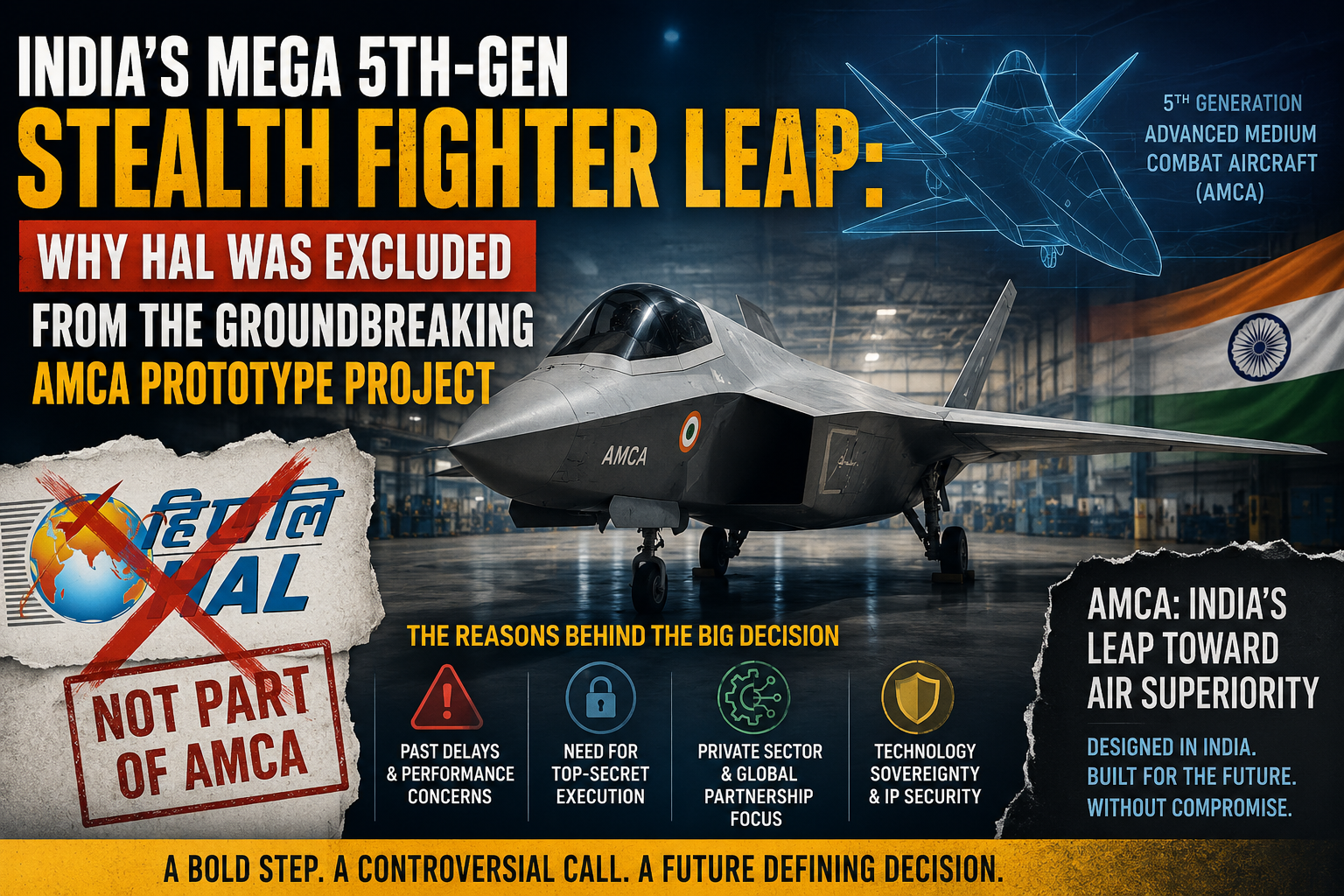
The AMCA fighter jet project Indian defense aerospace landscape has just witnessed its most significant tectonic shift in decades. In a historic move that signals a bold departure from traditional defense procurement strategies, the Ministry of Defence (MoD) has officially issued a Request for Proposal (RFP) for the indigenous fifth-generation Advanced Medium Combat Aircraft (AMCA) development. This massive step forward under the ‘Make in India’ initiative aims to fast-track the creation of five cutting-edge stealth prototypes. However, the most stunning revelation sending shockwaves through the defense establishment is the complete omission of State-run aerospace giant Hindustan Aeronautics Limited (HAL) from this critical phase. Instead, India is betting big on the private sector, shortlisting three heavyweight private consortia to spearhead the manufacturing of its crown jewel fighter program alongside the Aeronautical Development Agency (ADA).
Understanding the News: The AMCA fighter jet project Takes Flight
On Wednesday, May 27, 2026, the Ministry of Defence officially advanced India’s multi-billion-dollar fifth-generation stealth fighter jet program by issuing the RFP to three shortlisted private sector entities. This milestone marks the transition of the Advanced Medium Combat Aircraft (AMCA) from a series of sophisticated laboratory blueprints into physical, operational prototypes designed to patrol and protect Indian skies.
The project is structured around an ambitious infrastructure roadmap. Just weeks prior, on May 15, 2026, Defence Minister Rajnath Singh, alongside Andhra Pradesh Chief Minister N. Chandrababu Naidu, laid the foundation stone for a colossal ₹15,803-crore AMCA dedicated manufacturing and infrastructure facility in the Sri Sathya Sai district of Andhra Pradesh. This massive financial and logistical commitment underscores the government’s resolve to build a robust aerospace ecosystem capable of supporting next-generation defense technologies.
The three private sector contenders competing for this historic project include:
The Larsen & Toubro (L&T) and Bharat Electronics Limited (BEL) Combine: Merging L&T’s heavy precision engineering capabilities with BEL’s extensive defense electronics and avionics expertise.
Tata Advanced Systems Limited (TASL): The defense arm of the Tata Group, which already boasts robust global aerospace supply chain credentials.
The Bharat Forge and BEML Consortium: Combining world-class metallurgical forging capacities with heavy industrial manufacturing experience.
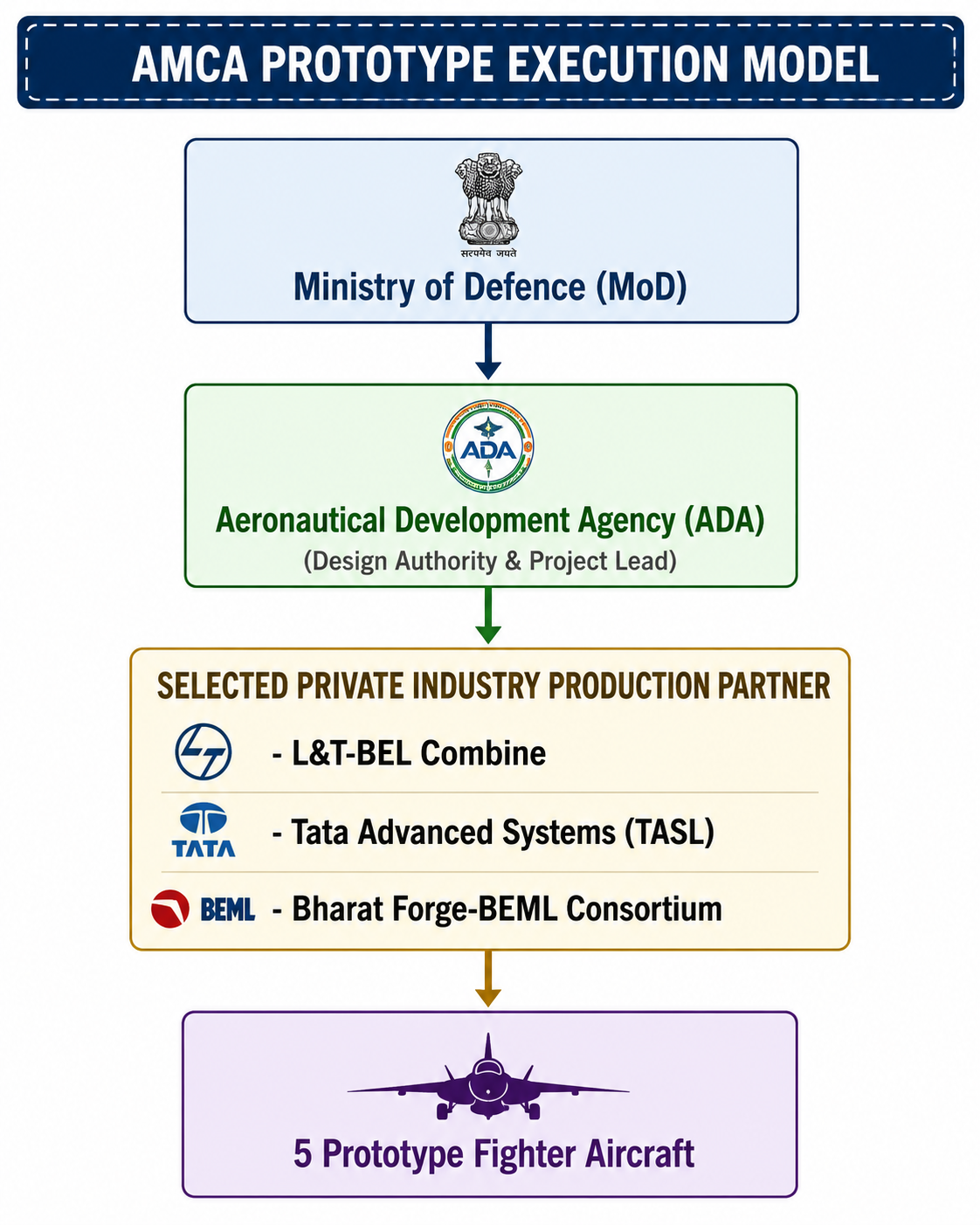
The chosen partner will collaborate directly with the Aeronautical Development Agency (ADA) to manufacture five initial prototypes. These aircraft will undergo rigorous structural, technical, and flight testing procedures to pave the way for eventual mass production.
What is the AMCA? Exploring India’s Next-Gen Stealth Aircraft
The Advanced Medium Combat Aircraft (AMCA) is India’s premier defense program aimed at designing, developing, and manufacturing an indigenous fifth-generation stealth fighter jet. To fully grasp why the project structure has shifted away from public sector monopolies, one must understand the sheer technological complexity of the platform being built.
A fifth-generation fighter jet represents the absolute pinnacle of current aviation engineering. It is not merely an agile aircraft with weapons bolted onto its wings; it is an integrated, low-observable flying supercomputer. The AMCA program focuses on achieving several defining benchmarks of modern aerial warfare:
1. Advanced Low-Observable (Stealth) Geometry
True stealth requires designing an airframe that scatters radar waves away from the enemy’s receiver. The AMCA incorporates a highly specialized design featuring serpentine air intake ducts (which hide the highly reflective engine fan blades), an internal weapons bay to ensure radar waves do not bounce off external missiles, and radar-absorbent materials (RAM) coated across its skin.
2. Supercruise Capability
Supercruise is the ability of a fighter aircraft to sustain supersonic flight (speeds exceeding Mach 1) without engaging its fuel-guzzling afterburners. This allows the AMCA to intercept threats rapidly over long distances while conserving valuable fuel, maintaining a lower thermal signature, and remaining deeply embedded within a combat theater for longer durations.
3. Integrated Avionics and Sensor Fusion
Modern combat pilots face information overload. The AMCA solves this by utilizing an Active Electronically Scanned Array (AESA) radar combined with infrared search and track (IRST) systems and an extensive electronic warfare (EW) suite. Through “sensor fusion,” the onboard computers process data from all these systems simultaneously, presenting the pilot with a single, highly accurate, and unified picture of the battlespace.
+-------------------------------------------------------------------+
|                     AMCA CORE DESIGN SPECS                        |
+-------------------------------------------------------------------+
|  Feature                  | Tactical Advantage                    |
+---------------------------+---------------------------------------+
|  Internal Weapons Bay     | Maximizes Stealth Profile             |
|  Serpentine Air Ducts     | Obscures Engine Fan Radar Reflection  |
|  Supercruise Propulsion   | Efficient, High-Speed Sustained Flight|
|  AESA Radar + Fusion      | Long-Range Multi-Target Engagement    |
+---------------------------+---------------------------------------+
Why HAL Was Kept Out of the AMCA Prototype Project
Hindustan Aeronautics Limited (HAL) has always been India’s go-to manufacturer for military planes. However, the government deliberately chose to leave HAL out of the new AMCA stealth fighter prototype project.
Here are the three main reasons why the Ministry of Defence sidelined HAL for this phase:
1. Resolving the Monopolistic Production Bottleneck
For decades, HAL has faced severe criticism regarding its delivery timelines and production throughput. The LCA Tejas program, while ultimately a technological success, suffered from decades of delays, forcing the Indian Air Force (IAF) to continuously extend the service life of aging, legacy fighter fleets.
By introducing competitive private entities into the AMCA prototype phase, the Ministry of Defence aims to break the traditional public sector monopoly. Private sector manufacturing frameworks operate under strict commercial timelines, performance-linked financial penalties, and agile corporate supply chains. This pressure is expected to drastically compress the time required to move from an initial prototype to a flight-tested, production-ready aircraft.
2. Overburdened Order Books and Capacity Constraints
HAL is not short on work. The state-run manufacturer currently holds massive, high-priority order books that demand its full attention, manufacturing real estate, and engineering workforces. HAL is currently managing:
Mass production of the LCA Tejas Mk1A variants for the IAF.
Design and development cycles for the larger LCA Tejas Mk2.
Collaborative manufacturing of the Sukhoi Su-30 MKI upgrades.
Production lines for indigenous helicopters, including the Advanced Light Helicopter (ALH) Dhruv, Light Combat Helicopter (LCH) Prachand, and Light Utility Helicopter (LUH).
Flooding HAL’s ecosystem with yet another massive, highly experimental fifth-generation fighter development program would likely lead to severe resource contention, resulting in systemic delays across multiple defense projects simultaneously.
3. Realizing the True Spirit of the ‘Make in India’ Defense Framework
The ‘Make in India’ and Atmanirbhar Bharat (Self-Reliant India) initiatives were never intended to simply mean “made by the government.” The ultimate long-term goal is to cultivate a robust, multi-layered, and globally competitive private defense-industrial complex within India, similar to the ecosystems found in the United States or Western Europe.
By handing the AMCA prototype development to private consortia like Tata, L&T, or Bharat Forge, the government is incentivizing the private sector to invest their own capital, build specialized infrastructure, and train highly skilled aerospace engineers. This expands India’s total national industrial capacity instead of merely recycling state funds back into state-run factories.
+--------------------------------------------------------------------+
|               STRATEGIC COMPARISON: PRODUCTION MODELS              |
+--------------------------------------------------------------------+
|  Parameters             | Legacy DPSU Model (HAL) | New AMCA Model |
+-------------------------+-------------------------+----------------+
|  Market Structure       | Monopoly                | Competitive    |
|  Supply Chain Style     | Hierarchical            | Global/Agile   |
|  Capacity Utilization   | Overburdened            | Greenfield     |
|  Capital Investment     | 100% State-Funded       | Public-Private |
+-------------------------+-------------------------+----------------+
Breaking Down the Shortlisted Private Consortia
The selection process was initiated when the MoD issued an initial Expression of Interest (EoI). The three corporate alliances that stepped forward represent the finest engineering, electronics, and metallurgical capabilities within India’s private sector.
Larsen & Toubro (L&T) – Bharat Electronics Limited (BEL) Combine
This partnership brings together two heavyweights of Indian engineering and defense electronics. L&T possesses decades of experience in high-end precision defense engineering, having played pivotal roles in building India’s indigenous nuclear submarines (Arihant-class) and advanced missile launch platforms. BEL, a public-private hybrid powerhouse, dominates the Indian defense electronics landscape. Together, they offer a complete package: L&T provides the heavy structural, manufacturing, and assembly capabilities, while BEL delivers the advanced radar systems, cockpit displays, and communication avionics necessary for a fifth-generation jet.
Tata Advanced Systems Limited (TASL)
TASL is arguably the most globally integrated aerospace player within India’s private sector. It already runs advanced manufacturing facilities producing fuselages, wings, and critical structures for international aerospace companies, including Boeing, Lockheed Martin, Airbus, and Sikorsky. TASL’s experience with complex global supply chains, strict international quality benchmarks, and advanced composite materials makes them a highly competent prime integrator candidate for a complex stealth aircraft like the AMCA.
Bharat Forge – BEML Consortium
This alliance pairs world-class metallurgical capabilities with heavy heavy-duty industrial assembly experience. Bharat Forge is a global leader in metal forging, critical powertrain components, and specialized artillery systems. BEML (formerly Bharat Earth Movers Limited) brings massive structural fabrication, heavy assembly lines, and rail/defense manufacturing infrastructure to the table. This consortium offers deep expertise in handling advanced alloys and complex titanium structural forgings—materials that form the backbone of high-stress components in supersonic stealth fighter jets.
The AMCA Programme Execution Model: A New Era of CollaborationThe paradigm shift away from traditional public sector monopolies is governed by a new regulatory framework known as the AMCA Programme Execution Model. Formally approved by Defence Minister Rajnath Singh last year, this model establishes a transparent, merit-based framework for public-private defense partnerships.
Under this model, the Aeronautical Development Agency (ADA) remains the primary design authority, retaining full ownership of the intellectual property, aerodynamic designs, stealth profiles, and core system architectures. However, instead of passing these designs exclusively to a state-run production agency, the ADA will collaborate directly with the selected private sector industry partner.
This model provides equal opportunities for private corporations to participate independently, form strategic joint ventures, or establish consortia. It bridges the gap between state-backed conceptual design and private sector production efficiency, creating a streamlined pipeline intended to deliver high-quality military hardware on schedule.
+-------------------------------------------------------------------+
|               MILESTONES ALONG THE AMCA ROADMAP                   |
+-------------------------------------------------------------------+
|  Date           | Milestone Achieved / Target                     |
+-----------------+-------------------------------------------------+
|  Mid-2025       | Approval of AMCA Programme Execution Model      |
|  May 15, 2026   | Foundation laid for ₹15,803-cr Infrastructure   |
|  May 27, 2026   | RFP issued to three shortlisted consortia       |
|  Late 2026      | Commercial evaluation and partner selection     |
|  2029–2030      | Target rollout of first physical prototypes     |
+-------------------------------------------------------------------+
Timelines, Technical Evaluations, and Next Steps
With the Request for Proposal (RFP) now formally in the hands of the three shortlisted bidders, the clock is ticking on one of India’s most critical defense procurement cycles.
The shortlisted consortia will now conduct deep-dive internal assessments to prepare their comprehensive technical and commercial bids. They must detail exactly how they plan to manufacture the airframe, integrate complex subsystems, manage quality control, and meet cost targets.
According to senior defense ministry officials, once the companies submit their formal responses, the MoD will initiate a comprehensive technical and commercial evaluation process. This evaluation phase is expected to take between four to five months to complete.
The evaluation teams will judge proposals based on several strict operational metrics:
Technical Competence: The bidder’s capacity to handle advanced radar-absorbent composite materials and execute precision assembly.
Financial Viability: A realistic cost-per-unit assessment for prototype fabrication to prevent budget overruns.
Infrastructure Readiness: The speed with which the bidder can operationalize assembly lines at the newly designated ₹15,803-crore industrial hub in Andhra Pradesh.
Once the winning consortium is selected, contracts will be signed, and the manufacturing phase for the five prototypes will begin in earnest. Industry insiders estimate that the first physical roll-out of an operational AMCA prototype could take place within the next three to four years, followed by extensive flight trials conducted by the Indian Air Force.