
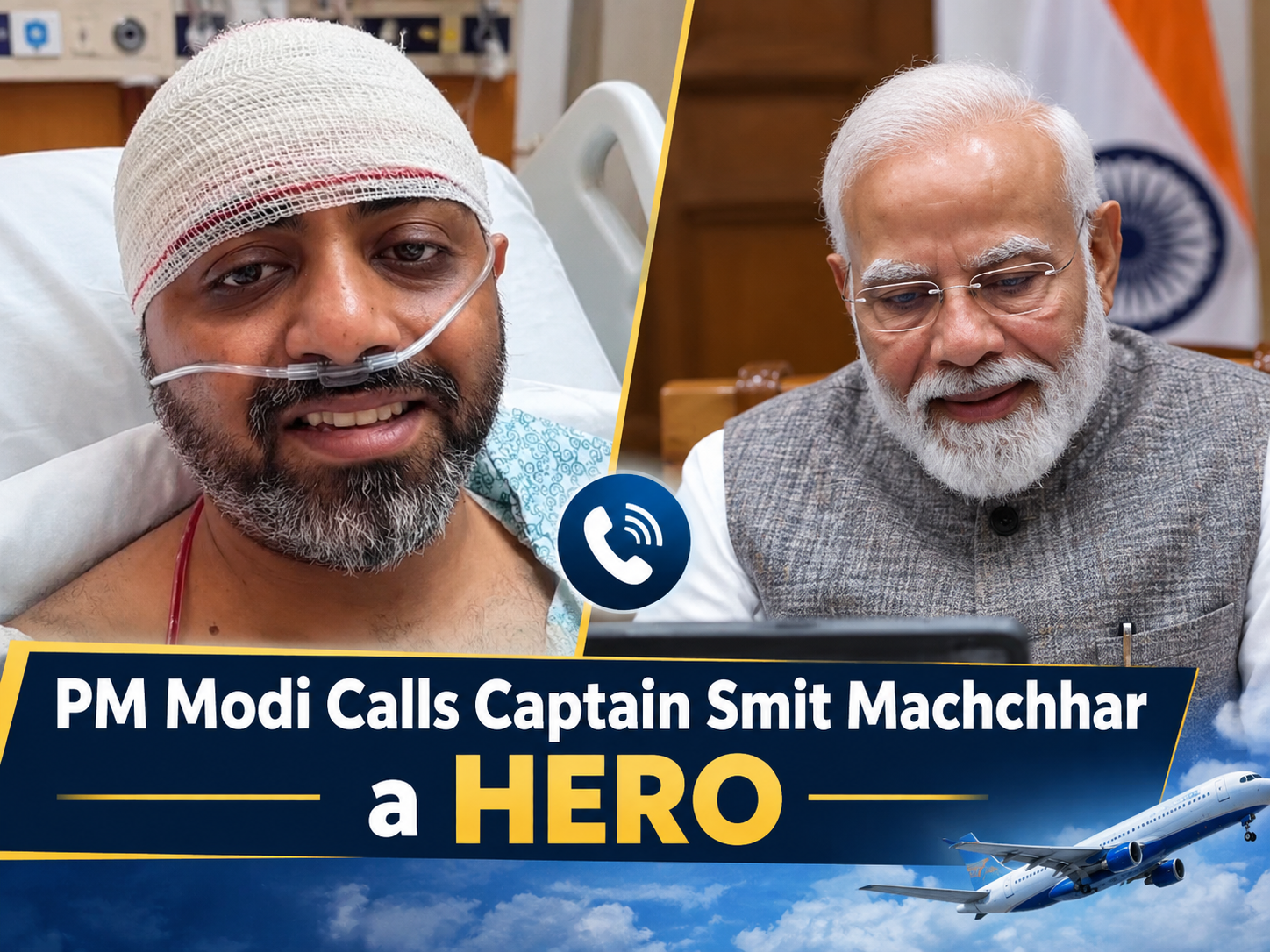
Captain Smit Machchhar has emerged at the centre of attention after a dramatic mid-air emergency involving a flydubai flight, an incident that placed the lives of around 170 passengers and crew members at serious risk.
What makes the episode particularly striking is not only the scale of the danger but also what happened inside the cockpit after the Indian pilot himself was seriously injured. Speaking with Prime Minister Narendra Modi during a video call from a hospital in the UAE, Machchhar described a moment when he realised that his own survival was closely connected to the safety of everyone on board.
He told the prime minister that he was fighting for his life but understood that he could not give in to fear because hundreds of people were depending on him.
For Machchhar, faith also became an important source of strength. During the crisis, he said he was reciting the Hanuman Chalisa and credited Lord Hanuman with giving him courage.
The conversation with Modi offered a deeply personal perspective on an incident that has otherwise been viewed primarily through the lens of aviation safety and emergency response.
Captain Smit Machchhar speaks to PM Modi from UAE hospital
Prime Minister Narendra Modi spoke with Captain Smit Machchhar while the pilot was recovering in a UAE hospital.
According to the account of their conversation, Modi praised the pilot for his actions during the emergency and wished him a speedy recovery. Machchhar, meanwhile, spoke about the circumstances in which he had to continue functioning despite suffering serious injuries.
The exchange became emotional for the pilot. At one point, Machchhar apologised to the prime minister after breaking down during the conversation.
The emotional reaction was understandable given the circumstances. The pilot had recently experienced an event in which a routine commercial flight suddenly turned into a potentially catastrophic emergency.
Machchhar also reportedly told Modi that he had never imagined he would one day get an opportunity to speak directly with the prime minister.
The conversation came a day after Modi had spoken with Machchhar’s wife and parents. The prime minister had assured the family that Indian missions would provide support to the pilot and his relatives while he recovered.
What Captain Smit Machchhar said gave him courage
One of the most significant aspects of the conversation was Machchhar’s explanation of how he managed to keep going during the crisis.
The pilot described the situation as a fight for his own life. At the same time, he recognised that his actions could determine whether the other people aboard the aircraft survived.
That realisation appears to have played a crucial role in his response.
Rather than thinking only about his own injuries, Machchhar focused on the passengers and the responsibility associated with being the captain of a commercial aircraft.
He also spoke about his religious faith.
During the emergency, Machchhar said he was reciting the Hanuman Chalisa. He attributed his courage during those moments to Lord Hanuman.
This detail gives the incident a personal dimension that is often missing from technical accounts of aviation emergencies.
For a pilot, training provides procedures to follow when something goes wrong. But in an extreme situation, an individual’s mental resilience, ability to remain focused and personal sources of strength can also become important.
In Machchhar’s case, his account suggests that professional responsibility and personal faith existed side by side during the crisis.
Why the mid-air incident became so serious
The incident reportedly began during a confrontation involving the captain and co-pilot while the aircraft was cruising at a high altitude.
The aircraft was flying at approximately 34,000 feet when the situation developed into a serious emergency.
Machchhar sustained severe injuries during the incident. Despite those injuries, he managed to regain access to the cockpit.
The aircraft then experienced an extremely rapid descent.
According to the details available about the incident, the Boeing 737 descended at a rate of approximately 23,000 feet per minute before reaching an altitude of around 15,600 feet.
For comparison, commercial aircraft normally descend in a controlled manner according to flight procedures and air-traffic instructions. A descent rate of the scale reported in this incident therefore illustrates how quickly the situation developed.
The immediate challenge was not simply controlling the aircraft.
The crew also had to deal with an unusual emergency at a very high altitude while the captain was injured.
That combination created a situation in which time, communication and cockpit access became critical.
The cockpit door became a crucial part of the incident
One of the most important details in the sequence of events was the cockpit door.
The reported circumstances indicate that Machchhar was able to unlock the cockpit door despite his injuries. Once access to the cockpit was restored, the crew and others could intervene and help prevent the situation from escalating further.
The significance of cockpit access cannot be understated.
Modern commercial aircraft are designed with strict security procedures around the flight deck. Cockpit doors are intended to prevent unauthorised access, and procedures governing entry are an important part of aviation security.
In an abnormal situation involving the flight crew themselves, however, those security arrangements can become part of the emergency-management challenge.
The incident therefore raises broader questions about how airlines, regulators and operators prepare for highly unusual scenarios involving incapacitation, conflict or loss of normal cockpit control.
Those questions will ultimately need to be addressed through the official investigation rather than speculation.
A pilot with extensive Boeing 737 experience
Captain Smit Machchhar is not a newcomer to commercial aviation.
The information available about his career indicates that he has more than 13 years of experience in commercial flying and approximately 9,750 total flying hours.
A substantial portion of that experience has involved the Boeing 737 family.
Before joining Flydubai, Machchhar reportedly spent around 11 years with SpiceJet, where he worked as a Line Training Captain.
That background is significant when considering his response to an emergency.
Commercial airline pilots undergo extensive training involving abnormal and emergency situations. Captains are also responsible for making decisions under pressure while managing communication with air traffic control, cabin crew and other members of the flight team.
Experience cannot eliminate risk, but it can provide a framework for responding to unexpected events.
In this case, Machchhar’s professional experience appears to have been an important part of the broader circumstances surrounding the incident.
However, it would be premature to attribute the outcome to any single factor without the findings of the official investigation.
PM Modi calls Captain Machchhar a hero
Prime Minister Narendra Modi publicly praised Machchhar following the incident.
In a social media post, Modi described the Indian pilot as a hero and highlighted his courage and determination to protect passengers despite being seriously injured.
The prime minister also said India was proud of Machchhar.
Modi later referred to the incident during an event marking the centenary celebrations of the Union Public Service Commission in New Delhi.
While speaking about the episode, he highlighted the pilot’s patience, presence of mind and courage.
The comments reflected the wider public reaction to the incident, particularly because the pilot’s actions were reportedly taken while he was himself facing serious physical danger.
The human side of an aviation emergency
Airline accidents and near-disasters are often discussed through statistics.
Aircraft type.
Altitude.
Descent rate.
Flight path.
Number of passengers.
Crew procedures.
Emergency systems.
But behind each of those numbers are people.
The conversation between Modi and Machchhar brought that human element into focus.
Machchhar was not speaking about the incident from a press conference or television studio. He was recovering in a hospital.
His description of fighting for his own life while simultaneously thinking about the passengers illustrates the psychological burden that can accompany an aviation emergency.
The pilot’s account also shows why commercial aviation depends so heavily on human decision-making.
Aircraft are equipped with sophisticated technology, automated systems and multiple safety mechanisms. Yet pilots remain responsible for interpreting situations, responding to unexpected developments and coordinating with other people during emergencies.
What impact could this incident have on aviation security?
The full implications of the incident will depend on the outcome of the investigation.
It would be inappropriate to reach definitive conclusions before investigators establish the sequence of events and determine how the aircraft systems, cockpit procedures and crew actions interacted.
Nevertheless, incidents of this nature can lead the aviation industry to examine several areas.
One is cockpit security.
Another is crew coordination.
A third is how airlines prepare for situations in which a member of the flight crew becomes incapacitated or is unable to perform normal duties.
There may also be questions surrounding communication between cockpit and cabin crew during unusual emergencies.
These are not necessarily indications that existing procedures failed. They are areas that investigators and regulators may examine to understand what happened and whether lessons can be applied elsewhere.
Aviation safety has historically developed through the detailed examination of incidents and accidents.
Every unusual event can potentially contribute to a better understanding of risk.
Why the reported descent rate matters
The reported descent rate of roughly 23,000 feet per minute is one of the most dramatic technical details associated with the incident.
At an altitude of about 34,000 feet, the aircraft had a substantial amount of vertical distance between it and the ground.
But aviation emergencies can develop rapidly.
An unusually high descent rate means that the aircraft can lose thousands of feet in a very short period.
For passengers, the experience would likely have been frightening and confusing.
For the flight crew, however, the focus would have been on regaining control, stabilising the aircraft and dealing with the underlying emergency.
The fact that the aircraft eventually reached a significantly lower altitude before the situation was brought under control is an important part of the incident’s timeline.
The exact reasons behind the descent, the sequence of crew actions and the aircraft’s technical response will need to be established through investigation.
Flydubai suspends flights involving Israel
In the aftermath of the incident, Flydubai reportedly suspended flights to and from Israel while the investigation continued.
The decision adds another dimension to the story because the incident occurred against a complicated operational and regional backdrop.
Airlines routinely review flight operations when security or safety conditions change. Temporary suspensions can therefore be part of a broader risk-management process.
However, the suspension should not automatically be interpreted as proof of a specific cause or finding related to the mid-air incident.
The investigation into what happened remains the key source for understanding the event itself.
What happens next in the investigation?
The most important next step is the formal investigation.
Investigators will need to reconstruct the flight’s timeline and determine exactly what happened inside the aircraft.
That process can involve flight-data recordings, cockpit voice information where available, aircraft systems data, communications with air traffic control, crew statements, maintenance records and other evidence.
Investigators may also examine the physical injuries suffered by the pilot and how those injuries affected his ability to perform his duties.
The aim of an aviation investigation is generally to establish facts and identify safety lessons rather than simply assign blame.
That distinction matters.
An incident involving a commercial aircraft can have multiple contributing factors. Understanding those factors requires evidence rather than assumptions.
Captain Smit Machchhar’s story is about more than one dramatic moment
The attention surrounding Captain Smit Machchhar has largely focused on what happened during those critical minutes in the aircraft.
But his story also highlights something broader about commercial aviation.
A pilot’s responsibility does not end with operating the aircraft under normal conditions.
Captains are entrusted with the safety of everyone aboard. When something unexpected happens, they may have to make decisions with incomplete information and under enormous pressure.
Machchhar’s account suggests that his sense of responsibility toward the passengers became central to his actions.
His statement about realising that the passengers could lose their lives if he failed to show courage provides a direct insight into his thinking at the time.
At the same time, the pilot’s own condition reminds us that aviation emergencies affect crew members just as profoundly as passengers.
A story of professional duty and personal courage
The incident involving Captain Smit Machchhar has generated widespread attention because several elements came together at once.
There was a commercial aircraft carrying a large number of people.
There was a serious emergency at high altitude.
The captain himself was injured.
The aircraft experienced a rapid descent.
And the crew had to regain control of an extraordinarily difficult situation.
Machchhar’s conversation with Prime Minister Modi added another layer to the story.
Instead of focusing only on the technical details, the conversation revealed what the pilot himself felt during the emergency.
He spoke about fear, responsibility, faith and courage.
His reference to the Hanuman Chalisa was particularly personal.
It showed that, in the middle of an aviation emergency governed by technology and procedures, the pilot also relied on something deeply personal to maintain his resolve.
That does not change the technical facts of the incident, but it helps explain the human experience behind them.
Final thought
Captain Smit Machchhar is recovering after a mid-air incident that put the safety of the flydubai flight’s passengers and crew in danger.
His conversation with Prime Minister Narendra Modi gave a look into what he went through during those crucial minutes.
Machchhar said the situation felt like a fight for his life.. He knew he had to stay strong because the lives of the passengers were on the line.
He shared that he was reciting the Hanuman Chalisa during the crisis. He said Lord Hanuman gave him the courage to keep going.
His background as a pilot matters. He has over ten years of experience flying aircraft. He has logged thousands of hours on Boeing 737 planes. That experience gives weight to what happened.
The full story will only come out after the official investigation finishes.
For now this moment stands as an example of how professional training, responsibility and personal faith can meet in a high-pressure situation.
As Captain Machchhar continues to heal people will not just watch over his health. They will also follow the investigation into what happened on the plane. They will want to know how the emergency unfolded.. They will ask what lessons the aviation world might learn.
For the passengers who were on that flight it was not a case study in aviation. It was an experience where the actions of the flight crew made all the difference.
For Captain Smit Machchhar it was a moment described in simple words: a fight, for his own life while knowing that so many others depended on him.