
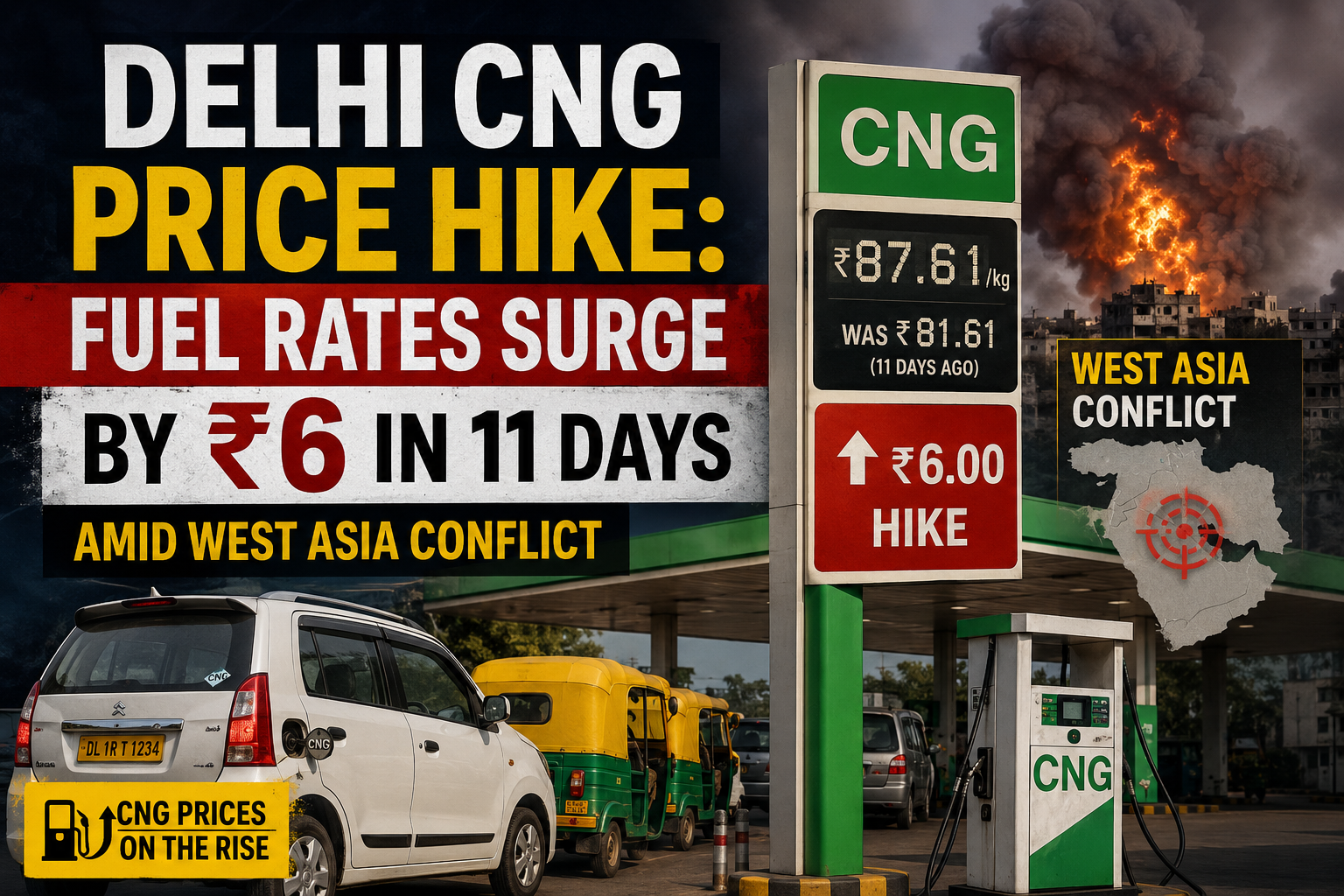
Delhi CNG price hike moves have once again rattled household budgets across the National Capital Region. In a move that highlights India’s extreme vulnerability to global geopolitical turbulence, Indraprastha Gas Limited (IGL) announced a fresh increase in the retail rates of Compressed Natural Gas (CNG) on Tuesday, May 26, 2026. This latest revision marks a steep escalation in energy costs for millions of daily commuters, logistics operators, and public transport drivers who rely heavily on this clean fuel alternative.
The immediate catalyst for the sudden jump in fuel prices lies thousands of miles away in West Asia. An intensifying conflict involving Iran, combined with severe logistical and security disruptions around the strategic Strait of Hormuz, has choked international energy supply lines. As a result, domestic city-gas distributors have found themselves with little choice but to pass on the rising burden of input gas costs directly to end consumers. With four back-to-back price adjustments executed within a span of less than two weeks, the cumulative financial strain is beginning to trigger a massive domino effect across the wider retail economy.
Understanding the Latest Fuel Rate Revision in the National Capital
The decision by Indraprastha Gas Limited to increase rates by another ₹2 per kilogram has pushed the retail price of CNG in the national capital to a historic high of ₹83.09 per kilogram. This latest ₹2 adjustment represents the fourth upward revision implemented by the city-gas major since the middle of May, painting a grim picture for those attempting to manage their monthly transport expenditures.
To understand how rapidly these costs have escalated, it is essential to trace the timeline of the price adjustments over the past eleven days:
May 15, 2026: The initial shock came with a sharp increase of ₹2 per kilogram, breaking a period of relative price stability.
May 17, 2026: Just forty-eight hours later, global supply pressures forced an additional upward revision of ₹1 per kilogram.
May 23, 2026: A third tranche added another ₹1 per kilogram to the retail price as procurement costs remained elevated.
May 26, 2026 (Today): The latest announcement tacked on another ₹2 per kilogram, completing a ₹6 total increase over an eleven-day window.
This rapid-fire progression of piecemeal increases highlights the volatility currently gripping global energy markets. Rather than introducing a single, massive price shock, distribution companies are updating their pricing matrices in real-time as cargo insurance rates fluctuate and international spot prices for natural gas spike.
Regional Breakdown CNG Price Hike Across Delhi-NCR and Mumbai
While the capital city itself faces a steep rate of ₹83.09 per kg, the impact is even more pronounced for satellite cities within the broader National Capital Region due to varying local tax structures, state-level Value Added Tax (VAT), and transportation overheads. IGL, alongside other major regional distributors, updated its digital billing systems early Tuesday morning to reflect the new realities across different economic hubs.
| Location / Urban Center | Revised CNG Price (per kg) |
| Delhi (NCT) | ₹83.09 |
| Noida | ₹88.70 |
| Greater Noida | ₹88.70 |
| Ghaziabad | ₹88.70 |
| Gurugram | ₹86.12 |
| Mumbai (MGL Network) | ₹84.00 |
The pricing discrepancy between Delhi and its neighboring cities in Uttar Pradesh (Noida and Ghaziabad) has now widened to more than ₹5 per kilogram. This gap has historically prompted commercial drivers to queue up at borderside fueling stations in Delhi, leading to longer wait times at fuel bunks within the city limits.
Meanwhile, Western India is facing an identical crunch. In Mumbai, Mahanagar Gas Limited (MGL), the premier city-gas distributor for the financial capital, took an aggressive stance by discontinuing all prevailing support schemes and promotional subsidies for its commercial customer base. With Mumbai’s standard baseline price sitting firm at ₹84.00 per kg, the sudden removal of these corporate subsidies effectively means that industrial units, commercial fleets, and large-scale restaurant kitchens are facing a much higher operational cost increase than the retail numbers suggest.
The Geopolitical Catalyst: Iran War and the Strait of Hormuz Crisis
India imports roughly 90 percent of its overall energy requirements, making its domestic economy exceptionally sensitive to international conflicts. The underlying structural driver behind the current domestic gas crisis is the active warfare involving Iran and the subsequent security collapse around the Strait of Hormuz.
[Persian Gulf] ---> [Strait of Hormuz] ---> [Arabian Sea] ---> [Indian Ports]
                           ^
                (Disruptions / Conflict)
The Strait of Hormuz is arguably the most critical maritime chokepoint in the world for global energy security. Located between Oman and Iran, it connects the Persian Gulf with the Gulf of Oman and the Arabian Sea. At its narrowest point, the shipping lane is only a few miles wide, meaning any military activity, drone strikes, or naval blockades instantly freeze a significant percentage of the world’s liquefied natural gas (LNG) and crude oil shipments.
As insurance companies raise premiums for commercial vessels traveling through the region, shipping conglomerates are being forced to choose between paying exorbitant war-risk insurance fees or rerouting their massive cargo carriers around the Cape of Good Hope in South Africa. The latter option adds weeks to transit times, burns thousands of tons of additional maritime fuel, and creates an artificial shortage of available shipping containers, all of which directly inflates the landed cost of natural gas at Indian import terminals like Dahej and Hazira.
The Economic Domino Effect on Daily Commuters and Cab OperatorsFor the average citizen, a steep increase in fuel prices is not an abstract macroeconomic metric; it is an immediate deduction from disposable household income. The most vulnerable segment of the workforce includes auto-rickshaw drivers, app-based cab aggregators (such as Ola and Uber), and delivery executives who rely on CNG vehicles to remain profitable in an increasingly competitive urban landscape.
Voice from the Ground: “Our daily earnings have dropped significantly over the last two weeks,” says Rajesh Kumar, an auto-rickshaw driver operating near Connaught Place. “We cannot change our fares arbitrarily because passengers will simply walk away or take the metro. Every time IGL raises the price, it comes directly out of what I bring home to feed my family.”
App-based cab drivers face a similar dilemma. While transport departments fix baseline fares, the commission models of digital aggregators rarely adjust fast enough to keep pace with a fuel hike that occurs four times in eleven days. This lag results in widespread driver dissatisfaction, an increase in ride cancellations, and a refusal by drivers to switch on air conditioning units during peak summer hours to conserve fuel.
Supply Chain Strain: Rising Freight Costs and Retail InflationThe impact of high energy costs extends far beyond passenger transport. A substantial portion of the intermediate commercial vehicle fleet—ranging from light delivery tempos that restock local grocery shops to medium-duty trucks carrying perishables into Azadpur Mandi—has transitioned to clean gas over the last decade in response to clean-air mandates in North India.
When logistics companies experience an unexpected surge in their fleet operations budget, those costs are quickly pushed down the supply chain:
Wholesale Transportation: Freight forwarders add a temporary fuel surcharge to their standard shipping contracts.
Distributor Markup: Fast-moving consumer goods (FMCG) distributors absorb the surcharge by adjusting the wholesale margins of everyday commodities.
Retail Point of Sale: Independent shopkeepers and supermarkets revise the retail price stickers on daily essentials.
Consequently, consumers are seeing an incremental rise in the price of staple food items like fresh milk packages, loaves of bread, and seasonal green vegetables. When combined with the fact that commercial 19-kg LPG cylinders recently registered a massive price jump of ₹993—bringing the wholesale commercial cylinder price to ₹3,071.50 in Delhi—the cost of running a commercial kitchen has completely changed, making dining out or ordering food via digital apps an expensive luxury.
The Broader Fuel Crisis: Comparing Petrol, Diesel, and LPG Trends
The current gas price hike cannot be viewed in isolation; it is compounding an existing affordability crisis across all major fossil fuels and petroleum products. The current domestic retail pricing strategy reveals that consumers are facing a multipronged assault on their household savings.
Petrol: Currently trading at ₹102.12 per litre in Delhi, maintaining a premium that discourages long-distance personal vehicle use.
Diesel: Sitting at ₹95.20 per litre, which continues to stress heavy long-haul interstate trucking networks.
Commercial LPG: Retailing at ₹3,071.50 per 19-kg cylinder, hitting the hospitality and cloud-kitchen sectors severely.
CNG: Now at ₹83.09 per kg, rapidly losing its historical status as a cheap alternative fuel.
For years, the Indian automotive market saw a massive consumer shift toward CNG factory-fitted passenger cars because the operating cost per kilometer was significantly cheaper than conventional petrol or diesel engines. However, with the current price convergence, the financial payback period for purchasing a premium alternate-fuel vehicle is extending, which could potentially slow down the adoption curve of green transport alternatives in the private sector.
Policy Limitations: India’s Structural Vulnerability to Global ShiftsThe recurring policy question raised by trade unions and consumer advocacy forums is simple: Why can the government not intervene to stabilize prices during an international emergency? The answer lies in the harsh realities of India’s domestic resource constraints and international trade dynamics.
Because the country relies heavily on external energy ecosystems, national oil marketing companies (OMCs) and city-gas distributors must buy their raw supplies at international spot prices when long-term bilateral contracts fall short of domestic demand. While the government possesses strategic petroleum reserves, these are primarily designed to handle absolute physical supply disruptions during wartime, rather than managing retail price fluctuations for civilian commercial markets.
Furthermore, domestic gas allocation policies prioritize the fertilizer sector and power generation plants to safeguard food production and grid stability. This systemic prioritization forces city-gas distributors to meet a major portion of their expanding transport demand by importing premium-priced Liquefied Natural Gas (LNG) from the open global spot market, making the retail pump prices directly hostage to geopolitical flare-ups in the Middle East.
Future Outlook: Will Energy Prices Cool Down Anytime Soon?
Looking ahead, market analysts and energy economists offer a cautious view regarding any immediate price relaxation at the pumps. For prices to cool down, a definitive de-escalation of hostilities in West Asia is required, alongside a complete restoration of safe, unhindered maritime shipping through the Strait of Hormuz.
Until international commercial shipping lanes return to normal operations and marine insurance firms lower their war-risk premiums, IGL and other major distributors like MGL will likely have to keep their current pricing models in place. Fleet owners, independent transport operators, and daily commuters across Delhi-NCR will need to adjust their financial plans to navigate this high-cost energy period, as the ripple effects continue to influence the wider Indian retail economy.