
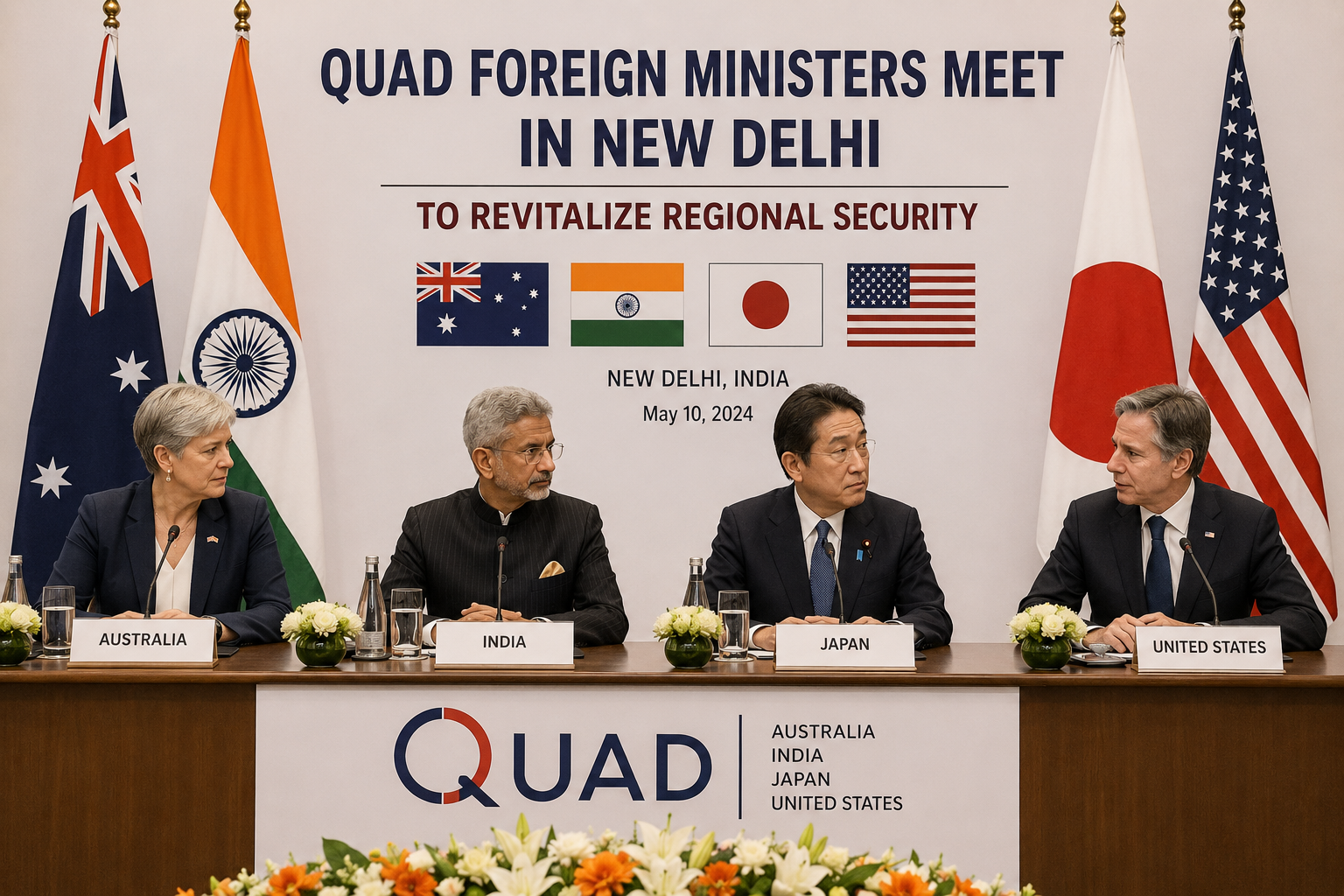
The Quad foreign ministers meet in New Delhi this Tuesday, marking a critical juncture for the Quadrilateral Security Dialogue as it seeks to reclaim its geopolitical momentum. The high-profile gathering brings together India’s External Affairs Minister S. Jaishankar, U.S. Secretary of State Marco Rubio, Australian Foreign Minister Penny Wong, and Japanese Foreign Minister Toshimitsu Motegi. This meeting arrives at a time when global observers have questioned the strategic speed and cohesion of the coalition, particularly under the shifting foreign policy paradigms of U.S. President Donald Trump.
For months, political analysts have debated whether the alliance—comprising Australia, India, Japan, and the United States—was losing its edge to competing bilateral interests and escalating global conflicts. By convening in the Indian capital, the four major democracies aim to send a definitive signal to the Indo-Pacific region: the Quad remains a cornerstone of regional stability, capable of transitioning from a diplomatic talking shop into an actionable security architecture.
1. The Strategic Context of the New Delhi Summit
The backdrop of this ministerial assembly is defined by complex geopolitical friction. The Indo-Pacific region faces an increasingly assertive China, while the broader global economy is reeling from secondary shocks, including the recent maritime disruptions in the Middle East.
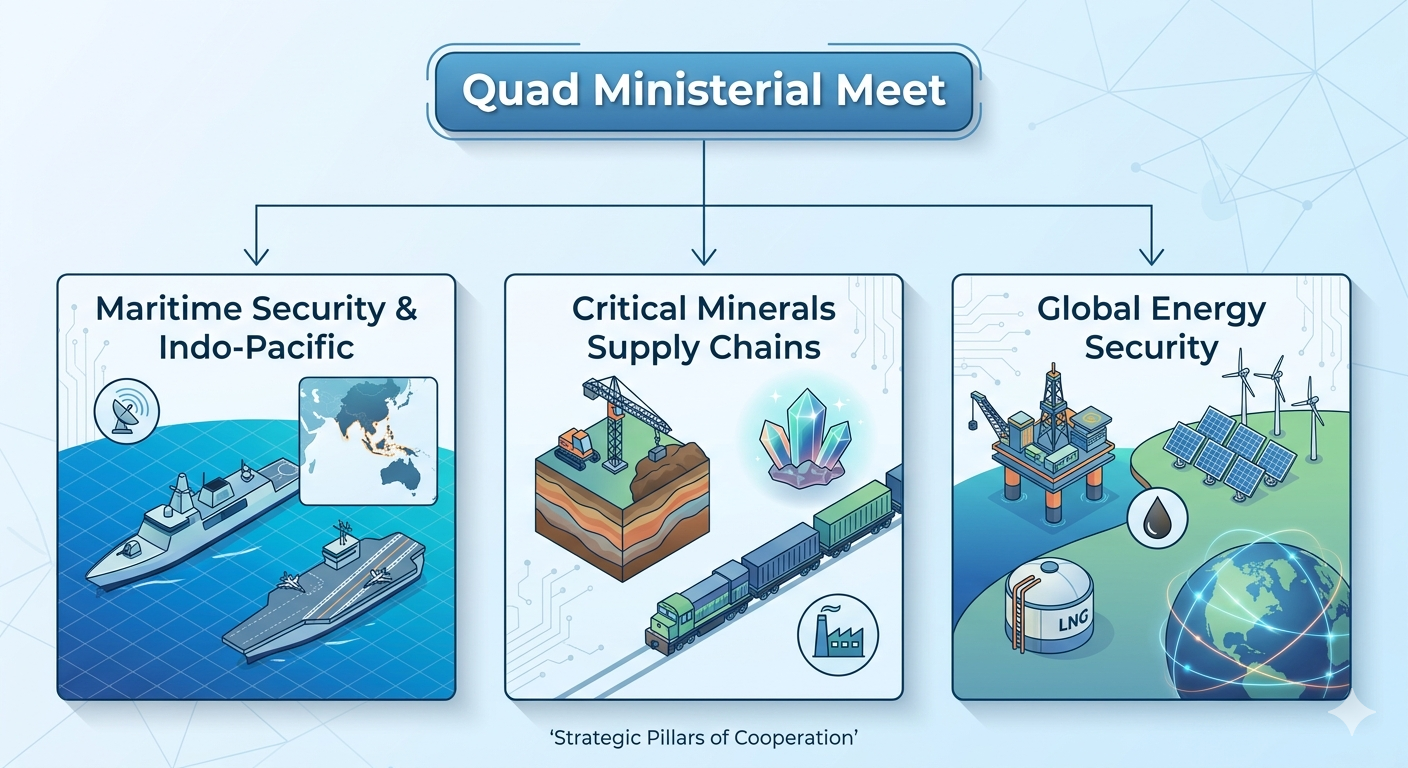
The New Delhi meeting represents the third major ministerial gathering since September 2024. While the grouping previously layout ambitious plans for integration, the practical implementation of these initiatives has been slow. A long-anticipated leaders’ summit, originally slated to take place in India last year, failed to materialize. That delay was largely attributed to trade frictions and tariff disagreements between President Trump and Indian Prime Minister Narendra Modi. Consequently, this ministerial interaction is tasked with repairing institutional momentum and setting the stage for a rescheduled heads-of-state summit later this year.
2. Diplomatic Objectives: Moving Beyond “Semi-Annual Meetings”
A primary objective for the diplomats in New Delhi is to transform the Quad from an advisory committee into an active operational partnership. This sentiment was explicitly emphasized by U.S. Secretary of State Marco Rubio upon his arrival in India for a four-day official visit aimed at fortifying bilateral and multilateral ties.
Speaking to local media, Rubio noted that Washington is no longer satisfied with the Quad functioning merely as a recurring forum for like-minded countries. Instead, the United States is pushing for “concrete actions” across specific sectors, most notably maritime security, infrastructure resilience, and the securing of critical mineral supply chains. The American delegation’s focus indicates a desire to institutionalize the Quad’s initiatives, making them resilient against domestic political shifts within any of the four member states.
3. The China Factor and the Balance of Power
While official Quad communiqués often avoid explicitly naming Beijing, the shared concern over China’s expanding military and economic footprint is the primary structural driver of the alliance. Each of the four nations faces distinct challenges relative to Chinese policy:
India: Shares a heavily militarized, disputed Himalayan border with China. While Prime Minister Modi has recently shown a tactical willingness to manage ties with Beijing to balance trade pressures from Washington, underlying strategic anxieties remain high.
Japan: Faces persistent maritime standoffs in the East China Sea, particularly around the Senkaku (Diaoyu) Islands, where Chinese coast guard and naval vessels regularly challenge Japanese jurisdiction.
Australia: Navigates a complex relationship balancing its massive economic reliance on Chinese markets with the acute necessity of preserving open, rule-based trade lanes in the South China Sea.
The United States: Views China as its primary long-term strategic competitor, seeking to build a network of interlocking alliances in Asia to deter unilateral changes to the regional status quo.
Beijing has consistently denounced the Quad, characterising it as a “Cold War-style construct” and an Asian equivalent of NATO designed explicitly to contain its peaceful rise. The ministers meeting in New Delhi must balance robust deterrence strategies with diplomatic communication to ensure that defensive alignments are not misconstrued as direct provocations.
4. Critical Mineral Supply Chains and Economic Security
Economic security has become indistinguishable from traditional national defense, a reality that Japan understands intimately. Tokyo is utilizing the New Delhi summit to aggressively advocate for the diversification of critical mineral supply chains.
| Mineral Category | Key Applications | Current Dominant Supplier | Quad Initiative Objective |
| Rare Earth Elements | Aerospace, Defense Systems | China | Developing alternative processing facilities in Australia and the US. |
| Lithium & Cobalt | EV Batteries, Grid Storage | Global (Processing in China) | Establishing secure, tariff-free supply corridors among member states. |
| Semiconductor Materials | Advanced Microchips | East Asia Supply Chains | Investing in domestic fabrication capabilities within India and the US. |
Following previous diplomatic disputes, Beijing restricted the export of several critical elements vital for aerospace, defense systems, and semiconductor manufacturing. This vulnerability highlighted the danger of relying on a single, politically volatile supplier for materials essential to modern technology. The Quad’s focus on critical minerals aims to build an insulated supply loop, leveraging Australia’s rich raw mineral reserves, India’s massive labor and processing potential, and the technological and financial capital of Japan and the United States.
5. Maritime Security and the Strait of Hormuz Crisis
While the Quad’s primary geographic theater is the Indo-Pacific, global maritime interconnectedness means that crises elsewhere inevitably alter its agenda. The New Delhi discussions are set to feature prominent deliberations on the Middle East, specifically regarding the three-month-old conflict involving U.S. and Israeli forces against Iran, which led to the closure of the Strait of Hormuz.
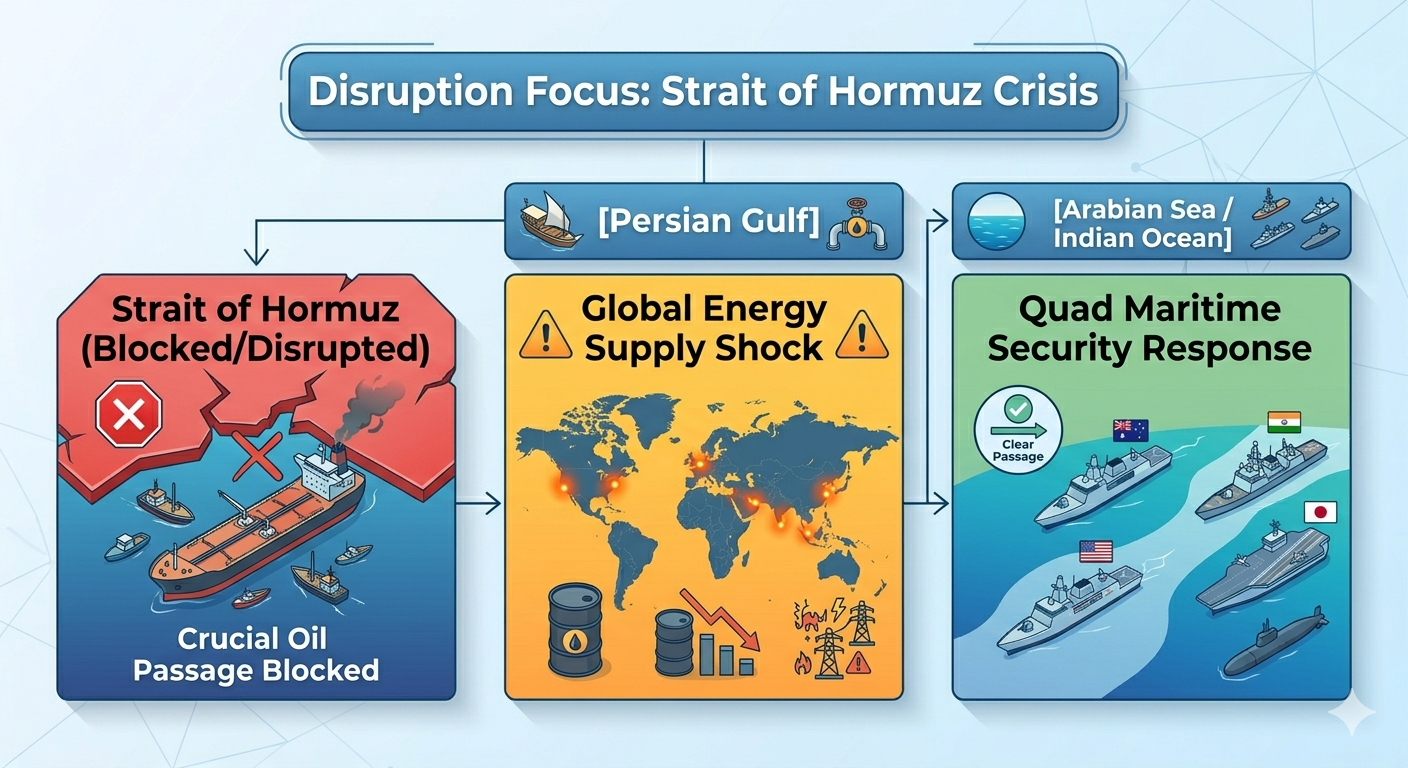
The closure of this vital choke point has severely disrupted global energy markets, driving up shipping insurance rates and forcing tankers to take longer, more expensive routes around Africa. For energy-dependent nations like Japan and India, the stability of the Western Indian Ocean is an existential priority.
The ministers are reviewing how existing Quad frameworks, such as the Indo-Pacific Partnership for Maritime Domain Awareness (IPMDA), can be expanded or adapted. The IPMDA aims to provide real-time tracking of dark shipping and maritime anomalies, a capability that is increasingly necessary as asymmetric threats to commercial shipping evolve globally.
6. Leader-Level Engagement and Internal Frictions
A major critique leveled against the Quad in recent months has been the perceived lack of engagement at the head-of-government level. While foreign ministers meet with relative frequency, the ultimate strategic direction of the alliance depends on the consensus of its leaders.
The failure to host the anticipated summit last year exposed internal policy contradictions within the alliance. President Donald Trump’s “America First” economic platform, characterized by aggressive global tariff offensives, has occasionally collided with New Delhi’s “Make in India” manufacturing ambitions. These trade frictions created diplomatic space that Beijing attempted to exploit, leading to a temporary stabilization of India-China border talks.
However, recent diplomatic communications suggest an effort to realign these personal and national relationships. During a phone call to a U.S. reception in New Delhi, President Trump publicly praised Prime Minister Modi, stating that India could count on American support “100%.” The challenge for the diplomats meeting in New Delhi is to translate this political goodwill into a definitive schedule for a leaders’ summit later this year, an objective that Japanese officials emphasize rests largely on India’s scheduling as the host nation.
7. The Evolving Security Architecture of the Indo-Pacific
The Quad does not exist in a vacuum; it is part of a broader, evolving security architecture in the region that includes AUKUS (Australia, the UK, and the US), the bilateral alliances of the United States, and growing minilateral arrangements like the US-Japan-Philippines triad.
                     ┌──────────────────────────────┐
                     │  Indo-Pacific Architecture   │
                     └──────────────┬───────────────┘
                                    │
         ┌──────────────────────────┼───────────────────────────┐
         ▼                          ▼                           ▼
┌──────────────────┐      ┌──────────────────┐        ┌──────────────────┐
│       QUAD       │      │      AUKUS       │        │   Minilaterals   │
│ (US, IN, JP, AU) │      │   (US, UK, AU)   │        │ (US, JP, PH, etc)│
│ Focus: Maritime, │      │ Focus: Submarines│        │ Focus: Targeted  │
│ Tech, Minerals   │      │ & Advanced Tech  │        │ Defense Pacts    │
└──────────────────┘      └──────────────────┘        └──────────────────┘
The unique value of the Quad lies in its comprehensive approach. Unlike AUKUS, which is explicitly a military and technology-transfer pact, the Quad blends hard security initiatives with public goods delivery—such as vaccine distribution, climate monitoring, disaster relief, and infrastructure financing. By maintaining this multi-faceted identity, the Quad seeks to present an attractive alternative to Chinese economic development models like the Belt and Road Initiative (BRI), offering regional partners a transparent, sustainable pathway to growth.
8. Conclusion: The Road Ahead for the Quad
As the Quad foreign ministers meet in New Delhi, the stakes extend far beyond routine diplomatic coordination. The ministers face the dual task of addressing immediate global security crises, such as the maritime choke points in the Middle East, while reinforcing the long-term deterrence structures necessary to preserve a free and open Indo-Pacific.
The success of this week’s meetings will not be measured by the eloquence of its joint statements, but by the concrete actions that follow. If the diplomats can successfully lock in a date for a comprehensive leaders’ summit, advance the integration of critical mineral supply chains, and expand maritime intelligence sharing, the Quad will effectively silence its critics. In doing so, it will reaffirm its position as an indispensable element of the modern global security landscape, demonstrating that these four diverse democracies can successfully align their strategic interests to safeguard international stability.