
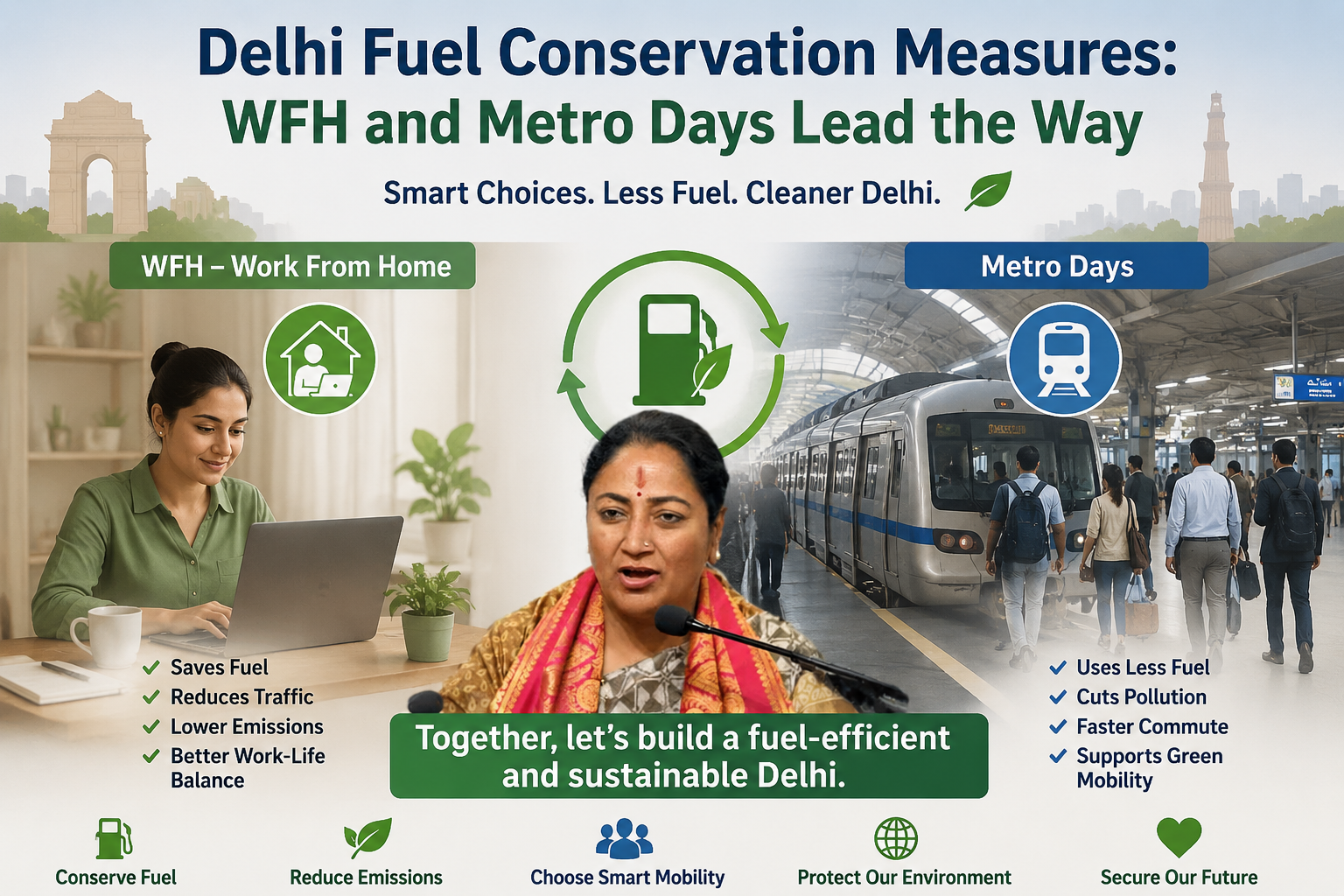
The Delhi fuel conservation measures recently announced by the state government mark a historic shift in how urban India approaches energy consumption. Following a powerful appeal by Prime Minister Narendra Modi for “wise spending” and “responsible consumption,” Chief Minister Rekha Gupta has rolled out a sweeping roadmap to insulate the Indian economy from global volatility.
With tensions in West Asia and disruptions in the Strait of Hormuz putting immense pressure on India’s foreign exchange reserves, Delhi is stepping up. This isn’t just about saving petrol; it’s about “economic patriotism.” From mandatory work-from-home (WFH) days to the innovative “Monday Metro” initiative, the capital is setting a precedent for the rest of the country.
1. The WFH Revival: 2 Days of Remote Work
One of the most significant Delhi fuel conservation measures is the re-introduction of work-from-home protocols for government employees. All Delhi government staff will now work from home two days a week.
This move draws inspiration from the efficiency seen during the COVID-19 pandemic. By keeping thousands of employees off the road for 40% of the workweek, the government expects a massive dip in daily fuel consumption. Additionally, 50% of all official meetings will now be conducted via virtual conferences, eliminating the need for inter-departmental travel.
2. “Monday Metro” and the “No Car Day” Appeal
To lead by example, the government has designated every Monday as “Monday Metro.” On this day:
Ministers, senior officers, and junior staff will ditch their private or official cars.
Commuting will be done exclusively via the Delhi Metro.
A “No Car Day” appeal has been extended to the general public, encouraging citizens to choose public transport at least once a week.
To facilitate this, the government is deploying 58 special buses to ferry staff from 29 government colonies, ensuring that the transition to public transport is seamless and efficient.
3. Drastic Cuts in Official Convoys
In a stunning display of leadership, Chief Minister Rekha Gupta has slashed her own official carcade by 60%. Previously a larger fleet, the convoy is now restricted to just four vehicles. Interestingly, two of these four vehicles are Electric Vehicles (EVs), signaling a permanent shift toward sustainable mobility.
Furthermore, petrol limits for all government officers have been slashed by 20%, bringing the monthly cap significantly lower than the previous 200-litre limit.
4. The “Mera Bharat Mera Yogdan” Campaign
The Delhi fuel conservation measures are not just policy changes; they are part of a social movement. The “Mera Bharat Mera Yogdan” (My India, My Contribution) campaign will run for 90 days.
The Pledge: Citizens will be administered a pledge to practice responsible consumption.
Awareness: The campaign aims to educate the public on how saving fuel directly strengthens India’s foreign exchange reserves and protects the rupee.
5. Energy Audits and Electricity Saving
Fuel isn’t the only resource under the microscope. To reduce the carbon footprint and save on electricity costs, new rules have been set for government buildings:
AC Temperature Limits: Air conditioners in all offices must be set between 24°C and 26°C.
Master Switches: Installation of master switches is now mandatory to ensure all lights and electronics are killed at the end of the day, preventing “phantom” energy loss.
6. Financial Prudence: Bans and Allowances
The government has also implemented a six-month freeze on the purchase of any new vehicles—petrol, diesel, or even electric. This “wait and watch” approach ensures that government funds are diverted to more critical economic areas.
To support employees during this transition, the government has actually increased the transport allowance by 10%, acknowledging the rising costs of living while still pushing for public transport use. Furthermore, a one-year ban on foreign travel for ministers and officers ensures that “non-essential” foreign exchange spending is halted immediately.
7. Why This Matters: The Global Context
Prime Minister Modi’s appeal at the Secunderabad Parade Grounds highlighted a grim reality: India is heavily dependent on imports for crude oil, gold, and edible oils. The ongoing Iran conflict has made these imports more expensive and less reliable.
Experts suggest these measures are not “austerity” (which implies a withdrawal of government spending) but rather “economic prudence.” By reducing unnecessary consumption, the government ensures that India has the “firepower” to keep the economy stable even if global oil prices skyrocket.
The Road Ahead
The success of these Delhi fuel conservation measures depends on the collective participation of the “Aam Aadmi.” As the city shifts toward online meets, EV convoys, and “Monday Metros,” the goal is clear: to build a self-reliant India that can withstand any global storm.
What can you do?
Follow the “No Car Day” once a week.
Set your home AC to 25°C.
Choose carpooling or the Metro for your daily commute.
Delhi has started the journey. It’s time for the rest of the nation to follow.
Key Highlights of the New Policy
| Measure | Target | Expected Impact |
| WFH | 2 Days/Week | Lower Traffic & Fuel Use |
| Carcade Cut | 60% Reduction | Leadership by Example |
| New Vehicles | 6-Month Ban | Budgetary Savings |
| AC Settings | 24°C – 26°C | Lower Grid Pressure |
| Foreign Travel | 1-Year Ban | Forex Preservation |