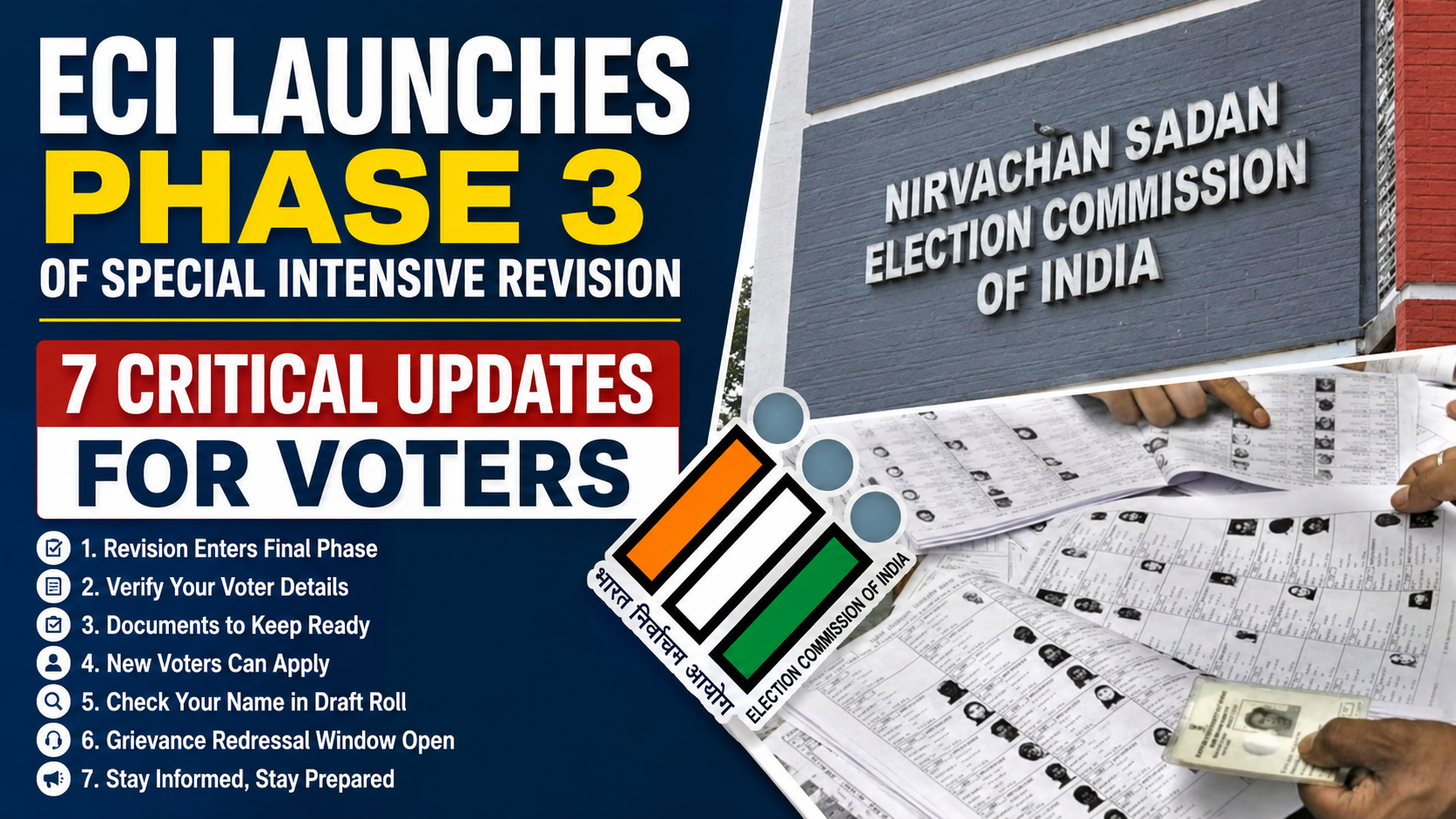
The Election Commission of India (ECI) has officially initiated Phase 3 of the Special Intensive Revision (SIR) of electoral rolls across 16 States and 3 Union Territories. This massive undertaking, announced on Thursday, May 14, 2026, aims to sanitize India’s voter lists by ensuring only eligible citizens are registered. By syncing with the ongoing national Census house-listing operations, the ECI is deploying an unprecedented administrative force to clean up the data that powers the world’s largest democracy.
Understanding the ECI Special Intensive Revision Phase 3
The ECI Special Intensive Revision Phase 3 is the penultimate stage of a nationwide effort to modernize and verify the electoral database. With Chief Election Commissioner Gyanesh Kumar at the helm, the commission is moving toward a “zero-error” electoral roll.
In this phase, over 3.94 lakh Booth Level Officers (BLOs) are hitting the streets. Their mission? To conduct door-to-door verification for approximately 36.73 crore electors. This phase is particularly significant because it includes the National Capital Territory of Delhi, where the final electoral rolls are expected to be published by October 7, 2026.
Why the SIR is Necessary: Lessons from Phases 1 and 2
To understand why the ECI Special Intensive Revision Phase 3 is so vital, we have to look at the staggering numbers from the previous stages. The ECI isn’t just adding new names; they are removing millions of “ghost” voters, duplicates, and those who have migrated or passed away.
Phase 1 (June – September 2025): Primarily focused on Bihar. This stage saw the removal of roughly 47 lakh voters (about 5–6% of the state’s electorate) just in time for the Assembly elections.
Phase 2 (Started October 2025): This phase covered heavyweights like Uttar Pradesh and West Bengal. The results were eye-opening:
Total Deletions: The voter count dropped from 50.99 crore to 45.81 crore—a reduction of 10.2%.
State Highlights: Uttar Pradesh saw 2.04 crore deletions, while West Bengal removed 83.86 lakh ineligible names.
The Geography of Phase 3: Who is In and Who is Out?
The ECI Special Intensive Revision Phase 3 covers almost the entire remaining map of India, with three notable exceptions: Himachal Pradesh, Jammu and Kashmir, and Ladakh.
The ECI has been transparent about why these regions are deferred. The decision rests on two main pillars:
Weather Constraints: High-altitude and snow-bound areas make door-to-door verification impossible during certain months.
Census Synchronization: These regions will wait for the completion of Phase 2 of the national Census to ensure the administrative machinery isn’t overstretched.
A Unified Approach: Census and SIR
One of the most strategic moves by the ECI in 2026 is the alignment of the ECI Special Intensive Revision Phase 3 with the National Census house-listing operations.
Typically, these are two distinct, massive logistical exercises. However, by using “common field machinery”—essentially the same pool of local officials and data collectors—the government is reducing “voter fatigue” and administrative overlap. When a Census official knocks on your door, there is a high likelihood they are also verifying your status on the electoral roll.
The Human Element: An Appeal from the Chief Election Commissioner
Chief Election Commissioner Gyanesh Kumar emphasized that while the machinery is in place, the success of the ECI Special Intensive Revision Phase 3 depends on public cooperation.
“I appeal to all electors to enthusiastically participate in Phase III of the Special Intensive Revision and fill out their enumeration forms,” Kumar stated. “The objective is to ensure that only eligible voters are included and no ineligible names remain.”
Step-by-Step: What Voters Need to Do During Phase 3
If you live in one of the 16 states or 3 UTs covered in this phase (including Delhi), here is what you should expect:
BLO Visit: A Booth Level Officer will visit your residence for physical verification.
Document Ready: Have your ID proofs (Aadhaar, Passport, etc.) ready to verify age and residence.
Form Submission: Use the “Enumeration Forms” provided to correct any errors in your current listing or to register if you have recently turned 18.
Digital Tracking: While the physical visit is key, voters are encouraged to use the ECI’s digital portals to track their revision status.
The Impact on Future Elections
The completion of the ECI Special Intensive Revision Phase 3 will mark a turning point in Indian electoral history. By purging nearly 10% of the electorate in earlier phases, the ECI has already proven that the previous rolls were significantly inflated.
A “leaner” electoral roll means:
More Accurate Voter Turnout Percentages: When the denominator (total voters) is accurate, the turnout reflects true democratic participation.
Reduced Scope for Fraud: Eliminating duplicates and deceased voters prevents the misuse of voter ID cards.
Better Resource Allocation: The ECI can better plan polling booths and security based on actual, verified resident voters.
Looking Ahead: The Final Publication
For residents of Delhi and the other participating states, the clock is ticking toward October 7, 2026. This is the date the ECI has circled for the publication of the final rolls. Once Phase 3 concludes and the special schedules for the Himalayan regions are completed, India will possess the most accurate and technologically verified electoral database in its history.
The ECI Special Intensive Revision Phase 3 isn’t just an administrative chore; it is a fundamental strengthening of the democratic fabric. As the BLOs begin their rounds, it is the responsibility of every citizen to ensure their voice is accurately represented on the roll.
Key Takeaways for Citizens
Check Your Status: Don’t wait for the BLO; visit the National Voters’ Service Portal (NVSP).
Be Proactive: If you’ve moved house recently, Phase 3 is your window to ensure your registration moves with you.
Spread Awareness: Ensure that elderly neighbors and first-time voters understand the importance of the enumeration forms.
The ECI Special Intensive Revision Phase 3 is a massive leap toward an era of “One Citizen, One Vote, One Identity.” Stay informed, stay registered, and ensure your part in the 2026 electoral landscape is secured.