
DMart Q1 results are officially out, and they present a classic corporate paradox. On the surface, Avenue Supermarts—the powerhouse behind India’s favorite discount retail chain, DMart—continues to look like an unstoppable money-printing machine. The headline numbers for the first quarter ended June 30, 2026, boast steady double-digit growth in both top-line revenue and bottom-line profits.
Yet, if you peel back the layers of the financial statements released on Saturday, July 11, a much more nuanced and fiercely competitive story emerges.
While the value retailer is still pulling in crowds in non-metro areas, its older, mature brick-and-mortar strongholds in major metros are experiencing a significant growth chill. With intense pressure mounting from e-commerce giants and ultra-fast quick commerce apps, DMart’s latest earnings report offers a fascinating look at how consumer behavior is changing across urban India.
Let’s dive deep into the numbers, the category shifts, and the strategic course corrections shaping DMart’s roadmap for the rest of FY27.
The Headline Numbers: Growth Remains Resilient
To understand where DMart is heading, we first need to look at where it stands. On a consolidated basis, Avenue Supermarts delivered a structurally sound performance that aligns well with its reputation as a defensive, high-quality retail stock.
Consolidated Financial Performance
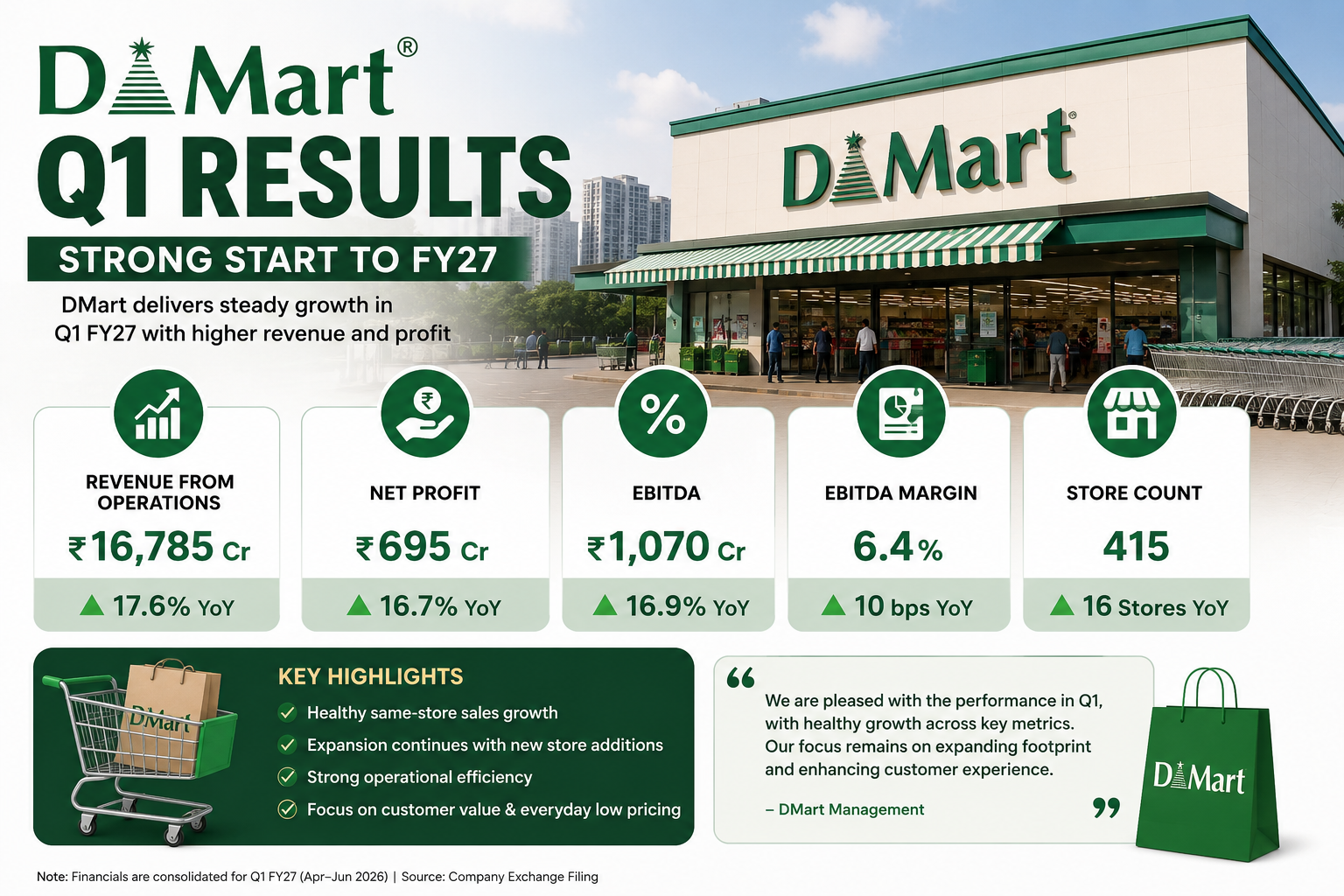
Revenue from Operations: Climbed 15% year-on-year (YoY) to ₹18,794.5 crore, up from ₹16,360 crore in the corresponding quarter of the previous fiscal year.
Net Profit (PAT): Increased by 11.3% YoY to ₹860.6 crore (rounded to ₹1,61 crore in primary exchange summaries), compared to ₹773 crore in Q1 FY26.
EBITDA: Rose 15% to ₹1,499 crore, showcasing stable operational efficiency.
EBITDA Margin: Held steady at a healthy 7.98%.
Earnings Per Share (EPS): Increased to ₹13.20 from ₹11.88 in Q1 FY26.
Standalone Financial Performance
On an isolated basis, the parent company performed slightly better, indicating that the core offline business is bearing the financial weight of its digital experiments.
Standalone Net Profit: Jumped 12.8% to ₹935.8 crore.
Standalone Revenue: Advanced 15.1% to ₹18,343.5 crore, up from ₹15,932.1 crore in Q1 last year. Sequentially, standalone revenue grew by 6% compared to the ₹17,204.5 crore recorded in Q4 FY26.
The Big Concern: The Sputtering Engine of Mature Stores
While a 15% growth in revenue is enviable for most brick-and-mortar retail businesses, equity analysts and retail insiders are focusing on a different metric: Like-for-Like (LFL) growth.
LFL growth tracks the sales performance of stores that have been open for two years or longer. It is the truest indicator of a retailer’s organic health because it excludes the artificial revenue bump that comes from opening shiny new locations.
According to the management commentary, DMart’s LFL growth experienced a sharp deceleration during the April–June period.
| Metric | Q4 FY26 | Q1 FY26 | Q1 FY27 (Current) |
| Like-for-Like (LFL) Growth | 10.8% | 7.1% | 5.5% |
Like-for-Like (LFL) Growth Trend:
Q4 FY26:  ███████████ 10.8%
Q1 FY26:  ███████ 7.1%
Q1 FY27:  ██████ 5.5%  <-- Sharp Deceleration
This drop from a stellar 10.8% in the previous quarter to just 5.5% this quarter signals that growth in mature, long-standing stores is slowing down considerably.
Anshul Asawa, Managing Director & CEO of Avenue Supermarts, addressed this head-on:
“Two years and older DMart stores grew by 5.5% during Q1 FY27 as compared to 7.1% in Q1 FY26. In large metros, growth in older stores, which have significantly higher revenue per square foot, was flat this quarter. While stores in non-metros continue to grow well.”
The Metro vs. Non-Metro Divergence
This flat growth in large metros is a significant shift. For years, DMart’s mega-stores in Tier-1 cities acted as cash cows. They operated with incredibly high efficiency, packing massive foot traffic into every square foot of retail space.
However, urban consumers are rapidly changing how they shop. In major metropolitan areas, convenience is increasingly taking precedence over absolute cost savings. The immediate gratification offered by 10-minute grocery delivery apps has fundamentally disrupted the traditional weekend trip to the local hypermarket.
In contrast, non-metro markets (Tier-2 and Tier-3 cities) remain highly lucrative for DMart. In these regions, quick commerce infrastructure is either non-existent or too expensive to scale efficiently, allowing DMart’s core value proposition—unbeatable discounts via its Everyday Low Cost – Everyday Low Price (EDLC-EDLP) strategy—to work perfectly.
Changing Basket Dynamics: Quick Commerce Bites into Foods
A closer look at DMart’s product mix reveals exactly where the digital competition is hurting the most. The company’s revenue is divided into three primary categories: Foods, Non-Food FMCG, and General Merchandise & Apparel.
1. The Foods Category (Under Pressure)
Current Share: 54.93%
Previous Year Share (Q1 FY26): 55.60%
Analysis: This segment includes daily staples, groceries, dairy, processed foods, and fresh produce. While it remains DMart’s largest revenue contributor, its share is visibly shrinking. This is the exact battleground where quick commerce players are aggressively discounting and capturing market share. When an urban consumer runs out of milk, flour, or instant noodles, they are increasingly choosing an app over a physical trip to DMart.
2. Non-Food Consumer Goods (Stable)
Current Share: 19.60%
Analysis: Personal care products, toiletries, and home care items remained stable. These items are often bought in bulk monthly cycles, helping DMart retain its core customer base.
3. General Merchandise and Apparel (The Silver Lining)
Current Share: 25.47% (Up from 24.73% last year)
Analysis: This is the bright spot in the Q1 earnings report. General merchandise (home appliances, crockery, plastics) and apparel carry much higher profit margins than highly commoditized groceries. The rising share in this category helped insulate DMart’s EBITDA margins, protecting overall profitability despite the slowdown in food volume growth.
Real Estate Metrics: The Sales-per-Square-Foot Dilemma
DMart’s business model relies heavily on high inventory turnover and maximum space utilization. However, the aggressive push into new locations alongside flat metro store sales has created a minor efficiency drag.
The company reported that its revenue from sales per square foot was down 2.37% year-on-year, landing at ₹8,571 for Q1 FY27.
This drop suggests that while DMart is successfully building out more retail space, the newer stores are taking longer to mature, or the existing space isn’t generating the same transaction density as before.
Despite this, DMart’s expansion machine isn’t slowing down. The retailer added three massive new stores during the quarter, bringing its total store count to 503 as of June 30, 2026. The company continues to lean into a cluster-based expansion strategy, opening new locations near existing supply chain hubs to keep logistics costs incredibly low.
E-Commerce Reality Check: DMart Ready Scales Back to Focus
DMart’s digital arm, Avenue E-Commerce Ltd (AEL), which operates the DMart Ready online grocery delivery business, continues to navigate a difficult path toward profitability.
For the quarter ended June 30, 2026, AEL reported a comprehensive loss of ₹91.39 crore.
Instead of chasing unprofitable revenue across the country, DMart’s digital management team is executing a strategic pivot. The company is actively scaling back its geographic footprint to protect its balance sheet, choosing execution quality over sheer scale.
Vikram Dasu, Whole Time Director & CEO of Avenue E-Commerce Ltd, explained the rationalization:
“We continue to deepen our focus in large metro cities while improving our model. During the quarter, we have discontinued our operations in seven cities which were marginal contributors. As of June 30, 2026, we operate in 11 cities.”
By pulling out of seven underperforming cities and focusing exclusively on 11 core urban centers, DMart Ready is attempting to build a sustainable omni-channel model that complements its physical stores rather than draining cash in a burning hyper-local delivery war.
The Moat: Why DMart is Far from Down
Despite the clear headwinds in metro markets, it would be a mistake to underestimate Avenue Supermarts. The company’s fundamental economic moat remains completely intact.
The EDLC-EDLP Engine: DMart operates on a relentless “Everyday Low Cost – Everyday Low Price” principle. By buying goods in massive volumes directly from manufacturers and paying suppliers incredibly fast (often within days instead of the industry standard of 30–60 days), DMart secures cash discounts that no competitor can easily match.
Ownership of Real Estate: Unlike most retail chains that rent their properties, DMart owns the land or holds long-term leases on the majority of its stores. This protects the company from rising rental costs, keeping fixed overhead low during economic downturns or competitive real estate spikes.
Unmatched Balance Sheet Strength: DMart remains a virtually debt-free enterprise with significant cash reserves. While tech-first quick commerce platforms rely heavily on continuous venture capital or public market funding to subsidize operational losses, DMart funds its growth entirely through internal cash flows.
What Lies Ahead for Avenue Supermarts?
The Q1 FY27 results serve as a clear sign that India’s retail landscape is maturing and bifurcating.
In metros, DMart can no longer rely on structural inertia to drive growth. It will need to innovate its digital omni-channel experience, potentially optimize its DMart Ready pick-up points, and find ways to make its massive urban stores experiential hubs rather than just transactional spaces.
In non-metros, the runway for growth remains massive. As long as rising disposable incomes drive Tier-2 and Tier-3 consumers toward organized retail, DMart’s value-first proposition will continue to attract millions of shoppers.
Ahead of the earnings announcement, Avenue Supermarts shares closed marginally higher by 0.04% at ₹4,081. As the market digests these numbers on Monday, the focus won’t be on the solid ₹861 crore net profit—it will be on how effectively management plans to kickstart growth in those critical, mature metro stores.
Disclaimer: The information provided above is for educational purposes only. We strongly advise investors to consult with SEBI-certified financial experts before making any investment decisions.