
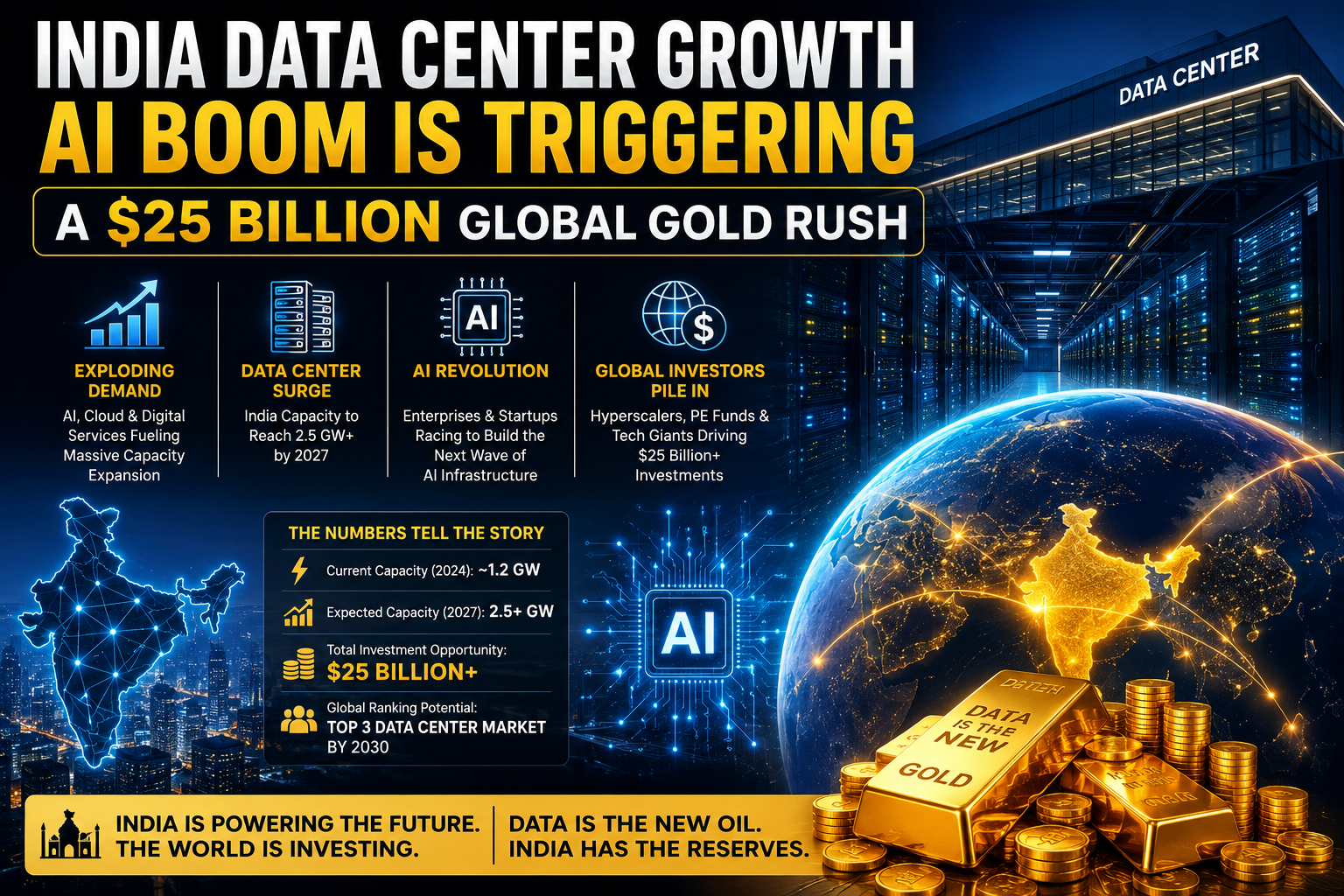
India Data Center Growth is no longer just a structural shift; it has officially transformed into a high-stakes global infrastructure gold rush. As artificial intelligence (AI) adoption accelerates exponentially and governments worldwide push fiercely for digital sovereignty, India has emerged as the absolute epicenter for next-generation digital infrastructure. With billions of dollars in institutional capital, sovereign wealth, and private equity chasing a finite amount of space and power, the subcontinent is rapidly evolving from a massive consumer of digital services into a dominant global supplier of raw AI compute power.
According to deep-market data shared by investment banking heavyweight Avendus Capital, India’s data center market is sitting at a pivotal inflection point. The industry has already scaled its capacity from a modest 800 Megawatts (MW) in December 2022 to an impressive 1.6 Gigawatts (GW) by December 2025. But this is just the foundational baseline. Experts project that between now and 2030, the country will witness an annual average capacity addition of 650 to 700 MW, culminates in a staggering $25 billion of deployed capital over the next few years.
What is driving this unprecedented influx of global capital, and how is it reshaping both domestic infrastructure and global supply chains? Let’s break down the core dynamics fueling this monumental industrial expansion.
1. The Geopolitical and Latency Advantage: The 100-Millisecond Window
One of the most compelling operational realities driving global hyperscalers to Indian shores is the country’s unique geographic positioning. In an interconnected digital economy, physical location dictates latency, and latency dictates user experience.
“India sits within 100 milliseconds of the Middle East and Southeast Asia, making it an ideal regional digital hub,” notes Sunil Gupta, Co-founder and CEO of Yotta Data Services.
This geographic sweet spot allows operators based in India to serve vast, data-hungry populations across multiple continents with minimal lag. As western European nations and major tech hubs in the United States face severe constraints around power availability, prolonged grid-connection timelines, and skyrocketing construction costs, India offers a highly competitive alternative.
The global spillover effect is real. When international enterprise AI workloads struggle to find high-density power envelopes in mature markets, that demand naturally shifts to regions that can rapidly deploy high-quality data centers and massive graphics processing unit (GPU) clusters at scale. India is uniquely positioned to absorb this excess global demand, transitioning its digital ecosystem into a premium export hub for AI computational workflows.
2. Aggressive Policy Push: Sovereign AI and the 2047 Tax Holiday
Massive infrastructure booms do not happen in a vacuum; they require a deliberate, protective, and highly encouraging regulatory framework. The Indian government has systematically checked every box necessary to de-risk the sector for institutional investors.
Data Localisation Mandates: Regulatory frameworks across banking, financial services, and insurance (BFSI), alongside general enterprise governance, strictly dictate that citizen data must reside within national borders. This completely eliminates the option of hosting critical workloads in offshore clouds.
Sovereign AI Infrastructure: The central government’s strong advocacy for building national, self-reliant AI capabilities has forced enterprises, startups, and public sector units to seek out domestic infrastructure providers.
The Extended Tax Holiday: In a definitive move to cement long-term visibility, the recent Union Budget extended a highly attractive tax holiday until the year 2047 for foreign companies delivering cloud and digital services to global customers directly out of Indian data centers.
This fiscal framework offers global private equity funds exactly what they crave: a predictable, multi-decade, non-cyclical capex runway backed by rock-solid regulatory compliance.
3. The Multi-Billion Dollar Hyperscale Commitments
The sheer volume of capital being funneled into the country highlights the long-term conviction of the world’s largest tech conglomerates. Global hyperscalers—primarily Amazon Web Services (AWS), Microsoft Azure, and Google Cloud—have collectively committed close to $57 billion to scale up their data center footprints across India.
Simultaneously, India’s public cloud services market, which stood at a robust $17 billion in 2025, is on track to skyrocket to $44 billion by 2030, compounding at an aggressive annual growth rate (CAGR) of 22 percent, according to International Data Corporation (IDC) data.
To put this capital deployment into perspective, look at the recent deal flow monitored by institutional desks:
| Data Center Operator | Institutional Backer / Investor | Transaction / Investment Scale |
| CtrlS | Canada Pension Plan Investment Board (CPPIB) | Rs 7,000 Crore |
| Airtel’s Nxtra Data | Alpha Wave, Carlyle, Anchorage Capital | $1 Billion Fundraising |
| STT GDC | KKR and Singtel | $1.3 Billion Capital Injection |
| Yotta Data Services | Non-Institutional Investors | $150 Million raised at a $3.9B Valuation |
| Sify Infinit Spaces | Kotak DC Fund | $73 Million |
| HyperVault (TCS & TPG) | Dedicated New Subsidiary | $2 Billion planned over upcoming years |
4. The Domestic Conglomerate Clash: Input Economics and Cheap Power
While global private equity firms are backing local operators, India’s two largest domestic conglomerates—Reliance Industries and the Adani Group—are scaling up massive, vertically integrated digital infrastructure platforms. In the infrastructure asset class, long-term profitability is dictated entirely by input economics, and the most critical input for an AI data center is raw, uninterrupted electricity.
Reliance Jio’s Sovereign AI Play
Reliance Industries, in tandem with its digital arm Jio, has laid out an audacious roadmap involving an investment of Rs 10 lakh crore (approximately $110 billion) over the next seven years. The objective is to establish an end-to-end sovereign AI infrastructure network. This includes constructing AI-ready hyperscale data centers, building out a nationwide edge compute network, and deploying specialized AI services across industries.
AdaniConneX’s Green Energy Integration
On the other side of the landscape, the Adani Group is leveraging its joint venture with global operator EdgeConneX. Operating under the banner of AdaniConneX, the group plans to deploy a staggering $100 billion by 2035 to build out 5 Gigawatts (GW) of data center capacity. Crucially, this massive capacity will be powered directly by the group’s extensive renewable energy portfolio, addressing the severe carbon footprint concerns associated with running high-density AI clusters.
Because both Reliance and Adani control some of the lowest-cost power generation options in the country, they can structure highly competitive, long-term colocation contracts that traditional real estate developers simply cannot match.
5. The Critical Spillover: The AI Power Grid Bottleneck
The narrative surrounding India Data Center Growth frequently focuses on server racks, fiber optic cables, and advanced silicon like Nvidia GPUs. However, industry insiders realize that the ultimate bottleneck isn’t the chips—it is the electric grid infrastructure required to keep them running.
An AI data center running dense inferencing and training workloads consumes significantly more power per square foot than a traditional enterprise cloud data center. This reality has caused a massive global surge in demand for power equipment, ultra-high-voltage transformers, and heavy-duty distribution networks.
This structural trend was vividly illustrated on public equity markets on July 10, when power-grid and cable infrastructure stocks experienced an across-the-board rally driven directly by rising global data center grid constraints.
The Global Power Infrastructure Rally
As the AI investment cycle broadens from semi-conductors to transmission networks, investors are realizing that grid capacity must be built out before a single server can be powered on. This has led to massive order visibility for power equipment manufacturers globally:
Gaon Cable: Surged a remarkable 9.46% in a single session following its 35 billion won order for medium-voltage cables destined for a U.S.-based AI data center, alongside a 60 billion won bus duct supply contract through its subsidiary LSCUS.
Taihan Cable & Solution: Jumped 8.81% after securing a 45 billion won order for a 330-kilovolt ultra-high-voltage grid project to power a major AI data center installation in Australia.
HD Hyundai Electric: Advanced 4.42% after announcing a massive long-term supply agreement worth approximately 1 trillion won with a global Big Tech hyperscaler, subsequently raising its annual order guidance by 24% to a formidable $5.2 billion.
LS Electric: Gained 6.92% on the back of booking nearly 3 trillion won in cumulative first-half orders, positioning it to easily breach its annual target of 4 trillion won.
Enterprise contracts with tech giants are fundamentally changing. They are transitioning from fragmented, one-off transactions into multi-year, fixed-capacity package agreements. For equipment providers, this provides a highly profitable, highly visible stream of recurring revenue.
Understanding the Two Distinct Business Models
To properly analyze where capital is flowing, it is essential to distinguish between the two core operating strategies deployed within the Indian digital infrastructure ecosystem:
Global Hyperscalers (AWS, Azure, Google Cloud)
These platforms focus primarily on selling highly abstracted cloud services, software development kits (SDKs), complex managed databases, out-of-the-box machine learning APIs, and global platform architecture. They buy or lease massive capacity to host their proprietary software ecosystems.
Domestic Infrastructure Operators (CtrlS, Yotta, Nxtra, Sify)
Local operators focus heavily on physical asset management. They specialize in colocation space, managed hosting, fiber connectivity, physical security, sovereign cloud environments, custom built-to-suit capabilities, and dedicated GPU-as-a-service clusters for local enterprises.
Rather than chasing pure real estate margins, global institutional capital is viewing local Indian operators as infrastructure toll roads. They are securing long-duration, power-anchored positions on structural demand that will remain completely insulated from economic cycles.
Summary: A Paradigm Shift in Infrastructure Capital
The multi-billion-dollar investment wave pouring into India’s data center ecosystem represents a fundamental rewiring of modern infrastructure asset classes. Driven by unmatched domestic data generation, an ironclad regulatory environment, competitive development costs, and an undeniable global power shortage, India has secured its position as the premium digital engine of Asia.
For global investors, conglomerates, and grid infrastructure providers, the message is clear: the AI gold rush is firmly underway, and all digital roads are leading directly to India.