
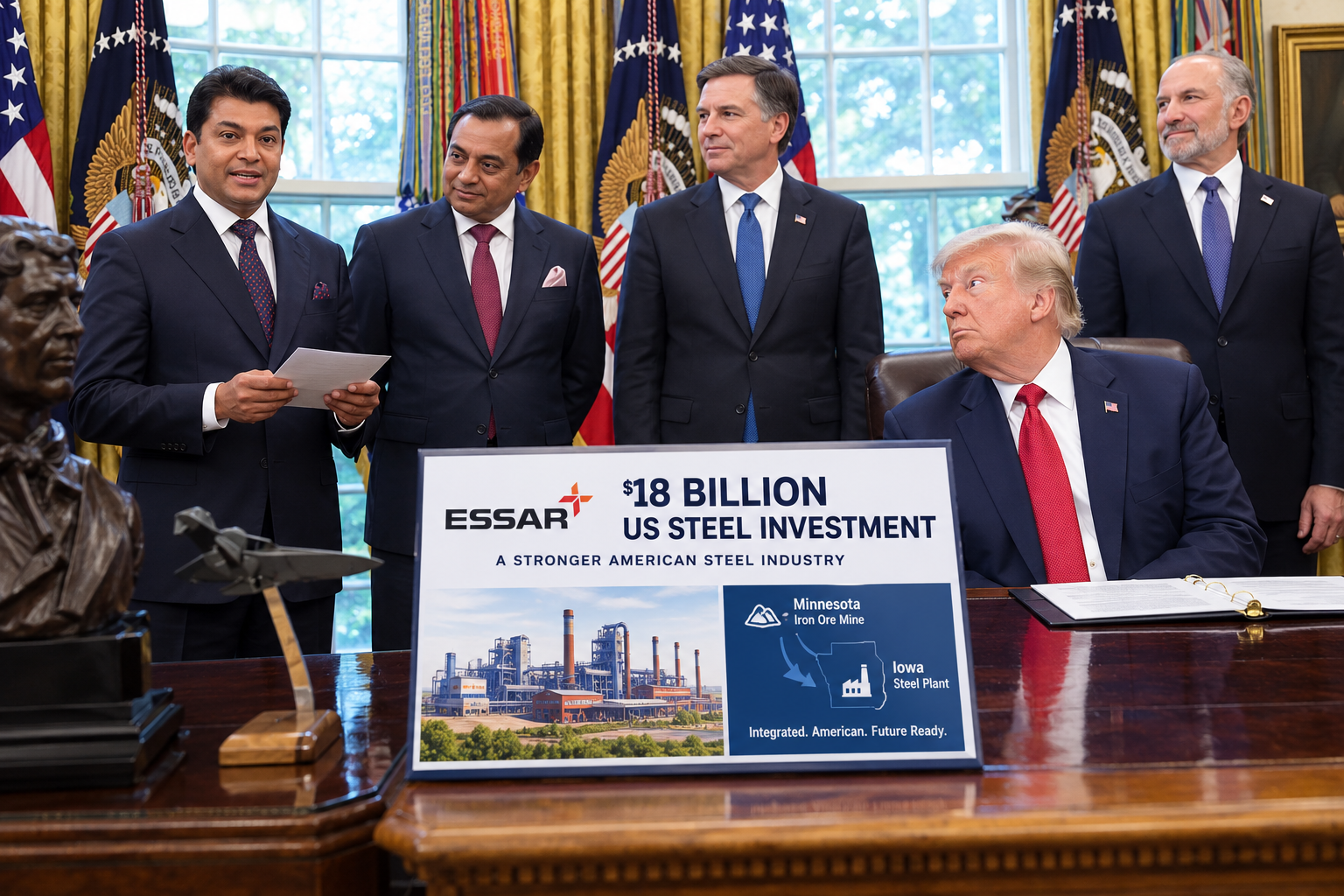
Essar Group US Steel Investment is a step in the global steel world. Essar Group from India plans to put $18 billion into the United States. Essar Group US Steel Investment will build a $15 billion steel plant in Iowa. Use the iron ore mine and pellet plant that Essar Group already owns in Minnesota.
Essar Group US Steel Investment will tie these two places together so that steel is made entirely inside America. Donald Trump announced Essar Group US Steel Investment at a White House event on September 29 2026. Essar Group US Steel Investment should help steel makers grow factories and give thousands of jobs in the Midwest.
Essar Group US Steel Investment plans to start the Iowa plant in 2030. After it is finished the plant will make 10 million tonnes of steel each year. Mesabi Metallics, the US arm of Essar Group is building the project. Essar Group US Steel Investment will link the iron ore mine in Minnesota with the steel plant in Iowa so that raw ore is turned into steel all inside America. More than the money this announcement shows how foreign money is helping factories and how the world steel network is shifting. Essar Group US Steel Investment also starts an important era in the partnership, between India and the United States.
Essar Group US Steel Investment: Key Highlights
The proposed investment brings together several major components of the steel production process, from iron ore mining to finished steel manufacturing.
Here are the key details of the project:
- Total investment: $18 billion, including the existing Minnesota investment.
- Proposed Iowa steel complex: $15 billion.
- Location: Iowa, United States, with iron ore sourced from Minnesota.
- Project developer: Mesabi Metallics, a subsidiary of Essar Group.
- Expected production start: 2030.
- Annual steel production capacity: 10 million tonnes at full development.
- Construction employment: More than 8,000 jobs projected during construction.
- Permanent employment: At least 1,750 full-time jobs expected at the Iowa facility.
- Minnesota investment: Approximately $3 billion already invested in the iron ore mine and pelletizing facility.
- Technology: Direct Reduced Iron (DRI) and Electric Arc Furnace (EAF) steelmaking.
- Supply chain: Iron ore from Minnesota will supply the Iowa steel complex.
These figures describe the project’s announced plans and expected outcomes. The facility is still under development, and the projected capacity and employment figures should not be treated as current operating results.
What Is the $18 Billion Essar Group Investment in the US?
The Essar Group investment is a plan to establish an integrated American steel business by connecting iron ore mining in Minnesota with a large steel manufacturing complex in Iowa.
The total investment of $18 billion includes two major components. The first is the proposed $15 billion steel complex in Iowa. The second is the approximately $3 billion already invested in the Minnesota iron ore mine and pelletizing facility.
The project is being developed through Mesabi Metallics, which has been operating in Minnesota since acquiring Minnesota Steel in 2007.
The company’s broader objective is to create a domestic supply chain that reduces the need to depend on imported raw materials for the planned steel production process.
Instead of sourcing iron ore from overseas and transporting it to American steel mills, the company intends to use its Minnesota mining operations to supply the Iowa complex.
This integrated model could give the company greater control over raw material sourcing, production planning and logistics.
The investment also reflects Essar Group’s international expansion strategy, which includes businesses across energy, infrastructure, metals, mining and technology.
For the United States, the project represents a proposed expansion of domestic industrial capacity. For India, it demonstrates how an Indian-origin conglomerate is using its experience in the steel sector to develop a large manufacturing operation in a major overseas market.
Why Is the Iowa Steel Plant Significant?
The proposed Iowa facility is the component of the Essar Groups US investment plan.
With a planned investment of $15 billion the steel complex is expected to become a manufacturing facility once completed.
According to the announcement the plant is projected to produce 10 million tonnes of steel at full capacity. If achieved that would make it a substantial addition, to the steel manufacturing landscape.
The project is expected to support industries that rely heavily on steel, including construction, transportation, energy, infrastructure, automotive manufacturing and defence-related production.
Steel is an industrial material. Its availability and cost can influence the development of infrastructure projects, manufacturing operations and large-scale construction activities.
By developing a facility of producing steel from domestically sourced iron ore Mesabi Metallics aims to establish a manufacturing network that connects mining, processing and steel production.
The Iowa plant is also expected to use steelmaking technologies, including direct reduced iron and electric arc furnaces.
These technologies are intended to improve energy efficiency and reduce emissions compared with coal-based blast furnace production methods.
However the actual environmental performance of the facility will depend on its design, energy sources, operating practices and production mix.
How Minnesota and Iowa Will Work Together
One of the defining features of the project is the connection between the Minnesota iron ore mine and the proposed Iowa steel complex.
The two locations will form different parts of the same production chain.
1. Iron Ore Mining in Minnesota
Mesabi Metallics operates an iron ore mining project in Nashwauk, Minnesota, located in the Mesabi Iron Range.
The company says it has invested nearly $3 billion in the mine and associated pelletizing facility.
The mine is expected to produce a direct-reduction-grade iron ore pellet known as Patriot Pellet. This material is designed for use in modern steelmaking processes that rely on direct reduced iron.
The company has described the mine as the first new iron ore mine built in the United States in 50 years.
The Minnesota operation is expected to supply the raw material needed for the planned Iowa steel complex.
2. Processing Iron Ore into Pellets
Iron ore extracted from the mine will be processed into pellets suitable for direct reduction.
Pelletizing helps prepare the iron ore for use in modern steelmaking processes.
The company intends to produce high-quality pellets designed to support efficient steel production.
The Minnesota facility is therefore expected to serve as a critical raw material supplier for the Iowa complex.
3. Steel Production in Iowa
The proposed Iowa facility will use iron ore from Minnesota as a major input for steel manufacturing.
The planned production process includes direct reduction of iron ore followed by electric arc furnace steelmaking.
The company intends to combine hot direct-reduced iron with scrap steel in its electric arc furnaces.
This approach is designed to connect domestic mining resources with modern steel production technology.
4. Finished Steel for American Industries
Once the Iowa facility becomes operational, the company expects to supply finished steel products to industries across the United States.
Potential customers include businesses involved in infrastructure, automotive manufacturing, shipbuilding, energy, household appliances and other industrial activities.
The project is intended to create a domestic production chain in which iron ore is mined in Minnesota and converted into finished steel in Iowa.
This structure could help the company coordinate raw material supply and manufacturing operations more closely.
Production Capacity and the 2030 Timeline
The Iowa steel complex that is being planned is expected to start making steel in 2030.
When the facility is completely built it is expected to make about 10 million tonnes of steel every year.
This number is the amount the plant is designed to make. It is not the amount the plant will make away when it starts working.
Big projects like this usually take steps to complete. These steps include planning, building, putting in machines testing everything and slowly increasing how much is made.
The company has not shared a plan for each step of the building process. They also have not said how fast the plant will reach its yearly output.
The 2030 date is the time the company has set for starting production.. How much steel is actually made will depend on how well the plant is built and how smoothly it runs.
For the steel industry this project could be a help, for making more steel in the country if everything goes as planned
Job Creation: What the Project Could Mean for Employment
Employment is one of the important economic factors tied to the Essar Group US Steel Investment. The project is expected to bring job opportunities to the region both during construction and once the plant begins operations.
Construction Jobs
The company says the Iowa project will lead to than 8,000 jobs during the construction phase. These jobs could include construction workers, engineers, equipment operators, technicians and other professionals needed to build an industrial facility. The project may also involve vendors and suppliers which could support even more jobs in related businesses. However this number is a projection. It is not a confirmed count of positions.
Permanent Jobs in Iowa
Once the plant starts operating Mesabi Metallics plans to employ least 1,750 full-time workers at the Iowa facility. These jobs could cover manufacturing, maintenance, engineering, logistics and administrative roles. The company also plans to work with suppliers and businesses across Iowa and the broader Midwest. The actual number of jobs will depend on the final scale of operations production levels and the workforce needed to run the plant.
Employment in Minnesota
The Minnesota mining operation is already creating jobs. At the time of the announcement than 1,500 construction workers were on site plus over 200 full-time employees. The company expects full-time employment at the mine to grow to 350 workers once the facility is fully running. These numbers are for the Minnesota operation only. Should not be mixed with the estimated jobs, in Iowa. Each location contributes separately to employment.
Economic Impact: A Potential Boost for the Midwest
The investment could have effects that go well beyond the steel plant itself.
Large industrial projects need help from kinds of businesses—construction companies, transport operators, equipment suppliers, engineering firms and other service providers.
Because of this the project’s economic impact might reach further than just the workers hired directly by Mesabi Metallics.
The company says its investment in American-made steel could lead to $95 billion in economic output. This number covers both the construction phase and the first 10 years when the plant is fully running.
This is a company projection. It is not a guaranteed result.
Still the estimate includes the expected activity tied to the project over time.
Potential benefits may include:
- jobs during construction and later during operations.
- Higher demand for goods and services from regional suppliers.
- Increased business activity linked to support and logistics.
- Greater need for transportation and infrastructure upgrades.
- Help for manufacturing industries that rely on steel.
How big these effects turn out to be will depend on how the project’s carried out how many suppliers get involved and how much of the spending stays within the region.
For Iowa and Minnesota this project could create an industrial link, between mining and steel manufacturing.
Technology Behind the Steel Plant: DRI and Electric Arc Furnaces
The proposed Iowa steel complex is expected to use Direct Reduced Iron (DRI) and Electric Arc Furnace (EAF) technology.
These processes are important because they can support steel production with an energy and raw material profile from traditional blast furnace-based manufacturing.
What Is Direct Reduced Iron Technology?
Direct Reduced Iron technology involves removing oxygen from iron ore without melting the material
The process produces a metallic iron product that can be used as a raw material in steelmaking.
In the planned Iowa facility iron ore, from Minnesota will be converted into Direct Reduced Iron before being used in the steelmaking process.
The company intends to use Direct Reduced Iron in its Electric Arc Furnaces.
Using Direct Reduced Iron while it is still hot can reduce the amount of energy required during melting.
The approach is designed to improve production efficiency and reduce energy consumption.
What Is Electric Arc Furnace Technology?
An Electric Arc Furnace produces steel by using energy to generate intense heat.
The process can use scrap steel and other metallic materials as inputs.
In the proposed Iowa complex the company plans to use a mixture of Direct Reduced Iron and scrap steel.
This production method differs from the blast furnace route, which relies heavily on coal-based processes to produce iron before converting it into steel.
Electric Arc Furnace production can offer environmental advantages depending on the materials and energy sources used.
Why These Technologies Matter
The combination of DRI and EAF technology is central to the company’s plan to establish a modern steel production facility.
The company says the integrated approach is expected to reduce energy use and emissions compared with traditional coal-fired blast furnace production.
However, the actual environmental benefits will depend on factors such as electricity generation, fuel consumption, raw material sourcing and the efficiency of the final plant.
The project’s long-term performance will need to be assessed once the facility is operating.
Essar Group’s Global Business and Industrial Experience
I learned that Essar Group is an industrial conglomerate that began in 1969 founded by brothers Shashi Ruia and Ravi Ruia.
Essar Group has grown businesses in areas. Essar Group now operates in energy, infrastructure, metals and mining, technology and retail.
Essar Group owns a steel plant in Hazira, Gujarat. Essar Group also has a refinery in Vadinar.
Essar Group extends its reach abroad. Essar Group. Runs operations in many markets around the world.
Essar Group bought Shells Stanlow refinery in the United Kingdom. Essar Group also plans a low‑carbon steel plant in Saudi Arabia.
Essar Group’s planned US investment builds on Essar Group’s experience in work and steel businesses.
Essar Group sees this project as an overseas commitment. Essar Group hopes this will grow Essar Group’s presence, in the metals and manufacturing world.
This investment puts Mesabi Metallics at the heart of Essar Group’s plan. Essar Group aims to link raw material production with large‑scale steel manufacturing.
What Trump Said About the Project
US President Donald Trump made an announcement about the Iowa steel project during a White House event. The event included members of the Ruia family and several American officials.
Trump called the planned steel facility the steel plant in American history. He connected the project to his administration’s focus on boosting manufacturing. He also pointed to the 50% tariffs on imported steel that were put in place the year before.
According to Trump these tariffs had pushed companies to build manufacturing plants in the United States. His remarks highlighted the administration’s stance, on trade policy and the importance of industrial growth.
The announcement came at a time when Iowa held significance ahead of the US midterm elections. Several key Iowa political figures were present. They included Governor Kim Reynolds, Senator Joni Ernst and Representatives Mariannette Miller-Meeks and Ashley Hinson.
Though the announcement had economic implications the investment itself was a corporate effort. It involved Essar Group and its US subsidiary.
India-US Economic Relations: Why the Investment Matters
The Essar Group US Steel Investment adds a layer to economic connections between India and the United States.
The project involves an Indian-origin conglomerate that commits capital to manufacturing work in the American Midwest.
It also shows how international companies can help industrial growth by investing, sharing technology and linking supply chains.
For India the Essar Group US Steel Investment highlights the reach of a major industrial group that knows metals, mining and infrastructure.
For the United States the Essar Group US Steel Investment represents a planned increase in steel production capacity that is backed by money.
Ravi Ruia, Vice Chairman and Founder of Essar Group said the Essar Group US Steel Investment reflects the Essar Group’s expansion goals and its promise to help strengthen India-US economic cooperation.
Rewant Ruia, Chairman of Mesabi Metallics described the Essar Group US Steel Investment as a step toward linking Minnesota’s iron ore resources with steelmaking work, in Iowa.
The wider economic importance of the Essar Group US Steel Investment will depend on when the project finishes how well it does in business and how the supply chain grows.
How the Investment Fits Into the US Steel Industry
I see the American steel industry depends on a variety of production methods and raw material sources.
I notice that traditional integrated steel mills use iron ore and blast furnace technology. Electric arc furnace facilities on the hand often depend mostly on recycled scrap steel and other metal inputs.
I believe the Mesabi Metallics project is built to merge iron ore resources with modern electric arc furnace production.
I think by linking the Minnesota mine with the Iowa complex the company wants to build a production model that uses sourced iron ore and also mixes scrap steel into the manufacturing process.
I feel this could offer a supply chain for steel production in the United States.
I see that the project also shows an industrial interest in strengthening domestic manufacturing networks and making critical raw materials more accessible.
I understand that the plants real contribution, to the steel market will depend on its actual production levels, product mix, operating costs and customer demand.
Business Analysis: What Could Make the Project Work?
The idea for the investment has good points but whether it works in the long run depends on things that have to do with selling products and running the business.
1. Getting Iron Ore from the Home Country
The mine in Minnesota is an important part of the companys plan.
By having control over the iron ore Mesabi Metallics wants to make sure they have the materials for making steel.
This could help the people who dig the ore and the people who make the steel work together.
But how well this works depends on how much it costs to dig up the ore how much it costs to move it the quality of the pellets. How well the factories work.
2. Making a Lot of Steel
The plant in Iowa is expected to make 10 million tonnes of steel every year. That is a big goal.
A place this big could help different businesses that need steel.
But getting to make that much steel will need the building to be done right the workers to be. Customers who want to buy the steel.
So the big number should be seen as something the company wants to reach not something it’s sure to get.
3. Using New Ways to Make Steel
The plan to use reduced iron and electric arc furnaces could help the company use less energy and less raw material.
This way of making steel is supposed to work and make less pollution than the old ways that use coal.
But how well it works depends on how energy costs, how much the materials cost, how good the machines are and how well the workers run them.
4. Getting Customers Who Need Steel
Steel is used in different areas like building houses making power plants moving things making cars and building roads.
The company’s plan for getting steel to customers could help businesses that need to have a supply of steel.
How well the project does financially depends on the deals the company makes with customers how good the steel is, how much it costs and how well it can compete with other companies.
5. Risks in Getting Things Done and Paying for It
A project that needs billions of dollars to be built has a lot of things that can go wrong.
If the building takes long or costs more than expected or if the machines are hard to get or if the market changes it could delay the plan and make it more expensive.
The project will also need to have ways to move the materials from Minnesota to Iowa.
All these things will be important, in seeing if the investment can reach the goals it set for making steel and creating jobs.
Key Challenges That Could Affect the Project
Although the announcement outlines an industrial investment several challenges could influence the final outcome.
Construction and Commissioning
The Iowa facility is expected to begin production in 2030.
Achieving this target will require the completion of an industrial development involving construction, equipment installation and commissioning.
Any delays could affect the production timeline and the projects overall economics.
Steel Market Conditions
The profitability of a steel plant depends on market demand selling prices, raw material costs and competition.
Changes in steel prices or demand from major industries could influence the projects commercial performance.
Energy Costs
DRI and EAF production require energy inputs.
Electricity prices, fuel costs and energy availability could affect operating expenses.
The plants ability to manage energy consumption will be a factor in its long-term competitiveness.
Logistics and Supply Chain Coordination
The project depends on a coordinated supply chain connecting the Minnesota mine with the Iowa steel complex.
Transport infrastructure, material handling and delivery reliability will be essential to maintaining production efficiency.
Environmental Performance
The company expects the facility to be more energy-efficient and environmentally friendly, than coal-fired steelmaking facilities.
However the actual environmental impact will depend on the technology configuration, electricity sources, operating efficiency and emissions management.
Independent assessments and operating data will be needed to evaluate the plants performance after it begins production.
What the Investment Means for India’s Industrial Sector
The proposed project also offers a perspective on the international expansion of Indian industrial businesses.
Essar Group has experience across steel, energy, infrastructure and mining.
The US investment could expand the group’s overseas manufacturing presence and strengthen its position in the international steel value chain.
The project also illustrates how Indian companies can participate in industrial development in foreign markets through long-term capital investment.
However, the financial benefits for the group will depend on the project’s commercial performance and its ability to operate profitably over time.
The announcement does not provide a detailed breakdown of expected returns, financing arrangements or the project’s projected profitability.
Those details will be important for assessing the investment from a corporate financial perspective.
What to Watch Next
As the project moves from being announced to being developed several important steps will help understand how it is progressing.
Construction progress: Updates about the building the land being prepared and the big machines being put in place will help see if the project is moving toward its goal of producing goods by 2030.
Minnesota mine operations: How the iron ore mine and the place where it is made into pelletss working will be important because the Iowa area is expected to depend on this for its materials.
Investment deployment: Information about when and how the money’s being spent will help explain how the big $18 billion investment is being used.
Employment updates: The real numbers of people being hired during building and when it is running will show how well the project is matching its job goals.
Technology and environmental performance: More details about how much energy’s used how much pollution is made and how well the machines work will help see the benefits of the planned DRI and EAF technology.
Customer agreements: Contracts with customers and information, about the types of steel products that will be made could give an idea of the plants business plan.
These changes will help decide how the announced investment becomes a working business.
A Major Industrial Expansion With Long-Term Implications
The Essar Group US Steel Investment is a step forward in expanding steel manufacturing capacity in the United States.
The plan includes a $15 billion steel complex in Iowa and an existing iron ore operation in Minnesota. This setup is meant to create a supply chain, from raw material mining to finished steel production.
The project wants to produce 10 million tonnes of steel every year. It also aims to create jobs and use steelmaking methods. These features make the project important to watch in the steel industry.
For Essar Group this investment could grow its presence in industries. For the United States it offers a way to boost domestic steel production and manufacturing infrastructure. For India-US ties it shows how large cross-border investments can support industrial growth.
Still how impact the project will have over time depends on many things. These include construction progress, access to financing, market demand, operating costs and how well the Minnesota and Iowa facilities work together.
Production is expected to begin around 2030. The next few years will be key to seeing if the investment becomes industrial capacity creates jobs and boosts economic activity.
In the end the Essar Groups $18 billion investment in the United States is a planned expansion in steel manufacturing. It connects Minnesota’s iron ore resources with a large-scale steel plant, in Iowa. How much economic and industrial change it brings is still unknown.