
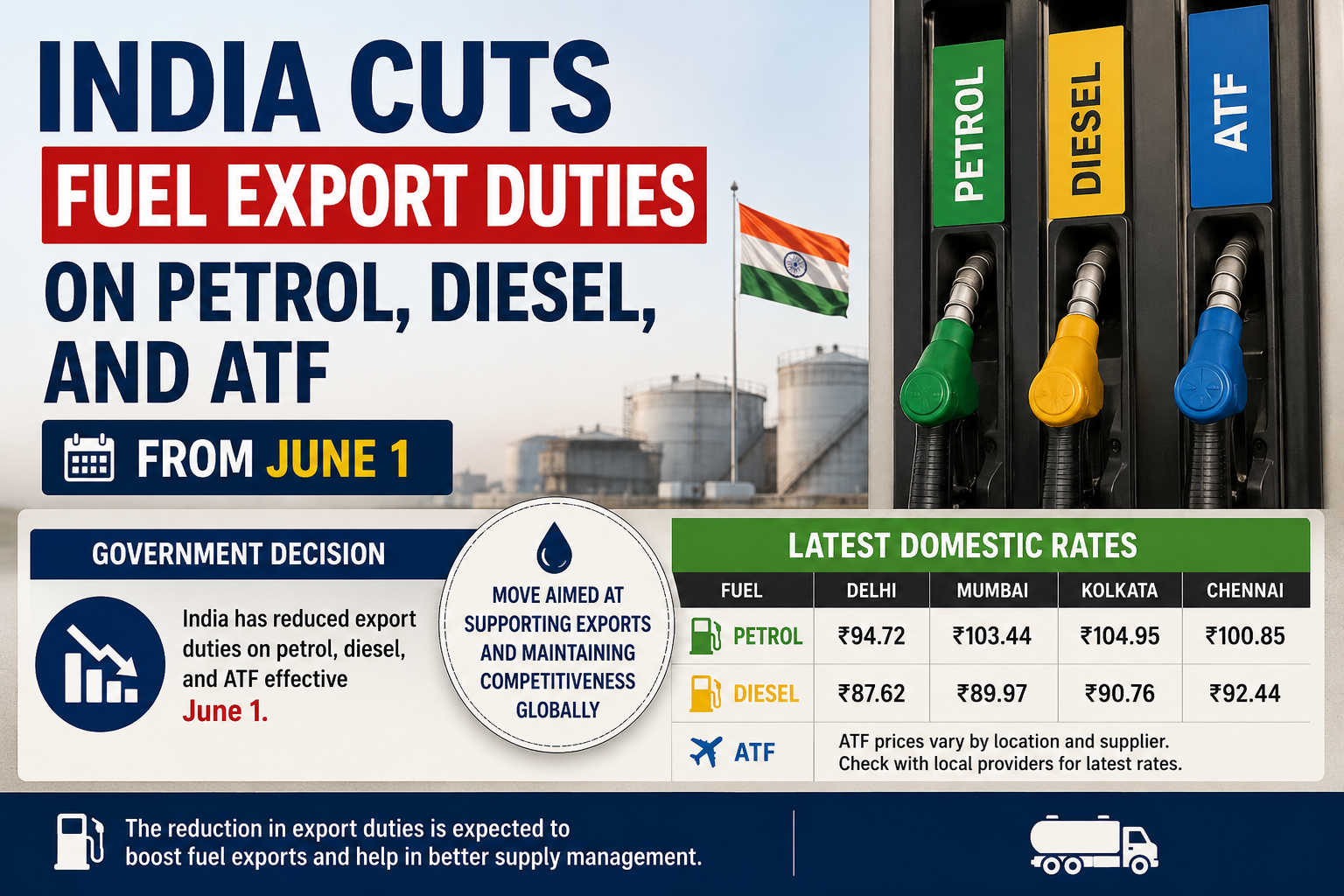
The Central Government of India has officially announced Fuel Export Duties a significant revision in the Special Additional Excise Duty (SAED) and export levies on essential petroleum products, including petrol, high-speed diesel, and Aviation Turbine Fuel (ATF). According to an official notification released by the Ministry of Finance on Saturday, the newly adjusted tariff rates will take effect from June 1, 2026.
This fortnightly calibration comes at a crucial juncture when global energy markets are navigating unprecedented volatility due to escalating geopolitical tensions in West Asia. While the reduction in export duties aims to ease the financial pressure on domestic oil refiners exporting products abroad, retail consumers back home continue to grapple with record-high fuel prices at the pumps following multiple domestic price hikes in the month of May.
Explanation of the New Fuel Export Duties Structure
In its official statement, the Ministry of Finance clarified that the adjustments to the export levies are strictly aligned with international product margins and the average global benchmark prices of crude oil and refined products since the previous review.
“The rates are being revised on a fortnightly basis and the last such revision was undertaken with effect from 16th May, 2026. The rates are prescribed based on the average international prices of crude oil, petrol, diesel, and ATF prevailing during the period since the last review. The rates for the next fortnight beginning 1st June, 2026, have been notified by the Central Government today.”
The specific breakdown of the revised export levies effective from June 1, 2026, is as follows:
Petrol Exports: The export duty has been set at ₹1.5 per litre (comprising SAED of ₹1.5 and Road and Infrastructure Cess (RIC) set at Nil). This translates to approximately $0.0158 per litre at the current exchange rate mechanism ($1 = ₹95.00).
Diesel Exports: The export duty has been pegged at ₹13.5 per litre (SAED – ₹13.5; RIC – Nil).
Aviation Turbine Fuel (ATF) Exports: The export levy on jet fuel has been revised to ₹9.5 per litre (applicable as SAED only).
By lowering these duties, the government aims to ensure that Indian refining giants—both in the public sector and private sector, such as Reliance Industries Limited (RIL) and Nayara Energy—remain competitive in international markets, allowing them to capture better margins on overseas shipments when global refined product spreads compress.
Mechanics of Fortnightly Revisions: Why Export Levies Fluctuate
India first introduced windfall profit taxes and export duties on crude oil production and refined petroleum exports in July 2022. The primary objective of this fiscal tool was twofold: to prevent domestic refiners from prioritizing highly lucrative export markets over local supply obligations, and to absorb a portion of the supernormal profits earned by oil producers due to surging global crude prices.
The calculation matrix relies heavily on the average international prices of crude oil, petrol, diesel, and ATF monitored during the preceding 14-day window.
| Petroleum Product | New Export Duty (Effective June 1, 2026) | Component Breakdown |
| Petrol (Motor Spirit) | ₹1.5 per litre ($0.0158) | SAED: ₹1.5 / RIC: Nil |
| Diesel (HSD) | ₹13.5 per litre | SAED: ₹13.5 / RIC: Nil |
| ATF (Jet Fuel) | ₹9.5 per litre | SAED only |
When global cracks—the differential margin between the cost of crude oil and the selling price of refined products—widen, the government raises the SAED to claim a share of the windfall gains. Conversely, when international product margins narrow or crude oil prices stabilize, the Ministry of Finance lowers the export levies to protect the operational viability of domestic exporting units.
Domestic Fuel Consumers Left Out in the Cold
While international trade operations receive a minor reprieve through reduced export duties, the Ministry of Finance explicitly confirmed that there will be absolutely no change in the existing excise duty rates on petrol and diesel cleared for domestic consumption.
This policy stance implies that the relief granted to exporters will not translate into lower prices for everyday commuters, transport operators, or commercial logistics firms across India. The retail prices of fuel remain tethered to the domestic dynamic pricing model managed by Public Sector Undertaking (PSU) Oil Marketing Companies (OMCs) like Indian Oil Corporation Limited (IOCL), Bharat Petroleum Corporation Limited (BPCL), and Hindustan Petroleum Corporation Limited (HPCL).
The Context Behind the Recent Retail Price Surge
The status quo on domestic excise duties comes on the heels of a bruising week for Indian consumers. Retail petrol and diesel prices were hiked across the nation on Monday, May 25, marking the fourth consecutive price upward revision within a brief span of less than two weeks.
OMCs have cited sustained volatility in global benchmark crude rates (such as Brent and West Texas Intermediate) alongside soaring freight insurance premiums—compounded by ongoing maritime security threats and geopolitical instability in West Asia—as the driving factors behind the domestic price inflation.
Comprehensive Metro-Wise Breakdown of Retail Fuel Prices
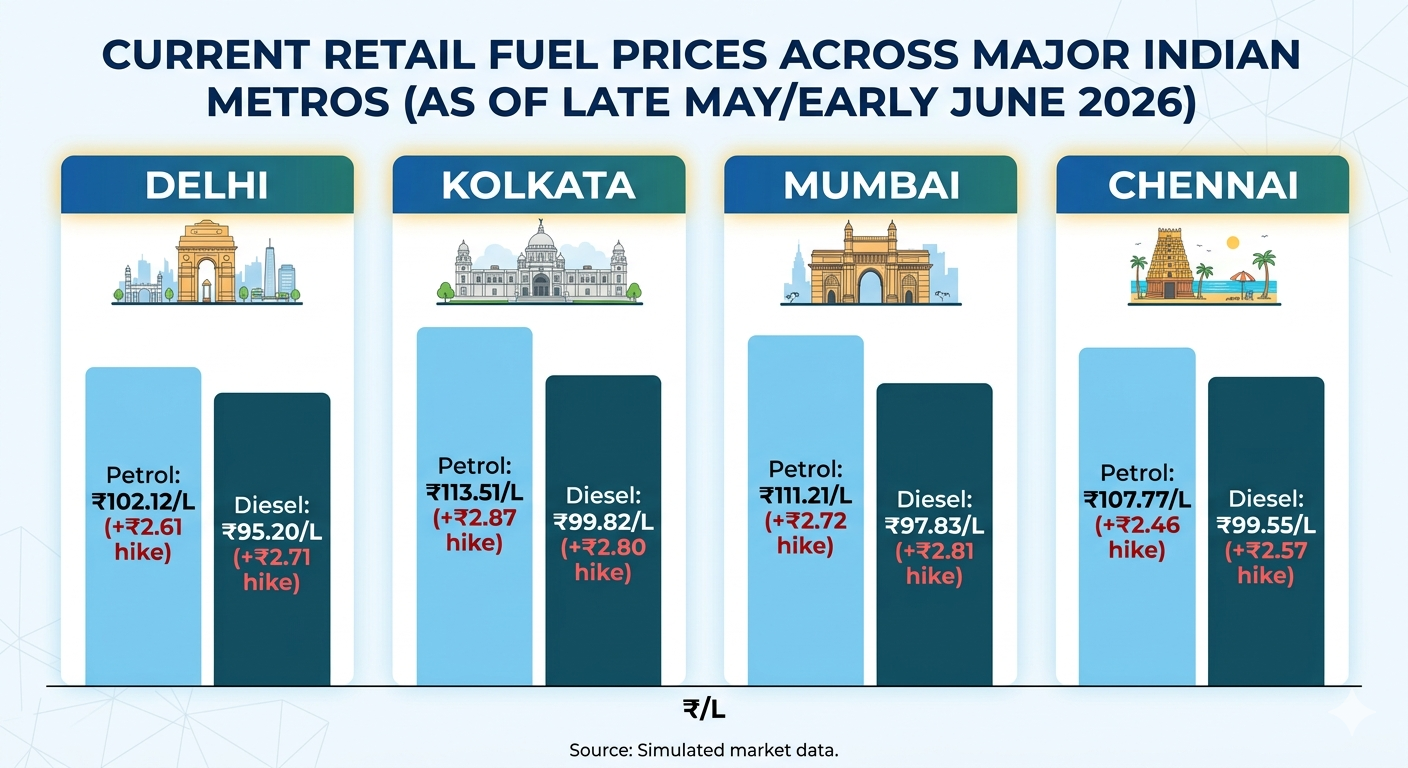
The cumulative impact of the four recent price hikes has pushed fuel rates to historic heights, with petrol crossing the psychological threshold of ₹100 per litre in the national capital and hovering well above that mark in other metropolitan hubs.
1. New Delhi
In the national capital, the latest retail price revision saw petrol prices increase by ₹2.61, officially pushing the rate to ₹102.12 per litre. Concurrently, diesel prices were pushed up by ₹2.71, bringing the retail price to ₹95.20 per litre. The breaching of the ₹100 mark in Delhi serves as an indicator of the intense inflationary pressures currently running through the domestic energy supply chain.
2. Kolkata
Consumers in West Bengal’s capital are experiencing some of the steepest pricing curves among the major metros. Petrol prices in Kolkata jumped by ₹2.87, settling at a steep ₹113.51 per litre. Diesel rates experienced a parallel rise of ₹2.80, placing the fuel at ₹99.82 per litre, just a fraction away from hitting the triple-digit milestone.
3. Mumbai
Historically known for having higher fuel rates due to localized state taxes and value-added tax (VAT) structures, Mumbai saw petrol prices climb by ₹2.72, reaching ₹111.21 per litre. Diesel prices grew by ₹2.81, forcing transport operators to shell out ₹97.83 per litre.
4. Chennai
In Tamil Nadu, the pricing trajectory followed an identical upward arc. Petrol prices scaled up by ₹2.46 to reach ₹107.77 per litre. Diesel prices escalated by ₹2.57, bringing the retail price to ₹99.55 per litre at the dispensing pumps.
Macroeconomic Impact on Consumers and the Transport Sector
The diverging trends between softening export duties and hardening domestic retail prices carry profound macroeconomic implications for India’s broader economy, particularly regarding inflationary management and fiscal policy.
The Logistics and Supply Chain Strain
Because diesel functions as the primary fuel source for commercial trucking, agricultural machinery, and heavy interstate logistics, an increase pushing close to ₹100 per litre across major states severely inflates input costs for supply chains.
Logistics associations have voiced concern that sustained high diesel prices inevitably force transport operators to levy fuel surcharges on moving essential commodities. This creates a compounding inflationary effect on daily consumer items, including perishable agricultural goods, dairy products, fast-moving consumer goods (FMCG), and industrial raw materials.
The Dilemma Faced by Oil Marketing Companies
While retail consumers bear the immediate financial brunt, Indian OMCs are operating within a tight fiscal framework. When international crude oil prices remain elevated and volatile, failure to align domestic retail rates with international realities results in substantial under-recoveries for these corporations.
The windfall taxes and export levies revised for June 1 represent the sovereign’s method of rebalancing these economic forces—clawing back extra margins from outbound trade to stabilize the wider national balance sheet, even as retail marketing margins remain tightly managed.
Global Factors Driving the Energy Market Volatility
To understand why the government must consistently review these export levies every fortnight, one must look at the structural factors defining the global oil trade in mid-2026.
West Asian Geopolitical Friction: Ongoing naval disruptions, trade corridor restrictions, and sudden flare-ups in the Middle East have introduced a persistent risk premium to crude pricing, making maritime transport insurance more expensive.
OPEC+ Production Strategy: Strategic output curbs maintained by major oil-producing nations continue to keep global crude inventories relatively lean, preventing any sharp drop in global raw energy prices.
Refinery Capacity Utilization Fluctuations: Global refining configurations are adjusting to shifting patterns of demand, causing international cracks for middle distillates like diesel and jet fuel to fluctuate rapidly.
The fortnightly revisions provide a necessary fiscal buffer, allowing the Indian treasury to stay agile. By offering a reduction in export levies when global cracks narrow, the policy ensures that Indian refiners do not cut back on processing capacity, thereby maintaining structural security of supply within the country’s borders.
What Lies Ahead for the Next Review Cycle?
As the revised export duties come into effect on June 1, 2026, market participants, financial analysts, and consumer groups will be keeping a close watch on international energy tickers over the next two weeks. Should global crude prices ease or stabilize due to unexpected increases in production from non-OPEC quarters, OMCs might find the fiscal headroom necessary to offer a pause or a minor rollback on domestic pump prices during mid-June.
Conversely, if geopolitical flashpoints in West Asia worsen, causing global product cracks to widen again, the Ministry of Finance will likely roll back these export duty cuts in the next scheduled review, while consumers may have to brace for further pressure at the domestic retail pumps. For now, the economic landscape remains divided: international product lines receive a tactical breather, while the domestic consumer continues to shoulder the weight of high global energy costs.