
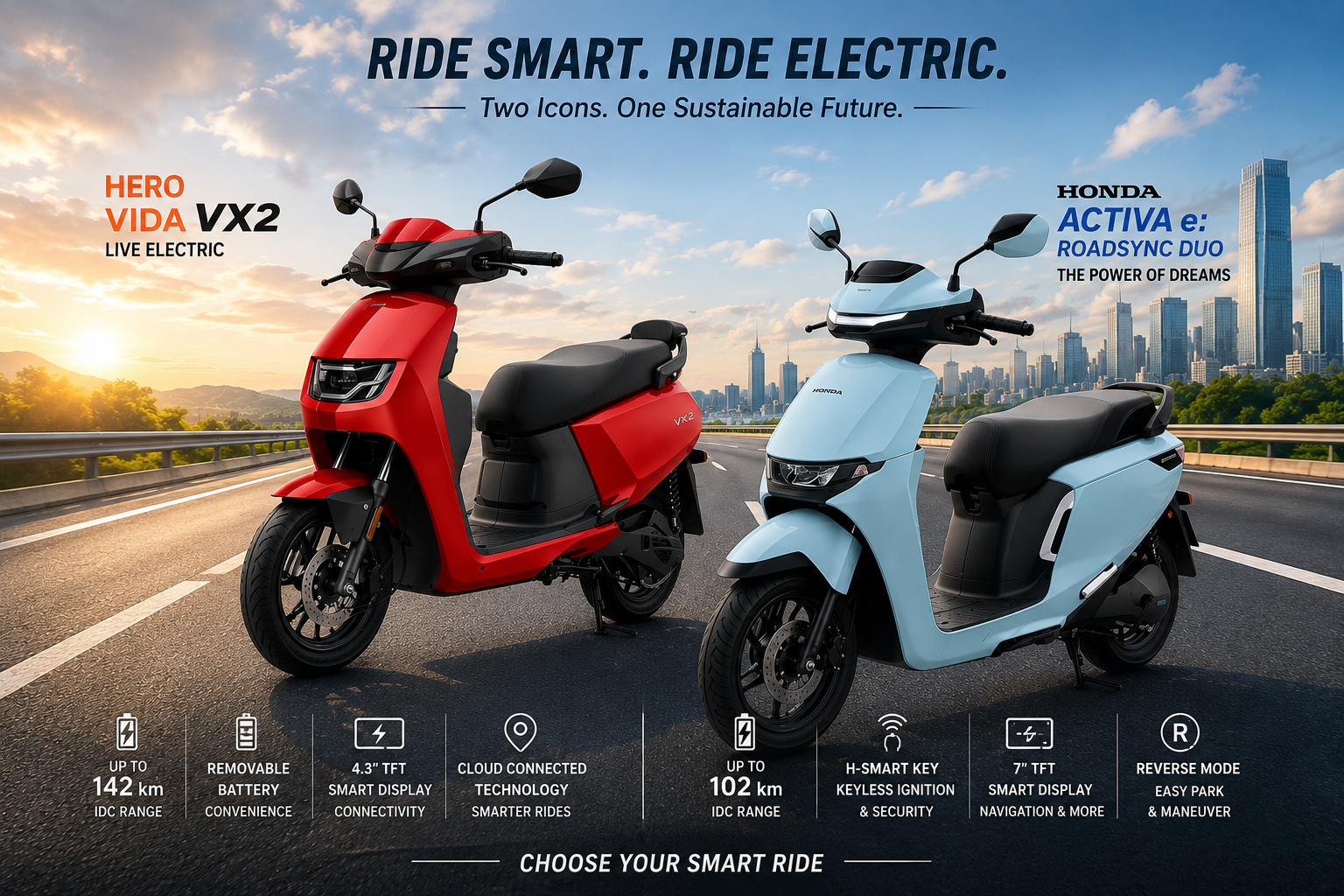
Hero Vida vs Honda EV is the newest high-stakes rivalry electrifying the Indian two-wheeler market, fundamentally changing how urban commuters view vehicle ownership. For decades, Honda and Hero MotoCorp battled for dominance in the internal combustion engine (ICE) arena with legends like the Splendor and the Activa. Now, that historic competition has spilled over into the electric vehicle (EV) segment. Rather than relying solely on traditional home charging, both manufacturing giants are betting heavily on the Battery-as-a-Service (BaaS) infrastructure to lower the entry cost of green mobility.
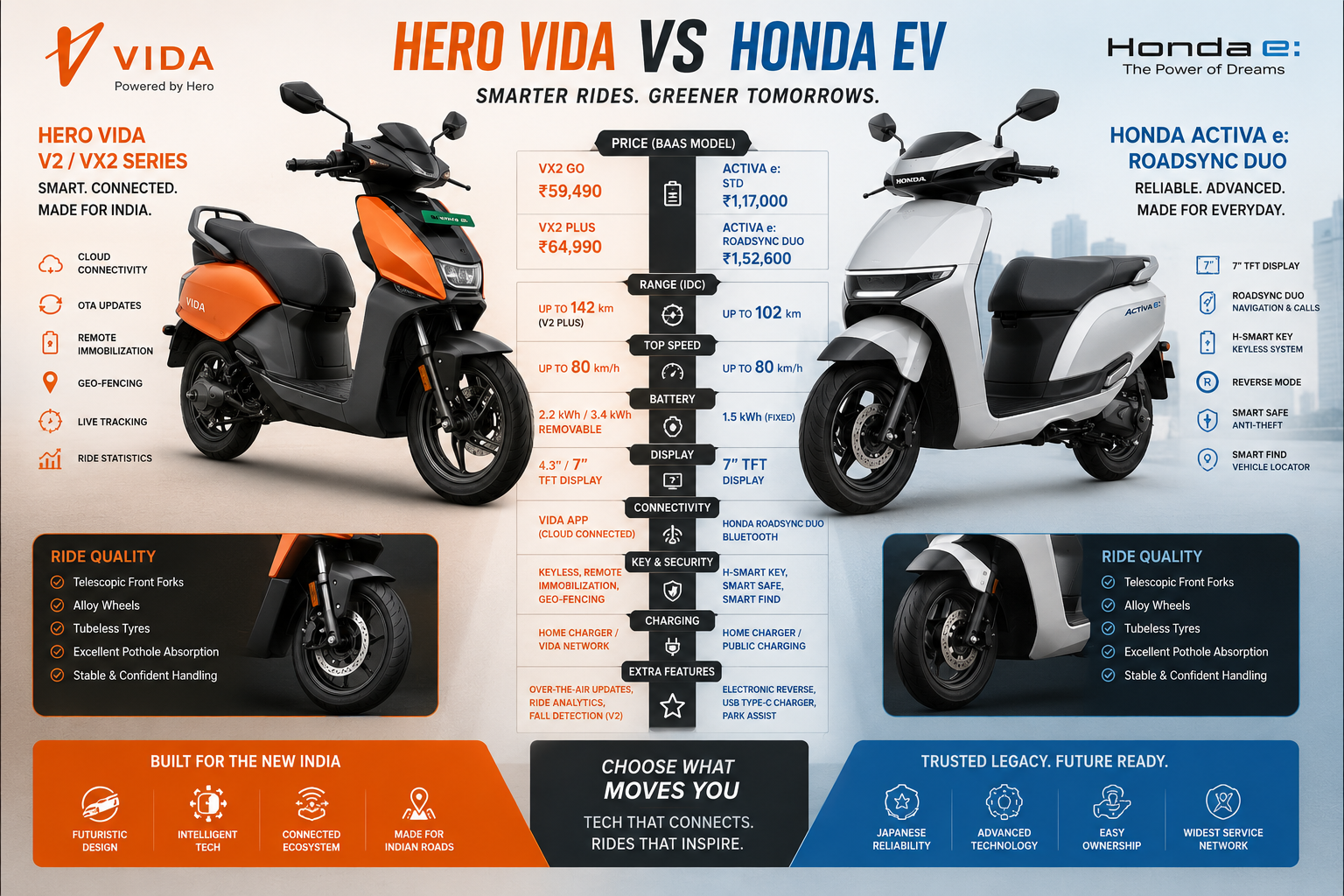
This paradigm shift means buyers are no longer stuck paying a massive upfront premium for a permanent lithium-ion battery pack. Instead, you purchase the chassis of the scooter at a significantly lower price point and lease the battery pack via flexible subscription models. However, while the overarching goal of reducing initial costs remains identical, Honda and Hero’s premium sub-brand, VIDA, approach the mechanics of battery swapping, ownership, and home charging from completely opposite directions.
The Core Lineups: Models, Variants, and Upfront Pricing
Navigating the showroom floor reveals distinct strategies. Honda focuses on a dual-threat lineup consisting of a premium tech-laden commuter and a bare-bones neighborhood runabout. Hero VIDA divides its energy between the highly accessible, modular VX2 family and the performance-oriented V2 series.
1. The Honda EV Entrants
Honda’s charge into the Indian electric space is spearheaded by two distinct platforms launched at the Bharat Mobility Global Expo:
Honda Activa e: The direct electric spiritual successor to India’s most trusted petrol scooter badge. It caters to family buyers wanting iconic reliability mixed with modern telemetry. It sells in two major trims: the Activa e: Standard (priced around ₹1,19,909 ex-showroom) and the top-tier Activa e: Honda RoadSync Duo (priced at ₹1,52,463 ex-showroom).
Honda QC1: A featherweight, highly economical option built strictly for short-distance grocery runs and tight neighborhood commuting. Stripped of complex instrumentation, it features a single variant retailing at a highly accessible baseline of ₹90,486 ex-showroom.
2. The Hero VIDA Entrants
Hero MotoCorp’s premium EV wing counters with a highly modular architecture that explicitly separates structural vehicle costs from the energy cells:
VIDA VX2 Series: This versatile platform comes in two main structural trims: the VX2 Go and the VX2 Plus. Purchased outright with the battery included, the VX2 Go costs ₹99,490, while the VX2 Plus stands at ₹1,10,000. However, leveraging the BaaS model drops the upfront vehicle chassis price down to an incredibly low ₹59,490 (VX2 Go) and ₹64,990 (VX2 Plus).
VIDA V2 Series: Positioned as the sportier, long-range flagship of the brand, the premium VIDA V2 commands a starting ex-showroom sticker price of approximately ₹1,29,566, targeted squarely at performance-hungry urban youths.
Hero Vida vs Honda EV Performance, Range, and Mechanical Specifications
When comparing real-world utility, motor output and chassis architecture dictate how these electric vehicles behave on crowded Indian tarmac.
| Specification Parameter | Honda Activa e: (RoadSync Duo) | Honda QC1 | Hero VIDA VX2 (Go / Plus) | Hero VIDA V2 |
| Ex-Showroom Price | ₹1,19,909 to ₹1,52,463 | ₹90,486 | ₹1,10,000 | ₹1,29,566 onwards |
| Motor Type & Peak Power | 6.0 kW Swingarm PMSM | 1.8 kW BLDC Hub Motor | 6.0 kW PMSM | High-output PMSM |
| Top Speed | 80 km/h | 50 km/h | 70 to 80 km/h | 85 km/h |
| 0-60 km/h Acceleration | 7.3 seconds | N/A | ~4.2 seconds (0-40 km/h) | Under 4 seconds (0-40 km/h) |
| Real-World Range | 102 km per charge | 80 km per charge | 92 km (2.2kWh) / 142 km (3.4kWh) | 142+ km per charge |
| Kerb Weight | 118 kg (Std) / 119 kg (Duo) | 89.5 kg | Approx. 104 kg | Approx. 125 kg |
| Under-Seat Storage | Minimal (Battery Occupied) | 26 Litres | 33.2 Litres | 26 Litres |
Acceleration and Powertrain Dynamics
The Activa e: utilizes a sophisticated swingarm-mounted Permanent Magnet Synchronous Motor (PMSM) pumping out a peak 6.0 kW and 22 Nm of torque, clearing the 0-60 km/h sprint in 7.3 seconds. It glides effortlessly into three distinct riding profiles: Eco, Standard, and Sport, topping out at a confident 80 km/h.
Conversely, the budget-friendly Honda QC1 drops the swingarm layout for a simpler 1.8 kW Brushless DC (BLDC) hub motor capped at a maximum speed of 50 km/h. It is incredibly light at 89.5 kg, making it exceptionally nimble for elderly family members or teenagers handling daily domestic errands.
Hero’s VIDA platforms maintain a sporty, rapid power delivery curve across the board. The VIDA VX2 series uses its 6.0 kW motor to hit 0-40 km/h in just 4.2 seconds, maxing out between 70 km/h and 80 km/h depending on whether you opt for the Go or Plus battery configuration. The flagship VIDA V2 raises the ceiling further, pushing past an 85 km/h top speed with an aggressively tuned throttle response meant to challenge premium commuter vehicles.
The Battery Infrastructure Battle: Closed Loop vs. Open Charging
The most polarizing divergence between the Hero Vida vs Honda EV philosophies lies in how energy is replenished. This is the exact point where prospective buyers must evaluate their daily living situations and proximity to regional charging networks.
Honda’s Absolute Swapping Ecosystem (HEID)
Honda has implemented a strict, closed-loop battery swapping system managed by Honda Power Pack Energy India (HEID). Both the Activa e: and the QC1 are designed without any onboard charging port hardware. You cannot plug these scooters into a standard 15A wall socket at home or inside your garage.
Instead, ownership revolves entirely around dropping off depleted battery cells at automated Honda network kiosks and immediately pulling out fully replenished, factory-certified modular packs. The Activa e: relies on two interconnected 1.5 kWh battery packs (3.0 kWh total capacity) nestled tightly under the saddle to achieve its real-world range of 102 km. While this model completely eliminates the hours spent waiting around a charging cable, it completely sacrifices under-seat storage space on the Activa e: and makes you entirely dependent on the physical presence of Honda swapping infrastructure in your specific municipal zone.
Hero VIDA’s Removable Hybrid Ecosystem
Hero’s VIDA operates on a highly flexible hybrid philosophy. The dual-battery arrays (offered in 2.2 kWh combinations for the VX2 Go and 3.4 kWh configurations for the VX2 Plus) are completely removable.
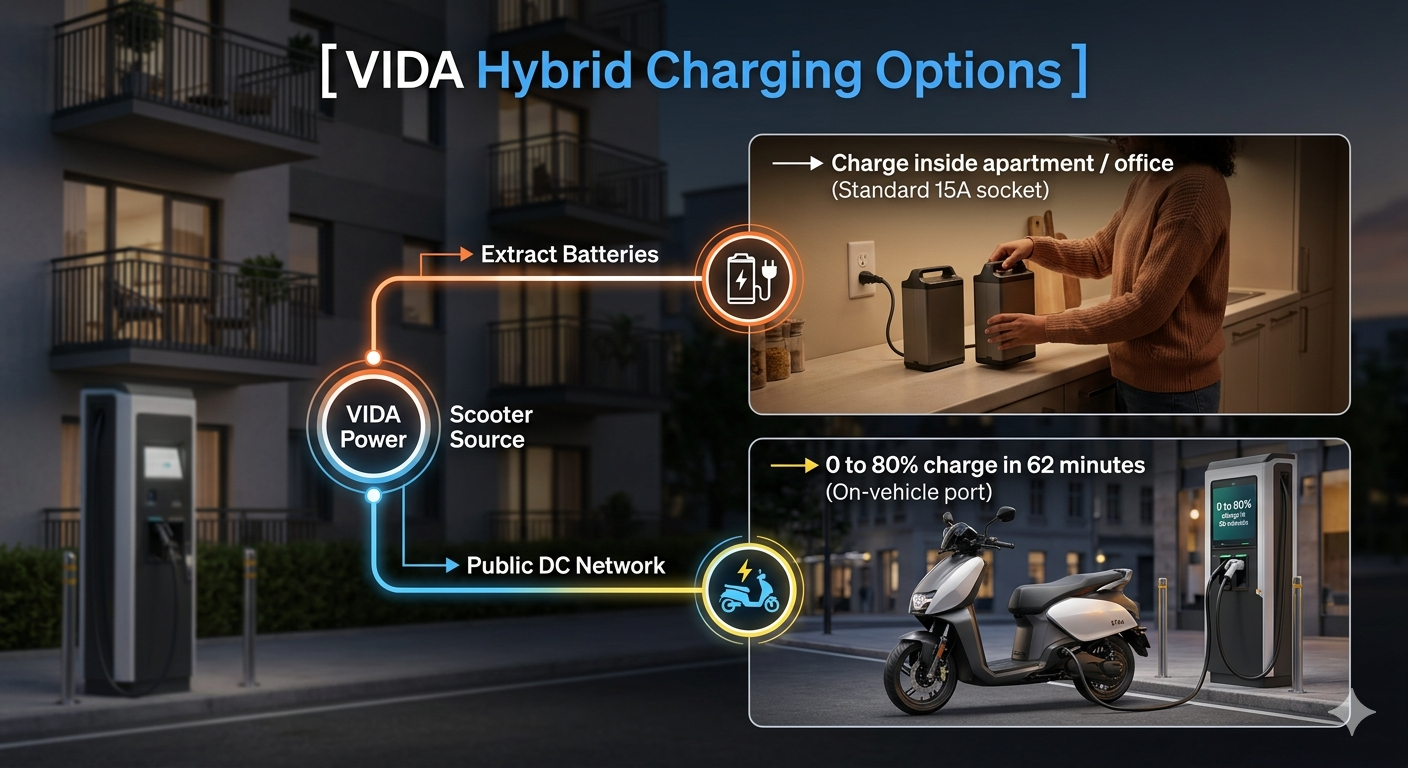
This structural setup delivers the best of both worlds. If you reside in a high-rise apartment complex without a dedicated parking-lot power grid, you can easily pull the modules out, carry them upstairs, and plug them into any standard domestic outlet. Furthermore, if you are out on the open road, the chassis retains an onboard port capable of juice-ups from 0 to 80% in just 62 minutes utilizing public DC fast-charging systems. As an added benefit of this structural spacing, the VIDA VX2 frees up a massive 33.2-litre under-seat storage cavity, easily swallowing a full-faced helmet.
Analyzing the BaaS Subscription Plans and Monthly Costs
Because the Battery-as-a-Service architecture separates the vehicle body from the power cells, calculating the long-term cost of ownership requires a close look at recurring subscription options.
1. Honda’s Fixed Energy Brackets
Honda packages its monthly battery leasing fees into predictable, tier-based data-style plans. These are optimal for fixed-distance daily commuters who can accurately forecast their monthly mileage:
Lite Plan: Priced at an economical ₹678 per month, tailored for riders with low daily run times requiring up to 20 kWh of energy monthly.
Basic / Lite Commuter Plan: Priced at ~₹1,999 per month plus GST. This caps total monthly energy extraction at 35 kWh, which breaks down to roughly 40 km of active daily operations.
Advance / Heavy Commuter Plan: Priced at ~₹3,599 per month plus GST. This extends the threshold to 87 kWh of monthly energy extraction, supporting robust commercial or long-distance applications of up to 100 km daily.
Important Operational Catch: Unused kilowatt-hour allowances do not roll over into the next billing cycle. If you buy the Heavy Commuter plan but only consume 50 kWh due to a vacation, the remaining 37 kWh expires at the end of the month.
2. Hero VIDA’s Pay-As-You-Go Mileage Model
Hero VIDA eschews rigid monthly brackets in favor of a granular, usage-based fee structure. Under their BaaS model, after purchasing the chassis at its discounted rate, the customer pays a nominal base lease fee combined with an active running cost calculated between ₹0.90 and ₹1.24 per actual kilometer driven.
If your vehicle sits parked inside a garage for two weeks, your operating bill drops proportionally, making it an incredibly fair framework for unpredictable schedules or multi-vehicle households.
Smart Features, Connectivity, and Urban Ride QualityModern electric scooters double as rolling smart devices. The tech packages bundled into the top-tier variants highlight how much data is accessible on the move.
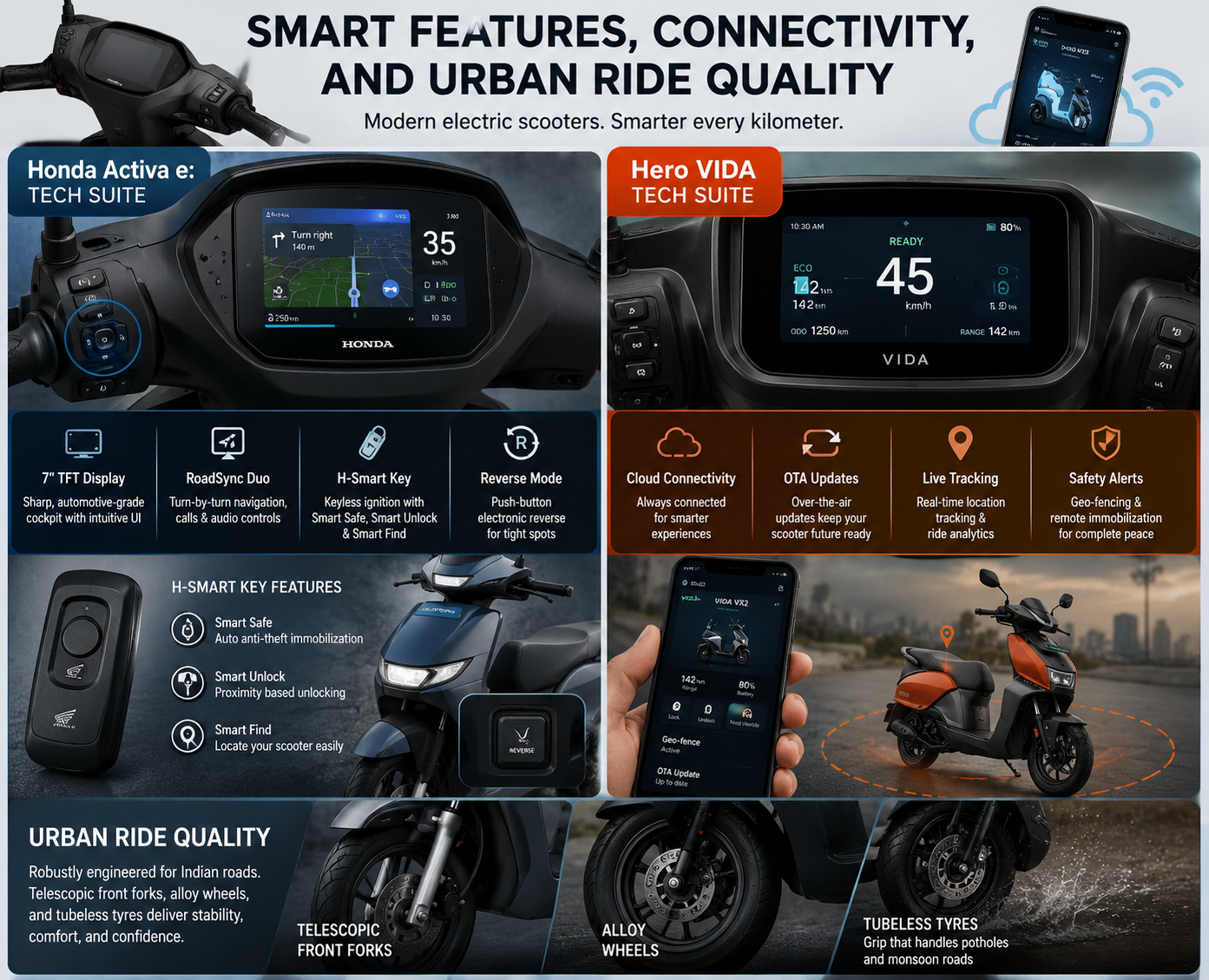
The Honda Tech Suite
Opting for the premium Honda Activa e: RoadSync Duo swaps out the basic layout for a sharp, automotive-grade 7-inch Thin-Film Transistor (TFT) cockpit screen. Controlled via a tactile multi-directional physical toggle switch on the left handlebar cowl, the system pairs up with your smartphone to handle real-time turn-by-turn map navigation, incoming call alerts, and audio controls.
It also utilizes Honda’s advanced H-Smart keyless ignition fob, incorporating automated anti-theft immobilization (Smart Safe), proximity unlocking (Smart Unlock), and a vehicle locator feature (Smart Find). For tight parking garages, the Activa e: adds a dedicated push-button electronic reverse mode.
The Hero VIDA Tech Suite
The VIDA lineup counters with a brilliant, high-contrast interactive screen layout (a 4.3-inch system on the VX2 up to premium wider displays on the V2). The underlying operating software features robust cloud-linked connectivity options, allowing for over-the-air (OTA) software updates, remote tracking, geo-fencing safety boundaries, and instantaneous electronic remote immobilization if unauthorized movement is detected by the internal sensors.
The physical ride quality is exceptionally well-sorted, deploying robust telescopic front forks and alloy wheel sets wrapped in sticky tubeless tires that handle deep monsoon potholes with excellent composure.
Final Verdict: Which BaaS Scooter Matches Your Commute?
The choice between a Hero Vida vs Honda EV ultimately comes down to your local infrastructure and personal charging preferences rather than raw performance specs.
Choose the Honda EV Lineup (Activa e: or QC1) if:
You live in a major metro city with an extensively mapped, active Honda Power Pack swapping network nearby.
You absolutely despise waiting for a battery to charge and love the convenience of a 2-minute battery swap.
You have a highly predictable daily route that maps perfectly onto Honda’s structured monthly energy plans.
Choose the Hero VIDA Lineup (VX2 or V2) if:
You want complete energy independence and want the option to charge your batteries at home, at the office, or via public fast chargers.
You want a lower upfront purchase price (starting at ₹59,490 via BaaS) coupled with a flexible, pay-per-kilometer operating cost.
You require ample under-seat storage space for helmets and daily cargo bags.
Disclaimer: Expected prices are based on industry estimates and are subject to change upon official announcement. Views expressed are informational; please consult your nearest Hero Vida vs Honda EV dealership for actual on-road pricing and availability.