

How to invest in US stocks is a question that lakhs of Indian retail investors ask daily, especially with the ongoing global boom in artificial intelligence, semiconductors, and electric vehicles. Until recently, buying shares of global tech giants like Nvidia, Apple, or Tesla involved navigating fragmented overseas platforms, steep subscription fees, and complex foreign wire transfers. However, a major regulatory milestone is set to completely democratize international investing for Indian retail wealth creators.
India’s top four discount brokerages—Zerodha, Groww, Upstox, and Angel One—have officially secured retail execution licenses from the International Financial Services Centres Authority (IFSCA). This crucial green light permits them to offer direct cross-border investing setups right out of Gujarat International Finance Tec-City (GIFT City), the country’s premier specialized financial zone.
With these leading fintech heavyweights entering the arena, everyday Indian traders will soon be able to build international portfolios seamlessly inside their trusted domestic ecosystems. This detailed analysis unpacks how the new regulatory approvals work, the architectural differences behind the execution frameworks, and the tax implications you need to track.
Why This Regulatory Nod is a Game-Changer for Retail Capital
For a long time, geographical barriers and high transaction friction limited global asset allocation to ultra-high-net-worth individuals (UHNIs). While boutique platforms and select banking institutions offered overseas avenues, they lacked the massive distribution network and user-friendly interface design that domestic retail applications boast.
The entry of India’s big four digital brokers completely alters this landscape:
Massive Scale and Reach: Together, Groww (1.3 crore+ active users), Zerodha (68.5 lakh+ users), Angel One (66.8 lakh+ users), and Upstox (19.2 lakh+ users) manage the overwhelming majority of India’s retail trading volumes.
The Power of the SpaceX and AI Waves: Retail enthusiasm for global stocks has hit an all-time high, driven by high-profile corporate movements. The recent market buzz around SpaceX, alongside highly anticipated upcoming initial public offerings (IPOs) from artificial intelligence giants like Anthropic and OpenAI, has driven structural capital outflows into US equities.
A Pre-Built Roadmap: This transition follows the successful rollout of similar features by Raise Financial’s platform, Dhan, and SAMCO Securities, indicating that the retail global-investing blueprint is already functioning effectively.
Structural Breakdown: Broker-Dealer vs. Global Access Provider
While all four platforms have won approval to facilitate international stock trading, they are approaching the technical setup via two distinct operational models regulated by the IFSCA.
1. The Broker-Dealer Route (Zerodha & Upstox)
Zerodha and Upstox have chosen to operate under the Broker-Dealer licensing framework. In this system, the Indian broker sets up an intermediary desk at GIFT City that acts as an indirect clearing pipeline. To actually execute and clear equity orders on US stock exchanges like the NYSE or Nasdaq, they partner with global clearing institutions and institutional foreign brokers.
According to regulatory filings, Zerodha and Upstox will route their customer trades through established overseas clearing houses, including Interactive Brokers, ViewTrade International, and Alpaca Securities.
2. The Global Access Provider Framework (Groww & Angel One)
Groww and Angel One are establishing their international operations under the Global Access Provider (GAP) framework. The GAP model is an innovative, highly streamlined regulatory architecture introduced by the IFSCA to facilitate clean cross-border capital movement for retail users.
Instead of routing orders through multi-layered broker desks, a GAP-licensed entity connects the investor directly to an ecosystem paired with a US-based execution broker. One of the biggest advantages of the GAP framework is that it completely optimizes structural overheads, allowing platforms to eliminate unnecessary account maintenance fees and complex international withdrawal charges when bringing your capital back to India.
| Brokerage Platform | Regulatory Operating Model | International Clearing & Execution Partners |
| Zerodha | Broker-Dealer Framework | Interactive Brokers, ViewTrade, Alpaca Securities |
| Groww | Global Access Provider (GAP) | Direct US-Broker Clearing Alliances |
| Upstox | Broker-Dealer Framework | Interactive Brokers, ViewTrade, Alpaca Securities |
| Angel One | Global Access Provider (GAP) | Direct US-Broker Clearing Alliances |
Technical Integration and Projected Launch TimelinesDon’t expect to see a “Buy Apple Stock” button in your app tomorrow morning. The four brokerage firms are slated to spend the next two to three months finishing backend software development.
This process requires heavy engineering work. The platforms must link their core Indian trading systems with foreign clearing houses, test fractional-share buying engines (allowing you to buy $10 worth of a stock priced at $3,000), and build out automated currency conversion dashboards that convert Indian Rupees (INR) to US Dollars (USD) in real-time. Furthermore, they must run extensive security testing to satisfy strict compliance audits mandated by the IFSCA before opening these gateways to the public.
Compliance and Limits: The Liberalised Remittance Scheme (LRS)
All international investments made through GIFT City operate under the core regulatory boundaries set by the Reserve Bank of India (RBI).
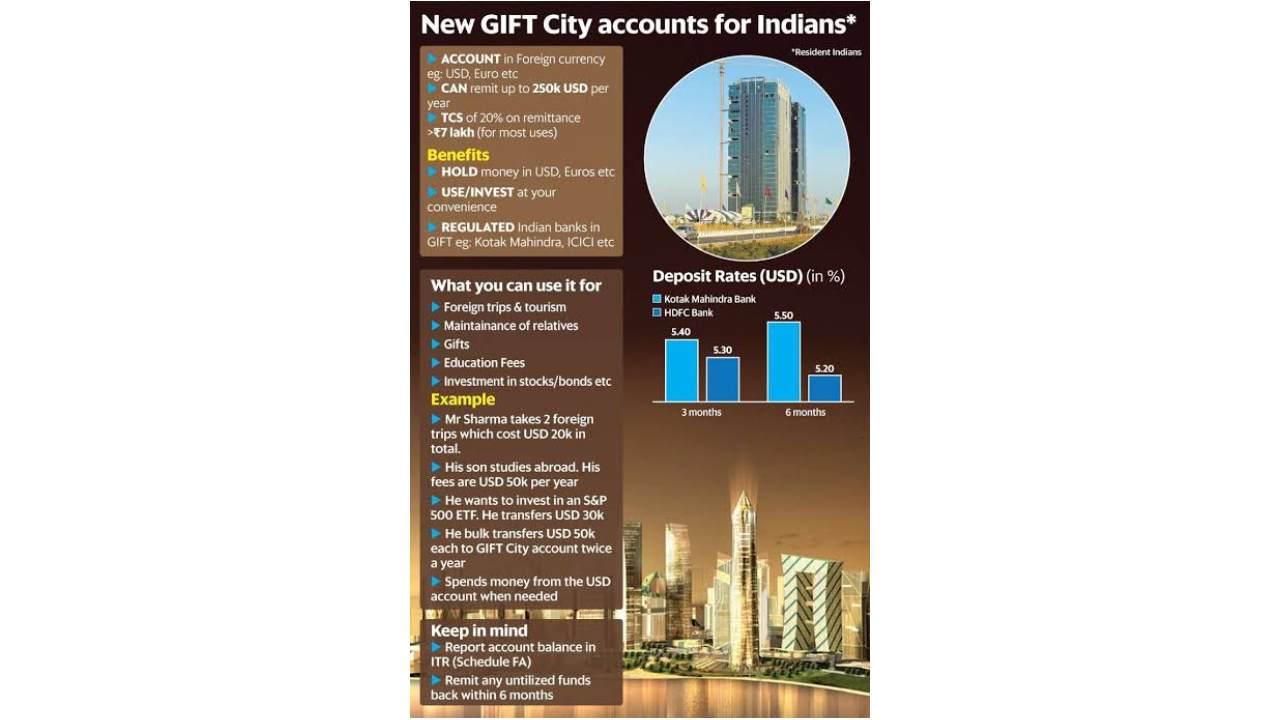
The primary pillar governing this is the Liberalised Remittance Scheme (LRS). Under the LRS framework, the RBI permits an individual Indian resident to legally remit an absolute maximum of $250,000 USD per single financial year abroad. This annual limit covers all forms of offshore spending combined, including foreign real estate investments, overseas travel, educational expenses, and global equity trading.
When you onboard onto the upcoming US stock features on these applications, your platform will automatically track your transactions against this $250,000 capital limit to keep your account perfectly compliant with the Foreign Exchange Management Act (FEMA).
Taxation Realities: Navigating TCS and Capital Gains Tax
When managing a global portfolio, your net returns depend heavily on tax management. Investing in US equities triggers specific tax rules that differ from standard Indian stock market transactions:
1. Tax Collected at Source (TCS)
The Indian government implements a 20% Tax Collected at Source (TCS) on all outward foreign remittances exceeding ₹7 Lakhs within a financial year.
If your total capital transfers abroad stay below the ₹7 Lakh threshold in a year, you do not pay any upfront TCS.
The moment your remittances cross ₹7 Lakhs, a flat 20% tax is levied on the excess amount.
Important Note on TCS: TCS is not an additional final tax expense. It acts as an advance tax credit that you can fully claim and adjust against your total domestic income tax liability when filing your annual Income Tax Return (ITR).
2. Capital Gains Tax Structure
Gains from selling US equities are treated under distinct holding periods compared to domestic shares:
Short-Term Capital Gains (STCG): If you sell a US stock after holding it for less than 24 months, the profit is classified as a short-term gain. These profits are added directly to your standard domestic income and are taxed at your applicable personal income tax slab rate.
Long-Term Capital Gains (LTCG): If you hold your global shares for 24 months or longer before liquidating, the profits qualify as long-term capital gains. These long-term gains are taxed at a flat rate of 12.5%.
Step-by-Step Preview: How the Global Investing Workflow Will FunctionBased on the operational architecture of active platforms like Dhan, we can map out exactly how the investment journey will look once Zerodha, Groww, Upstox, and Angel One push their updates live:
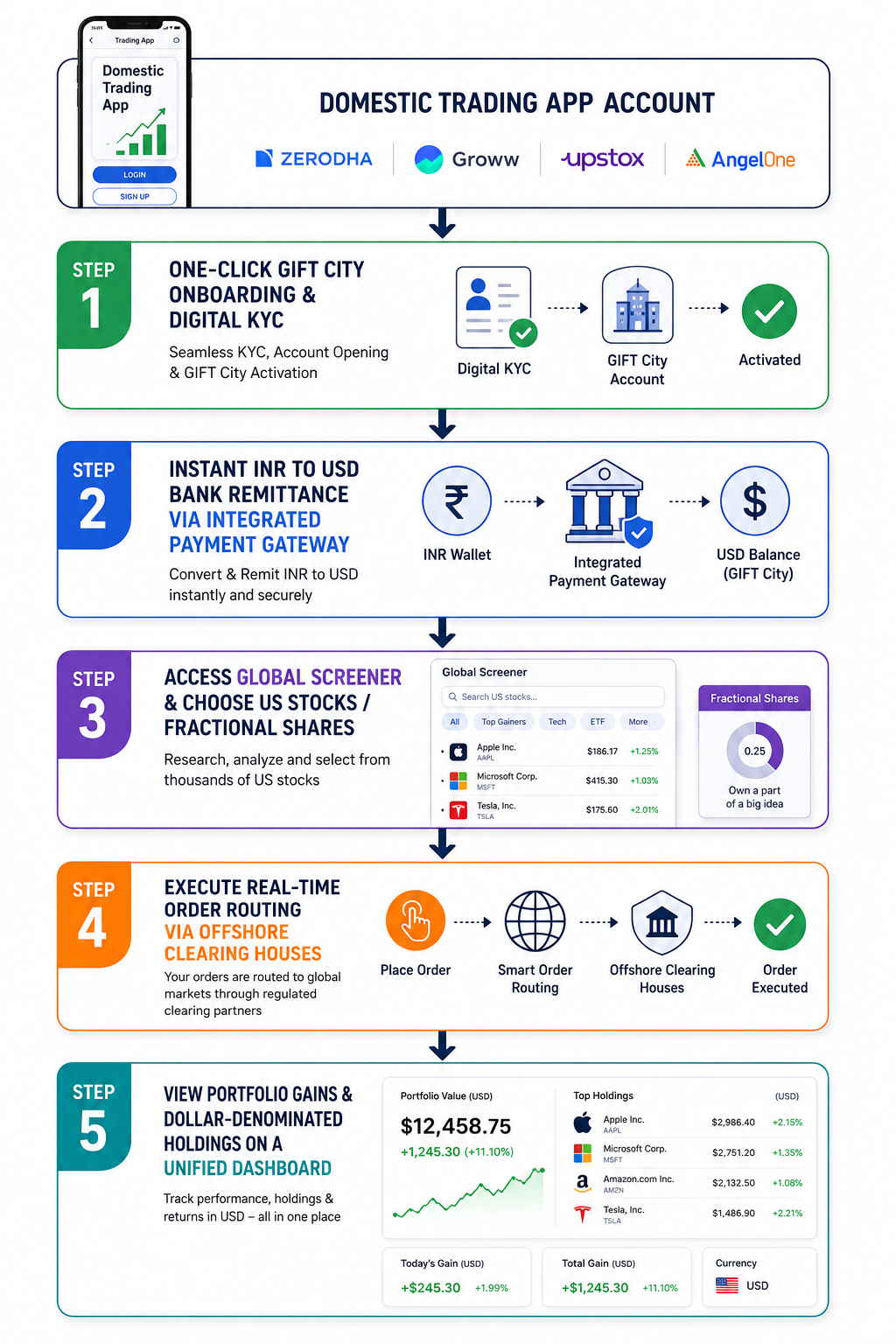
GIFT City Account Activation: Users will complete a one-time, fully paperless onboarding form directly inside their existing app to open a specialized international investing sub-account.
Funding the Global Wallet: You can transfer funds directly from your linked Indian bank account. Leading banking institutions like HDFC Bank, ICICI Bank, Axis Bank, and Kotak Mahindra Bank have already optimized automated retail remittance rails to convert your INR into USD balances smoothly.
Order Placement and Fractional Trading: Once your dollar wallet is funded, you can search for global tickers. Because many prominent US stocks trade at hundreds or thousands of dollars per single share, the platforms will support fractional investing, allowing you to buy a microscopic fraction of a high-priced stock for as little as $1 USD.
Portfolio Tracking: All your international equity allocations, dollar-denominated returns, and dividend collections will display on a single, unified interface right alongside your Indian stock and mutual fund investments.
Strategic Micro-Diversification: Why Look Outside the Domestic Market?
While the Indian stock market has shown strong growth over the last decade, investing all your capital in one country exposes you to geographic concentration risk. Spreading your investments into global equities offers two major strategic advantages:
1. Exposure to Unique, Non-Domestic Sectors
The Indian indices are heavily weighted toward financial services, traditional manufacturing, energy, and information technology outsourcing. However, the domestic market offers few pure-play options for pioneering sectors like advanced lithography semiconductor foundries, cutting-edge artificial intelligence infrastructure, large-scale commercial space technology, or global biotechnology labs. Direct US market access lets you invest directly in the companies driving these global shifts.
2. Hedging via Currency Depreciation
When you invest in assets denominated in US Dollars, your portfolio gets a natural structural boost if the Indian Rupee depreciates against the USD over time. Historically, the dollar has shown a steady upward trend against the rupee over long cycles. This structural currency movement means that even if a US stock’s price remains flat, your net portfolio value in INR terms increases simply due to the currency exchange tailwind.
Final Takeaway for Retail Wealth Creators
The formal entry of Zerodha, Groww, Upstox, and Angel One into the international investment landscape marks a major shift for Indian retail investors. By turning GIFT City into an efficient bridge to Wall Street, the regulatory framework eliminates old roadblocks like confusing bank paperwork, high wire transfer fees, and hidden administrative charges.
As these platforms roll out their technology integrations over the next few months, retail wealth creators should use this time to study international market mechanics, plan their asset allocation strategy, and understand how LRS and TCS rules fit into their financial planning. Global diversification is no longer an exclusive luxury—it is about to become an integrated, single-click feature on your smartphone.
Disclaimer
The information provided in this blog is for educational and informational purposes only and does not constitute financial, investment, or tax advice. Investing in US stocks involves significant risks, including market volatility and currency exchange fluctuations.